
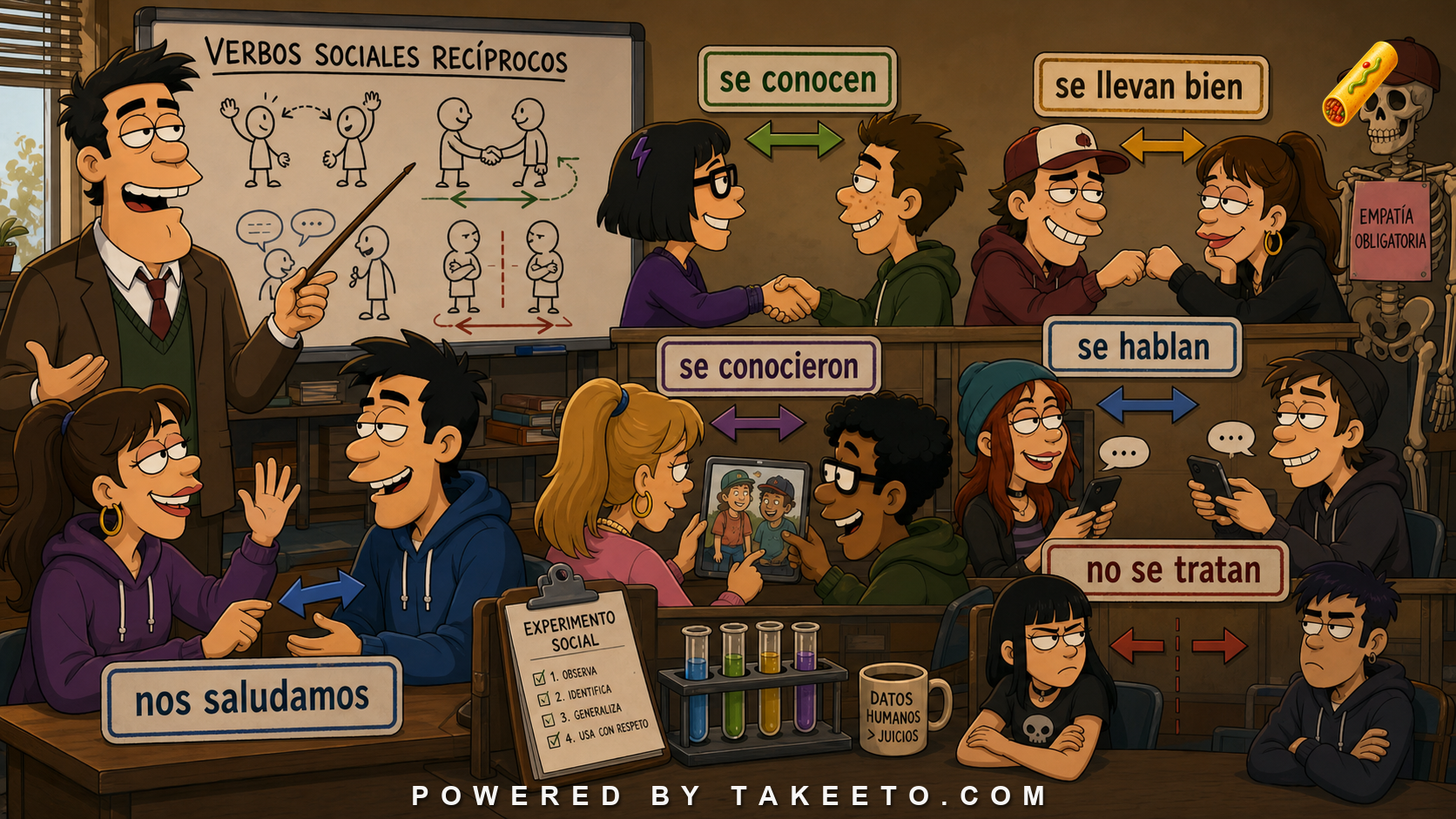
Spanish relationships often use plural pronominal verbs
Many social verbs in Spanish describe not one person’s action but a relationship between people. The pronoun marks that the social action is mutual or relationship-based.
Compare:
Saludé a Ana.
I greeted Ana.
Ana y yo nos saludamos.
Ana and I greeted each other.
Conozco a Luis.
I know Luis.
Luis y Marta se conocen.
Luis and Marta know each other.
The key principle is:
Reciprocal social verbs describe interaction and relationship states, not just individual actions.
This is why Spanish uses forms such as saludarse, conocerse, escribirse, llamarse, llevarse bien, hablarse, and tratarse.
Saludarse: greeting each other
Saludar means to greet someone.
Saludé al vecino.
I greeted the neighbor.
Saludarse means to greet each other.
Nos saludamos al entrar.
We greeted each other when entering.
Los dos candidatos se saludaron antes del debate.
The two candidates greeted each other before the debate.
The reciprocal form focuses on the social exchange. It may involve words, a handshake, a kiss on the cheek, a nod, or another greeting depending on culture and context.
Conocerse: meeting and knowing each other
Conocerse is central because it can describe both the event of meeting and the state of knowing each other.
Se conocieron en la universidad.
They met at university.
Se conocen desde la infancia.
They have known each other since childhood.
The preterite usually presents the first meeting as an event. The present or imperfect often presents an ongoing relationship.
Cuando se conocieron, eran muy jóvenes.
When they met, they were very young.
Ya se conocían antes de trabajar juntos.
They already knew each other before working together.
This distinction is especially important in narratives.
Escribirse and llamarse: reciprocal communication
Communication verbs often use reciprocal pronouns.
Nos escribimos todos los días.
We write to each other every day.
Se llaman por teléfono los domingos.
They call each other on Sundays.
Se mandan mensajes.
They send messages to each other.
These verbs may describe ongoing contact, not just one event. In relationship narratives, they show social maintenance.
Después del viaje, siguieron escribiéndose.
After the trip, they kept writing to each other.
The reflexive-looking form is not self-directed. It is reciprocal.
Llevarse bien and llevarse mal
Llevarse bien/mal describes how people get along.
Se llevan bien.
They get along well.
No me llevo bien con mi jefe.
I don’t get along with my boss.
Mis hermanos se llevan mal.
My siblings get along badly.
This expression is not about physical carrying. It is a relationship predicate. Llevarse here means having a certain interpersonal dynamic.
The adverb matters:
llevarse bien
get along well
llevarse mal
get along badly
llevarse regular
get along so-so
In some regions, llevarse pesado or other colloquial variants may appear, but bien/mal is the core learner target.
Hablarse: being on speaking terms
Hablarse can mean to talk to each other or to be on speaking terms.
Se hablan todos los días.
They talk to each other every day.
Ya no se hablan.
They don’t speak to each other anymore.
The second sentence is not merely about current silence. It often implies a damaged relationship.
Después de la pelea, no se hablan.
After the fight, they are not on speaking terms.
This is a social-state verb, not just a speech-event verb.
Tratarse: interacting or having relations
Tratarse can describe how people deal with one another or whether they have social relations.
Se tratan con respeto.
They treat each other with respect.
Casi no se tratan.
They hardly interact / They do not really have dealings with each other.
No se tratan desde hace años.
They have not been in contact for years.
It can sound more formal or socially analytical than hablarse.
Relationship timelines
Many reciprocal social verbs distinguish an event from a state.
Event:
Se conocieron en 2018.
They met in 2018.
Se saludaron al llegar.
They greeted each other upon arriving.
Se pelearon ayer.
They had a fight yesterday.
State:
Se conocen desde 2018.
They have known each other since 2018.
Se llevan bien.
They get along well.
No se hablan.
They are not on speaking terms.
Narratives depend on this distinction. A story often moves from first meeting to relationship state to rupture or reconciliation.
Singular subjects and con
With one subject, use con for the other participant.
Me llevo bien con Ana.
I get along well with Ana.
No me hablo con mi primo.
I’m not on speaking terms with my cousin.
Me escribo con un amigo de Chile.
I write back and forth with a friend from Chile.
This structure lets a single grammatical subject participate in a reciprocal relationship.
Common learner traps
The first trap is translating se llevan bien literally as “they carry themselves well.” It is a relationship expression.
The second trap is using conocer where conocerse is needed for mutual knowledge.
Ana y Luis se conocen.
Ana and Luis know each other.
The third trap is missing tense effects.
Se conocieron.
They met.
Se conocían.
They knew each other.
The fourth trap is overexplaining reciprocity in English when Spanish is compact.
Se escriben.
They write to each other.
No extra phrase is required unless ambiguity matters.
Remediation notes: event, state, and relationship timeline
Reciprocal social verbs are easy to mistranslate because they can describe either a single event or an ongoing relationship. The tense often tells you which.
Compare:
Se conocieron en 2019.
They met in 2019.
Se conocen desde 2019.
They have known each other since 2019.
The preterite se conocieron marks the event of first meeting. The present se conocen marks the continuing relationship. English “know” and “meet” separate these meanings; Spanish separates them with tense and aspect.
A similar contrast appears with communication verbs:
Se escribieron ayer.
They wrote to each other yesterday.
Se escriben todos los meses.
They write to each other every month.
Ya no se hablan.
They are no longer on speaking terms.
No se hablan may not mean they physically never exchange words in every possible situation. It often describes a broken relationship or social distance.
Llevarse bien/mal is not literal carrying. It is a relationship predicate:
Me llevo bien con mis vecinos.
I get along well with my neighbors.
No se llevan bien.
They do not get along.
Notice that llevarse bien con can be used with a singular subject and a companion phrase, while reciprocal se llevan bien uses a plural subject.
Tratarse needs caution because it has multiple branches:
No se tratan.
They do not have dealings with each other.
Se trata de un problema complejo.
It is a complex problem / The issue is a complex problem.
These are not the same construction. The first is social interaction. The second is an impersonal or presentational expression.
The social-verb routine is to place the sentence on a timeline. Is Spanish describing first contact, repeated contact, current relationship state, broken contact, or general social compatibility? Then choose tense and construction: se conocieron, se conocen, se escriben, no se hablan, se llevan bien, no se tratan.
Example bank walkthrough
se conocen
They know each other.
Learner action: relationship state.
se conocieron
They met each other.
Learner action: event, often first meeting.
nos saludamos
We greeted each other.
Learner action: reciprocal social action.
se llevan bien
They get along well.
Learner action: treat as relationship predicate.
se hablan
They talk to each other or are on speaking terms.
Learner action: context decides frequency vs relationship state.
no se tratan
They do not interact or have dealings.
Learner action: recognize social distance.
Suggested interactive module: relationship-state timeline
A strong tool for this article would map social relationships over time.
Suggested functions:
- Event vs state toggle: se conocieron vs se conocen.
- Relationship quality: llevarse bien/mal/regular.
- Contact verbs: hablarse, escribirse, llamarse, mandarse mensajes.
- Rupture mode: pelearse, dejar de hablarse, no tratarse.
- Single-subject builder: me llevo bien con, me hablo con.
- Narrative generator: first meeting → friendship → conflict → reconciliation.
- Translation checker: flags literal translations of llevarse.
Final rule
Spanish social life is often encoded with reciprocal pronominal verbs. Se conocen, se saludan, se escriben, se hablan, and se llevan bien describe relationships, not isolated grammar tricks.
Read the pronoun as a social bridge between participants.