
Rioplatense Spanish is not an exotic exception
Many learners meet Rioplatense Spanish through Argentina, especially Buenos Aires, or through Uruguay. They hear vos, the distinctive pronunciation of y/ll, and words like che, and they decide this variety is an exception to “normal Spanish.”
That framing is wrong. Rioplatense Spanish is a major, prestigious, media-rich variety with its own internal variation and strong literary, musical, cinematic, and urban identity.
The key principle is:
Rioplatense Spanish is not Spanish plus quirks. It is a coherent regional system.
Learners do not need to imitate every feature, but they should recognize the system without treating it as a novelty.
The region and the label
“Rioplatense” refers to the Río de la Plata region, especially much of Argentina and Uruguay, with Buenos Aires and Montevideo as major urban centers. Argentina itself is dialectally diverse: the Spanish of Buenos Aires is not identical to that of Córdoba, Mendoza, the northwest, Patagonia, or the northeast.
Still, several features are strongly associated with Rioplatense urban speech and widely recognized internationally.
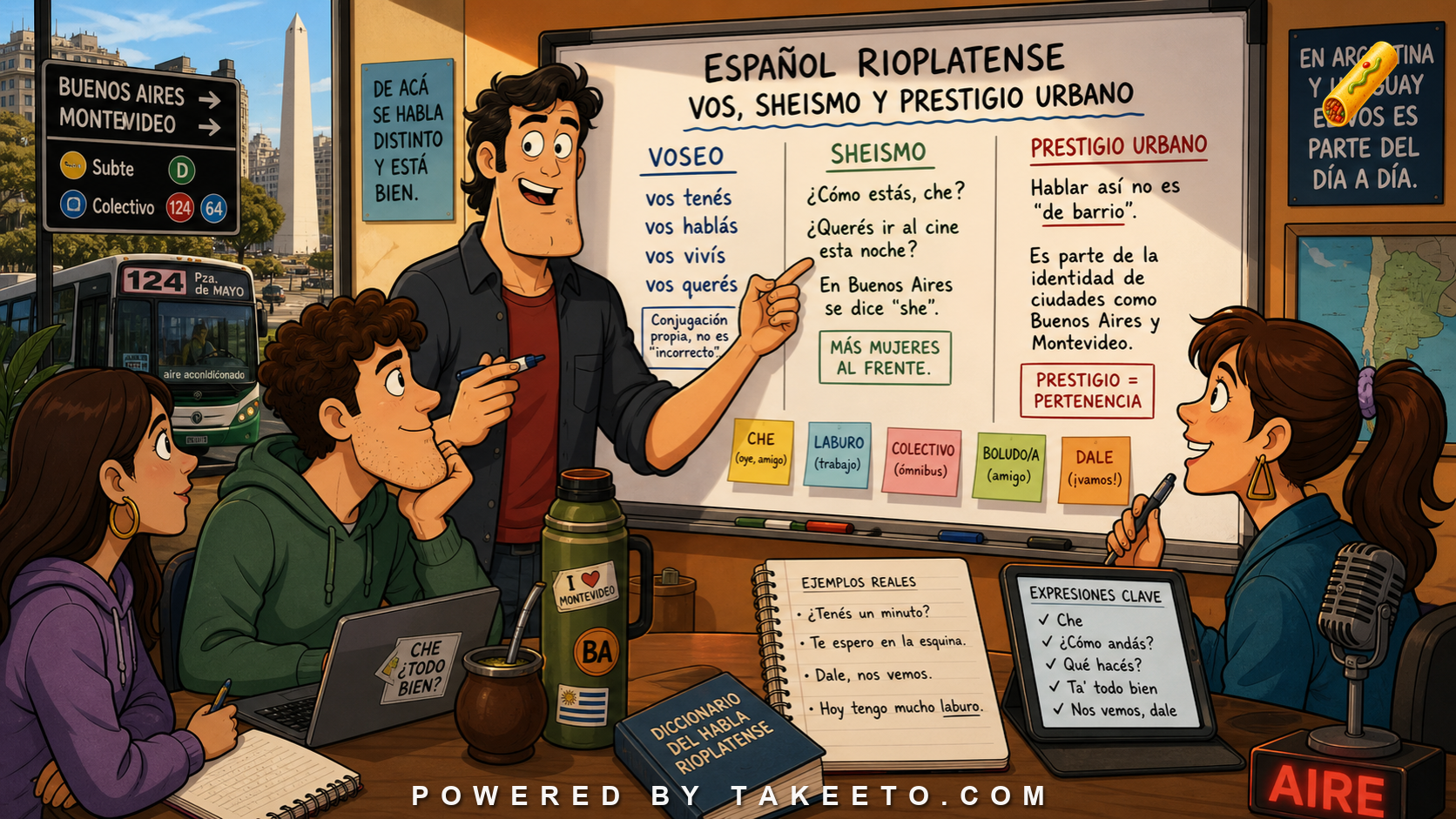
Voseo: vos as ordinary address
The most important grammatical feature is voseo.
Instead of:
tú tienes
tú hablas
Rioplatense Spanish commonly uses:
vos tenés
vos hablás
This is not archaic, rude, or slang in its own context. It is ordinary second-person singular familiar address.
Examples:
¿Vos tenés tiempo?
Do you have time?
¿De dónde sos?
Where are you from?
Hablás muy rápido.
You speak very fast.
A learner trained only on tú must recognize vos forms quickly. Otherwise ordinary conversation will look like a grammar error.
Ustedes for plural address
Rioplatense Spanish uses ustedes as the normal plural “you,” not vosotros.
¿Ustedes vienen?
Are you all coming?
The system is therefore:
vos hablás
usted habla
ustedes hablan
not:
tú hablas / vosotros habláis
This matters for verb agreement. Vos takes its own familiar singular forms. Ustedes takes third-person plural verb forms.
Sheísmo and zheísmo: y and ll
Another famous feature is the pronunciation of y and ll. In much Rioplatense speech, these are pronounced with a sound similar to English sh or to a voiced version like the s in English measure, depending on speaker and context.
Examples:
yo
calle
lluvia
A learner may hear something like:
sho / zho
cashe / cazhe
shuvia / zhuvia
The voiceless sh-like pronunciation is often called sheísmo; the voiced pronunciation is often called zheísmo. Distribution varies by age, region, and social factors.
Learner action: do not confuse this with mispronunciation. It is a recognized regional feature.
Intonation and rhythm
Rioplatense intonation is often recognizable even before individual words are identified. Learners and linguists often note historical Italian immigration as one influence in the region’s sound and culture. That history matters, but it should not be turned into a cartoon. Rioplatense Spanish is not “Spanish spoken like Italian.” It is a Spanish variety shaped by multiple histories, migrations, social classes, urban cultures, and media norms.
Learners should listen for:
- melodic sentence contours,
- emphatic discourse rhythm,
- phrase-final intonation patterns,
- expressive particles,
- casual reductions.
Intonation is part of the dialect. Vocabulary alone will not make you understand it.
Che: address, attention, and identity
Che is one of the best-known Rioplatense discourse words.
It can call attention, address someone, soften a move, or mark conversational involvement.
Che, ¿tenés un minuto?
Hey, do you have a minute?
Che, qué raro.
Hey, that’s strange.
It is informal. Learners should recognize it, but use it carefully. Overusing che as a foreign learner can sound like performing an accent rather than communicating.
Vocabulary: laburo, colectivo, boliche
Some common regional words:
laburo
work/job, informal
colectivo
bus, especially in Argentina
boliche
nightclub/bar, depending on region/context
pibe / piba
kid, young person
plata
money, widespread beyond Rioplatense but very common
Learner action: label vocabulary by region and register. Laburo is not the same as formal trabajo. Colectivo may not mean the same thing in every country.
Formal Rioplatense Spanish
A mistake: learners hear vos, che, and slang, then assume Rioplatense Spanish is generally informal. Not true.
Formal Rioplatense Spanish appears in journalism, courts, universities, business, literature, scholarship, diplomacy, and public institutions. It may still use regional pronunciation and vos in appropriate contexts, but formal writing follows standard conventions.
Compare:
Che, ¿venís al laburo mañana?
Hey, are you coming to work tomorrow?
with:
Se informa a los interesados que la inscripción permanecerá abierta hasta el viernes.
Interested parties are informed that registration will remain open until Friday.
Same region, different register.
Learner production choices
If your target is Rioplatense Spanish, learn vos actively. It is central, not optional.
If your target is another variety, learn Rioplatense features for recognition:
- vos tenés, vos hablás, vos sos,
- vení, decí, hacé,
- y/ll as sh-like,
- ustedes plural,
- common words like che, laburo, colectivo.
Do not mix vos randomly into otherwise Mexican or Peninsular speech unless you understand the social effect.
Example bank walkthrough
vos tenés
Voseo form of tener.
Learner action: recognize tenés as second-person singular, not plural.
vos hablás
Voseo present indicative.
Learner action: note final stress and accent mark.
calle / yo
Words showing y/ll pronunciation.
Learner action: expect sh-like or zh-like sound in many Rioplatense speakers.
che
Informal attention/address marker.
Learner action: recognize first; use only with appropriate context.
laburo
Informal word for work/job.
Learner action: know formal trabajo remains essential.
colectivo
Bus in Argentina.
Learner action: treat transportation vocabulary as regional.
ustedes
Plural “you.”
Learner action: do not expect vosotros in ordinary Rioplatense speech.
Remediation notes: Rioplatense consistency and over-imitation
Rioplatense Spanish often attracts imitation because its features are so recognizable. Learners hear che, vos tenés, and sh-like y/ll, then start sprinkling them into otherwise non-Rioplatense Spanish. That is a mistake. The remediation here is consistency.
If Rioplatense is your target, learn the system as a system:
vos sos, not random tú eres in the same register.
vos tenés, not accidental vos tienes unless you are deliberately studying a region where that mixture is normal.
vení, decí, hacé, mirá, not only the present-tense forms.
ustedes, not vosotros, for plural address.
local pronunciation of y/ll, but not as a joke or costume.
If Rioplatense is not your target, learn it for recognition. That means you should understand:
¿De dónde sos? = ¿De dónde eres?
¿Tenés tiempo? = ¿Tienes tiempo?
Vení acá = Ven aquí / Ven acá.
Decime = Dime.
The pronunciation section also benefits from more precision. Sheísmo and zheísmo are not simply two fixed pronunciations that every Argentine or Uruguayan uses equally. They vary by region, age, social identity, and speech style. Learners should know that yo, calle, and lluvia may sound sh-like or zh-like in many Rioplatense settings, but should not assume all Argentina speaks the same way. Argentina includes many regional varieties, and Uruguay is not just "small Argentina" linguistically.
The Italian-influence note also needs discipline. It is reasonable to mention Italian immigration when discussing cultural and intonational history in the Río de la Plata. It is sloppy to say Rioplatense Spanish is "Spanish with Italian pronunciation." That framing erases Spanish-internal development, migration from many sources, local class histories, indigenous and neighboring influences, and modern media norms.
A register repair matters too. Words like laburo, pibe, boliche, and che are not wrong, but they are not neutral replacements for trabajo, niño/joven, discoteca/bar, and a standard attention-getter. A learner applying for a job, writing to a professor, or speaking to an official should not over-regionalize casual words simply to sound authentic.
Production test:
Could you say the same sentence formally, neutrally, and casually in a Rioplatense target?
Example:
Formal: Quisiera saber si usted tiene disponibilidad mañana.
Neutral familiar: ¿Tenés tiempo mañana?
Casual familiar: Che, ¿tenés un rato mañana?
That contrast is real competence.
Suggested interactive module: Rioplatense recognition trainer
A strong tool for this article would connect voseo, pronunciation, and vocabulary.
Suggested functions:
- Voseo converter: tú tienes → vos tenés; tú hablas → vos hablás.
- Command mode: vení, decí, hacé, hablá.
- Y/ll audio toggle: standard yeísmo, sheísmo, zheísmo.
- Vocabulary cards: che, laburo, colectivo, pibe, plata.
- Register labels: informal, neutral, formal, slang.
- Region notes: Buenos Aires, Montevideo, broader Argentina/Uruguay, with caution.
- Listening quiz: identify vos forms in clips.
- Production target selector: active Rioplatense vs recognition-only mode.
Final rule
Rioplatense Spanish is a major Spanish system, not a collection of oddities.
Learn vos, recognize y/ll pronunciation, respect the region’s registers, and do not reduce the dialect to stereotypes. If it is your target, learn it seriously. If it is not, recognize it confidently.