
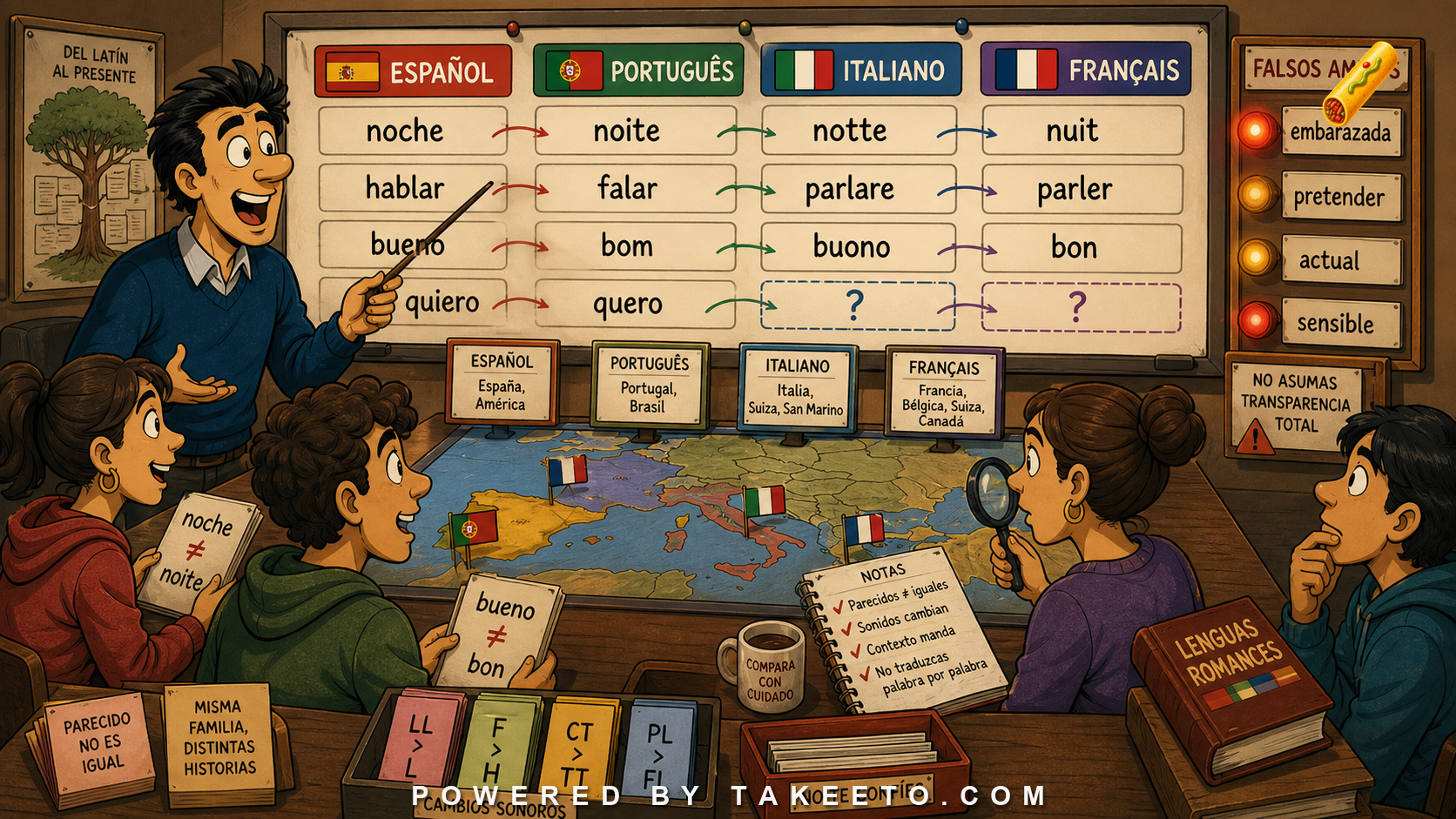
Similar ancestry does not mean easy equivalence
Spanish, Portuguese, French, and Italian are Romance languages. They share inheritance from Latin, and that inheritance creates cognates, similar grammatical categories, parallel verb systems, related articles, and recognizable word families. But they are not dialects of one another, and similarity can deceive.
A Spanish learner may see:
noche / noite / notte / nuit
hablar / falar / parlare / parler
bueno / bom / buono / bon
quiero / quero
The family resemblance is real. So are the differences.
The key principle is:
Romance comparison is useful when it shows patterns, dangerous when it makes you assume that similar forms have identical sound, grammar, or meaning.
Comparison should sharpen Spanish, not replace Spanish study.
Shared Latin inheritance
The Romance languages developed from varieties of spoken Latin across different regions. Because of this, they share many roots:
Spanish madre, Portuguese mãe, Italian madre, French mère
Spanish mano, Portuguese mão, Italian mano, French main
Spanish cantar, Portuguese cantar, Italian cantare, French chanter
Shared roots help reading, especially in formal vocabulary. Words related to administration, science, law, religion, and education often look familiar across languages because many are learned Latinisms.
Learner action: use cognates to build reading speed, but verify pronunciation and usage.
Sound systems diverged strongly
Pronunciation is where Romance comparison becomes humbling. Written Spanish and Portuguese may look close, but European Portuguese and Brazilian Portuguese have sound patterns that differ sharply from Spanish. French spelling hides many historical sounds and has nasal vowels, liaison, silent letters, and stress patterns unlike Spanish. Italian pronunciation is more transparent for Spanish speakers in some ways, but consonant length, vowel quality, and rhythm still differ.
Example:
Spanish noche
Portuguese noite
Italian notte
French nuit
All are related, but the spoken forms do not collapse into one.
Learner action: never assume a cognate is pronounced “the Spanish way.”
Articles and gender feel familiar but differ
Romance languages have gender and articles, but the forms differ:
Spanish: el, la, los, las
Portuguese: o, a, os, as
Italian: il, lo, la, i, gli, le
French: le, la, les
Gender may align, but not always. A noun’s gender in Spanish does not guarantee the same gender in French or Italian. Plural patterns also differ.
Learner action: do not transfer gender automatically across Romance languages.
Verb systems: similar categories, different details
Romance languages share many verb categories: person, number, tense, mood, aspect, subjunctive, conditional, participles, and compound forms. But the distribution differs.
Spanish uses the personal a, has a robust subjunctive system, and places object pronouns according to Spanish rules. Portuguese has features such as the personal infinitive and different clitic-placement patterns. French requires subject pronouns much more consistently and has many written distinctions not heard in speech. Italian has its own pronoun placement, auxiliary selection, and tense preferences.
Learner action: treat Romance grammar as a set of related systems, not one system with accents.
False friends and partial friends
False friends are words that look related but differ in meaning. Partial friends overlap in some contexts but not all.
Examples across Romance languages can be tricky. Spanish actual means current, not usually English “actual.” Portuguese embarazada is not the same as Portuguese embaraçada. French librairie is not Spanish librería in every translation context for English speakers. Italian burro means butter, not Spanish burro.
Even when meaning is close, collocations differ. A word may be grammatically equivalent but not idiomatically natural.
Object pronouns and clitics
Romance languages all have object pronoun systems, but placement and form vary. Spanish learners must not import Portuguese or Italian clitic placement into Spanish.
Spanish:
Lo vi.
Voy a verlo. / Lo voy a ver.
Portuguese and Italian have related but distinct rules. French object pronouns normally appear before the conjugated verb in many contexts but follow a different system.
Comparison helps you notice that object pronouns are a Romance family feature. It does not give you Spanish placement rules automatically.
Comparison as study method
A good Romance comparison workflow:
- Start from a Spanish word or structure.
- Compare related forms in Portuguese, French, and Italian.
- Ask what sound change or grammar difference explains the divergence.
- Return to Spanish and write the Spanish rule.
- Add a false-friend warning if needed.
The point is not to learn four languages at once. The point is to deepen Spanish by seeing what it shares and what it does differently.
Example bank walkthrough
noche / noite / notte / nuit
Related forms from Latin, with different sound changes.
Learner action: use the set to see history, not to assume pronunciation.
hablar / falar / parlare / parler
Different Romance verbs for speaking, with different histories.
Learner action: compare but keep Spanish hablar usage separate.
bueno / bom / buono / bon
Related adjective family.
Learner action: note gender/number behavior inside each language.
quiero / quero
Spanish and Portuguese forms look close.
Learner action: do not assume full tense, pronunciation, or usage equivalence.
Remediation notes: comparison must not erase system boundaries
The key repair for Romance comparison is to stop treating cognates as permission to translate mechanically. Spanish, Portuguese, French, and Italian share Latin ancestry, but each language has its own sound system, pronoun placement, article use, tense preferences, spelling conventions, idioms, and register norms.
A cognate grid should include meaning, not only form. Spanish actual and French actuel may align more closely with “current” than English “actual.” Spanish librería is a bookstore, while English “library” is biblioteca. Portuguese embarazada is not the normal way to say pregnant; Spanish embarazada is. Italian burro means butter, not Spanish burro. These are not traps because Romance languages are chaotic; they are normal semantic divergence.
Object pronouns are a major boundary. Spanish lo vi, French je l’ai vu, Italian l’ho visto, and Portuguese equivalents do not just swap words. Position, agreement, contractions, clitic clusters, and formality differ. Learners moving between Romance languages should study pronoun grammar directly rather than assuming one system transfers.
Sound correspondence is useful when disciplined. Spanish noche, Portuguese noite, Italian notte, and French nuit show shared ancestry plus divergent sound change. Spanish hablar, Portuguese falar, Italian parlare, and French parler show that cognacy and borrowing histories do not always line up in a simple one-to-one pattern.
Mutual intelligibility also needs realism. Reading a related Romance language may feel possible sooner than listening. But partial comprehension can be dangerous in legal, medical, academic, or travel contexts. Recognizing a cognate is not the same as understanding the sentence.
Production target: use comparison in three columns: safe transfer, danger zone, no transfer. Safe transfer might be broad gender awareness or many Latin roots. Danger zone includes false friends and pronouns. No transfer includes language-specific idioms, spelling rules, and politeness formulas. Comparison should sharpen boundaries, not blur them.
Suggested interactive module: Romance cognate and grammar grid
A strong tool for this article would compare forms without flattening differences.
Suggested functions:
- Cognate table: Spanish, Portuguese, Italian, French.
- Sound-change notes: f/h, ct/ch/it/tt, diphthongs, nasal vowels.
- Pronunciation warning: written similarity versus spoken distance.
- Grammar panel: articles, pronouns, verb endings, object placement.
- False-friend detector: similar form, different meaning.
- Spanish target mode: convert comparison into a Spanish learner rule.
Final rule
Romance comparison is powerful because Spanish is not isolated. It is risky because relatives are not clones.
Use Portuguese, French, and Italian to see patterns. Then return to Spanish and learn the Spanish system on its own terms.