
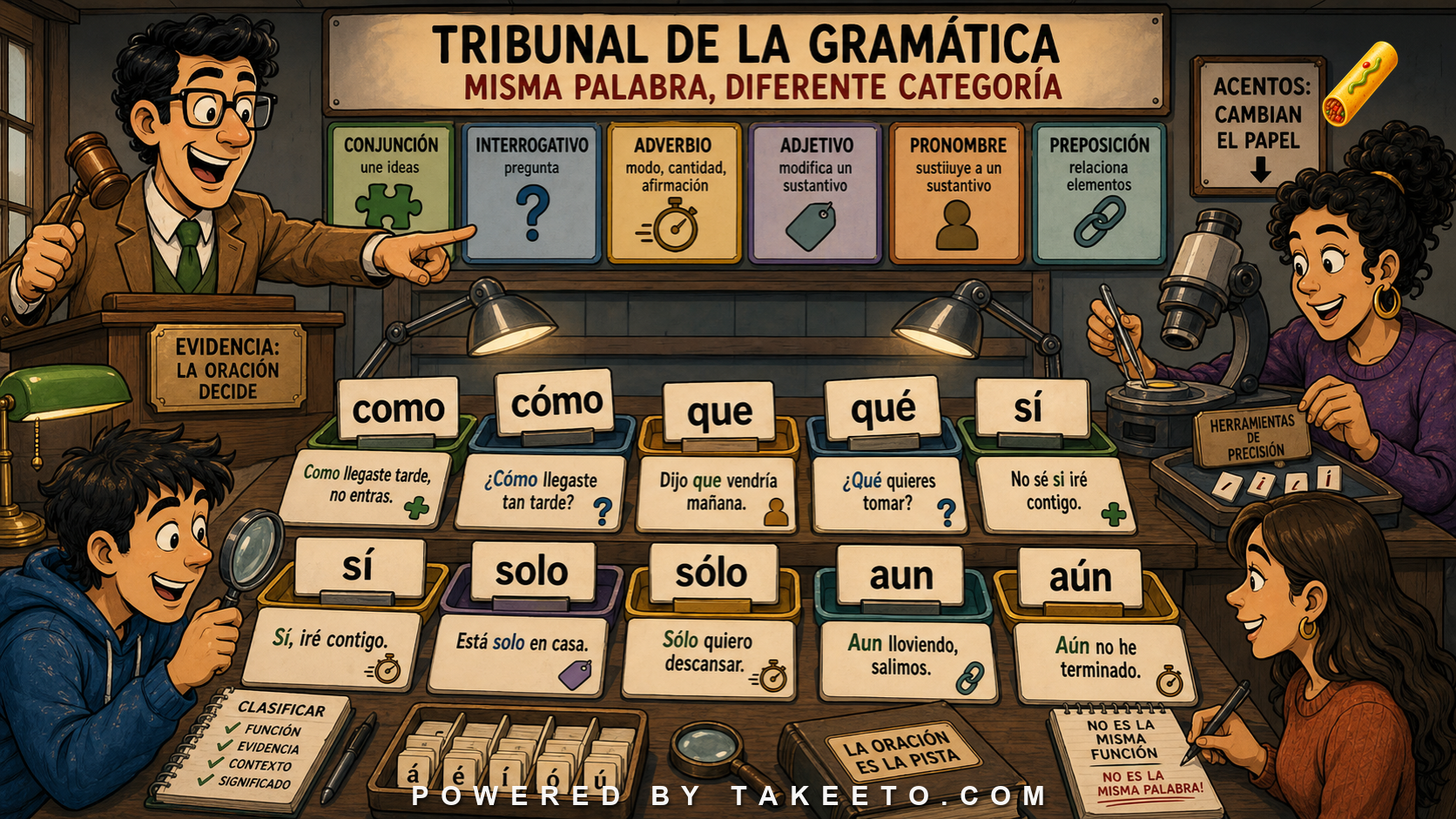
High-frequency words are not single-purpose words
Spanish has small words that appear everywhere:
como
que
si
solo
aun
A learner may look them up once and think they know them. Then the same form appears in a different role and the sentence collapses.
Example:
Como no había tiempo, comimos rápido.
The first como means since/because. The second form inside comimos belongs to the verb comer. In another sentence:
Trabajo como traductor.
Como means as. In a question:
¿Cómo funciona?
Cómo means how.
The key principle is:
Classify the role before translating the word.
Spelling is not enough. Function decides meaning.
Como and cómo
Como can serve several roles.
Comparison
Habla como su padre.
He speaks like his father.
Here como compares.
Role or function
Trabaja como profesora.
She works as a teacher.
Here como means “as” in the role sense.
Manner, often without accent in non-question clauses
Lo hice como me dijiste.
I did it the way you told me.
Causal connector
Como no había datos, no pudimos concluir nada.
Since there was no data, we could not conclude anything.
Initial como + finite verb often signals cause.
First-person verb form
Como a las ocho.
I eat at eight.
This como is from comer.
Interrogative/exclamative cómo
¿Cómo se pronuncia?
How is it pronounced?
¡Cómo ha cambiado!
How much it has changed!
The accent marks interrogative or exclamative force, direct or indirect:
No sé cómo se pronuncia.
I don’t know how it is pronounced.
Que and qué
Que is one of the busiest words in Spanish.
Subordinating conjunction
Creo que tiene razón.
I think that he is right.
Relative pronoun
El libro que compré es excelente.
The book that I bought is excellent.
Comparative or result structures
Es más difícil que antes.
It is more difficult than before.
Tan claro que todos entendieron.
So clear that everyone understood.
Exclamative or interrogative qué
¿Qué significa esta palabra?
What does this word mean?
¡Qué difícil!
How difficult!
Indirect question:
No sé qué significa.
I don’t know what it means.
Learner action:
For que/qué, first ask whether it introduces a clause, refers back to a noun, compares, or asks/exclaims.
Si and sí
Si without accent often introduces a condition or indirect yes/no question.
Si llueve, no salimos.
If it rains, we will not go out.
No sé si viene.
I don’t know whether he is coming.
Sí with accent can mean yes or refer emphatically to oneself in certain expressions.
Sí, estoy de acuerdo.
Yes, I agree.
Lo hizo por sí mismo.
He did it by himself.
The accent is not decoration. It separates functions.
Solo and sólo
Solo can be an adjective:
Está solo.
He is alone.
It can also be an adverb meaning only:
Solo quiero entender la idea principal.
I only want to understand the main idea.
Many older texts use sólo for the adverb:
Sólo quiero entender la idea principal.
Modern editorial practice often writes solo without an accent in both uses, except that some writers or editors may use the accent to avoid ambiguity in particular cases. Learners should recognize both forms, but in most contemporary neutral writing solo without the accent is common.
Potential ambiguity:
Estudia solo los domingos.
This could mean:
- He studies alone on Sundays.
- He studies only on Sundays.
A good writer often rewrites if ambiguity matters:
Estudia sin compañía los domingos.
Estudia únicamente los domingos.
Learner action:
Do not depend on the accent to solve all ambiguity. Use context and rewrite when necessary.
Aun and aún
Aun without accent often means even, including, or even if.
Aun los expertos pueden equivocarse.
Even experts can make mistakes.
Aun cuando sea difícil, conviene intentarlo.
Even when / even if it is difficult, it is worth trying.
Aún with accent means still or yet.
Aún no ha llegado.
He still has not arrived.
El problema aún existe.
The problem still exists.
A useful test:
If you can replace it with todavía, use aún.
Aún no ha llegado. → Todavía no ha llegado.
But:
Aun los expertos... → Todavía los expertos...
That does not work.
Why dictionaries split entries
A dictionary may list como, cómo, que, qué, si, sí, solo, aun, and aún as different entries or subentries because they do different grammatical jobs.
Learners should not memorize one English equivalent. They should identify category:
- conjunction,
- relative pronoun,
- interrogative pronoun/adverb,
- adverb,
- adjective,
- verb form,
- conditional marker,
- affirmation.
Category predicts translation.
Example bank walkthrough
como
Comparison, role, manner, cause, or verb form.
Learner action: inspect position and verb structure.
cómo
Interrogative/exclamative “how.”
Learner action: watch indirect questions: no sé cómo.
que
Conjunction, relative pronoun, comparison/result marker.
Learner action: identify what clause it introduces.
qué
Interrogative/exclamative “what/how.”
Learner action: direct and indirect questions both need the accent.
si
If/whether.
Learner action: distinguish conditional from indirect yes/no question.
sí
Yes or emphatic self-related form.
Learner action: accent changes function.
solo / sólo
Alone or only; older/accented adverb form may appear.
Learner action: use context; rewrite ambiguity.
aun / aún
Even versus still/yet.
Learner action: test aún with todavía.
Parsing workflow for ambiguous small words
When you meet one of these forms:
- Do not translate immediately. Pause.
- Check accent. cómo/qué/sí/aún often mark different functions.
- Find the finite verb. Does the word introduce a clause?
- Check position. Initial como may be causal; cómo in a question asks manner.
- Look for antecedents. que may refer back to a noun.
- Check whether it modifies a noun, verb, or whole clause. solo may be adjective or adverb.
- Try substitution tests. aún = todavía; sino = correction; como = porque? as?
- Translate by role. Category first, English second.
Accent marks often reveal category, not decoration
Many high-frequency Spanish forms are short, common, and category-ambiguous. Accent marks often help distinguish function:
como / cómo
que / qué
si / sí
aun / aún
The accent does not merely make the word look formal. It often marks interrogative, exclamative, affirmative, or adverbial value.
Compare:
No sé cómo lo hizo.
I don’t know how he/she did it.
Lo hizo como le dijeron.
He/she did it as they were told.
In the first, cómo introduces an indirect question. In the second, como marks manner or comparison. The spelling reflects the syntactic job.
Como has several lives
Examples:
Como arroz todos los días.
I eat rice every day. (como = first-person singular of comer)
Lo hice como pude.
I did it as best I could. (como = manner)
Es tan alto como su hermano.
He is as tall as his brother. (como = comparison)
Como estaba cansado, me fui temprano.
Since I was tired, I left early. (como = causal connector)
¿Cómo se escribe?
How is it written? (cómo = interrogative)
The parser must identify the clause role before translating.
Que and qué
Que may be a relative pronoun, conjunction, comparative element, or part of a fixed structure:
El libro que compré.
The book that I bought.
Quiero que vengas.
I want you to come.
Más alto que antes.
Taller than before.
Qué asks or exclaims:
¿Qué significa esto?
What does this mean?
No sé qué significa.
I don’t know what it means.
¡Qué difícil!
How difficult!
A learner who searches only for one dictionary entry will miss the grammatical split.
Si and sí
Si without accent introduces a condition or indirect yes/no question:
Si llueve, no salimos.
If it rains, we won’t go out.
No sé si vendrá.
I don’t know whether he/she will come.
Sí with accent marks affirmation or reflexive/prepositional pronoun in some contexts:
Sí, estoy de acuerdo.
Yes, I agree.
Lo hizo por sí mismo.
He did it by himself.
The accent often prevents a major reading error.
Solo and sólo: production versus recognition
Modern standard practice generally favors writing solo without an accent whether it means “alone” or “only,” except where a style guide or writer allows an accent to avoid real ambiguity. Learners will still encounter sólo in older texts, conservative editorial habits, and some publications.
For production, the safest general habit is:
solo = alone / only, interpreted by context.
For recognition, understand both:
Vino solo.
He came alone.
Solo vino Juan.
Only Juan came.
Sólo vino Juan.
Older or disambiguating spelling for “Only Juan came.”
Do not build your grammar around the accent. Build it around syntactic role.
Aun and aún
A useful rule:
aún = still / yet
aun = even / even if / including
Examples:
Aún no ha llegado.
He/she still has not arrived.
Aun sin dinero, siguió estudiando.
Even without money, he/she kept studying.
Aun los expertos se equivocan.
Even experts make mistakes.
The accent marks a difference in meaning, not just pronunciation habit.
Parsing workflow
For any short ambiguous form:
- Find the verb of the clause.
- Ask whether the word introduces a question, condition, comparison, relative clause, or noun clause.
- Check accent marks, but do not rely on spelling alone in informal text.
- Identify whether the word is functioning as a verb, pronoun, conjunction, adverb, or adjective.
- Translate the role, not the spelling.
High-frequency words are difficult precisely because they are flexible. The solution is not memorizing ten translations. The solution is syntactic classification.
Informal writing may remove the clues
In texts, comments, and search queries, accent marks may disappear:
no se como hacerlo
si quieres te digo
que significa esto
A fluent reader reconstructs the intended categories:
No sé cómo hacerlo.
Si quieres, te digo.
¿Qué significa esto?
This is why learners must not depend only on written accent marks. Accents are important in correct writing, but real-world digital Spanish may omit them. The deeper skill is classification by clause role.
Ask:
- Is the word asking a question?
- Is it introducing a condition?
- Is it functioning as a verb?
- Is it affirming?
- Is it comparing?
Then restore standard spelling. This turns messy input into a grammar exercise instead of a source of confusion.
Suggested interactive module: high-frequency word category classifier
A strong tool for this article would ask learners to classify before translating.
Suggested functions:
- Sentence input: Como no había tiempo, salimos.
- Target word: como.
- Category choices: comparison, role, causal connector, verb form, question word.
- Feedback: causal connector; translates as since/because.
- Accent contrast: como vs cómo, si vs sí, aun vs aún.
- Ambiguity mode: solo examples requiring rewrite.
- Dictionary view: show separate functions under one spelling.
Final rule
Small Spanish words are high-frequency because they do many jobs.
Do not memorize como = like, que = that, si = if, solo = only, aun = even and stop there. Classify the word’s role in the sentence. Accent, position, clause structure, and context decide meaning.
Parsing comes before translation.