
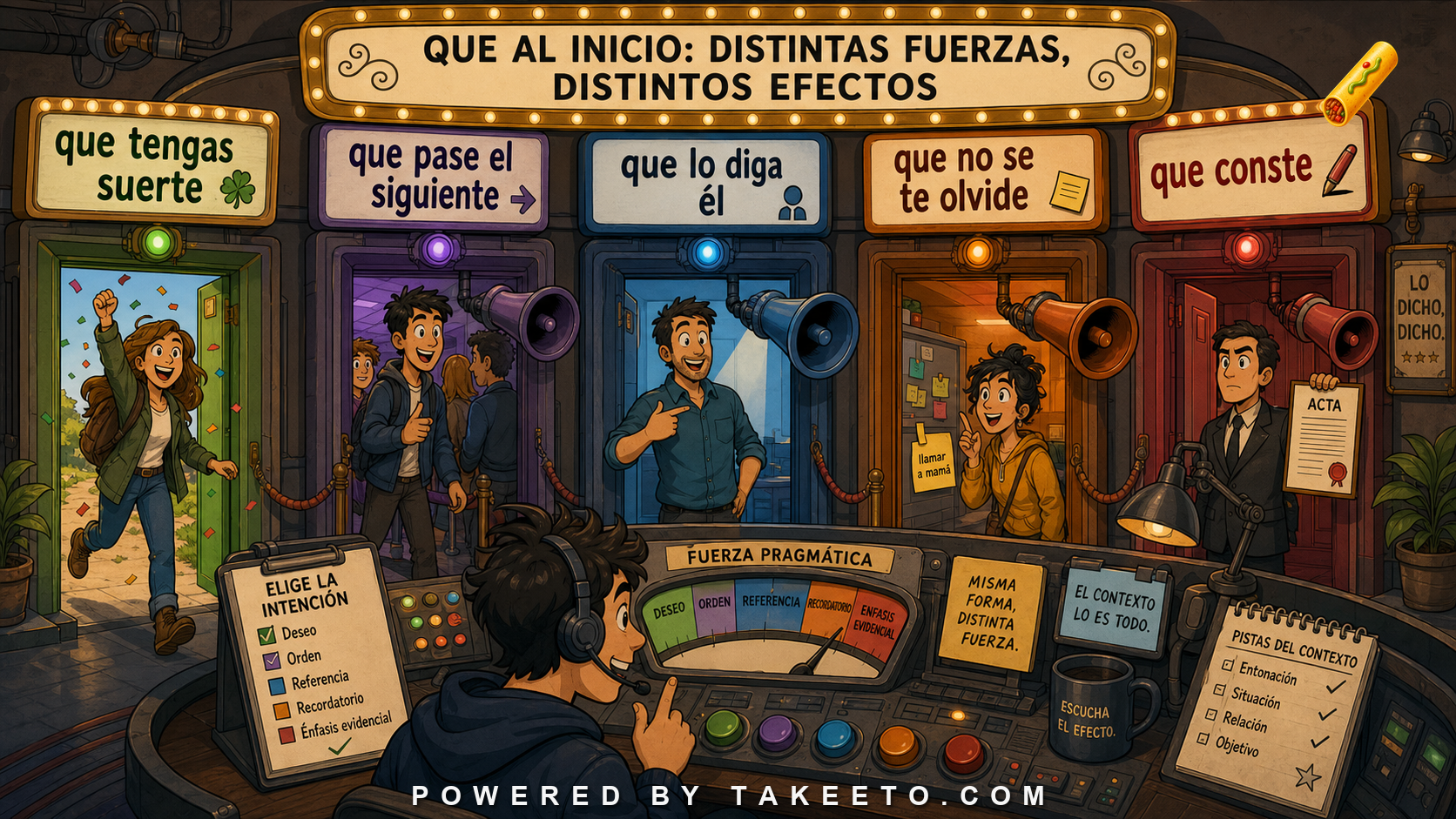
Que is not always just “that”
Learners first meet que as a connector:
Creo que tiene razón.
I think that he is right.
Quiero que vengas.
I want you to come.
But Spanish also uses que at the beginning of independent sentences:
Que tengas suerte.
May you have luck / Good luck.
Que pase el siguiente.
Next person, come in.
Que no se te olvide.
Don’t forget.
This que is not simply translating English “that.” It often introduces a wish, command, permission, warning, concession, or formulaic stance.
The key principle is:
Sentence-initial que often marks an elliptical or independent subjunctive clause whose force depends on context.
Wishes: que + subjunctive
One of the most common independent uses expresses a wish.
Que tengas suerte.
Good luck / May you have luck.
Que te mejores.
I hope you get better.
Que descanses.
Rest well.
Que lo pases bien.
Have a good time.
These are not commands in the strict sense. They are wish formulas. English often translates them with idiomatic phrases rather than literal “that.”
The hidden structure could be something like:
Espero que tengas suerte.
But in actual speech, the full verb is not needed.
Commands and instructions
Sentence-initial que can also give commands, especially in third person or formal/public contexts.
Que pase el siguiente.
Let the next person come in / Next.
Que lo diga él.
Let him say it.
Que nadie salga.
Nobody leave.
Que se sienten todos.
Everyone sit down.
This structure is useful because Spanish imperatives are limited by person and form. Que + subjunctive can command or direct someone indirectly.
Warnings and reminders
Some que clauses sound like reminders, warnings, or insistence.
Que no se te olvide.
Don’t forget.
Que tengas cuidado.
Be careful.
Que no llegues tarde.
Don’t be late.
The tone depends heavily on relationship, intonation, and context. The same grammar can be caring, parental, sharp, or routine.
Permission or concession
Que + subjunctive can allow, dismiss, or concede something.
Que diga lo que quiera.
Let him say what he wants.
Que vengan si quieren.
Let them come if they want.
Que sea difícil no significa que sea imposible.
The fact that it is difficult does not mean it is impossible.
The first two examples have a permissive or dismissive feel. The third uses que to turn a clause into a topic-like proposition.
Echoes and conversational reactions
In conversation, que can echo, challenge, or intensify something already said.
—No voy.
—¿Que no vas?
“I’m not going.”
“What do you mean you’re not going?”
¡Que sí!
Yes, I am / I said yes.
¡Que no!
No, I’m not / I said no.
This que is not the same as the wish-command pattern, but it belongs to the same larger fact: que is a discourse tool, not only a neutral connector.
Que conste
Que conste is a formula meaning something like “let it be noted,” “for the record,” or “just so it’s clear.”
Que conste que yo avisé.
For the record, I warned you.
This expression introduces a stance toward the record, responsibility, or future accountability. It is common enough to learn as a unit.
Ellipsis: what is missing?
Many independent que clauses feel as if a main verb is omitted:
Espero que tengas suerte. → Que tengas suerte.
Quiero que pase el siguiente. → Que pase el siguiente.
Procura que no se te olvide. → Que no se te olvide.
But learners should be careful. These are not always sentences with a recoverable single missing verb. Over time, independent que has become its own pragmatic pattern.
It is better to learn functions than to force one hidden translation.
Que after main verbs versus independent que
Compare:
Quiero que vengas.
I want you to come.
Que vengas.
Come / Make sure you come / I want you to come.
The first has an explicit main verb. The second relies on context.
That means independent que can be stronger, softer, more formulaic, or more ambiguous than a full sentence. It carries pragmatic force.
Not every sentence-initial que has the same grammar
A common learner repair is to separate three patterns that look similar on the page.
First, que + subjunctive can express a wish or directive:
Que tengas suerte.
Good luck.
Que nadie salga.
Nobody leave.
Second, que + indicative can echo, insist, or reassert something:
¡Que sí!
Yes, I said yes.
¡Que ya lo sé!
I already know!
¿Que no viene?
What do you mean he/she is not coming?
Third, que can introduce a nominalized or topic-like clause:
Que sea difícil no significa que sea imposible.
The fact that it is difficult does not mean it is impossible.
These are related historically and pragmatically, but they should not be collapsed into one rule. The mood and intonation help identify the function.
Tone can change a helpful formula into pressure
Many independent que clauses are socially delicate. The same wording can be affectionate, routine, or controlling.
Que descanses.
Rest well.
usually sounds warm.
Que no llegues tarde.
Don’t be late.
can be caring, parental, annoyed, or threatening depending on tone.
Que te quede claro.
Let this be clear to you.
can sound firm or confrontational.
Learners should not use independent que as a universal command device. It is common, but it carries interpersonal force. In neutral service or professional contexts, full forms may be safer:
Por favor, no salga todavía.
Please do not leave yet.
Le deseo mucha suerte.
I wish you good luck.
Example bank walkthrough
que tengas suerte
Wish formula.
Learner action: translate naturally as “good luck.”
que pase el siguiente
Instruction or public command.
Learner action: recognize third-person command force.
que lo diga él
Let him say it / he should say it.
Learner action: use context to decide whether it is permissive, directive, or emphatic.
que no se te olvide
Reminder or warning.
Learner action: notice the accidental se construction as well.
que conste
Formula meaning “for the record.”
Learner action: learn as a discourse marker of responsibility or record.
Interpretation routine
When que begins a sentence, ask:
- Is it followed by the subjunctive?
- Is the speaker wishing something?
- Is the speaker ordering or allowing something?
- Is it a reminder or warning?
- Is it echoing a previous statement?
- Is it a fixed formula?
- What tone does the context create?
Do not translate mechanically. Identify the function.
Suggested interactive module: independent que classifier
A strong tool for this article would classify sentence-initial que by pragmatic force.
Suggested functions:
- Function labels: wish, command, reminder, permission, echo, formula.
- Mood detector: subjunctive, indicative, fragment.
- Context cards: doctor’s office, family reminder, argument, farewell.
- Tone slider: gentle, neutral, sharp, formal.
- Expansion mode: possible hidden main clauses.
- Formula bank: que conste, que yo sepa, que digamos.
- Translation alternatives: good luck, let him, make sure, for the record.
Final rule
Sentence-initial que is a pragmatic signal.
It can express wishes, commands, warnings, permissions, echoes, and formulas. The subjunctive often carries the desired or directed event, while context supplies the force.
Do not treat every que as “that.” Spanish uses que to launch action, attitude, and response.