
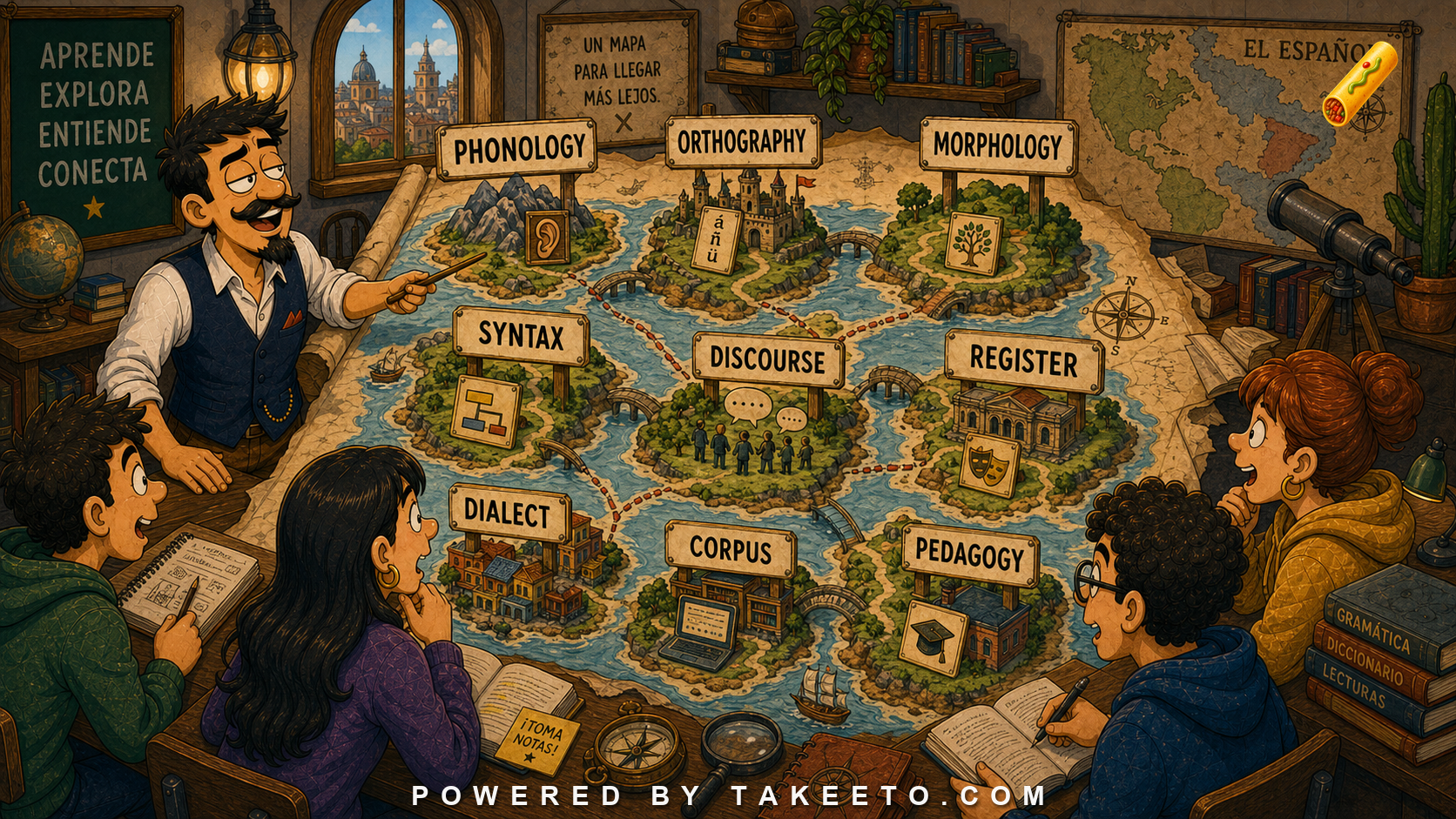
Spanish is not one skill
A learner says, “I want to learn Spanish.” That sounds like one goal. It is not.
Spanish is sound, spelling, word formation, sentence structure, discourse, register, dialect, history, text type, pragmatics, memory, and practice. A learner can improve one part while neglecting another. Someone may speak comfortably but write weakly. Someone may read academic prose but fail in fast conversation. Someone may know verb tables but miss register. Someone may understand classroom audio but collapse when listening to Caribbean speech. Someone may have heritage fluency in conversation but lack formal writing tools.
The serious learner needs a map.
A map does not make the work easy. It makes the work navigable.
The key principle is:
Spanish depth comes from connecting sound, structure, use, history, and text.
If those systems remain separated, the learner collects fragments. If they are connected, Spanish becomes an intelligible territory.
The five pillars
A serious Spanish map can begin with five pillars:
- Sound: phonology, pronunciation, stress, rhythm, listening.
- Structure: morphology, syntax, tense, mood, pronouns, agreement.
- Use: pragmatics, register, politeness, discourse, stance.
- History: Latin roots, sound change, orthography, contact, variation.
- Text: genres, domains, documents, media, academic prose, public language.
Most beginner courses emphasize pieces of sound and structure. Many apps emphasize vocabulary and retrieval. Conversation practice emphasizes use. Literature and news expose text. Historical and dialect knowledge often appears late, if at all.
The Takeeto-style 365-article project is valuable because it refuses to flatten Spanish into travel phrases or isolated cards. It treats Spanish as a language of systems.
Pillar 1: sound
Sound is not optional. Spanish spelling is more transparent than English spelling in many ways, but that does not mean Spanish pronunciation is automatic.
A serious learner must understand:
- vowel quality,
- stress placement,
- written accent marks,
- syllable structure,
- diphthong and hiatus,
- r and rr,
- b/v realization,
- d weakening,
- nasal assimilation,
- s variation,
- intonation,
- connected speech,
- reduced forms,
- listening reconstruction.
Sound matters for speech, but also for reading. Stress and accent marks help organize words. Vowel sequences explain why país, día, ciudad, and continúa behave differently. Listening to reduced speech helps the learner connect written para, está, cansado, and verdad to real spoken forms.
The serious rule:
Do not treat pronunciation as decoration after grammar. Sound is part of the grammar your ear uses.
A learner who cannot hear stress, reduction, or phrase rhythm will read Spanish with the eyes but not yet with the language's timing.
Pillar 2: structure
Structure is where many learners hit the intermediate wall. They know words. They recognize common tenses. They can survive conversation. But long sentences remain slow, and formal Spanish feels dense.
Structure includes:
- noun gender,
- number agreement,
- adjective placement,
- verb morphology,
- tense and aspect,
- mood,
- pronouns,
- prepositions,
- subordinate clauses,
- relative clauses,
- se constructions,
- passive and impersonal forms,
- nominalization,
- light verb constructions,
- prepositional government,
- complement patterns.
Structure is not a punishment. It is compression technology. Spanish uses structure to package relationships.
Example:
La aprobación de la propuesta por parte del comité permitió la continuación del proyecto.
This sentence looks heavy because actions have become nouns:
- aprobación from approve,
- propuesta from propose,
- continuación from continue.
Unpacked:
El comité aprobó la propuesta. Por eso, el proyecto pudo continuar.
The serious learner must learn both forms: compressed formal Spanish and unpacked clause-level Spanish.
The serious rule:
Grammar is not a list of rules to admire. It is a set of tools for unpacking meaning.
Pillar 3: use
Use is what happens when grammar enters social life.
A sentence can be correct and still socially wrong. It can be too direct, too distant, too casual, too bureaucratic, too regional, too intimate, or too vague.
Use includes:
- politeness,
- requests,
- complaints,
- apologies,
- disagreement,
- service encounters,
- phone openings,
- address forms,
- titles,
- hedging,
- stance,
- irony,
- social media compression,
- inclusive language,
- identity terms,
- register shifts.
Compare:
Quiero una respuesta.
Quisiera una respuesta.
Le agradecería que me enviara una respuesta cuando le sea posible.
The grammar changes, but so does the relationship. A serious learner must ask not only “What does this mean?” but “What does this do between people?”
Use also includes discourse. Spanish paragraphs depend on connectors, reference chains, source language, evidential distance, and reformulation.
Según el informe, la medida redujo los costos. Sin embargo, los datos no permiten afirmar que el cambio se deba exclusivamente a esa intervención.
This is not just vocabulary. It is source attribution, contrast, caution, and causality.
The serious rule:
Fluency is not only producing sentences. It is choosing forms that fit people, purpose, and evidence.
Pillar 4: history
History explains why Spanish looks the way it does.
A learner does not need to become a historical linguist to benefit from historical awareness. But Spanish becomes easier to organize when the learner sees roots, patterns, and inherited structures.
History supports:
- Latin-derived word families,
- academic vocabulary,
- spelling conventions,
- cognate recognition,
- false friend caution,
- regional variation,
- contact with Indigenous, African, Arabic, English, and other languages,
- formal and learned word layers,
- older documents and orthographic variation.
Word families reveal structure:
conducir, producir, reducir, introducción, producto, reproducción
A learner who sees roots and affixes does not memorize every word as an island.
History also prevents arrogance. Spanish did not develop in one place and then remain pure. It moved, changed, mixed, standardized, diversified, and continues to evolve. Dialect variation is not damage. It is language history in motion.
The serious rule:
Historical awareness turns vocabulary from a pile into a network.
Pillar 5: text
The final pillar is text. Spanish is not only conversation. It lives in contracts, songs, lab results, academic abstracts, recipes, court notices, app buttons, weather alerts, menus, protest slogans, museum labels, tax forms, privacy policies, and novels.
Each text type has its own habits.
A recipe says:
Añadir la cebolla y dejar cocer hasta que esté transparente.
A legal notice says:
El usuario podrá cancelar la suscripción conforme a las condiciones establecidas.
A research abstract says:
Este artículo analiza los resultados obtenidos a partir de un corpus de entrevistas semiestructuradas.
A public alert says:
Manténgase alejado de la zona afectada y siga las indicaciones de las autoridades.
These are all Spanish, but they do not teach the same skills. Domain literacy is the ability to recognize how a text type organizes meaning and action.
The serious rule:
To know Spanish well, you must know how Spanish behaves in different kinds of texts.
The supporting systems
Beyond the five pillars, several systems support serious learning.
Dialectology
Dialectology teaches the learner to expect variation without panic or contempt. It explains why vos, vosotros, ustedes, coche, carro, auto, móvil, celular, seseo, distinción, and final-s variation matter.
Pragmatics
Pragmatics teaches what language does in context. A request, warning, refusal, apology, joke, complaint, or hedge cannot be understood by grammar alone.
Corpus literacy
Corpus literacy teaches learners to ask evidence-based usage questions. Instead of guessing whether depender de or depender en is natural, the learner can check real usage.
Learning science
Learning science explains retrieval, spacing, feedback, interference, recognition versus production, and why isolated flashcards are not enough.
Pedagogy and product design
Pedagogy turns Spanish knowledge into teachable sequences: passages, highlights, glossaries, audio, PDFs, exams, feedback loops, and review schedules.
A serious Spanish curriculum is not a flat list. It is a knowledge graph.
Why ordinary app learning often feels shallow
Many language products simplify Spanish until the difficult parts disappear.
They may offer:
- isolated words,
- cute sentences,
- streaks,
- shallow translation drills,
- weak audio,
- vague fluency promises,
- little explanation,
- no domain literacy,
- no register awareness,
- no serious reading plan,
- no honest treatment of variation.
This does not mean apps are useless. Retrieval tools can help. Audio can help. Exams can help. Passages can help. Notifications can help when tied to memory. But a product loses educational trust when it pretends that exposure alone is enough.
The serious learner needs more than vibes. The learner needs explanation, repeated review, concrete artifacts, and accountable correction.
The point is not to make learning joyless. The point is to make it real.
How the 365-topic map fits together
The full project can be read as a progression.
Early topics build foundations: sounds, spelling, gender, verbs, basic syntax, core vocabulary.
Middle topics expand grammar and discourse: pronouns, se, tense, mood, connectors, subordination, reference, register.
Advanced topics open specialized literacy: translation, media, law, medicine, work, academic writing, public signs, apps, policy, data, historical documents, and more.
Final topics turn back toward method: corpus use, flashcards, reading-first learning, the intermediate plateau, serious study plans, self-audit, variety choice, and synthesis.
This is exactly the right arc. A learner begins by asking, “What does this word mean?” A serious learner eventually asks:
- What sound pattern am I hearing?
- What structure is this sentence using?
- What stance does this connector signal?
- What register does this form belong to?
- What variety is this speaker using?
- What text type am I reading?
- What evidence supports this usage?
- What should I review next?
That is Spanish literacy.
A serious learner's study map
A practical map might look like this:
| Pillar | Learner question | Practice type |
|---|---|---|
| Sound | Can I hear and produce the form? | audio, shadowing, stress marking, recording |
| Structure | Can I parse the sentence? | grammar notes, sentence bracketing, rewriting |
| Use | Does this fit the situation? | dialogues, register comparison, pragmatic analysis |
| History | What family or pattern does this belong to? | roots, affixes, cognates, etymological notes |
| Text | What kind of document is this? | domain reading, templates, annotation |
A balanced learner does not need equal time in every pillar every day. But over months, all pillars must appear.
What to do when you feel stuck
The intermediate plateau often feels like a personal failure. It usually is not. It is a map problem.
If you are stuck, diagnose by pillar:
- Sound problem: You understand transcripts but not speech.
- Structure problem: You know words but lose long sentences.
- Use problem: You can say things but not appropriately.
- History/vocabulary problem: Advanced words feel unrelated.
- Text problem: Real documents overwhelm you.
- Learning-system problem: You study but do not review effectively.
Each diagnosis points to a different repair.
Do not respond to every plateau with “more conversation.” Conversation is valuable, but it is not a universal solvent. If your issue is dense academic syntax, read and unpack academic syntax. If your issue is weak listening reconstruction, align audio and transcripts. If your issue is register, compare real examples by audience. If your issue is forgetting, fix the review loop.
From articles to tools
The 365-topic project should not remain only a reading corpus. It can become tools.
Possible tool families:
- sentence parsers,
- connector maps,
- pronunciation trainers,
- variety decision guides,
- register ladders,
- self-audit forms,
- passage-to-card flows,
- audio alignment tools,
- domain glossary annotators,
- curriculum knowledge graphs,
- error-analysis dashboards,
- printable study packets.
The strongest tools would not replace explanation. They would operationalize it.
A good tool says:
Here is the structure. Here is the example. Here is your attempt. Here is the error. Here is what to do next.
That is serious learning design.
Example bank walkthrough
Phonology
Phonology explains the sound system.
Learner action: study stress, vowels, consonants, and listening reductions as systems.
Orthography
Orthography connects spelling, stress, accent marks, and written conventions.
Learner action: treat accent marks as information, not decoration.
Morphology
Morphology explains word forms and word families.
Learner action: learn roots, prefixes, suffixes, verb forms, and abstract nouns together.
Syntax
Syntax explains how Spanish builds clauses and sentences.
Learner action: bracket dense sentences before translating.
Discourse
Discourse explains how sentences become arguments, stories, instructions, and documents.
Learner action: highlight connectors, reference chains, and stance markers.
Register
Register explains social and institutional fit.
Learner action: compare casual, formal, technical, and bureaucratic versions.
Dialect
Dialect explains regional and social variation.
Learner action: choose a production model and build broad listening awareness.
Corpus
Corpus work turns usage questions into evidence.
Learner action: check collocations and prepositions with real examples when possible.
Pedagogy
Pedagogy explains how learning materials create durable knowledge.
Learner action: connect passages, flashcards, audio, exams, notes, and review.
Remediation pass: turn the map into a navigation system
A final synthesis article can easily become a grand list: sound, grammar, discourse, dialect, history, texts, learning science, tools. A list may impress the reader, but it does not guide them. The remediation task is to turn the map into a navigation system.
A navigation system answers four questions:
- Where am I weak?
- What does that weakness connect to?
- What should I study next?
- How will I know that the study worked?
If the learner is weak in listening, the map should not simply say “study sound.” It should point to phonology, connected speech, reduced forms, dialect exposure, transcript alignment, shadowing, audio QA, and passage audio. If the learner is weak in formal reading, the map should point to clause parsing, nominalization, abstract nouns, academic verbs, connectors, reference chains, register, and domain literacy. If the learner is weak in production, the map should connect retrieval practice, collocation, prepositional government, writing audits, feedback loops, and re-exposure.
The five pillars are not shelves. They are routes.
Diagnostic routes through the five pillars
Route 1: “I know words but cannot follow long sentences.” Start with syntax and discourse. Study finite verbs, subordinate clauses, relative clauses, reference chains, connectors, nominalizations, and paragraph architecture. Then add domain texts. The problem is probably not vocabulary alone.
Repair path:
sentence bracketing → reference arrows → connector labels → plain-Spanish paraphrase → domain summary
Route 2: “I understand transcripts but not speech.” Start with sound. Study word boundaries, connected speech, final s, intervocalic d, reduced para/está, syllable timing, phrase rhythm, and regional audio. Use transcript alignment, not passive listening.
Repair path:
listen without text → rough transcript → compare → annotate reductions → replay micro-chunks → shadow one phrase
Route 3: “My Spanish is correct but unnatural.” Start with use. Study collocations, light verbs, register pairs, formulae, politeness, discourse markers, and genre. Correct grammar is not the same as idiomatic Spanish.
Repair path:
identify English-shaped phrase → check natural collocation → compare register → rewrite sentence → add phrase card
Route 4: “I can speak casually but not write formally.” Start with structure and text. Add abstract nouns, nominal style, academic verbs, formal connectors, citation language, institutional vocabulary, and paragraph structure. Heritage learners often need this route, but they are not the only ones.
Repair path:
casual sentence → neutral rewrite → formal rewrite → register note → paragraph integration
Route 5: “Different regions confuse me.” Start with dialectology and pragmatics. Choose a production model, then build passive awareness of address forms, pronunciation variation, regional vocabulary, tense preferences, and social meaning.
Repair path:
production target → audio model → regional contrast notes → passive recognition drills → register-sensitive use
Route 6: “I can study but do not retain.” Start with pedagogy and learning science. Connect passages, flashcards, audio, exams, spaced review, error logs, feedback, and re-exposure. The problem may be system design rather than motivation.
Repair path:
contextual exposure → retrieval → feedback → repair note → spaced revisit → production test
Before/after repair: from vague ambition to map-based study
Weak plan:
I need to get better at Spanish. I will review grammar, watch videos, and speak more.
This plan may lead to useful activity, but it does not identify the system behind the weakness.
Stronger map-based plan:
Main weakness: I lose formal articles after the first sentence.
Pillars involved: syntax, discourse, text, register.
Topics to study: finite verb anchors, relative clauses, dicho/tal/este reference, connectors such as sin embargo and en este sentido, nominalizations with -ción and -miento.
Routine: three times per week, bracket one paragraph, draw reference arrows, write a plain-Spanish paraphrase, then review cards for connectors and abstract nouns.
Evidence of improvement: after three weeks, summarize a 500-word article with correct claim/evidence structure.
Another weak plan:
I need to improve listening.
Stronger map-based plan:
Main weakness: I understand careful audio but miss casual reduced forms.
Pillars involved: sound, use, dialect.
Topics to study: connected speech, final s variation, d weakening, reduced para/está, phrase boundaries, regional audio.
Routine: five minutes of transcript alignment daily, one shadowing clip three times per week, one dialect comparison on weekends.
Evidence of improvement: identify at least five reductions in a one-minute clip before checking transcript.
The stronger plans are not more complicated. They are simply connected to the map.
The knowledge graph behind the 365 articles
The 365-article project should be understood as a graph, not a shelf of independent essays.
Some nodes are prerequisites. Stress and accent marks support pronunciation, spelling, verb forms, and dictionary use. Agreement supports sentence parsing and formal writing. Pronouns support reference chains, object placement, and discourse continuity. Connectors support academic prose, policy reading, journalism, and argument writing.
Some nodes are contrast sets. Ser/estar, por/para, preterite/imperfect, saber/conocer, pedir/preguntar, llevar/traer, aun/aún, and pero/sino/aunque/sin embargo should be linked because mistakes cluster there.
Some nodes are domain bridges. Legal Spanish connects obligation, passive se, nominalization, deadlines, and document structure. Medical Spanish connects body vocabulary, symptom description, caution language, dosage, and professional interpretation. Academic Spanish connects abstract nouns, reporting verbs, hedging, citations, and article architecture. Public-life Spanish connects signs, alerts, policy, campaigns, and institutional authority.
Some nodes are product artifacts. A passage connects focus items, review items, glossary notes, translation, audio, PDF export, flashcards, exams, and analytics. An error connects a mistaken item, a similar item, a remediation routine, and a future review.
This graph is the hidden curriculum. It is how a serious learning system avoids orphaned explanations.
How to use the map as a learner
A learner can use the map in a monthly cycle.
Week 1: identify the weak route. Choose one route: dense reading, reduced listening, formal writing, pronunciation control, register, dialect, or retention.
Week 2: select the supporting topics. Do not choose twenty. Choose three to five. For dense reading, that might be finite verbs, relative clauses, connectors, reference chains, and nominalizations.
Week 3: build a practice loop. Connect article reading to a passage, flashcards, audio, an exam, and a small writing or parsing task.
Week 4: audit and redirect. Ask whether the weakness changed. If not, decide whether the problem was poor topic selection, insufficient repetition, weak feedback, or unrealistic material.
This cycle prevents the learner from wandering through content randomly.
How to use the map as a curriculum designer
A curriculum designer should use the map to prevent three failures.
The first failure is flat sequencing. A list of vocabulary decks is not a curriculum. Learners need dependencies, review links, similarity links, and domain progression.
The second failure is orphaned content. If a deck item changes, the passage highlight, glossary note, audio, PDF, exam item, similar-item list, and analytics labels may also need updates. The map should show these dependencies.
The third failure is unearned domain literacy. A learner should not be thrown into legal, medical, academic, or policy texts without the grammar and discourse tools needed to read them. Domain literacy requires vocabulary, but it also requires document structure, register, modality, source language, and caution.
A strong curriculum map asks:
- What does this item depend on?
- What future texts will reuse it?
- What common mistakes should be linked to it?
- What audio, example, passage, and exam evidence supports it?
- What register or regional labels are needed?
- What should happen when the learner gets it wrong?
The five pillars as quality standards
The five pillars can become standards for evaluating any Spanish learning resource.
Sound: Does the resource teach how Spanish is pronounced in real speech, including stress, rhythm, intonation, reductions, and regional variation? Or does it silently treat text as speech?
Structure: Does it explain grammar as a system of forms, functions, and sentence architecture? Or does it provide isolated rules and translation tricks?
Use: Does it show register, politeness, collocation, genre, and pragmatic force? Or does it pretend one translation works everywhere?
History: Does it acknowledge that Spanish has developed over time and across communities, including orthography, colonial documents, identity terms, religious registers, and regional variation? Or does it present the language as timeless and uniform?
Text: Does it train reading across documents, media, domains, interfaces, signs, policies, academic prose, and public life? Or does it stop at learner dialogues?
This standard is blunt but fair. A resource does not need to cover everything at once. But a serious resource should know which pillar it is training and what it is leaving out.
Editorial roadmap for the full project
The final article should close by showing how the 365-article corpus can become more than articles.
It can become a curriculum graph, where each topic links to prerequisites, examples, confusables, and review items.
It can become a tool suite, with sentence parsers, connector maps, pronunciation trainers, audio alignment, corpus worksheets, register ladders, document annotators, and self-audit forms.
It can become a teacher resource, giving instructors article-length explanations, example banks, remediation tasks, and domain-reading modules.
It can become a learner operating system, where a serious adult learner moves from explanation to passage, passage to card, card to exam, exam to error log, error log to review, and review back to new reading.
Most importantly, it can create a standard for honesty. Spanish depth is not achieved by hiding difficulty. It is achieved by mapping difficulty well enough that learners can work through it.
Stronger closing frame
The final message should not be “Spanish is hard.” That is true but useless. It should not be “Spanish is easy if you use the right method.” That is comforting but dishonest.
The better closing is:
Spanish is structured. The work is large, but the structure can be learned.
A learner who sees sound, structure, use, history, and text as connected systems is no longer trapped by the intermediate plateau. They may still move slowly. They will still make mistakes. They will still meet texts, speakers, and situations that exceed their current level. But they will know how to diagnose the problem.
That is the serious learner’s advantage: not perfection, but orientation.
Quality-control checklist for the synthesis article
A finished version of this article should do more than summarize the previous 364 topics. It should make the reader want to use the map.
It should include concrete routes for common learner problems. It should show how article topics connect. It should speak to learners, teachers, curriculum designers, and product builders without becoming vague. It should name the limits of ordinary app learning without sounding bitter or inflated. It should make Takeeto’s thesis clear: durable Spanish learning requires explanations, examples, reading, audio, retrieval, review, correction, and artifacts that reinforce one another.
The final article should feel like a doorway, not a curtain call.
Quality-control questions for the full 365-topic project
A final synthesis article should also help editors and tool builders evaluate the project. Use these quality-control questions.
- Coverage: Does the project cover sound, spelling, morphology, syntax, discourse, register, dialect, history, domain literacy, and study method?
- Sequence: Do topics build on earlier explanations, or do advanced articles assume skills the curriculum never taught?
- Practice path: Does each article suggest a drill, worksheet, tool, or annotation method?
- Example density: Are examples natural, specific, and pedagogically useful?
- Register clarity: Does the article say whether a form is casual, formal, technical, regional, historical, or risky?
- Remediation: Does the article explain what to do when the learner gets the point wrong?
- Caution: Does the article mark high-stakes domains where professional support matters?
- Integration: Do passages, flashcards, audio, exams, PDFs, and articles reinforce one another?
- Respect: Does the project discuss dialect and identity without shame or flattening?
- Transfer: Can the learner use the explanation outside the article's examples?
These questions keep the map honest. A large project can look comprehensive while still failing at practice, sequencing, or transfer. The goal is not simply to publish 365 articles. The goal is to create a connected system of Spanish literacy support.
The final promise of the map
The map should not promise that Spanish becomes easy. It should promise that Spanish becomes less formless. A learner can point to a problem and say: this is sound, this is structure, this is register, this is domain vocabulary, this is dialect exposure, this is insufficient review, this is a high-stakes document that needs expert help.
That ability changes the learner's relationship to difficulty. Confusion becomes diagnosable. Errors become evidence. Study becomes less theatrical and more cumulative. That is the serious promise of the 365-topic project.
Suggested interactive module: full 365-topic Spanish knowledge map
A strong tool for this article would visualize the entire curriculum as a connected map.
Suggested functions:
- Five-pillar view: sound, structure, use, history, text.
- Topic nodes: all 365 articles as searchable nodes.
- Dependency links: stress before accent marks, pronouns before reference chains, connectors before academic prose.
- Similarity links: por/para, ser/estar, saber/conocer, pedir/preguntar.
- Domain clusters: legal, medical, academic, media, public life, technology, food, history.
- Study-path generator: beginner, heritage learner, translator, linguistics student, professional reader.
- Self-audit overlay: learner marks weak pillars.
- Tool links: parser, pronunciation trainer, corpus worksheet, register ladder.
- Review integration: connect article reading to Takeeto decks, passages, audio, PDFs, and exams.
- Progress without hype: show depth gained, not fake fluency badges.
Final rule
Spanish is not one mountain. It is a landscape.
You need sound, structure, use, history, and text. You need grammar and listening. You need discourse and register. You need dialect respect and evidence. You need passages, review, correction, and real documents.
A serious Spanish learner does not collect vibes. A serious learner builds a map, follows it, repairs weak paths, and keeps going.