
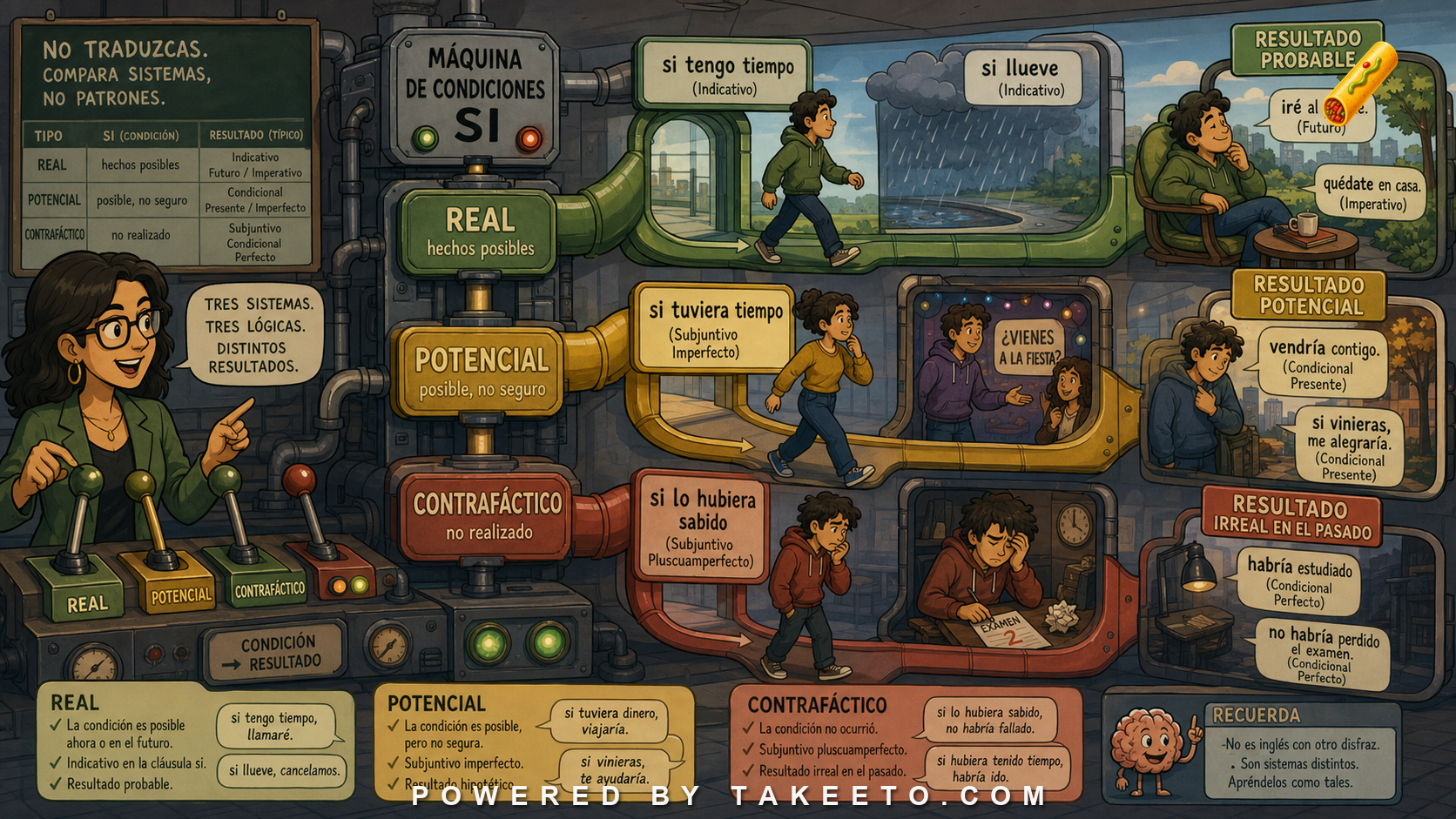
Si clauses build possible worlds
A sentence with si does not merely attach one event to another. It builds a conditional world: if this is true, then that follows.
Spanish marks different kinds of conditional worlds with different verb patterns.
Compare:
Si tengo tiempo, voy.
If I have time, I will go / I go.
Si tuviera tiempo, iría.
If I had time, I would go.
Si hubiera tenido tiempo, habría ido.
If I had had time, I would have gone.
These are not interchangeable. They place the condition at different distances from reality.
The key principle is:
Spanish si clauses distinguish open conditions, hypothetical conditions, and counterfactual conditions through tense and mood patterns.
Once you see the pattern, Spanish conditionals become much less mysterious.
Real or open conditions: si + indicative
Use the indicative when the condition is open, real, possible, habitual, or treated as a practical possibility.
Si tengo tiempo, te llamo.
If I have time, I will call you.
Si llueve, nos quedamos en casa.
If it rains, we will stay home.
Si estudias, aprendes.
If you study, you learn.
The condition may or may not happen, but the speaker presents it as a real possibility, not as an imagined contrary-to-fact situation.
Common combinations:
si + present indicative → present, future, command, or ir a + infinitive
Examples:
Si puedes, ven mañana.
If you can, come tomorrow.
Si llega temprano, vamos a empezar.
If she arrives early, we are going to begin.
Si tienes dudas, pregúntame.
If you have questions, ask me.
Present subjunctive normally does not follow conditional si
A major learner mistake is using the present subjunctive after si because the condition feels uncertain.
Avoid:
Si tenga tiempo, voy.
Standard Spanish says:
Si tengo tiempo, voy.
This surprises learners because they associate the subjunctive with uncertainty. But si already marks the conditional relationship. In ordinary real conditions, Spanish uses the indicative.
There are special cases where si does not function as a normal conditional “if,” such as indirect questions:
No sé si tiene tiempo.
I do not know whether he has time.
Some regional or stylistic variation exists in certain subordinate environments, but the core learner rule is firm:
For standard real conditions, use si + indicative, not si + present subjunctive.
Hypothetical conditions: imperfect subjunctive + conditional
Use the imperfect subjunctive when the condition is hypothetical, unlikely, contrary to present reality, or imagined.
Si tuviera tiempo, iría.
If I had time, I would go.
Si vinieras mañana, podríamos hablar.
If you came tomorrow, we could talk.
Si fuera más fácil, todos lo harían.
If it were easier, everyone would do it.
The result clause often uses the conditional:
iría, podría, haría, sería, tendría
This pattern does not always mean impossible. It can also be polite, tentative, or imagined. But it does move the condition away from ordinary reality.
Past counterfactuals: pluperfect subjunctive + conditional perfect
For unreal past conditions, use the pluperfect subjunctive in the si clause.
Si lo hubiera sabido, habría venido.
If I had known, I would have come.
Si hubiéramos salido antes, no habríamos perdido el tren.
If we had left earlier, we would not have missed the train.
Si me lo hubieras dicho, te habría ayudado.
If you had told me, I would have helped you.
The condition did not happen. The result did not happen. The sentence reconstructs an unreal past.
The result clause often uses:
habría + participle
But Spanish can also use other result forms depending on region, register, and meaning.
Mixed conditionals
Not every conditional fits a neat textbook row. Sometimes the condition is past and the result is present.
Si hubiera estudiado medicina, ahora sería médico.
If I had studied medicine, I would be a doctor now.
Past unreal condition, present unreal result.
Or the condition is present and the result refers to the past:
Si fuera más responsable, no habría cometido ese error.
If he were more responsible, he would not have made that mistake.
The forms follow the logic of time and reality, not a memorized table alone.
Si llueve and si lloviera
Compare:
Si llueve, cancelamos el partido.
If it rains, we cancel the game.
This is an open practical condition.
Si lloviera, cancelaríamos el partido.
If it rained, we would cancel the game.
This sounds more hypothetical. The rain is less immediate, less assumed, or part of an imagined scenario.
Mood changes how close the condition feels to practical reality.
Si vinieras: invitation, hypothesis, or politeness
Si vinieras mañana, podríamos hablar con calma.
This can mean: “If you came tomorrow, we could talk calmly.” It may be a hypothetical suggestion rather than a statement that coming is unlikely. The imperfect subjunctive can create polite distance.
Compare:
Si vienes mañana, hablamos.
If you come tomorrow, we’ll talk.
This is more direct and open.
Another learner trap: future forms after si
English often says:
If it will rain tomorrow...
or at least allows learners to imagine future meaning inside the if-clause. Standard Spanish normally does not use the future indicative in ordinary open si conditions.
Avoid as a default:
Si lloverá mañana, cancelamos.
Use:
Si llueve mañana, cancelamos.
If it rains tomorrow, we cancel / will cancel.
The present indicative carries future reference because si supplies the conditional frame.
The future can appear after si when si means “whether,” not conditional “if”:
No sé si lloverá mañana.
I do not know whether it will rain tomorrow.
Here si introduces an indirect question. It is not setting a condition for a result. That is why the future is possible.
Compare the two uses:
Si tengo tiempo, voy.
If I have time, I’ll go.
No sé si tendré tiempo.
I don’t know whether I’ll have time.
This distinction prevents two common errors at once: si tenga in open conditions, and si tendré where Spanish wants si tengo.
Hypothetical does not always mean impossible
The imperfect subjunctive in si tuviera often signals distance, but distance is not the same as impossibility.
Si pudieras venir mañana, sería ideal.
If you could come tomorrow, that would be ideal.
The speaker may think it is quite possible. The form makes the suggestion more tentative or polite. Likewise:
Si quisieras revisar el documento, te lo agradecería.
If you were willing to review the document, I would appreciate it.
This is not necessarily pessimistic. It is socially softened. Textbook labels like “unreal” are helpful for counterfactuals, but many real uses of the imperfect subjunctive are about politeness, imagination, or reduced pressure.
Example bank walkthrough
si tengo tiempo
Open condition. Use indicative.
Learner action: do not use present subjunctive after ordinary conditional si.
si tuviera tiempo
Hypothetical or contrary-to-fact present condition.
Learner action: pair naturally with conditional forms like iría or podría.
si hubiera tenido tiempo
Past counterfactual condition.
Learner action: expect a result like habría ido.
si llueve
Real possibility.
Learner action: use for practical planning.
si vinieras
Hypothetical, polite, or imagined condition.
Learner action: feel the distance from direct reality.
si lo hubiera sabido
Unreal past condition.
Learner action: learn as a common regret frame.
Conditional decision routine
Ask:
- Is the condition open and practical?
- Is it habitual or generally true?
- Is it imagined or less likely?
- Is it contrary to current reality?
- Is it contrary to past reality?
- Does the result belong to present, future, or past time?
Then choose:
- Open: si + indicative.
- Hypothetical: si + imperfect subjunctive, result often conditional.
- Past counterfactual: si + pluperfect subjunctive, result often conditional perfect.
Suggested interactive module: conditional probability grid
A strong tool for this article would place conditions on a grid of time and reality.
Suggested functions:
- Reality slider: open → hypothetical → counterfactual.
- Time selector: present/future, past, mixed.
- Form builder: si tengo, si tuviera, si hubiera tenido.
- Result builder: voy, iría, habría ido.
- Error warning: blocks si tenga for standard conditional use.
- Translation comparison: if I have, if I had, if I had had.
- Scenario prompts: weather, invitations, regrets, advice.
Final rule
Spanish si clauses do not take the subjunctive merely because something is uncertain.
Use si + indicative for real or open conditions. Use the imperfect subjunctive for hypothetical conditions. Use the pluperfect subjunctive for unreal past conditions.
The grammar is not about “if equals subjunctive.” It is about how close the condition is to reality.