
Sound change makes vocabulary less random
A learner compares Spanish with Latin, Portuguese, Italian, or French and sees patterns:
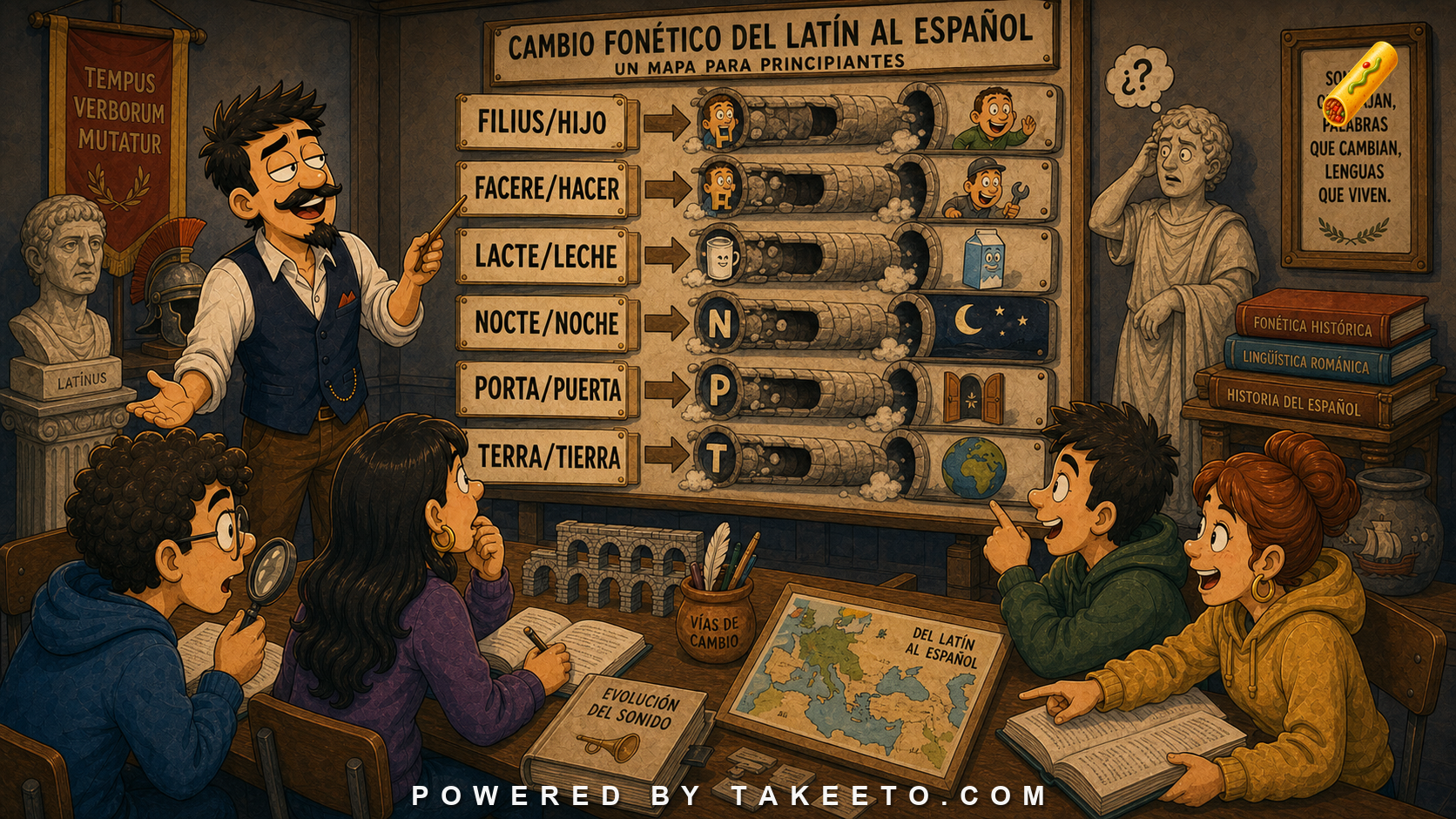
Latin facere → Spanish hacer
Latin filius → Spanish hijo
Latin lacte → Spanish leche
Latin nocte → Spanish noche
Latin porta → Spanish puerta
Latin terra → Spanish tierra
At first these changes look mysterious. But historical sound change is not random. It follows patterns, though the visible result may be obscured by analogy, borrowing, spelling, dialect, learned forms, and later standardization.
The key principle is:
Historical sound change can help learners see why Spanish words look the way they do, but it should be used as a map, not as a mechanical word generator.
This article gives a first map, not a full course in Romance phonology.
Latin f- and Spanish h-
One famous Spanish development is Latin initial f- becoming Spanish written h- in many inherited words, especially before vowels.
Examples:
facere → hacer
filius → hijo
ferrum → hierro
farina → harina
The modern h is silent in standard Spanish. The spelling preserves history. Related Romance languages may keep a more visible f: Portuguese fazer, Italian fare, French faire.
But there are exceptions and learned forms:
familia
forma
fácil
fiebre
Many such words are learned borrowings, later developments, or affected by different phonological conditions. The rule is useful, not universal.
Diphthongization: e and o become ie and ue
Stressed Latin short vowels often developed into Spanish diphthongs.
Examples:
terra → tierra
porta → puerta
bonum → bueno
septem → siete
This helps explain pairs inside Spanish too:
tener / tiene
poder / puede
dormir / duerme
Modern verb alternations are not identical to historical Latin changes in every detail, but the pattern of stressed vowel change is part of Spanish structure.
Learner action: see ie and ue not as irregular decoration but as deep Spanish patterns.
Palatalization: consonants move toward ch, ll, ñ, j
Latin consonant clusters often changed when sounds were pulled toward the palate.
Examples:
lacte → leche
nocte → noche
multum → mucho
The cluster -ct- often became ch in inherited Spanish words. Compare Portuguese noite and Italian notte for the same historical family.
Other palatal developments help explain ñ, ll, j, and related spellings, though each has its own history.
Learner action: when Spanish has ch where another Romance language has ct, suspect inherited sound change.
Consonant simplification and voicing
Latin consonants between vowels often changed, softened, voiced, or disappeared. Clusters simplified. Final sounds weakened. These changes explain why inherited words may look shorter or softer than Latin.
Examples:
Latin vita relates to Spanish vida
Latin lupum relates to Spanish lobo
Latin rotam relates to Spanish rueda through a more complex path
Learners should not memorize every change at first. The main lesson is that ordinary words are shaped by speech over time.
Learned words interrupt the pattern
If Spanish had only inherited words, sound-change patterns would be cleaner. But Spanish repeatedly borrowed from Latin and other languages. Learned words often preserve older-looking forms.
Compare:
hecho / facto
lleno / pleno
derecho / directo
leche / lácteo
Leche is inherited; lácteo is learned. Both relate to Latin milk vocabulary, but they entered Spanish through different routes. This is why historical phonology and doublets belong together.
Romance comparison sharpens the eye
Compare:
Spanish noche
Portuguese noite
Italian notte
French nuit
All descend from Latin nocte, but each language changed differently. Comparison helps learners stop treating Spanish forms as arbitrary.
Another set:
Spanish hacer
Portuguese fazer
Italian fare
French faire
The Spanish h is not random. It is a historical trace.
Do not overuse history in production
Historical knowledge helps recognition, spelling memory, cognates, and curiosity. It does not let you invent modern Spanish freely. Not every Latin word became a Spanish word. Not every sound change applies to learned borrowings. Not every cognate means what you expect.
Use history as explanation after evidence, not as a shortcut before learning.
Example bank walkthrough
filius / hijo
Latin initial f- and later developments help explain Spanish hijo.
Learner action: compare Portuguese filho and Italian figlio.
facere / hacer
Classic f- to h- example.
Learner action: connect with hecho, haces, hizo, while noting irregular verb history.
lacte / leche
Latin -ct- becomes Spanish ch in this inherited word.
Learner action: compare lácteo as a learned related word.
nocte / noche
Another -ct- to ch example.
Learner action: compare Portuguese noite, Italian notte, French nuit.
porta / puerta
Diphthongization of stressed vowel.
Learner action: connect with puerto and port- learned/international words cautiously.
terra / tierra
Diphthongization and spelling development.
Learner action: compare terrestre as learned-looking related vocabulary.
Remediation notes: sound change helps recognition, not improvisation
The main repair is to keep historical phonology from becoming a word-invention machine. Latin-to-Spanish sound changes explain many forms, but learners should not use them to invent modern Spanish words. They are recognition tools, spelling-memory tools, and cognate-analysis tools.
The famous f- > h- pattern is useful: Latin facere helps explain Spanish hacer, and filius helps explain hijo through historical stages. But not every Spanish h comes from Latin f, not every Latin f disappeared, and learned words can preserve f: forma, familia, fama, formal, factor. A learner should say “this is a common historical pattern,” not “f always becomes h.”
Diphthongization also needs boundaries. Stressed Latin short e and o often correspond to Spanish ie and ue in inherited words: terra > tierra, porta > puerta. But stress, word class, analogy, and learned borrowing matter. Related word families may alternate: tierra / terrestre, puerta / portal, bueno / bondad. These alternations are gold for vocabulary learning.
Palatalization is another useful map, not a universal rule. Forms like lacte > leche and nocte > noche help explain why Spanish may differ sharply from Portuguese leite/noite, French lait/nuit, or Italian latte/notte. Romance comparison shows that languages changed in different directions from shared Latin material.
Production target: use history after you have a real word. When you learn hecho, connect it to hacer and perhaps to Latin-related facto in de facto. When you learn noche, compare nocturno. When you learn lleno, compare pleno. Do not invent forms. Let historical knowledge strengthen memory and reading.
Suggested interactive module: Latin-to-Spanish sound-change explorer
A strong tool for this article would visualize major changes with caveats.
Suggested functions:
- Change cards: f- > h-, -ct- > ch, e/o > ie/ue, consonant voicing.
- Cognate comparison: Spanish, Portuguese, Italian, French.
- Inherited vs learned label: leche/lácteo, hecho/facto.
- Exception warning: learned forms, analogy, dialect, uncertain paths.
- Spelling memory mode: silent h, ch, ie/ue.
- Timeline view: Latin source, medieval forms, modern word.
Final rule
Spanish sound change is regular enough to explain many forms, but complex enough to punish overconfidence.
Use history to see patterns: hacer, hijo, leche, noche, puerta, tierra. Then learn modern words as modern words.