
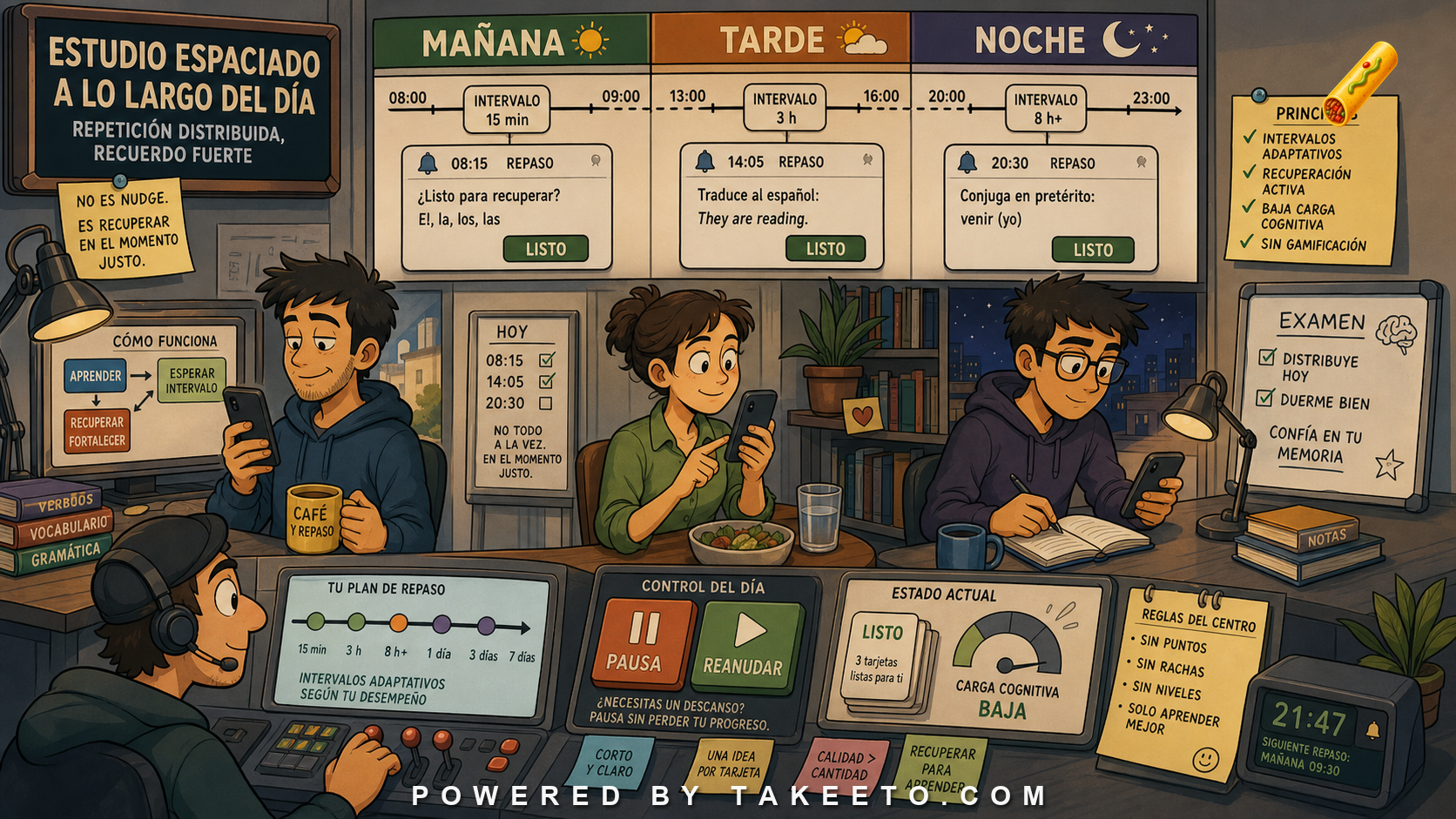
A notification should not be a guilt machine
Language apps often use notifications as pressure:
Keep your streak.
Don't lose your progress.
Study now.
Come back.
That may create engagement, but engagement is not the same as learning. A serious Spanish system should notify because the timing supports memory, not because the app wants attention.
The key principle:
Notifications should serve spaced retrieval, learner agency, and respect for interruption cost.
A good notification appears when study is pedagogically useful and the learner has agreed to be interrupted.
Spacing is about memory, not vibes
Spaced study works because retrieval after time has passed is harder and more useful than immediate repetition. The learner partially forgets, then reconstructs the form.
Example:
Morning passage:
pedir ayuda / preguntar la hora
Midday review:
Which verb means ask for something?
Evening exam:
I asked for help. → Pedí ayuda.
The intervals make the learner retrieve, not merely reread.
Ready cards should drive timing
A card is “ready” when it is due for review based on previous performance and interval. Notifications should align with ready items.
Bad:
Notify every hour because engagement metrics look good.
Better:
Notify when a meaningful batch of items is ready and the learner's quiet hours allow it.
The system should avoid notifications when there is nothing useful to review. It should also avoid dumping too many items at once.
Learner agency matters
A respectful notification system gives control:
- choose study windows,
- pause notifications,
- resume later,
- mute during work/school/sleep,
- set maximum notifications per day,
- choose review intensity,
- skip without shame,
- recover missed reviews intelligently.
A learner is not a lab rat. Memory design must live inside real life.
Interruption cost is real
A notification can break concentration, work, driving, conversation, or rest. Even a useful learning prompt has a cost.
Therefore, notifications should be:
- infrequent enough to be respected,
- clear about task size,
- easy to defer,
- tied to due review,
- never manipulative,
- never framed as personal failure.
Example good notification:
6 Spanish items are ready for review. About 3 minutes.
This tells the learner what will happen.
Across-day study can be light but effective
Spaced study does not require long sessions every time. A day might include:
Morning:
Read one short passage and listen to slow audio.
Midday:
Review 8 ready cards.
Afternoon:
Listen to natural audio once.
Evening:
Take a 5-minute mixed exam.
Before sleep:
Recheck missed items only.
The system distributes retrieval. It does not demand constant attention.
Notifications should connect to post-session review
After a study session, the system knows which items were easy, hard, missed, or confused. Notifications should respond to that data.
If the learner missed aún/aun, the next notification should not merely say “study Spanish.” It can point to a small due task:
Your aún/aun contrast is ready for review.
But this should be used carefully. Too much specificity may feel intrusive or cluttered. The learner should be able to choose notification detail level.
No gamification required
Learning can be motivating without streak pressure, cartoon rewards, or artificial scarcity.
Serious motivation can come from:
- visible improvement,
- clear next tasks,
- honest feedback,
- useful passages,
- meaningful exams,
- respectful reminders,
- printable artifacts,
- better comprehension.
Gamification is not automatically bad. But a serious Spanish learner should not need emotional manipulation to review due items.
Spacing should adapt after mistakes
Not all due items deserve the same next interval. If a learner retrieves plazo instantly three times, the interval can grow. If they confuse pedir and preguntar, the system should shorten the interval and route the item into contrastive review. If the learner recognizes an item but fails reverse translation, the next task should target production.
This makes notifications more intelligent. The message is not merely “study now.” It is “this kind of review is ready because this item behaved this way last time.” Learners do not need to see all scheduling math, but they should feel the system is responsive.
A respectful product can also explain in simple language: You missed this item yesterday, so it is back for a short review. That transparency turns spaced repetition from a black box into a learning partnership.
Example bank walkthrough
interval
Time gap between reviews.
Learner action: allow some forgetting before review.
notification
Prompt to return.
Learner action: use notifications that match your study windows.
retrieval
Active memory pull.
Learner action: answer before looking.
spacing
Distributed practice.
Learner action: study across time, not only in one block.
ready card
An item due for review.
Learner action: prioritize ready cards over random browsing.
pause
Temporary stop.
Learner action: pause during overload without guilt.
resume
Return after pause.
Learner action: let the system rebuild intervals.
exam
Structured retrieval after study.
Learner action: use short exams as consolidation.
Recovery after missed reviews
Real learners miss sessions. A respectful spaced system should recover intelligently rather than punish.
If reviews are missed for one day, the system can offer a small catch-up batch. If reviews are missed for two weeks, dumping every overdue item at once is counterproductive. Better recovery:
- Prioritize high-value and recently missed items.
- Reduce batch size.
- Reintroduce difficult items through passages.
- Reset intervals after successful retrieval.
- Let the learner choose a restart pace.
The message should be practical, not moralizing. Missed study is a scheduling problem to solve, not a character flaw.
Remediation notes: notifications should serve memory, agency, and recovery
The central repair is to make notification design ethically specific. A notification is justified when it helps the learner retrieve at a useful time. It is not justified merely because it increases opens. Serious Spanish study should not rely on guilt, streak anxiety, or artificial urgency.
Spacing is not magic timing. A card being “ready” means the system estimates that retrieval now may be useful. The learner still has a life. Notifications should respect quiet hours, work schedules, sleep, time zones, disability needs, and temporary overload. A learner should be able to pause without being punished by a giant backlog or shame message.
Batch size matters. A phone notification should not imply a 40-minute obligation unless the learner chose that. Good options might be one ready item, three-minute review, five-card batch, or post-session exam. The notification should say what kind of action is being requested: recognize, recall, listen, or finish a short exam. Vague prompts such as “Keep your streak alive!” are motivational noise, not pedagogy.
Recovery design is part of learning design. After missed days, the system should triage rather than flood. It can prioritize recently learned high-value items, known trouble spots, and items due soon, while deferring low-risk review. It can offer a restart plan: small catch-up, normal pace, or temporary light mode. This respects memory and prevents avoidance.
Notifications also need privacy care. A lock-screen message should not expose sensitive study content if the learner studies immigration, medical, legal, workplace, or personal topics. “Spanish review ready” may be safer than displaying a specific sentence.
Production target: design notifications with five controls: study windows, quiet hours, batch size, pause/resume, and privacy level. Then tie each notification to a memory reason. If there is no retrieval reason, do not send it. The learner should feel invited back to Spanish, not hunted by the app.
Suggested interactive module: study-session interval timeline
A strong tool for this article would show review timing across a day.
Suggested functions:
- Due-item queue: cards ready now, soon, later.
- Notification scheduler: learner-defined study windows.
- Batch size control: 3-minute, 5-minute, 10-minute sessions.
- Pause/resume: stop without destroying scheduling.
- Post-session exam: immediate consolidation after study.
- Missed-item review: small follow-up prompts.
- Interruption guard: quiet hours and maximum notifications.
- No-streak mode: progress without pressure mechanics.
Final rule
Notifications should exist for memory, not manipulation.
Use them to support spaced retrieval when items are ready, while respecting learner agency and interruption cost. A serious Spanish system helps the learner return at the right time without turning study into a guilt game.