
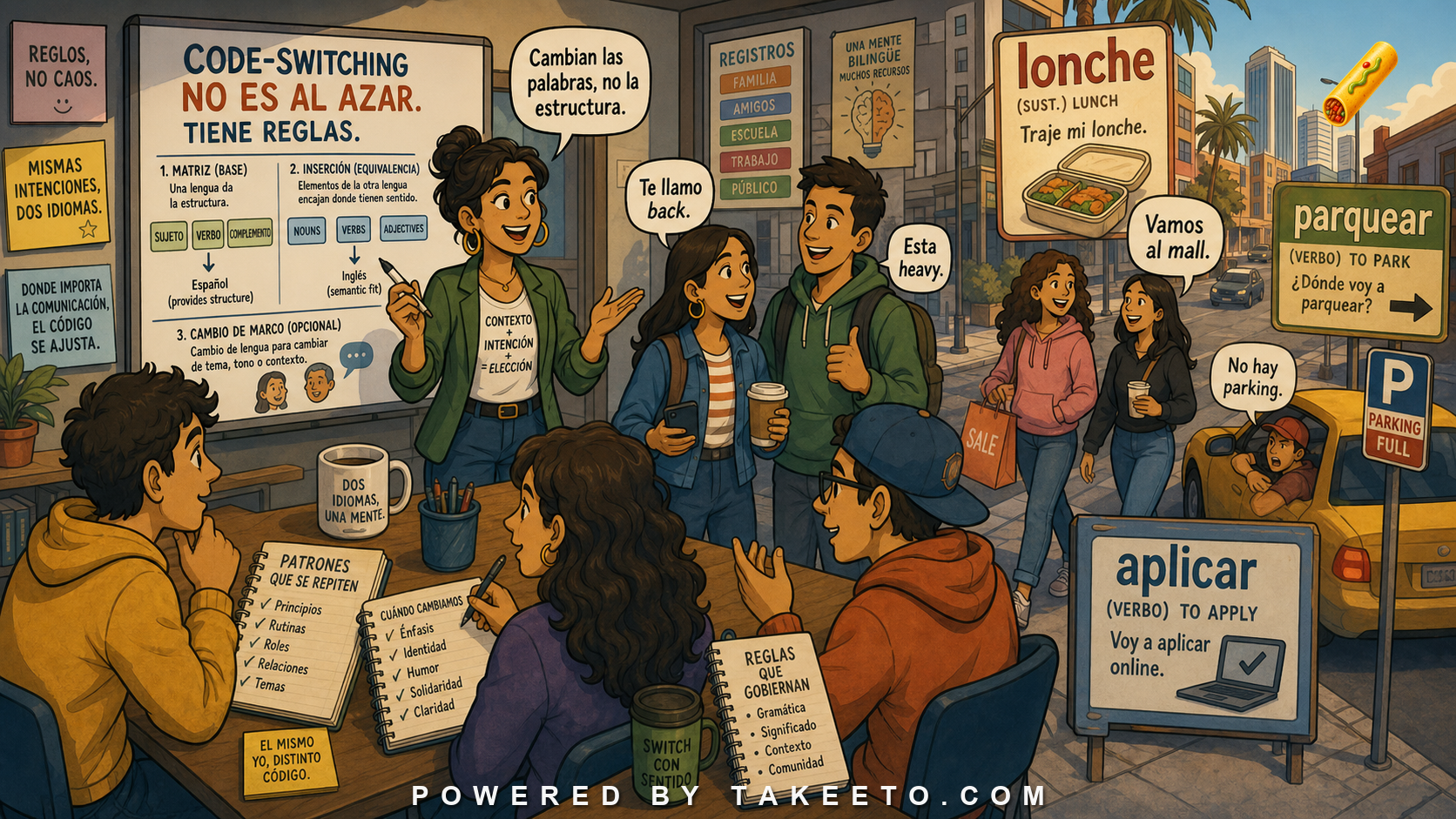
Bilingual speech is not linguistic confusion
The word Spanglish is used in many ways. Some people use it affectionately for Spanish-English bilingual speech. Some use it as an insult. Some use it for borrowed words, some for code-switching, some for calques, and some for any Spanish touched by English. That looseness creates confusion.
A serious learner needs sharper categories. Spanish-English contact includes borrowing, calquing, code-switching, translationese, bilingual discourse markers, local slang, and community norms. These are not the same phenomenon.
The key principle is:
Spanish-English bilingual speech is often systematic, socially meaningful, and grammatically constrained.
A speaker who says te llamo back is not necessarily unable to say te devuelvo la llamada. They may be using a bilingual community style. A speaker who says parquear may be using an established local loan verb. A speaker who says aplicar para un trabajo may be using an English-influenced calque that has spread in some communities but remains stigmatized or restricted in others.
Borrowing: when a word joins the language
Borrowing happens when a word from one language becomes part of another language’s speech community. Borrowed words may be adapted to Spanish phonology, morphology, and spelling.
Examples:
lonche
lunch, especially in some U.S. Spanish and Mexican-border contexts
parquear
to park, common in many American varieties
troca
truck, in some U.S./northern Mexican contexts
A borrowed verb like parquear behaves like a Spanish -ear verb: parqueo, parqueaste, parqueamos. That is not random mixing. It is Spanish morphology doing its work on borrowed material.
Learner action: identify whether a contact word is local, widespread, formal, informal, stigmatized, or accepted in the setting you need.
Calques: translating the structure
A calque copies a meaning or structure from another language.
Examples:
llamar para atrás
from “call back,” used in some bilingual communities
aplicar para un trabajo
from “apply for a job,” instead of more traditional postularse a, solicitar, or presentar una solicitud depending on country
tener un buen tiempo
from “have a good time,” where many contexts prefer pasarlo bien
Calques can become normal in a community. They can also sound like translation errors outside it. The question is not simply “Is this Spanish?” The better questions are: Where is it used? Who uses it? In what register? Will it be accepted in formal writing?
Code-switching: changing languages inside discourse
Code-switching occurs when bilingual speakers alternate between languages within a conversation, sentence, or discourse stretch.
Examples:
Te llamo back.
I’ll call you back.
Está heavy.
It’s intense/heavy.
Vamos al mall.
Let’s go to the mall.
The grammar is not chaos. Speakers usually switch at points that fit the structures available to them. In many bilingual communities, switching indexes identity, intimacy, topic, humor, efficiency, quotation, emphasis, or group membership.
A bilingual speaker may switch because one word is more available, because the topic belongs to a certain language domain, because the listener shares the code, or because the switch itself creates social meaning.
Translanguaging and repertoire
Some educators use translanguaging to describe how bilingual speakers use their full linguistic repertoire rather than keeping named languages in sealed boxes. This term is useful when the focus is classroom practice, identity, and flexible meaning-making. It does not erase the need to learn standard registers. It simply reminds us that real bilingual speakers do not always experience their linguistic resources as two separate classroom subjects.
A bilingual student may brainstorm in English, interview relatives in Spanish, quote a grandmother in regional Spanish, and write a formal essay in standard academic Spanish. A good curriculum can use that whole repertoire while still teaching genre control.
Stigma is social, not purely grammatical
The same feature can be heard as cool, lazy, authentic, uneducated, urban, funny, bilingual, or professional depending on who says it and where. That is how language ideology works.
A white monolingual learner using Spanglish for performance is not socially equivalent to a heritage speaker using community bilingual speech at home. A public-health flyer with clumsy translationese is not the same as a bilingual teenager switching naturally with friends. A formal legal notice should not rely on casual bilingual mixing.
Learner action: treat bilingual speech as legitimate, but do not use “legitimate” as an excuse to ignore audience and register.
Code-switching competence is not incomplete Spanish
Some fluent bilinguals code-switch frequently. Some avoid it in formal contexts. Some can switch styles with precision. Some speakers with limited Spanish also mix because of gaps. The behavior alone does not tell you the speaker’s competence.
You must look at control. Can the speaker maintain Spanish when the context requires it? Can they interpret for a monolingual Spanish-speaking relative? Can they write a formal Spanish email? Can they switch to English with a supervisor? Can they explain why one phrase feels community-based and another feels institutional?
The more control a speaker has, the less code-switching should be treated as deficiency.
Example bank walkthrough
lonche
A loanword from English lunch, used in some bilingual communities.
Learner action: know it as community vocabulary, but learn almuerzo and regional alternatives too.
parquear
A Spanish-adapted verb from English park.
Learner action: compare with estacionar, aparcar, and local norms.
aplicar
May be used under English influence for applying to jobs or programs.
Learner action: in formal international Spanish, consider solicitar, postularse, or presentar una solicitud.
te llamo back
An intra-sentential switch with Spanish object pronoun and English particle/adverb.
Learner action: recognize bilingual grammar; also know te devuelvo la llamada.
está heavy
English adjective inserted into Spanish frame.
Learner action: understand the social tone; do not use it in formal writing.
vamos al mall
English noun inside Spanish phrase with Spanish contraction al.
Learner action: compare with centro comercial, plaza, or local terms.
Remediation notes: name the contact type before judging it
The strongest repair for this article is to force a distinction before evaluation. A mixed-looking form may be an established loan, a one-time borrowing, a calque, a discourse switch, an identity marker, a joke, a family norm, or learner avoidance. Those are different phenomena.
Lonche and parquear can be community lexical items in some regions. They may be stigmatized in other settings, but they are not random mistakes. Aplicar for “apply for a job or program” may be a contact-influenced extension in U.S. contexts, but in careful international Spanish a learner often needs solicitar, postularse a, or presentar una solicitud depending on country and institution. Te llamo back is a bilingual discourse choice; it should not be taught as a neutral formal Spanish sentence. Está heavy may work as community youth speech or bilingual stance, not as a general replacement for está fuerte, está difícil, es intenso, or es grave.
Code-switching also needs a syntax repair. Bilingual speakers usually switch where the two languages can fit together in real-time discourse; fluent code-switching is not just throwing words together. A learner should not use this fact to imitate a community they do not belong to, but it matters because it breaks the lazy idea that bilingual speakers are confused.
Social function matters. Switching can quote someone, mark intimacy, soften a statement, create humor, signal neighborhood identity, discuss institutions, or manage vocabulary gaps. The same surface mix can therefore carry different meanings. Vamos al mall may simply name a local place category; it may also index U.S. Latino community speech. In a formal notice, however, centro comercial may be more appropriate.
Production target: for formal Spanish, choose stable Spanish alternatives. For analysis, label the type: borrowing, calque, code-switch, or register choice. For community interaction, listen first. Do not mock bilingual speech, and do not perform it clumsily to sound “authentic.”
Suggested interactive module: bilingual utterance annotator
A strong tool for this article would separate types of contact instead of labeling everything “Spanglish.”
Suggested functions:
- Contact type labels: borrowing, calque, code-switch, discourse marker, translationese.
- Morphology view: show Spanish endings on borrowed verbs: parquear, textear, chequear.
- Register warning: home, peer, community media, school, professional, legal/medical.
- Alternative generator: community phrase, neutral Spanish, formal Spanish, English equivalent.
- Speaker/audience mode: bilingual friend, monolingual relative, institution, classroom, public notice.
- Identity notes: mark when a switch performs humor, emphasis, solidarity, or quotation.
Final rule
Spanglish is not one thing, and code-switching is not random failure.
Separate borrowing, calque, code-switching, and translationese. Respect bilingual speech as grammar and identity. Then learn the register control to choose when bilingual mixing fits and when standard Spanish is required.