
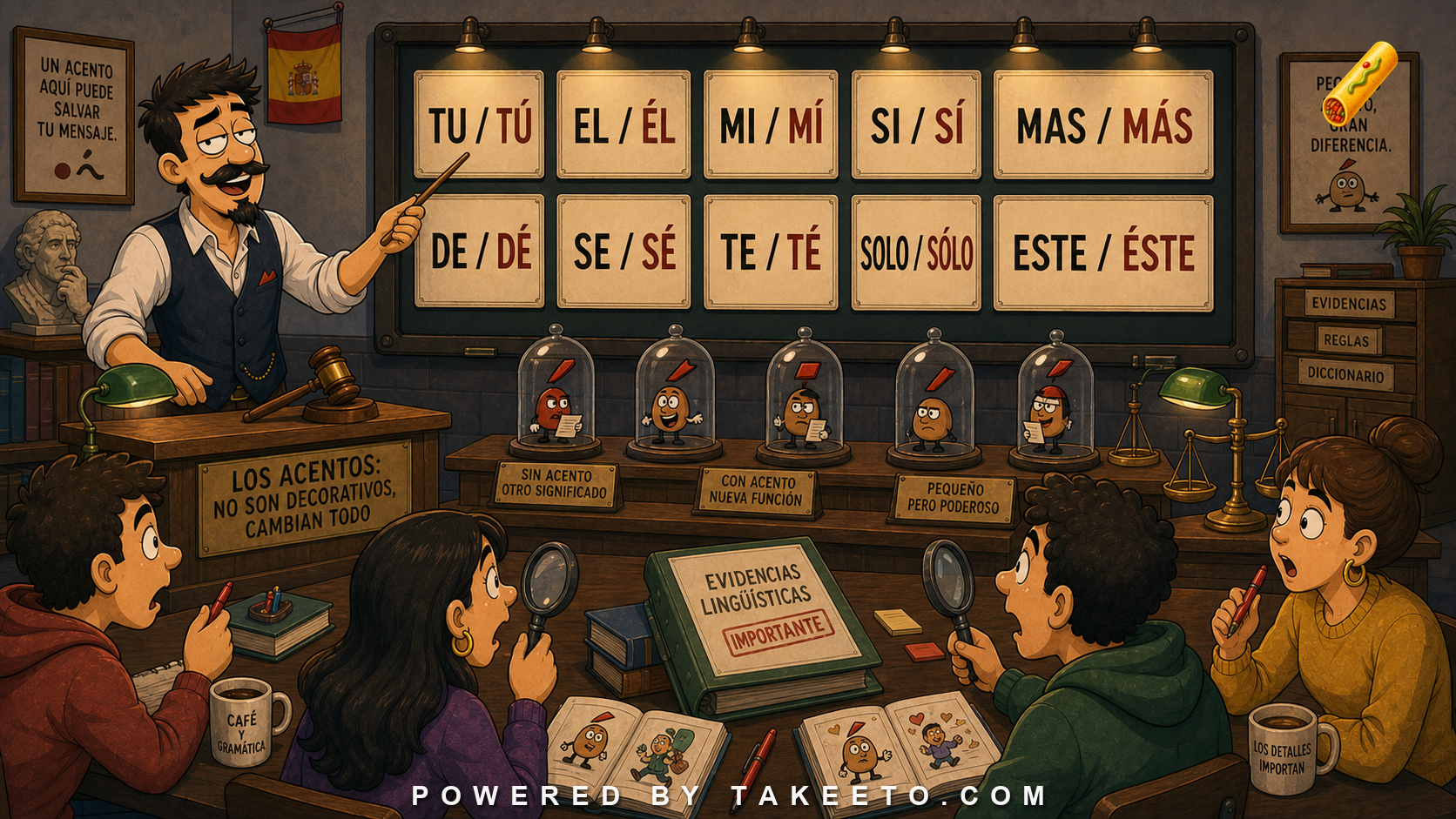
Not every accent mark is about stress prediction
A learner first learns that Spanish accent marks show stress.
That is true for words like café, teléfono, rápido, país. The accent mark tells the reader where stress falls, or how vowels divide into syllables.
Then the learner meets pairs like:
- tu / tú
- el / él
- mi / mí
- si / sí
- de / dé
- se / sé
- te / té
- mas / más
Now the explanation “accent marks show stress” is not enough. Both members of some pairs may be pronounced with similar stress behavior in context, and many are monosyllables. The accent mark is doing a different job: it is marking grammar.
This use is called the tilde diacrítica, the diacritical accent.
A practical rule:
Some Spanish accent marks distinguish grammatical words that would otherwise be written alike.
Why diacritical accents exist
Spanish generally does not write accent marks on monosyllables:
- fui
- fue
- vio
- dio
- ti
- fe
- sol
- pan
But Spanish makes exceptions when two short words share the same spelling and need to be distinguished by grammatical function.
The accent mark does not mean “say this louder” in a simple mechanical way. It means “this is the stressed or independent grammatical word, not the unstressed function word,” or in some cases “this is a different lexical item.”
The most important pairs are high-frequency and should be learned early.
Tú and tu
| Form | Function | Example |
|---|---|---|
| tu | possessive adjective: your | Tu libro está aquí. |
| tú | subject pronoun: you | Tú sabes la respuesta. |
Compare:
Tu casa es grande.
Your house is big.
Tú eres de Chile.
You are from Chile.
The accent distinguishes possession from person reference.
Do not write tú casa unless you mean something ungrammatical or are making a typo. The possessive is tu.
Él and el
| Form | Function | Example |
|---|---|---|
| el | definite article: the | El libro está en la mesa. |
| él | personal pronoun: he/him | Él llegó tarde. |
Compare:
El médico llamó.
The doctor called.
Él llamó.
He called.
The article el is unstressed and attaches to a noun phrase. The pronoun él stands as a noun phrase by itself.
Mí and mi
| Form | Function | Example |
|---|---|---|
| mi | possessive adjective: my | Mi hermana vive aquí. |
| mí | prepositional pronoun: me | Es para mí. |
Compare:
Mi café está frío.
My coffee is cold.
Este café es para mí.
This coffee is for me.
The word mí is used after prepositions: para mí, de mí, sin mí, por mí. But ti does not take an accent because there is no competing ti/tí pair in modern standard spelling.
Sí and si
| Form | Function | Example |
|---|---|---|
| si | if | Si vienes, comemos. |
| sí | yes; also reflexive pronoun after preposition in certain forms | Sí, quiero. / Lo hizo por sí mismo. |
Compare:
Si estudias, aprendes.
If you study, you learn.
Sí, estudio todos los días.
Yes, I study every day.
This is one of the most important contrasts in reading. A missing accent can change a conditional into an affirmation.
Té and te
| Form | Function | Example |
|---|---|---|
| te | object/reflexive pronoun | Te llamo mañana. |
| té | tea | Quiero té. |
Compare:
Te preparo café.
I’ll make you coffee.
Preparo té.
I’m making tea.
Here the contrast is lexical: pronoun versus noun.
Dé and de
| Form | Function | Example |
|---|---|---|
| de | of, from | Soy de Perú. |
| dé | form of dar | Espero que me dé una respuesta. |
Compare:
El libro de Ana está aquí.
Ana’s book is here.
Quiero que Ana me dé el libro.
I want Ana to give me the book.
The accent distinguishes a preposition from a verb form.
Sé and se
| Form | Function | Example |
|---|---|---|
| se | reflexive, impersonal, passive, pronominal, indirect-object replacement marker | Se llama Ana. / Se venden casas. |
| sé | I know; command form of ser | Sé la respuesta. / Sé amable. |
Compare:
Se fue temprano.
He/She left early.
Sé la verdad.
I know the truth.
Sé paciente.
Be patient.
This pair matters because se is one of the busiest words in Spanish. The accent on sé protects two high-frequency verb forms.
Más and mas
| Form | Function | Example |
|---|---|---|
| más | more, plus | Quiero más tiempo. |
| mas | but, literary or formal; equivalent to pero in limited use | Quiso ayudar, mas no pudo. |
In contemporary everyday Spanish, mas without accent is much less common than más. Many learners will rarely need to write mas, but they must recognize it in literary, formal, or older texts.
Compare:
Quiero más café.
I want more coffee.
Quiso venir, mas estaba enfermo.
He wanted to come, but he was sick.
Solo and demonstratives: the modern complication
Older teaching often said:
- sólo = only
- solo = alone
- éste/ése/aquél = pronouns
- este/ese/aquel = determiners before nouns
Modern standard guidance is more restrained. The general recommendation is to write solo and demonstratives este, ese, aquel without accents in ordinary cases. Accent marks may be used optionally in cases of real ambiguity, depending on the writer’s judgment and formal guidance, but they are not a routine requirement.
This means learners should not memorize “pronoun = accent” as a current universal rule.
Compare:
Trabajo solo los domingos.
I work alone on Sundays. / I work only on Sundays, depending on context.
If ambiguity truly matters, the best solution is often rewriting:
Trabajo solamente los domingos.
I work only on Sundays.
Trabajo sin compañía los domingos.
I work alone on Sundays.
For demonstratives:
Este libro es mío.
This book is mine.
Este es mío.
This one is mine.
Current neutral practice writes both este forms without accent unless a specific ambiguity justifies otherwise.
Interrogatives are another grammar-accent system
Words like qué, quién, cuándo, cómo, dónde, cuál, cuánto take accents in direct and indirect questions or exclamations:
- ¿Qué quieres?
- No sé qué quieres.
- ¿Cómo estás?
- Dime cómo lo hiciste.
- ¡Qué bonito!
They are contrasted with unaccented relatives and conjunctions:
- el libro que compré
- cuando llegue
- como quieras
- donde vivo
This article focuses on classic diacritical pairs, but learners should notice the bigger principle: accent marks often mark grammatical function.
Editing checklist
When editing Spanish, check these pairs deliberately:
| Check | Question |
|---|---|
| tu/tú | Is it possessive or a pronoun? |
| el/él | Article before noun or personal pronoun? |
| mi/mí | Possessive or after a preposition? |
| si/sí | Conditional if or yes/reflexive pronoun? |
| te/té | Pronoun or beverage? |
| de/dé | Preposition or dar form? |
| se/sé | se-marker or saber/ser form? |
| mas/más | but or more? |
| solo/sólo | Is accent needed under current norms? Usually no. |
| este/éste | Is accent needed under current norms? Usually no. |
Common learner mistakes
Mistake 1: Accent every pronoun-like word
Not all pronouns take accents. Ti has no accent. Modern demonstrative pronouns usually have no accent.
Mistake 2: Forgetting accents in high-frequency contrasts
Tu and tú are not interchangeable. El and él are not interchangeable.
Mistake 3: Treating accents as pronunciation only
The difference between de and dé is grammatical.
Mistake 4: Overusing obsolete school rules for solo and demonstratives
Be aware of modern guidance and the role of ambiguity.
Mistake 5: Relying on autocorrect
Autocorrect may not know your intended grammar. Si and sí can both be valid words.
Suggested interactive module: homograph contrast table
A useful tool for this article would present sentence pairs and ask users to choose the correct form.
Suggested functions:
- Pair cards: tu/tú, el/él, mi/mí, si/sí, te/té, de/dé, se/sé, mas/más.
- Sentence disambiguation: choose the right form from context.
- Modern norm alert: solo and demonstratives.
- Rewrite suggestion: solve ambiguity by rephrasing instead of relying on optional accents.
- Interrogative extension: que/qué, como/cómo, cuando/cuándo.
Example input:
___ quieres venir, dime que sí.
Possible output:
- Correct: Si quieres venir, dime que sí.
- First word: si = if
- Final word: sí = yes
Final rule
Spanish accent marks do not only tell you where to stress a word. They can also tell you what grammatical word you are reading.
Learn the high-frequency diacritical pairs as grammar, not as decoration. Then treat newer norm-sensitive cases such as solo and demonstratives with care rather than old slogans.
A missing accent may be a spelling error. It may also be a grammar error.