
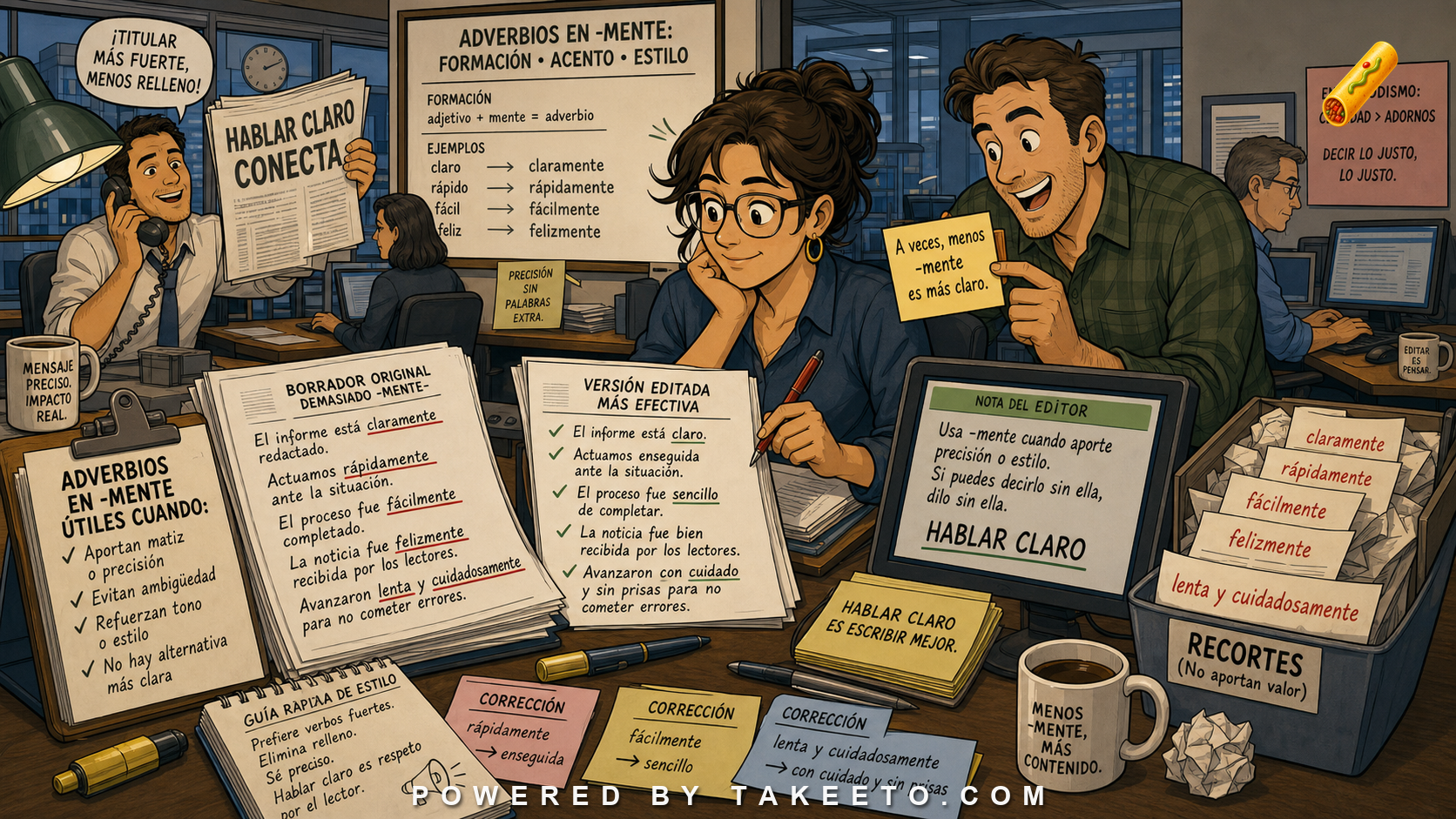
-mente adverbs are easy to form and easy to overuse
Spanish -mente adverbs often correspond to English -ly adverbs:
clara → claramente
clear → clearly
rápida → rápidamente
quick → quickly
fácil → fácilmente
easy → easily
This looks straightforward, and in many cases it is. But learners need to know four things:
- -mente is added to the feminine singular adjective form when that form exists.
- Accent marks are preserved from the adjective base.
- In coordinated adverbs, Spanish often uses -mente only on the last item.
- Too many -mente adverbs can make prose heavy.
The practical rule:
Form -mente adverbs carefully, then ask whether Spanish actually wants one.
Formation from the feminine adjective
For adjectives with masculine and feminine forms, use the feminine singular form plus -mente.
claro → clara → claramente
clear → clearly
lento → lenta → lentamente
slow → slowly
cuidadoso → cuidadosa → cuidadosamente
careful → carefully
perfecto → perfecta → perfectamente
perfect → perfectly
Why feminine? Historically, mente was a feminine noun meaning “mind” or “manner,” and the adjective agreed with it. Modern speakers do not usually analyze the word that way, but the formation rule remains.
| Adjective | Feminine base | Adverb |
|---|---|---|
| claro | clara | claramente |
| rápido | rápida | rápidamente |
| lento | lenta | lentamente |
| cuidadoso | cuidadosa | cuidadosamente |
| exacto | exacta | exactamente |
For adjectives that already have one form for both genders, add -mente directly:
fácil → fácilmente
feliz → felizmente
constante → constantemente
probable → probablemente
Accent preservation
Adverbs in -mente preserve the written accent of the adjective if the adjective has one.
rápido → rápidamente
fácil → fácilmente
cortés → cortésmente
If the adjective has no accent, the adverb normally has no accent:
claro → claramente
lento → lentamente
feliz → felizmente
This is unusual because -mente adverbs have two stressed elements in pronunciation: one on the adjective base and one on men. But in spelling, only the adjective’s original accent is preserved if it had one.
Compare:
rápida → rápidamente
The accent remains.
libre → libremente
No accent appears.
Do not write:
felízmente
because feliz has no written accent under ordinary rules.
Coordinated adverbs: lenta y cuidadosamente
When two or more -mente adverbs are coordinated, Spanish often keeps -mente only on the last one.
lenta y cuidadosamente
slowly and carefully
clara, precisa y brevemente
clearly, precisely, and briefly
The earlier adjectives appear in feminine singular form because they are understood with mente:
lenta y cuidadosamente
not:
lento y cuidadosamente
However, repeating -mente is also possible when emphasis, rhythm, or clarity calls for it:
lentamente y cuidadosamente
The shortened coordinated form is elegant and common in formal writing, but it can sound stiff if overused.
Adverbs modifying verbs, adjectives, and whole sentences
-Mente adverbs can modify verbs:
Respondió rápidamente.
He/she responded quickly.
They can modify adjectives:
Es profundamente injusto.
It is deeply unfair.
They can modify other adverbs:
Avanza sorprendentemente rápido.
It advances surprisingly fast.
They can comment on the whole sentence:
Lamentablemente, no pudimos asistir.
Unfortunately, we could not attend.
This flexibility makes them useful in formal and written Spanish. But usefulness can become overuse.
Style: when -mente becomes heavy
A sentence with one -mente adverb may be clear:
El informe explica claramente el problema.
A sentence with several may become bureaucratic:
El informe explica claramente, detalladamente y cuidadosamente el problema.
This is not automatically wrong, but it can feel heavy. Spanish often has alternatives:
El informe explica el problema con claridad y detalle.
or:
El informe explica el problema de forma clara y detallada.
Alternatives include:
| Heavy adverb | Possible alternative |
|---|---|
| claramente | con claridad |
| cuidadosamente | con cuidado |
| rápidamente | con rapidez / rápido in some contexts |
| frecuentemente | con frecuencia / a menudo |
| actualmente | en la actualidad, hoy, ahora depending on meaning |
Good style does not ban -mente. It uses it when it helps.
Adjective-adverb pairs without -mente
Spanish sometimes uses adjectives adverbially, especially in common expressions or colloquial style.
Habla claro.
Speak clearly.
Trabaja duro.
He/she works hard.
Corre rápido.
He/she runs fast.
These are not the same as full -mente adverbs in every register. Compare:
Habló claramente sobre el problema.
He/she spoke clearly about the problem.
Habló claro.
He/she spoke plainly/clearly, often more direct and idiomatic.
Trabajó duramente.
He/she worked harshly/hard, possible but may differ in tone.
Trabajó duro.
He/she worked hard.
Learners should not assume every English -ly requires Spanish -mente.
False friends and meaning traps
Some -mente adverbs resemble English adverbs but differ in usage.
actualmente
currently, not “actually” in most contexts
eventualmente
possibly/eventually depending on region and context, but not always equivalent to English “eventually”
finalmente
finally
realmente
really/actually
Example:
Actualmente vivo en Bogotá.
I currently live in Bogotá.
If you mean “actually,” often use:
en realidad
realmente
de hecho
depending on context.
Register and academic writing
Academic and formal Spanish often uses -mente adverbs for stance and organization:
teóricamente
theoretically
metodológicamente
methodologically
históricamente
historically
generalmente
generally
específicamente
specifically
These are not wrong. They are part of formal prose. But a paragraph packed with them may sound inflated. A strong writer varies adverbs, prepositional phrases, verbs, and sentence structure.
Compare:
El autor analiza históricamente el proceso y posteriormente explica detalladamente sus consecuencias.
Better, often:
El autor sitúa el proceso en su contexto histórico y luego explica sus consecuencias con detalle.
The second version uses stronger verbs and nouns instead of stacking adverbs.
Common learner errors
Error 1: Adding -mente to the masculine form
rápidomente
Correct:
rápidamente
Error 2: Dropping the adjective accent
rapidamente
Correct:
rápidamente
Error 3: Adding an accent where the adjective has none
felízmente
Correct:
felizmente
Error 4: Translating every English -ly mechanically
Speak clearly.
Possible:
Habla claramente.
Often more idiomatic as a command:
Habla claro.
Error 5: Overloading prose
Too many -mente adverbs can weaken style. Use alternatives such as con claridad, de forma rápida, a menudo, or a stronger verb.
Diagnostic workflow: form the adverb, then test whether it is stylistically needed
To build a -mente adverb, first find the adjective base.
If the adjective has masculine and feminine forms, use the feminine:
lento → lenta → lentamente
cuidadoso → cuidadosa → cuidadosamente
rápido → rápida → rápidamente
If the adjective has one form, add -mente directly:
fácil → fácilmente
constante → constantemente
feliz → felizmente
Then check the accent. The adverb keeps the accent if the adjective has one:
rápido → rápidamente
fácil → fácilmente
cortés → cortésmente
No adjective accent, no new written accent just because -mente is added:
normal → normalmente
feliz → felizmente
After spelling comes style. Ask whether the adverb is doing real work. In a sentence like:
Contestó rápidamente.
Rápidamente is useful. But in a sentence overloaded with adverbs:
Contestó rápidamente, claramente y educadamente.
Spanish may prefer a rewrite:
Contestó con rapidez, claridad y educación.
or:
Contestó rápido y con claridad.
In coordinated -mente adverbs, Spanish often places -mente only on the last element:
lenta y cuidadosamente
This is elegant in formal prose, but it can sound artificial in casual speech. A tool or teacher should therefore teach two skills: formation and judgment. Correct morphology does not guarantee good style.
Also remember that many common adverbial meanings use adjectives or prepositional phrases:
hablar claro
trabajar duro
con frecuencia
en serio
de repente
If every English -ly becomes Spanish -mente, the Spanish will often be grammatically correct but stylistically wooden.
Style decision after correct formation
Once you know how to form -mente adverbs, the next question is whether you should use one. This is a style decision, not a grammar decision.
Suppose English gives you “quickly.” Several Spanish options may be possible:
rápidamente
rápido
enseguida
con rapidez
de inmediato
They are not identical. Rápidamente is a regular adverb and works well in neutral or written prose. Rápido is shorter and common after some verbs. Enseguida means right away. Con rapidez sounds more formal or descriptive. De inmediato emphasizes immediacy.
Now take “carefully”:
cuidadosamente
con cuidado
con atención
detenidamente
Cuidadosamente is grammatical, but con cuidado may sound more natural in everyday instructions:
Lea las instrucciones con cuidado.
Read the instructions carefully.
In academic prose, detenidamente may be better if the meaning is “closely/in detail”:
Analizaremos los datos detenidamente.
The strongest learner habit is to keep a small alternative bank. For every new -mente adverb, note one or two non--mente ways to express a similar idea. This prevents robotic prose.
Also watch sentence rhythm. A sentence with three long -mente adverbs in a row often becomes heavy:
El proceso se realizó rápida, cuidadosa y eficientemente.
This coordinated shortening is possible, but it still sounds formal. In a user manual, it may be fine. In conversation, one might say:
Lo hicieron rápido y con cuidado.
Correct formation gives you access. Good style tells you when to choose another door.
Stance adverbs and sentence position
Some -mente adverbs modify the whole speaker stance rather than the action of the verb. Their position often signals that wider scope.
Francamente, no estoy de acuerdo.
Frankly, I do not agree.
Probablemente lleguen tarde.
They will probably arrive late.
Lamentablemente, no hay solución inmediata.
Unfortunately, there is no immediate solution.
These do not answer “How did the subject perform the action?” Francamente does not describe the manner of disagreeing; it frames the speaker’s attitude toward the statement. This is why commas are common with sentence-level adverbs, especially at the beginning of a sentence.
Distinguish:
Respondió honestamente.
He/she answered honestly.
Honestamente, no sé la respuesta.
Honestly, I don’t know the answer.
Same adverb family, different scope. Advanced reading depends on noticing that difference.
Applied contrast: adjective base and meaning drift
Some -mente adverbs do not feel like transparent manner forms anymore. Realmente can mean “really” or “actually” in some contexts, while actualmente means “currently.” Eventualmente often means “eventually” in some American varieties under English influence, but in more traditional or formal usage it can mean “possibly” or “contingently.”
This means learners should not rely only on morphology. The form tells you how the adverb was built; usage tells you what it means now. A good vocabulary notebook should record common collocations:
realmente importante
actualmente vigente
probablemente cierto
especialmente útil
Collocations prevent false confidence. If an adverb is frequent in formal writing, learn the kinds of adjectives, verbs, or whole clauses it tends to modify.
Contrast lab: rápidamente, rápido, con rapidez
Spanish often offers several adverbial strategies:
Respondió rápidamente.
He/she responded quickly.
Respondió rápido.
He/she responded fast/quickly. More direct and often conversational.
Respondió con rapidez.
He/she responded with speed. More nominal and often formal.
These are not identical in tone. Rápidamente is a standard adverb. Rápido as an adverbial adjective is common and compact. Con rapidez can sound more formal or administrative. The best choice depends on genre.
Try the same contrast with claro:
Explicó claramente el problema.
He/she explained the problem clearly.
Habló claro.
He/she spoke plainly/clearly.
Explicó el problema con claridad.
He/she explained the problem with clarity.
The phrase hablar claro is not simply a shorter version of hablar claramente; it often suggests directness or frankness. This is why learners should not treat -mente as a universal English -ly machine.
In revision, circle every -mente adverb in a paragraph. Keep the ones that add precision. Replace some with stronger verbs, prepositional phrases, or idiomatic adverbial adjectives. This single editing step can make formal Spanish much cleaner.
Learner notebook method for -mente adverbs
A serious vocabulary notebook should not store claramente = clearly and stop there. Store the adverb with its base adjective, accent behavior, and one alternative expression.
claro/clara → claramente → also con claridad, hablar claro
rápido/rápida → rápidamente → also rápido, enseguida, con rapidez
cuidadoso/cuidadosa → cuidadosamente → also con cuidado
This method teaches formation and style together. It also helps with spelling: if the adjective is rápido, the adverb is rápidamente; if the adjective is feliz, the adverb is felizmente. The written accent is not guessed at the adverb stage; it is inherited from the base when the base has one.
For advanced reading, also tag the adverb’s scope: manner, degree, probability, evaluation, or discourse stance. Probablemente and cuidadosamente are both -mente adverbs, but they do not do the same job.
V2 remediation refinement: correct formation is only half the style decision
Adverbs in -mente are mechanically predictable, but good Spanish prose does not use them every time English uses -ly. The remediation rule is two-stage: first form the adverb correctly, then decide whether the sentence wants it.
Formation:
rápido → rápida → rápidamente
claro → clara → claramente
fácil → fácil → fácilmente
feliz → felizmente
Accent marks are preserved from the adjective base when present:
rápido → rápidamente
fácil → fácilmente
But once the form is correct, style begins. A chain of -mente adverbs can make prose heavy:
El sistema procesa automáticamente, rápidamente y eficientemente los datos.
A cleaner version may use coordination or nouns:
El sistema procesa los datos de forma automática, rápida y eficiente.
El sistema procesa los datos con rapidez y eficiencia.
The traditional coordination pattern shortens all but the final -mente adverb:
lenta y cuidadosamente
clara y directamente
This is not the only possible style, but it is a useful formal option.
A second repair concerns adjective-adverb alternatives. Some adjectives function adverbially in common expressions:
hablar claro
trabajar duro
cantar bonito, in many varieties and colloquial registers
These are not interchangeable with every -mente form. Hablar claramente can mean “speak clearly,” but hablar claro can also mean “speak plainly/frankly.” The form changes register and sometimes meaning.
Use this style audit:
- Can I form the -mente adverb correctly?
- Does the sentence become heavy if I use it?
- Would con + noun, de manera + adjective, or an adverbial adjective sound more natural?
- Is the text academic, journalistic, conversational, or instructional?
The best writing choice is not always the most transparent morphology.
Suggested interactive module: -mente adverb builder
A useful tool would generate adverbs and flag style issues.
Suggested functions:
- Feminine-base builder: rápido → rápida → rápidamente.
- Accent preservation checker: fácil → fácilmente.
- Coordination builder: lenta y cuidadosamente.
- Style warning: detects clusters of -mente adverbs.
- Alternative suggestions: con cuidado, con frecuencia, hablar claro.
Example input:
careful and precise
Output:
cuidadosa y precisamente? Better coordinated adverbial phrase: cuidadosa y precisamente is possible but may sound uneven; con cuidado y precisión is often cleaner. For two adjective-derived adverbs: cuidadosa y precisamente follows the rule, but cuidadosamente y con precisión may be more natural depending on sentence.
The tool should teach formation and style, not just spelling.
Final rule
To form -mente adverbs, start from the feminine singular adjective when applicable: rápida → rápidamente, cuidadosa → cuidadosamente. Preserve the accent if the adjective has one: fácil → fácilmente.
Then ask whether a -mente adverb is the best stylistic choice. Spanish often has cleaner alternatives: con claridad, con cuidado, a menudo, hablar claro.