
Contact is not the same as family
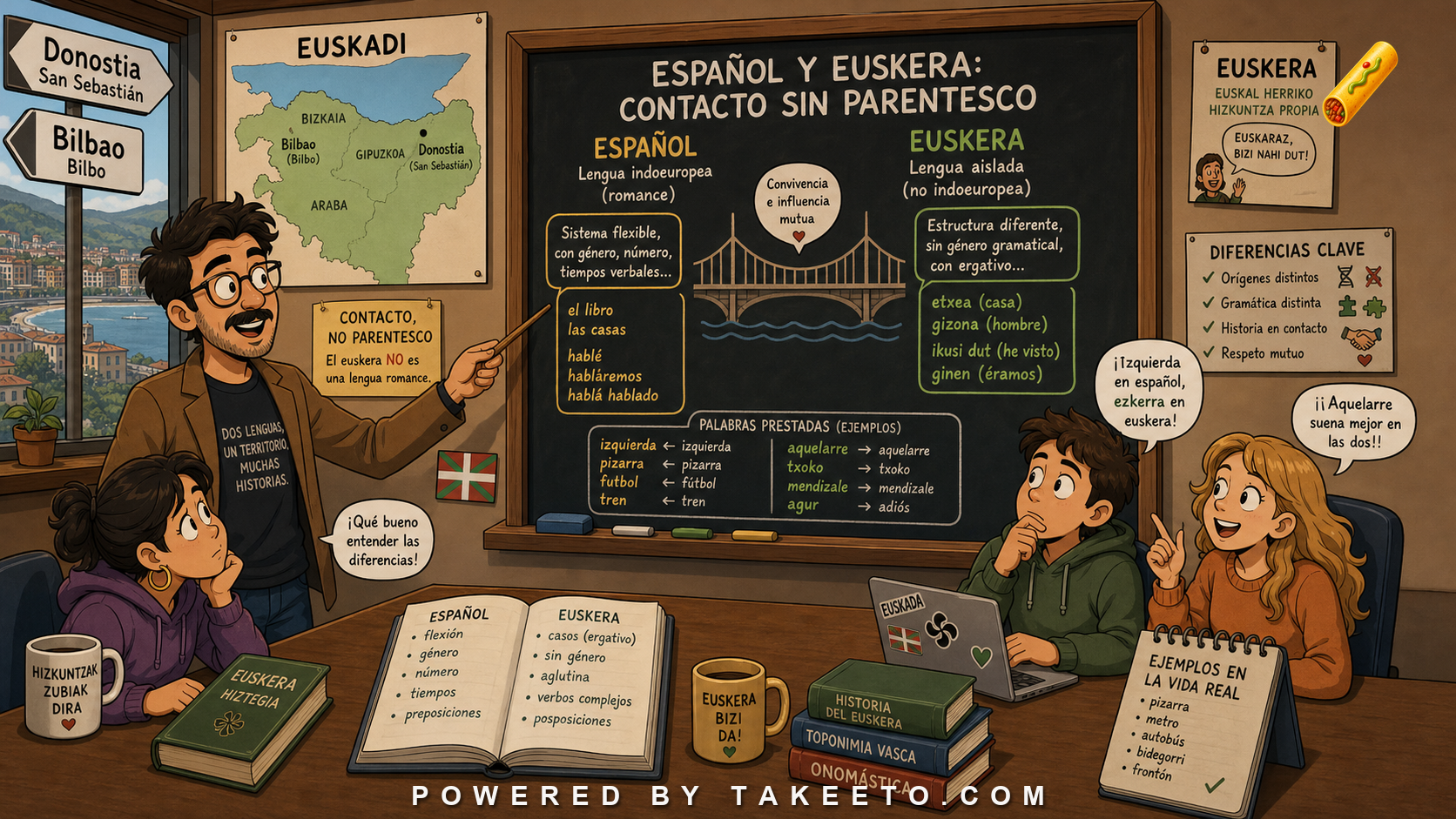
Spanish and Basque have been in contact for centuries, but they are not sister languages. Spanish is Romance, descended from Latin. Basque, or euskera/euskara, is not Romance and has no demonstrated genealogical relationship to Spanish. It is usually described as a language isolate: a language with no proven relatives.
This matters because learners often confuse contact with ancestry. A Spanish word can come from Basque, a Spanish dialect can be shaped by Basque contact, and a region can be bilingual without Basque being “a kind of Spanish.”
The key principle is:
Basque and Spanish are neighboring languages in contact, not members of the same language family.
A serious learner separates genealogy from geography.
Basque names in public space
In the Basque Country and neighboring areas, public signs and place names may appear in Basque, Spanish, or both:
Donostia / San Sebastián
Bilbao / Bilbo
Vitoria-Gasteiz
Euskadi
Euskal Herria
These pairs are not casual translations in every case; they are names with political, cultural, and administrative weight. A map, train announcement, government website, or street sign may choose one form or display both.
Learner action: preserve official paired names carefully, especially in travel, addresses, and formal writing.
Basque loanwords and possible influences
Spanish includes words often associated with Basque origin or Basque mediation, though etymologies vary in certainty.
Examples commonly discussed include:
izquierda
left
pizarra
slate / blackboard
aquelarre
witches’ sabbath, historically loaded term
Some terms are well established; others are debated. The responsible learner does not turn every unusual Spanish word into a Basque loan. As with Arabic and Indigenous influence, etymology requires evidence.
Basque contact and Spanish sound history
Basque contact is often mentioned in discussions of Spanish historical phonology, especially the development of Latin f- to Spanish h- in words such as hacer and hijo. Scholars have debated how much Basque or Basque-Romance bilingualism contributed to this change, and the full story is complex.
Learner action: it is fair to say that Basque contact is relevant to some historical discussions of Castilian, but careless to claim that Basque “caused Spanish” or that every Spanish h is Basque.
Bilingualism and identity
Basque-Spanish bilingualism is not uniform. Speakers differ by region, generation, schooling, family language, urban/rural background, and political identity. Some speak Basque natively. Some learn it in school. Some understand but do not speak. Some use Spanish as their dominant language while valuing Basque culturally.
Language choice can carry identity. A visitor should not reduce that choice to stereotype. Nor should a learner assume that everyone in the Basque Country speaks Basque fluently or that Basque is merely symbolic.
Structural difference
Basque grammar differs radically from Spanish. It has ergative alignment patterns, agglutinative morphology, rich case marking, different verb agreement structures, and postpositional relationships. Spanish knowledge may help with bilingual signs only when Spanish is displayed. It does not give access to Basque grammar.
Words such as etxea (house/the house), kalea (street/the street), or eskerrik asko (thank you) should be learned as Basque, not decoded through Spanish.
Standard Basque
Modern standard Basque, often called euskara batua, plays an important role in education, media, publishing, and public administration. Basque also has dialect diversity. A learner should know that the standard is not the whole language but is crucial for modern public use.
This parallels Spanish in a useful way: standardization supports writing and institutions, but regional speech remains real.
Example bank walkthrough
Euskadi
Basque Autonomous Community / Basque Country term in many contexts.
Learner action: distinguish administrative and cultural/geographic uses.
euskera / euskara
Basque language; forms vary by language and context.
Learner action: recognize both common Spanish and Basque-associated names.
izquierda
Spanish word for left, often discussed as Basque-origin.
Learner action: useful example of contact vocabulary, but verify etymologies individually.
pizarra
Slate/blackboard; commonly associated with Basque origin.
Learner action: learn modern meanings beyond origin.
aquelarre
Historically loaded word connected with witchcraft discourse.
Learner action: treat cultural-history words carefully.
Donostia / San Sebastián
Basque/Spanish place-name pair.
Learner action: preserve both names where appropriate.
Bilbao / Bilbo
Spanish/international and Basque forms.
Learner action: recognize signage and local naming.
Remediation notes: Basque contact needs two separate maps
The repair is to maintain two maps at once: family relationship and contact. Basque is not genealogically related to Spanish in the way Catalan, Galician, Portuguese, French, or Italian are. It is commonly described as a language isolate because no genetic relationship has been demonstrated. But Basque and Spanish have been in contact for centuries. Unrelated languages can influence each other through geography, bilingualism, administration, trade, names, and daily life.
Names require care. Euskera and euskara are both encountered, with euskara the Basque form and euskera common in Spanish. Euskadi, País Vasco, and Euskal Herria are not always interchangeable; they can refer to different political, cultural, or geographic frames depending on context. City names such as Donostia/San Sebastián, Bilbao/Bilbo, Vitoria-Gasteiz, and Pamplona/Iruña show bilingual public naming. The learner should preserve the form used by the source rather than forcing one name everywhere.
Loanword caution is essential. Izquierda, pizarra, and aquelarre are often discussed in relation to Basque, but etymologies may be more or less secure depending on the word. Do not turn every unfamiliar Spanish word into a Basque loan. Contact etymology needs evidence, just like Arabic or Indigenous etymology.
Basque influence on regional Spanish should also be handled carefully. Certain phonetic, lexical, or discourse features may be associated with Basque-country Spanish, but a learner should avoid caricature. Bilingual speakers are not “speaking Spanish wrong”; they are navigating contact between two systems with different structures.
Production target: learn what kind of fact you are stating. Basque is not Romance is a family fact. Spanish and Basque are in contact is a sociolinguistic fact. This word may be Basque-derived is an etymology claim requiring support. Keeping those categories separate prevents most mistakes.
Suggested interactive module: language-family vs contact map
A strong tool for this article would separate ancestry from contact.
Suggested functions:
- Family map: Romance Spanish versus Basque language isolate.
- Contact layer: loanwords, place names, bilingual signs, phonology debates.
- Name pair cards: Donostia/San Sebastián, Bilbao/Bilbo, Vitoria-Gasteiz.
- Evidence labels: established loan, debated etymology, folk claim.
- Basic sign glossary: kalea, irteera, sarrera, udala, eskerrik asko.
- Standard/dialect note: euskara batua and regional varieties.
Final rule
Basque-Spanish contact is real, but contact is not kinship.
Spanish is Romance. Basque is not. Learn the place names, respect bilingual public life, and keep etymology cautious. Geography can bring languages together without making them relatives.