
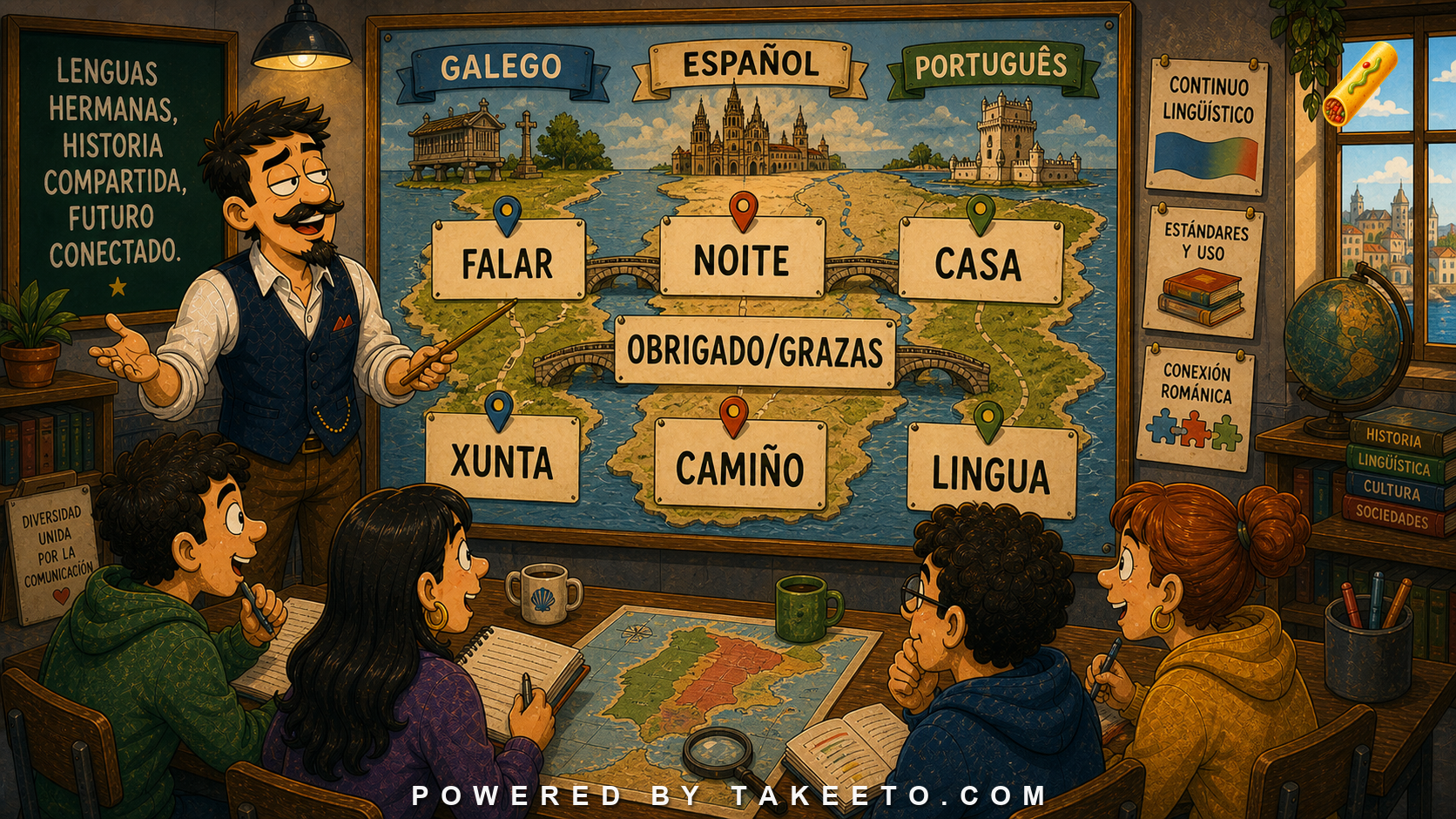
Galician belongs in the Spanish learner’s mental map
A Spanish learner may visit Galicia and see words such as:
galego
falar
noite
camiño
lingua
Xunta
These forms may look close to Portuguese, close to Spanish, or unfamiliar. That is not an accident. Galician is a Romance language of northwestern Iberia with a deep historical relationship to Portuguese and long contact with Spanish.
The key principle is:
Galician is not a Spanish accent; it is a Romance language with its own standard, history, and contact situation.
A learner who knows Spanish can use that knowledge to approach Galician, but should not reduce Galician to Spanish vocabulary with altered spelling.
Galician and Portuguese history
Medieval Galician-Portuguese was a major literary and linguistic continuum. Over time, political borders, standardization, administration, and cultural histories separated modern Galician and Portuguese standards. They remain closely related, and many forms show the connection.
Compare:
Galician falar / Portuguese falar / Spanish hablar
Galician noite / Portuguese noite / Spanish noche
Galician camiño / Portuguese caminho / Spanish camino
The comparison helps Spanish learners see that Iberia contains more than Spanish and Portuguese. It also shows how language boundaries are historical and political, not just linguistic.
Galician and Spanish contact
Galician is used in a society where Spanish is also widely present. Speakers may move between Galician and Spanish depending on family, school, workplace, age, politics, rural/urban context, media, and personal identity. Some people speak Galician-dominant varieties; others understand more than they produce; others use Spanish with Galician features.
Spanish influence can affect vocabulary, pronunciation, syntax, and public perception. Galician influence can also shape regional Spanish. Contact goes both ways, though not always under equal social power.
Learner action: do not hear Galician-influenced Spanish as simply “incorrect Spanish.” It reflects a bilingual environment.
Standardization and orthography
Galician has a standard written form, taught in schools and used in institutions, media, literature, and public signs. Orthographic choices can be politically and culturally meaningful, especially because of Galician’s relationship to Portuguese. Debates around reintegrationism and standard norms are beyond a beginner article, but learners should know they exist.
A respectful reading stance is to treat Galician spelling as its own system. Xunta is not a misspelling of Junta in Spanish. It is a Galician institutional form.
Similar words, different systems
Some Galician words are transparent to Spanish readers:
casa
mar
animal
Others are easier through Portuguese comparison:
falar
noite
lingua
Others require learning:
grazas
thank you
rúa
street
concello
municipality/council
A learner should avoid the “I can read it because I know Spanish” trap. Partial comprehension is useful, but public information, legal notices, literature, and institutional language need care.
Names and identity
Language names matter. In Galician, the language is galego. In Spanish, it is gallego. Galicia’s autonomous government is the Xunta de Galicia. Place names may have official Galician forms. Using the right form in the right context signals respect.
Learner action: when reading public signs, preserve official names rather than translating them casually.
Obrigado and grazas
Learners sometimes associate obrigado with Portuguese and gracias with Spanish. Galician commonly uses grazas for “thank you,” though obrigado/a can appear in some contexts, dialects, or contact situations. The key lesson is not to force one neighboring language’s formula onto another.
Learner action: learn local formulas as local formulas.
Example bank walkthrough
galego
Galician language or Galician identity term.
Learner action: recognize local-language naming.
falar
To speak.
Learner action: compare with Portuguese falar and Spanish hablar.
noite
Night.
Learner action: compare with Spanish noche and Portuguese noite.
casa
House; transparent Romance word.
Learner action: useful but not proof that all Galician is transparent.
obrigado / grazas
Thanks-related forms with different distributions.
Learner action: use grazas as a basic Galician thank-you form.
Xunta
Galician institutional term.
Learner action: do not “correct” it to Spanish Junta.
camiño
Road/path/way.
Learner action: connect with Camino and Portuguese caminho.
lingua
Language/tongue.
Learner action: note relationship to Spanish lengua.
Remediation notes: Galician is close, but not a Spanish-Portuguese compromise
The upgrade here is to stop describing Galician as halfway between Spanish and Portuguese. Historically, Galician and Portuguese share a deep Galician-Portuguese background, and modern Galician has long contact with Spanish. But Galician is not a compromise language. It has its own standard, literature, institutions, dialects, identity politics, and everyday speakers.
The obrigado/grazas point needs careful handling. Grazas is the basic standard Galician thank-you form learners should recognize and use first. Obrigado/a may appear in some dialectal, reintegrationist, Portuguese-contact, or stylistic contexts, but a Spanish learner should not assume it is the default just because it is familiar from Portuguese. Local formulas should be learned locally.
Spanish influence is real, but the word “influence” should not automatically mean contamination. A Galician speaker may use Spanish, Galician, or mixed features depending on context. A Spanish-speaking learner may hear regional Spanish with Galician phonetic or lexical influence. That is contact, not defective Spanish. At the same time, standard Galician is not just whatever emerges from Spanish contact; it has norms and literacy practices of its own.
Orthography deserves respect. Xunta is not a decorative spelling of Junta; it is the Galician institutional form. Rúa, camiño, lingua, noite, falar, and concello should be read as Galician words. If official signs use Galician place names, preserve them.
Production target: use comparison carefully. Spanish helps with casa and broad Romance patterns. Portuguese helps with falar and noite. But Galician forms need their own entries. A good learner note has three columns: Galician falar, Spanish hablar, Portuguese falar; Galician grazas, Spanish gracias, Portuguese obrigado/a. Comparison should orient, not replace.
Suggested interactive module: Galician-Spanish-Portuguese comparison triangle
A strong tool for this article would compare three related systems without collapsing them.
Suggested functions:
- Triangular cognate view: Galician, Spanish, Portuguese.
- Public-sign glossary: rúa, saída, concello, Xunta, horario.
- Historical note: Galician-Portuguese continuum and later standardization.
- Contact warning: Spanish-influenced Galician and Galician-influenced Spanish.
- Name-preservation mode: official place and institution names.
- Comprehension checker: transparent, semi-transparent, opaque.
Final rule
Galician is a Romance language with deep ties to Portuguese and long contact with Spanish. It is not a decorative variant of Spanish.
Use Spanish and Portuguese comparison to orient yourself, but learn Galician forms as Galician forms. Respect the standard, the place names, and the bilingual reality.