
Bad audio teaches bad Spanish quickly
Language apps can generate enormous amounts of audio. That is a strength only if the audio is good. A wrong stress pattern, wrong language voice, unnatural phrasing, or inconsistent dialect can train learners in the wrong direction.
If the text says:
público
but the audio stresses it like:
publicó
the learner is not just hearing a minor imperfection. They are hearing a different word form.
The key principle:
Spanish learning audio must be accurate enough to trust and natural enough to imitate.
Pronunciation target must be defined
Before judging audio, define the target.
Questions:
- Which Spanish variety is being used?
- Is c/z distinguished from s?
- Is ll/y merged or distinct?
- Are final consonants strongly pronounced?
- Is vosotros present?
- Is the register formal, conversational, or instructional?
- Is the speed slow, normal, or deliberately pedagogical?
Without a target, “correct” becomes vague. A Mexican voice, a Castilian voice, and a Caribbean voice may all be legitimate but not interchangeable in one beginner deck without labeling.
Stress errors are serious
Spanish stress distinguishes words and grammar:
hablo
I speak
habló
he/she spoke
público
public/audience
publicó
he/she published
práctico
practical
practicó
he/she practiced
TTS systems sometimes misread homographs or unfamiliar names. Human readers can also make mistakes. A QA system must flag stress-sensitive items.
Wrong-language voice is a common TTS failure
A Spanish sentence read by an English voice with Spanish words is not Spanish learning audio. It may be intelligible to a bilingual human, but it teaches distorted vowels, stress, rhythm, and consonants.
Warning signs:
- English-like vowels,
- wrong stress,
- English intonation,
- unnatural r,
- loanword pronunciation based on English,
- failure to handle accent marks.
A simple ASR transcript may still recognize the words. Recognition does not prove pedagogical quality.
Slow audio must not become robotic
Slow audio is useful when it preserves Spanish structure. It becomes harmful when it inserts unnatural pauses inside words or destroys phrase rhythm.
Good slow audio:
No sabía | que tenías que entregar | el informe | antes del viernes.
Bad slow audio:
No | sa | bí | a | que | te | ní | as...
Segmenting phrases is helpful. Breaking words unnaturally is not.
ASR audits are useful but limited
Automatic speech recognition can help detect mismatches between text and audio. If the expected text is deberá presentar and ASR hears something very different, that is a useful signal.
But ASR is not a judge of naturalness. It may accept audio that is ugly but recognizable. It may fail on legitimate dialectal pronunciation. It may miss stress errors when context helps transcription.
Use ASR as one layer:
- Generate or record audio.
- Run ASR transcript.
- Compare transcript to expected text.
- Flag mismatches.
- Manually review flagged lines.
- Randomly audit passed lines.
- Re-record or regenerate when needed.
Manual listening remains necessary
Human review catches what machines often miss:
- unnatural prosody,
- wrong emotional tone,
- awkward pauses,
- dialect inconsistency,
- stress errors,
- clipped words,
- low audio quality,
- overacted delivery,
- sentence-level rhythm problems.
For learning products, audio QA should have logs. If a line fails, record why and how it was fixed.
Audio QA should include names, numbers, and abbreviations
Many audio systems perform well on ordinary sentences and fail on the edges: personal names, country names, abbreviations, acronyms, dates, amounts, email addresses, and interface labels. Spanish learning content contains many of these.
Examples that need attention:
Sr., Dra., EE. UU., IVA, DNI, 15 %, 3.º, México, Bogotá, García Márquez
The audio should not read Spanish abbreviations as English, misplace stress in proper names, or turn document numbers into unnatural noise. For beginner learners, these errors are not minor. They teach the wrong sound for forms that appear in real documents.
A good QA checklist therefore includes an edge-case pass. Test abbreviations, names, numbers, acronyms, punctuation, and mixed-language text separately from ordinary prose. The failures often hide there.
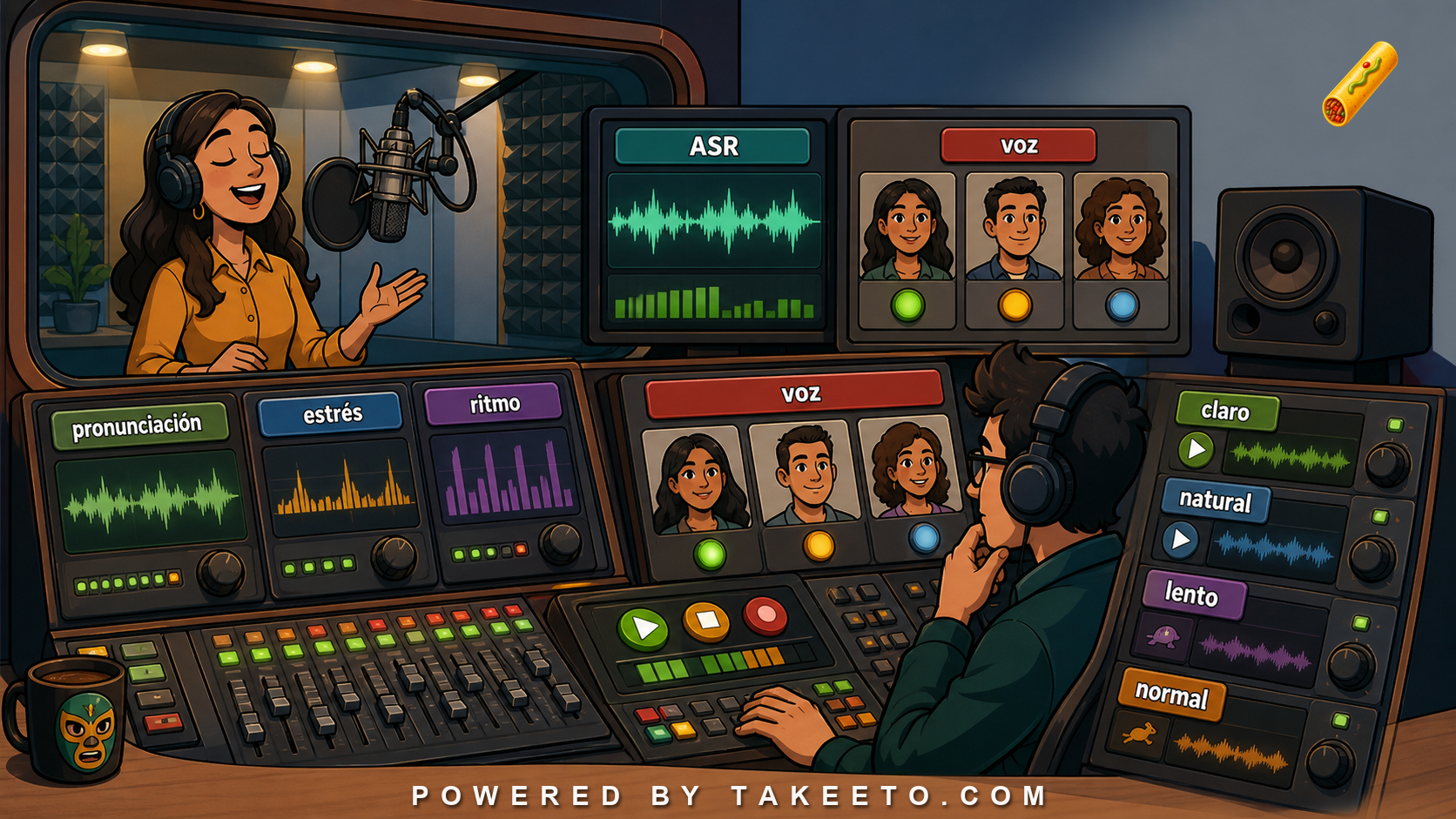
Example bank walkthrough
pronunciation
The actual sound form of the Spanish.
Learner action: do not trust audio blindly if it sounds off.
stress
Word stress.
Learner action: check accent-sensitive contrasts.
Spanish voice
A voice configured for Spanish phonology and rhythm.
Learner action: avoid English-voice Spanish.
ASR
Automatic speech recognition.
Learner action: use as a mismatch detector, not final authority.
mismatch
Difference between expected text and heard/transcribed audio.
Learner action: flag and review.
slow speed
Pedagogical pacing.
Learner action: ensure phrase rhythm remains natural.
normal speed
Natural listening target.
Learner action: use it for transfer to real speech.
Item audio and sentence audio need different QA
Isolated item audio and sentence audio fail in different ways. Item audio must get pronunciation and stress exactly right because there is no context to rescue it:
público
publicó
Sentence audio must also handle prosody, phrase rhythm, and natural grouping:
El público publicó una reseña.
A system can pass item audio and fail sentence audio if the voice pauses unnaturally or stresses the wrong phrase. It can also pass sentence audio while hiding a bad isolated pronunciation through context. Serious QA checks both layers separately.
Remediation notes: ASR is a signal, not an audio-quality judge
The strongest repair for audio QA is to avoid outsourcing judgment to speech recognition. ASR can catch some mismatches: wrong language voice, missing word, severe pronunciation failure, or transcript mismatch. But ASR can also accept unnatural audio or reject valid dialectal pronunciation. It is a signal, not an authority.
Manual listening remains necessary. A reviewer should check language, dialect target, stress, vowel quality, consonants, pacing, phrase grouping, intonation, background noise, clipping, and whether the audio matches the displayed text. For Spanish, stress errors are especially damaging because público, publico, and publicó are different forms. TTS can sound fluent while putting stress in the wrong place, mishandling names, or reading abbreviations oddly.
The article should add a genre match. A usage sentence, a formal notice, a dialogue, a side-1 vocabulary item, and a passage narration require different prosody. A legal-style sentence should not be read with cartoon enthusiasm. A casual dialogue should not sound like a court announcement. Audio quality includes social fit, not only pronunciation accuracy.
Dialect labels should be explicit. “Spanish voice” is too vague. Is the target Mexico, Spain, Colombia, neutral Latin American broadcast style, Rioplatense, Caribbean, or another model? A product can include multiple varieties, but the learner should know what they are hearing. Random voice switching without labels can confuse pronunciation targets.
A remediation workflow should be practical: flag, categorize, regenerate or rerecord, re-audit, and log the fix. Categories might include wrong language, wrong text, stress error, unnatural pacing, dialect mismatch, bad abbreviation reading, noise, clipping, prosody mismatch, and ASR false alarm.
Production target: use automated checks for scale, but require human review for high-impact audio. Side-1 items, minimal pairs, conjugations, names, and sentences with stress-sensitive forms deserve special accountability. Audio is not decoration; it is part of the Spanish model.
Suggested interactive module: audio QA dashboard
A strong tool for this article would combine automated and human review.
Suggested functions:
- Expected text display: sentence or item.
- Audio playback: slow and normal.
- ASR transcript: compare to expected text.
- Mismatch highlight: missing, added, or misrecognized words.
- Stress-risk flag: accent-sensitive forms.
- Dialect label: intended variety.
- Manual rating: pronunciation, rhythm, naturalness, pacing.
- Remediation workflow: regenerate, re-record, approve, reject.
Final rule
Spanish audio quality is not a cosmetic issue.
Define the pronunciation target, check stress, avoid wrong-language voices, use ASR as a signal, and keep human listening in the loop. Learners imitate what you give them, so the audio must deserve imitation.