
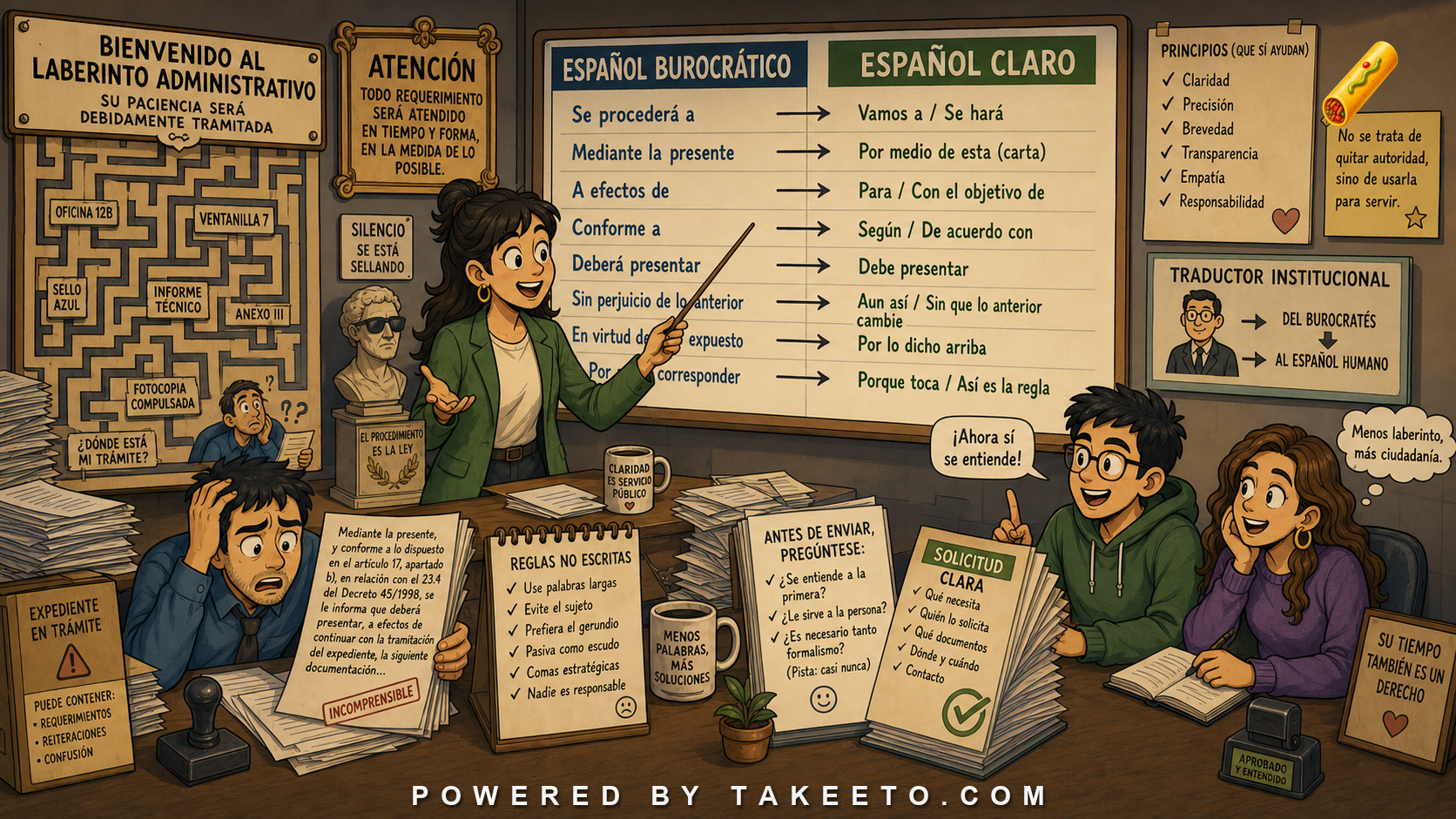
Bureaucratic Spanish is not just formal Spanish
A learner who can read ordinary Spanish may still freeze in front of an administrative notice:
Mediante la presente se le comunica que deberá presentar la documentación requerida conforme a lo establecido en la normativa vigente.
The words are not rare in isolation. The difficulty comes from the style. Bureaucratic Spanish compresses authority, procedure, obligation, evidence, and distance into formulaic structures. It often avoids direct human subjects. It turns actions into nouns. It uses impersonal forms to make the institution sound stable and official.
The key principle is:
Bureaucratic Spanish is a system of authority and procedure, not simply a collection of difficult words.
The learner's task is not to imitate every formula. The task is to identify who must do what, by when, under what rule, and with what consequence.
Formulae create institutional distance
Bureaucratic writing uses fixed phrases because institutions repeat similar actions: notifying, requesting, certifying, authorizing, rejecting, approving, warning, and recording.
Common formulae include:
mediante la presente
by means of this document / hereby
a efectos de
for the purposes of
conforme a
in accordance with
en virtud de
by virtue of / under
se le comunica
you are hereby informed
These phrases are not conversation. Nobody normally says mediante la presente at a café. In a document, however, the phrase signals that the text is performing an official act.
Learner action: treat formulae as document signals. Ask what the document is doing: notifying, requiring, authorizing, certifying, or warning.
Passive se hides the actor
A central feature of bureaucratic Spanish is se:
se procederá a la revisión del expediente
the file will be reviewed / review of the file will proceed
se deberá presentar la solicitud antes del viernes
the application must be submitted before Friday
se informa al interesado
the interested party is informed
This se gives the text an impersonal institutional voice. It may be useful when the actor is obvious, irrelevant, or institutional. But it can also obscure agency. Who will review the file? Who must submit the request? Who is responsible for delay?
To read it, rewrite it in plain form:
La oficina revisará el expediente.
Usted debe presentar la solicitud antes del viernes.
La administración informa al interesado.
Learner action: convert passive or impersonal se into an active sentence to locate actor and action.
Nominalization turns actions into things
Bureaucratic Spanish often prefers nouns where ordinary Spanish would use verbs:
la presentación de la documentación
the submission of the documentation
la realización del trámite
the completion of the procedure
la aprobación de la solicitud
the approval of the application
el cumplimiento de los requisitos
compliance with the requirements
This style is compact and abstract. It also creates chains:
Para la aprobación de la solicitud será necesaria la presentación de la documentación acreditativa del cumplimiento de los requisitos.
A plain rewrite:
Para aprobar la solicitud, usted debe presentar documentos que demuestren que cumple los requisitos.
The official version emphasizes process and evidence. The plain version emphasizes the reader's action.
Learner action: when you see a long noun phrase, ask what verb is hidden inside it: presentar, aprobar, cumplir, acreditar, revisar, resolver.
Obligation verbs carry legal force
Administrative Spanish uses obligation language carefully.
deberá presentar
must submit
tendrá que abonar
will have to pay
queda obligado a
is obliged to
se requiere
is required
será necesario
it will be necessary
Deberá is especially common in instructions, forms, notices, contracts, and rules. It is future in form, but often functions as formal obligation.
Compare:
Debe presentar el formulario.
You must submit the form.
Deberá presentar el formulario.
You shall / must submit the form.
The second sounds more institutional. A learner should not confuse it with a future prediction. It usually tells the reader what is required.
Precision and obscurity can coexist
Bureaucratic style is not automatically bad. It can be precise. It can identify legal sources, deadlines, document types, required evidence, and procedural status. A form cannot always sound like a friendly text message.
But precision becomes obscurity when the document hides the answer to basic questions:
- Who must act?
- What exactly must be submitted?
- Where must it be submitted?
- By what date?
- What happens if it is not submitted?
- Which rule is being invoked?
A serious reader respects the function of official language but does not worship its fog.
Common reading trap: translating the formula instead of the function
A learner may translate mediante la presente as “through the present” and then get stuck. Bureaucratic formulae should be translated by function. Mediante la presente se le informa usually means “This notice informs you.” A efectos de often means “for the purpose of.” Conforme a points to a rule that governs the action.
The same applies to se procederá a. In many documents, it adds ceremony more than meaning. Se procederá a la revisión often means se revisará or revisaremos, depending on agency. But be careful: in a legal or administrative context, formulae can mark procedure, authority, or sequence. Do not delete them before you know whether they carry legal effect.
A good learner rewrite has two layers: a plain summary for comprehension and a careful version that preserves legal terms. The summary helps you act. The careful version protects the meaning.
Example bank walkthrough
se procederá
Impersonal future construction. Often means that an office or institution will begin or carry out an action.
Learner action: ask who is actually proceeding and what step follows.
mediante la presente
Formula meaning “by means of this document” or “hereby.”
Learner action: identify the document act: notification, request, authorization, warning.
a efectos de
Means “for the purposes of.”
Learner action: look for the administrative purpose after the phrase.
conforme a
Means “in accordance with.”
Learner action: the following noun phrase often names a law, rule, contract, or procedure.
deberá presentar
Formal obligation.
Learner action: convert it to debe presentar for comprehension, but preserve formal force in serious documents.
Plain rewrite ladder
A useful way to train bureaucratic reading is to rewrite in three layers.
Layer 1 preserves the official meaning but removes the fog:
Se procederá a la revisión de la documentación presentada.
La oficina revisará los documentos presentados.
Layer 2 names the reader's action:
Usted presentó documentos; la oficina los revisará.
Layer 3 adds consequence if the document provides it:
Si falta algún documento, la oficina le pedirá que lo envíe antes de continuar.
The goal is not to replace the official text in legal settings. The goal is comprehension. Learners should keep the original wording when deadlines, rights, obligations, or legal references matter, but they should use plain rewrites to find the real procedural structure.
Remediation notes: extract the legal action without deleting the legal frame
The most important repair for this article is to separate understanding from replacement. A learner may rewrite a bureaucratic sentence into plain Spanish to understand it, but that does not mean the plain rewrite is legally equivalent. Deberá presentar la documentación requerida conforme a lo establecido en la normativa vigente can be unpacked as usted debe entregar los documentos que exige la norma, but the original wording still carries institutional reference, obligation, and legal anchoring.
A good remediation workflow therefore has two columns. In the first column, keep the original formula. In the second, write the action meaning. Example: a efectos de → “for the purpose of”; conforme a → “according to this rule”; se procederá a → “the institution will begin/do this procedure”; deberá presentar → “you must submit”; documentación acreditativa → “documents that prove the fact.” The learner should not simply replace every formal phrase with a casual one. They should identify the procedural force.
Bureaucratic Spanish also needs a status/action distinction. Some documents tell the reader to act: presente, adjunte, abone, comparezca, firme. Others state institutional status: queda inscrito, se encuentra pendiente, ha sido denegada, consta en el expediente. Others define rights or consequences: podrá interponer recurso, se entenderá desistida la solicitud, sin perjuicio de. These are not the same reading problem. An article that teaches bureaucracy should train the reader to tag each clause as action, status, authority, deadline, evidence, right, or consequence.
The remediation also needs to warn against false politeness. In official Spanish, se ruega may sound polite, but it can still mean a serious institutional request. Podrá may describe permission, not a friendly suggestion. Deberá is usually obligation, not simple future. A la mayor brevedad posible sounds softer than a fixed deadline, but it still pushes urgency.
Production target: after reading an administrative paragraph, write a six-line extraction: who acts, what action, what document, what deadline, what rule, and what consequence. If any line is blank, the learner has not finished reading the bureaucracy.
Suggested interactive module: bureaucratic-to-plain Spanish converter
A strong tool for this article would let the learner paste an official sentence and mark the layers.
Suggested functions:
- Formula detector: mediante la presente, conforme a, a efectos de, en virtud de.
- Actor recovery: Identify hidden subject behind passive or impersonal se.
- Verb recovery: Convert nominalizations into verbs.
- Obligation tag: deberá, se requiere, queda obligado, será necesario.
- Deadline highlighter: antes de, hasta, dentro de, plazo, vencimiento.
- Plain rewrite: Produce a reader-action summary.
- Legal caution: Flag parts that should not be simplified without professional review.
Final rule
Bureaucratic Spanish is built from formulae, passive se, nominalizations, obligation verbs, and institutional distance.
Read it by extracting the real task: who must do what, with which document, under which rule, by what deadline. Learn to understand bureaucratic style without copying its worst obscurity.