
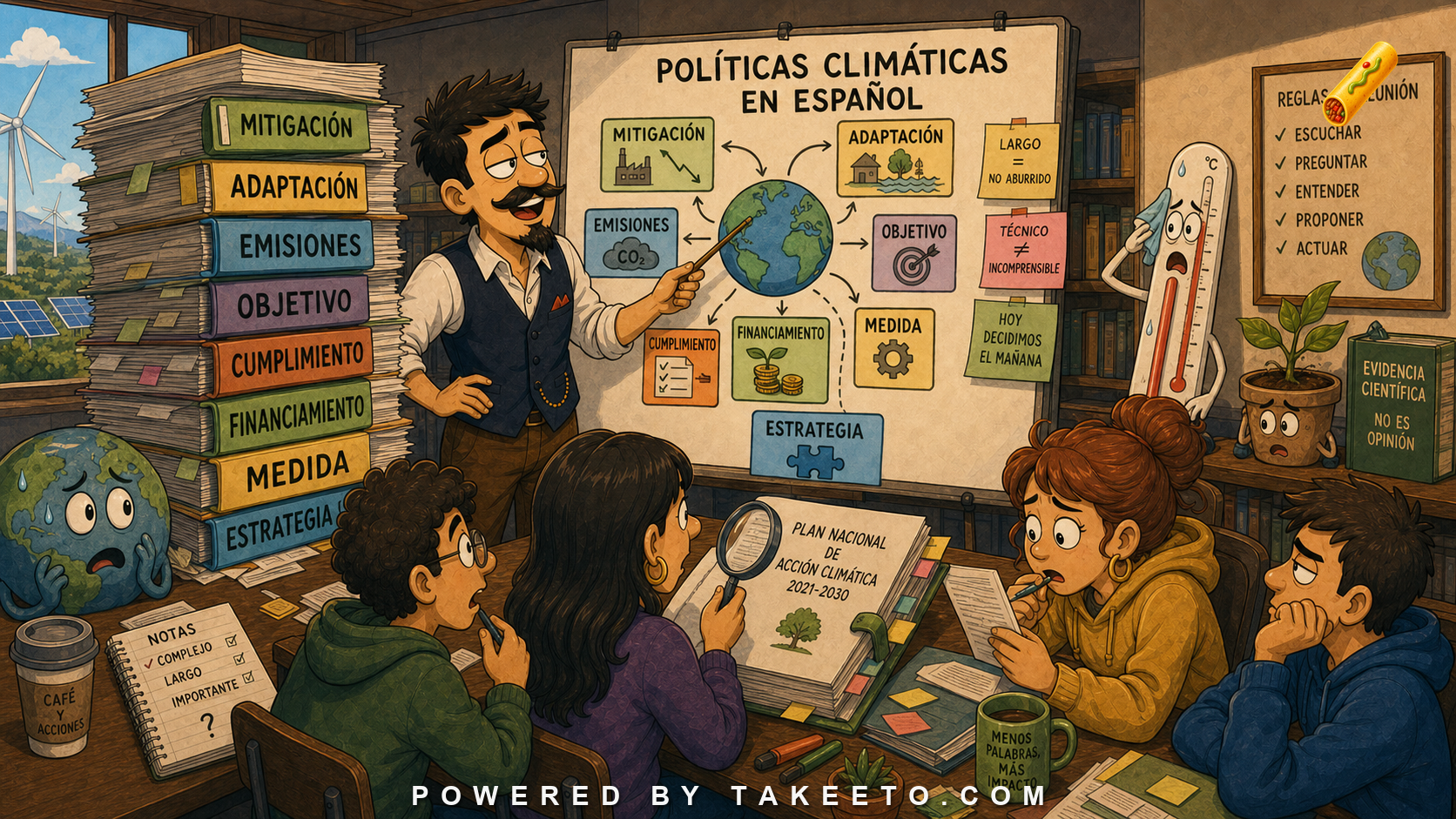
Climate policy Spanish is a grammar of goals and constraints
Climate policy documents do not usually read like ordinary environmental news. They are full of nouns that compress actions: mitigación, adaptación, reducción, implementación, financiamiento, cumplimiento, monitoreo, seguimiento, evaluación. They also use legal and administrative verbs: deberá, se promoverá, se establecerán, se implementará, tendrá como objetivo.
A learner may understand each term individually and still miss the policy architecture. The document is asking: What goal? By when? Through what measures? Who is responsible? With what funding? How will compliance be tracked?
The key principle is:
Climate policy Spanish is organized around targets, measures, institutions, timelines, and accountability.
If you read only for vocabulary, you miss the machinery.
Mitigación and adaptación
Two central terms are mitigación and adaptación.
Mitigación means reducing the causes of climate change, especially emissions.
medidas de mitigación
reducción de emisiones
transición energética
eficiencia energética
descarbonización
Adaptación means adjusting systems to climate impacts already occurring or expected.
medidas de adaptación
gestión del riesgo
infraestructura resiliente
protección frente a inundaciones
planes de sequía
Do not translate both as general “climate action.” They answer different problems. A policy can be strong in adaptation and weak in mitigation, or the reverse.
Objectives, targets, and timelines
Policy Spanish often distinguishes broad aims from measurable targets.
objetivo general
objetivo específico
meta
indicador
línea base
plazo
horizonte temporal
A objetivo may be broad. A meta often implies a measurable target. An indicador tells how progress will be measured. Línea base is the starting point against which progress is compared.
Example:
El plan tiene como objetivo reducir las emisiones en un 30% para 2030, tomando como línea base el año 2020.
The sentence contains a goal, amount, deadline, and baseline. Remove any one of those and the policy becomes vague.
Nominalizations make action look abstract
Climate documents rely heavily on nominalizations:
la implementación de medidas
la reducción de emisiones
el fortalecimiento de capacidades
la incorporación de criterios ambientales
el seguimiento del cumplimiento
These nouns can sound official and precise, but they may hide actors. Who implements? Who reduces? Who monitors? Who pays?
A useful reading move is to turn the noun back into a verb.
la implementación de medidas por parte de los municipios
Plain version:
Los municipios implementarán medidas.
This rewrite exposes responsibility.
Legal-modal phrases
Climate policy often uses a scale of obligation.
Strong:
deberá
estará obligado a
se exigirá
será requisito
Medium or programmatic:
se promoverá
se impulsará
se fomentará
se procurará
Weak or aspirational:
se buscará
se alentará
se podrá
cuando sea posible
A document full of se promoverá may set direction without enforceable duties. A document with deberá and clear deadlines is stronger. The difference matters for translation and policy reading.
Funding and implementation
Policy promises become real through financing and institutions.
Common terms:
financiamiento
presupuesto
fondos
inversión
mecanismo financiero
cooperación internacional
recursos públicos
incentivos
Implementation language includes:
entidad responsable
autoridad competente
gobierno local
ministerio
municipio
sector privado
sociedad civil
A climate plan may sound ambitious but fail to assign responsibility. The reader should look for the table or section that connects medida, responsable, plazo, indicador, and financiamiento.
International agreements and local execution
Spanish climate documents often reference international frameworks while assigning local tasks.
acuerdos internacionales
compromisos nacionales
contribución determinada a nivel nacional
estrategia nacional
plan municipal
implementación local
The rhetorical pattern is often: global commitment, national framework, local measures. Learners should not treat every level as the same actor. El Estado, la comunidad autónoma, el municipio, and el sector privado may have different responsibilities.
Executive summaries
Many policy documents begin with a resumen ejecutivo. It may be readable and useful, but it is also selective. It highlights goals, framing, and achievements. Detailed obligations may appear later in annexes, tables, or implementation sections.
A serious reader uses the summary to map the document, not to replace it.
Example bank walkthrough
mitigación
Reducing causes, especially emissions.
Learner action: connect to reductions, energy, transport, industry, land use.
adaptación
Adjusting to impacts.
Learner action: connect to risk, infrastructure, water, health, agriculture.
emisiones
Emissions.
Learner action: look for unit, sector, baseline, and target.
objetivo
Goal or objective.
Learner action: distinguish broad objective from measurable target.
cumplimiento
Compliance or fulfillment.
Learner action: ask how it will be monitored.
financiamiento
Funding.
Learner action: identify source, amount, and conditions.
medida
Measure or action.
Learner action: connect each measure to actor and deadline.
estrategia
Strategy.
Learner action: treat as framework, not necessarily action.
Climate-policy reading workflow
- Find the executive summary.
- Identify mitigation and adaptation sections.
- List all targets with numbers and dates.
- Mark baselines.
- Extract measures into a table.
- Add responsible institution for each measure.
- Add funding source if stated.
- Mark obligation verbs: deberá, se promoverá, se podrá.
- Look for monitoring and compliance language.
- Translate nominalizations into actor-plus-verb sentences.
Mini-workshop: turn a measure into a commitment table
Choose one sentence from a climate strategy and force it into five columns: actor, action, deadline, metric, and funding. A phrase like se promoverá la eficiencia energética will probably leave several blanks. That is the point. The blank fields show what the policy still has not specified. A stronger measure might say that a ministry will retrofit 500 public schools by 2030 using a named budget line and a measurable reduction in energy use. This exercise teaches learners to respect policy language without being impressed by abstraction alone.
Policy-force ladder
Climate documents should be read with a force ladder. At the soft end are se promoverá, se fomentará, se impulsará, and se buscará. These phrases often announce direction. In the middle are se establecerán mecanismos, se adoptarán medidas, and se desarrollará un plan. They sound more concrete but may still lack enforcement. At the hard end are deberá, queda obligado a, se exigirá, será requisito, se sancionará, and se publicará un informe anual.
A remediation task is to underline every verb of policy force and rewrite the paragraph as a table. If the document says se fomentará el transporte sostenible, the table should show missing actor, missing budget, missing metric, and missing deadline. If it says los municipios deberán presentar planes de movilidad antes de 2028, the table has stronger commitment.
This prevents learners from treating official tone as legal force. Policy Spanish often sounds decisive even when it is only directional. The careful reader asks what the grammar obligates, not only what the nouns aspire to.
Remediation drill: convert abstractions into an implementation grid
Take one climate-policy paragraph and extract every abstract noun: estrategia, medida, transición, adaptación, resiliencia, financiamiento, gobernanza, cumplimiento, monitoreo, descarbonización. Then place each noun into one of three columns: goal, instrument, or oversight.
Goal nouns describe desired outcomes: reducción de emisiones, neutralidad climática, resiliencia hídrica. Instrument nouns describe what will be done: subsidios, normas de eficiencia, planes municipales, infraestructura verde. Oversight nouns describe how implementation is tracked: informes, indicadores, sanciones, auditorías, evaluación periódica.
Now look for verbs and modal force. A sentence such as:
Se promoverá la adopción de tecnologías limpias.
belongs in a weaker category than:
Las empresas deberán reducir sus emisiones en un 30% antes de 2030.
The first sentence promotes; the second requires. The first may be policy direction; the second is closer to enforceable obligation. This exercise forces the learner to stop admiring the vocabulary and start measuring commitment.
For writing practice, summarize the paragraph in plain Spanish:
El plan propone X, exige Y, financia Z y todavía no aclara W.
That sentence is powerful because it lets you praise and criticize at the same time. Climate documents are rarely all empty or all binding. They are mixtures of aspiration, technical planning, institutional compromise, and political language. Advanced Spanish literacy means being able to locate each layer.
Suggested interactive module: climate-policy measure tracker
A strong tool for this article would convert dense policy prose into an accountability map.
Suggested functions:
- Measure extractor: finds medida, acción, programa, estrategia.
- Target parser: amount, baseline, deadline.
- Obligation meter: mandatory, encouraged, optional.
- Actor field: ministry, municipality, agency, company, community.
- Funding field: budget, fund, cooperation, unspecified.
- Mitigation/adaptation tagger.
- Executive-summary cross-check: summary promise versus detailed mechanism.
Applied reading drill: turn the policy into a table
When a climate paragraph sounds impressive, convert it into columns:
Se promoverá la implementación de medidas de adaptación en zonas costeras mediante programas de financiamiento y coordinación interinstitucional.
Table version:
| Measure | Type | Actor | Funding | Strength | Missing information |
|---|---|---|---|---|---|
| Adaptation measures in coastal areas | Adaptation | Not specified | Programs mentioned | Weak/medium: se promoverá | Deadline, budget, responsible agency |
This table exposes vagueness. Se promoverá may be useful, but it is not the same as se implementará antes de 2030 con presupuesto asignado. Policy literacy often begins when you turn nouns back into accountable verbs.
Remediation focus: turning policy abstractions into actors, deadlines, and measurable commitments
Climate policy Spanish is dense because it prefers nouns that sound institutional: mitigación, adaptación, implementación, financiamiento, cumplimiento, descarbonización, resiliencia. These nouns are not the problem. The problem is that they often hide who must do what by when. A reader who translates the nouns but never reconstructs the action has not understood the policy.
The remediation habit is to convert every policy sentence into an actor-action-deadline table. Se promoverá la eficiencia energética sounds responsible, but it does not yet say who will promote it, through what law or budget, in which sector, and how success will be measured. Policy Spanish must be read as a system of commitments, not as a chain of impressive nouns.
Common failure modes to repair
- Mistaking goals for measures: Objetivo, meta, estrategia, and medida are different. A goal says what should happen; a measure says what will be done.
- Ignoring legal modality: Deberá, podrá, se procurará, se impulsará, and queda obligado a express different degrees of obligation.
- Reading international language as local enforcement: A text may invoke global agreements while leaving domestic implementation vague.
- Missing the funding line: A policy without financing may be aspirational. Financiamiento, presupuesto, fondo, subsidio, and mecanismo deserve attention.
Before/after: repair a policy sentence
Weak version:
El país avanzará en la adaptación al cambio climático mediante nuevas estrategias sostenibles.
Stronger version:
El ministerio deberá presentar antes de diciembre de 2027 un plan de adaptación para zonas costeras, con presupuesto asignado, indicadores de riesgo y medidas de protección para viviendas e infraestructura crítica.
The upgraded sentence turns aspiration into administrative language. It names an actor, deadline, domain, funding expectation, measurement system, and affected infrastructure.
Upgrade workshop: extract the policy commitment
- Circle every nominalization: mitigación, adaptación, reducción, financiamiento, implementación.
- Rewrite each nominalization as a verb: reducir emisiones, adaptar infraestructura, financiar proyectos.
- Ask who performs the verb: ministry, municipality, company, household, international fund, school, transport agency.
- Find the time frame: para 2030, a partir de, en un plazo de, progresivamente.
- Identify the enforcement type: binding requirement, incentive, recommendation, pilot program, reporting obligation, or symbolic statement.
Quality-control checklist
- Does the document define baseline year and target year?
- Are reductions expressed as absolute emissions, intensity, percentage, or sector share?
- Is adaptación connected to a specific hazard such as drought, flood, heat, or sea-level rise?
- Are vulnerable populations named or left abstract?
- Is there a monitoring mechanism, or only policy intention?
Applied remediation drill: convert a climate measure into an implementation table
Use this source-style excerpt:
La estrategia contempla la reducción progresiva de emisiones del transporte urbano mediante incentivos a la movilidad eléctrica y la mejora de la infraestructura ciclista, sujeto a disponibilidad presupuestaria municipal.
A fast but weak reading might say:
The city will reduce emissions by switching transport to electric mobility and bikes.
That reading is incomplete. A stronger reading says:
The strategy considers a gradual reduction of urban transport emissions through incentives and bicycle infrastructure, but implementation depends on municipal budget availability.
The repair comes from five checks:
- Contempla is softer than ordena or garantiza.
- Reducción progresiva indicates a process, not an immediate result.
- Mediante incentivos suggests policy tools, but not necessarily mandates.
- Mejora de la infraestructura ciclista is a measure, but the text does not define location, scale, or deadline.
- Sujeto a disponibilidad presupuestaria is a major condition, not fine print.
Turn the sentence into a table with columns for actor, sector, measure, condition, missing detail, and possible indicator. The actor is probably municipal government, the sector is urban transport, the measure includes electric-mobility incentives and bike infrastructure, the condition is budget availability, and the missing details include amount, deadline, target, and enforcement. This is the kind of reconstruction that prevents policy Spanish from becoming empty green vocabulary.
Final rule
A climate policy document is not only a list of green words. Read it as a chain: objective, target, measure, actor, deadline, funding, and compliance. In Spanish, the chain is often hidden inside nominalizations and polite administrative verbs. Pull the chain apart before you trust the promise.