
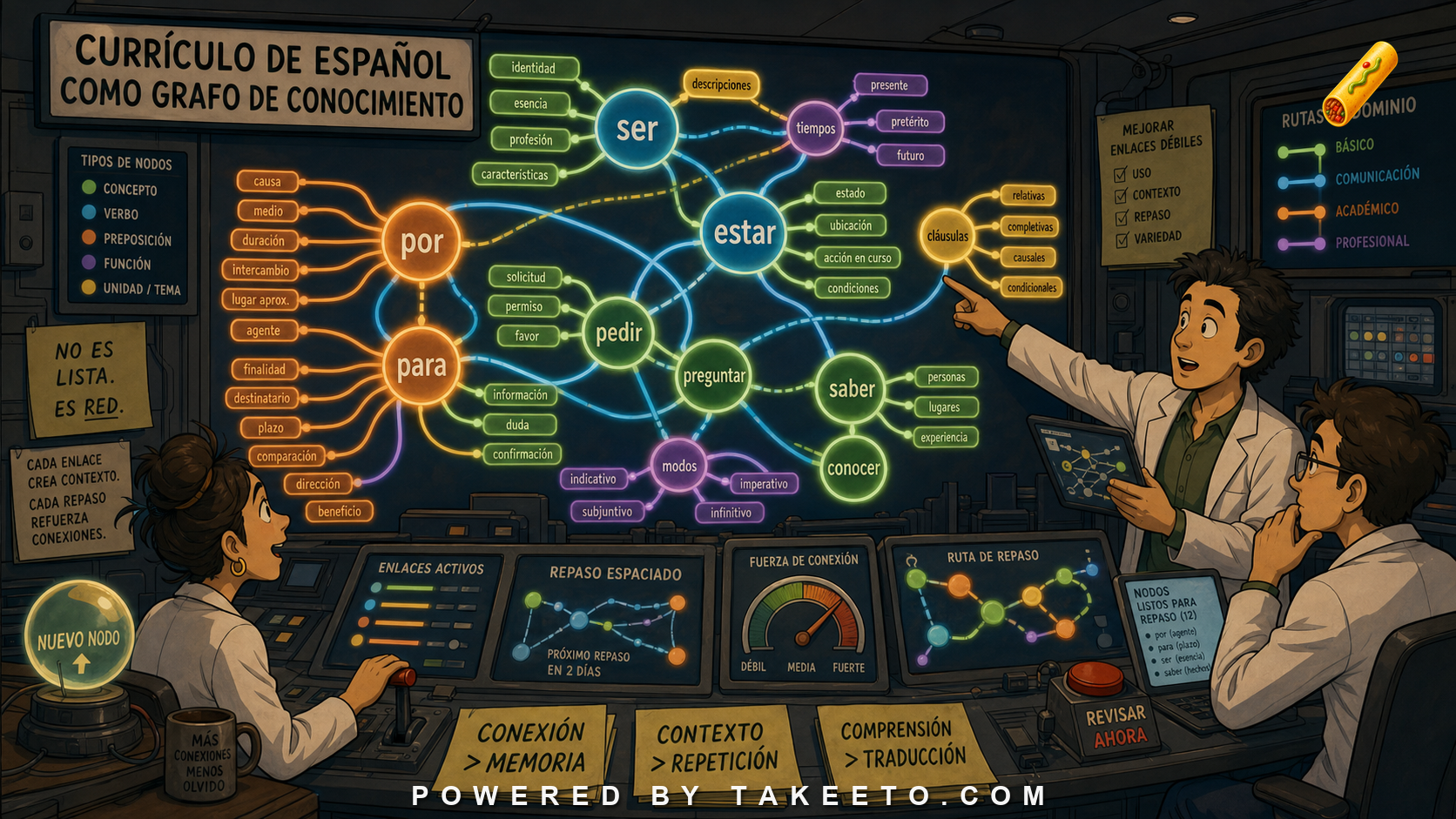
Spanish knowledge is relational
A flat vocabulary list lies by omission.
It may show:
- ser — to be;
- estar — to be;
- por — for/by/through;
- para — for/in order to;
- pedir — to ask for;
- preguntar — to ask;
- saber — to know;
- conocer — to know.
The list is not wrong. It is incomplete in the most dangerous way. These items are not independent. They form contrast sets, usage networks, grammar dependencies, register patterns, and error clusters.
A learner does not master ser by memorizing “to be.” They must contrast it with estar, see predicate types, learn adjective meaning shifts, and encounter it in identity, origin, event location, passive voice, and classification. A learner does not master por without para. A learner does not master pedir without separating it from preguntar. A learner does not master saber without conocer.
Spanish curriculum should therefore be modeled as a knowledge graph.
What a knowledge graph represents
A knowledge graph treats learning items as nodes connected by meaningful edges.
Nodes can be:
- vocabulary items;
- grammar topics;
- example sentences;
- passages;
- audio files;
- exams;
- errors;
- register labels;
- dialect notes;
- articles;
- decks;
- review events.
Edges can represent:
- prerequisite;
- similarity;
- contrast;
- common mistake;
- appears in passage;
- reviewed by exam;
- requires grammar note;
- belongs to word family;
- shares root;
- same collocation field;
- register relation;
- regional variant;
- audio contrast;
- remediation path.
This model is closer to how Spanish is learned.
Confusables should be first-class edges
Some of the most important connections are mistake links.
| Item A | Item B | Connection |
|---|---|---|
| ser | estar | predicate type, state/classification, adjective meaning shifts |
| por | para | cause/path/exchange vs purpose/destination/deadline |
| pedir | preguntar | ask for/request vs ask a question |
| saber | conocer | knowledge of facts/skills vs familiarity/acquaintance |
| llevar | traer | motion perspective and carrying/bringing |
| quedar | faltar | remaining/being left vs lacking/remaining to completion |
| pero | perro | tap/trill contrast |
| aún | aun | accent and meaning distinction |
A flat deck may review these items separately. A graph can bring them together when the learner confuses them.
Prerequisites prevent premature lessons
A graph can show when a topic is being taught too early.
For example, “subjunctive in relative clauses” depends on:
- present subjunctive formation;
- relative clauses;
- specificity of antecedents;
- indicative/subjunctive contrast;
- article choice;
- verbs such as buscar, necesitar, querer;
- prior exposure to que as relative marker.
If the learner has not encountered these nodes, the topic becomes memorized formula rather than understanding.
Another example: double object pronouns require:
- direct object pronouns;
- indirect object pronouns;
- pronoun placement;
- le/les → se before lo/la/los/las;
- agreement with direct object;
- clarifying a phrases.
A graph helps curriculum builders see whether lessons rest on missing supports.
Passages become integration nodes
A passage is a rich graph node because it connects many items.
A passage about applying for a scholarship may connect:
- solicitar;
- beca;
- plazo;
- adjuntar;
- cumplir los requisitos;
- antes de + infinitive;
- para que + subjunctive;
- se le olvidó;
- le mandó;
- present perfect or pluperfect;
- formal register;
- slow and natural audio;
- PDF packet;
- post-session exam.
When the learner struggles with that passage, the graph can identify which subnodes need review. Maybe the issue is vocabulary. Maybe it is object pronouns. Maybe it is audio speed. Maybe it is formal register.
Graphs support explanations
A knowledge graph can power better grammar notes.
If the learner taps se lo mandé, the system can know that this phrase connects to:
- mandar;
- indirect object pronouns;
- direct object pronouns;
- double pronoun order;
- le/les → se;
- preterite first person;
- pronoun placement;
- article 050 or 093;
- prior mistakes with le lo.
The note can remain short, but the system can offer the right deeper link.
Without graph structure, a product may show a generic definition: “I sent it.” That helps meaning but misses the learning opportunity.
Graphs support review scheduling
Review should not be based only on individual item decay. It should also consider related items.
If a learner misses para in a purpose sentence, the system might schedule:
- the missed card;
- a contrast with por;
- a passage where both appear;
- a short explanation of purpose vs cause;
- a cloze item;
- a reverse translation prompt.
If a learner misses pidió and chooses preguntó, the system should not merely repeat pedir. It should create a pedir/preguntar contrast.
Knowledge graphs make remediation targeted.
A graph is not a learner prison
A curriculum graph should guide learning, not overconstrain it.
Learners sometimes benefit from previews. They may encounter a subjunctive form before the formal subjunctive unit. They may learn a phrase such as quiero que vengas before mastering mood theory. They may read domain texts with partial support.
The graph should distinguish:
| Relation | Meaning |
|---|---|
| Hard prerequisite | Topic is very difficult without prior node. |
| Soft prerequisite | Prior node helps but preview is possible. |
| Review link | Earlier item should reappear here. |
| Confusable link | Items should be contrasted after errors. |
| Deepening link | Later topic refines earlier shortcut. |
| Domain link | Item appears in specialized reading. |
A graph should support flexible sequencing, not make the curriculum brittle.
The graph needs governance
A curriculum knowledge graph can become messy if every possible relationship is added without discipline.
Not every pair of items needs a link. casa and mesa are both nouns, but that does not make their relationship pedagogically important. ser and estar need a strong contrast link. pedir and preguntar need a confusable link. antes de salir and prepositions before infinitives need a construction link. público/publicó needs a stress contrast link.
A useful graph should define edge types carefully.
| Edge type | Use it when | Example |
|---|---|---|
| prerequisite | One topic strongly supports another | present subjunctive → subjunctive in relative clauses |
| contrast | Items are commonly compared | por ↔ para |
| confusable | Learners often choose one for the other | pedir ↔ preguntar |
| appears in | Item occurs in a passage or sentence | plazo → scholarship passage |
| explains | Article or note explains an item | accidental se article → se me olvidó |
| form-of | Surface form maps to base form | pidió → pedir |
| register | Item belongs to a register | solicitar → formal |
| audio contrast | Listening pair needs comparison | pero ↔ perro |
| remediation | Error should trigger a review path | missed me gustan → gustar agreement drill |
Without edge standards, the graph becomes a junk drawer. With standards, it becomes a curriculum engine.
Learner data should update the graph experience
The graph itself may be stable, but a learner’s path through it should change with evidence.
If a learner has no trouble with saber/conocer, that edge can remain quiet. If they repeatedly confuse the pair, the graph should surface the contrast. If they read passages well but fail listening, audio nodes should become more prominent. If they know infinitive forms but miss conjugated passage forms, form-of edges should guide review.
Personalization should not mean random rearrangement. It should mean using evidence to choose which graph relationships matter now.
Examples:
| Learner evidence | Graph response |
|---|---|
| Misses pidió but knows pedir | Show form-of link and stem-change note. |
| Chooses estar where ser is needed | Open ser/estar contrast set. |
| Recognizes plazo in text but not audio | Route to audio node and usage sentence. |
| Understands words but fails passage question | Route to discourse and reference-chain support. |
| Uses formal word in casual prompt | Surface register edge. |
The graph turns mistakes into routes.
Graphs help editors too
A curriculum graph is not only for learners. It helps writers and reviewers.
Before editing a passage, an editor can see which focus items, review items, grammar topics, audio files, exams, and PDFs depend on it. Before retiring a deck, a curriculum designer can see which passages would lose coverage. Before changing the translation of quedar, a reviewer can see linked examples: me queda bien, quedan tres sillas, quedamos a las ocho, quedarse en casa.
This prevents accidental simplification. A word like quedar is not one item in practice. It is a family of constructions. A graph helps the product respect that complexity.
The learner-facing graph should be simple
The internal graph may contain thousands of nodes. The learner does not need to see all of them.
A learner-facing view should answer practical questions:
- What am I studying now?
- What does this depend on?
- What does it connect to?
- What am I confusing it with?
- Where can I review it in context?
- Which explanation should I read?
For por/para, a learner might see a small map: cause/path/exchange/duration on one side; purpose/destination/deadline/recipient on the other; examples in the middle; a review button; a passage link. That is enough.
The internal graph can be complex. The learner view should be humane.
Useful graph questions
A curriculum graph becomes valuable when it can answer questions that a flat list cannot. Designers should be able to query the system in ordinary pedagogical terms.
Examples:
- Which active items have no passage occurrence?
- Which focus items have audio but no sentence context?
- Which review items have not appeared in the last five sections?
- Which learner mistakes connect to por/para?
- Which items require the learner to know indirect objects?
- Which PDFs are stale because a source passage changed?
- Which examples use vos in a curriculum path labeled as Spain-focused?
- Which formal-register items lack a register note?
These questions make the graph practical. It is not there to look impressive. It is there to make invisible relationships searchable.
The graph can also support learner-facing explanations. If a learner repeatedly misses se me olvidó, the product can show a small map: this item connects to accidental se, indirect-object pronouns, affected participants, and event framing. That map should not overwhelm the learner, but it can make review feel purposeful. The learner sees that the mistake is not random. It belongs to a structure, and structures can be repaired.
Graphs should stay editable
A curriculum graph is only useful if editors can correct it. If links are generated once and then treated as hidden infrastructure, the graph will become stale. Writers, teachers, and QA reviewers need simple ways to mark a missing prerequisite, remove a bad similarity link, add a register edge, or connect a learner error to a better remediation path.
This is especially true for Spanish because many relationships are judgment-sensitive. Aplicar para may be a contact-influenced form in one context and a usage warning in another. Vos may be core in one curriculum path and passive-recognition material in another. Se venden casas and regional impersonal alternatives require nuance. A graph that cannot store nuance will eventually flatten the language it is supposed to explain.
V2 remediation refinement: the graph needs governance, not only connections
The first draft presented Spanish curriculum as a knowledge graph. The remediation pass adds the missing governance layer. A graph is only useful if its nodes and edges are maintained with clear meanings. Otherwise it becomes a beautiful tangle that no teacher, learner, or system can trust.
Define edge types carefully:
| Edge type | Example | Product use |
|---|---|---|
| prerequisite | indirect objects → gustar | prevent premature lessons |
| confusable | por ↔ para | build contrastive review |
| morphology family | tener → tengo, tuv- | connect forms and stems |
| construction family | se me olvidó ↔ accidental se | route explanations |
| register relation | pedir ↔ solicitar | choose domain examples |
| passage reuse | item appears in later deck | support cumulative reading |
| mistake link | learner confused pedir and preguntar | personalize remediation |
Each edge should have a reason and a review policy. Is the link manually curated, generated by error data, derived from shared lemma, or inferred from semantic similarity? Does it affect lesson unlocks, review scheduling, explanations, or only internal analytics? Can an editor override it? Can a learner’s repeated mistakes strengthen it for that learner without changing the global curriculum?
Governance prevents overreach. A knowledge graph should support learners, not trap them in algorithmic assumptions. A learner may be allowed to preview advanced material even if prerequisites are incomplete; the system should simply warn and support. Mistake links should help review, not stigmatize. Similarity links should be inspected because superficial string similarity can mislead: actual and actualmente are related, but their English false-friend risk is semantic; pero/perro is phonological; pedir/preguntar is lexical; ser/estar is grammatical and semantic.
The v2 standard is: graph edges are curriculum claims. Treat them with the same seriousness as grammar explanations.
Suggested interactive module: Spanish curriculum graph visualization
A useful tool would display nodes and links at several zoom levels.
Zoom 1: broad areas:
- sound;
- spelling;
- noun phrase;
- verb system;
- pronouns;
- prepositions;
- discourse;
- register;
- domain literacy;
- learning system.
Zoom 2: topic clusters:
- ser/estar;
- tense/aspect;
- se constructions;
- object pronouns;
- subjunctive;
- connectors;
- audio/listening.
Zoom 3: item links:
- busco un profesor que hable linked to relative clauses, subjunctive, specificity, buscar, indefinite article.
The visualization could filter by:
- due review;
- learner mistakes;
- upcoming prerequisites;
- weak clusters;
- passage coverage;
- audio exposure;
- domain readiness.
Final rule
Spanish curriculum is a graph, not a list.
Items connect through prerequisites, contrasts, passages, mistakes, grammar dependencies, collocations, register, dialect, audio, and review history. Modeling those connections makes sequencing smarter, notes more relevant, exams more diagnostic, and remediation more targeted. A flat list can store Spanish. A graph can teach it.