
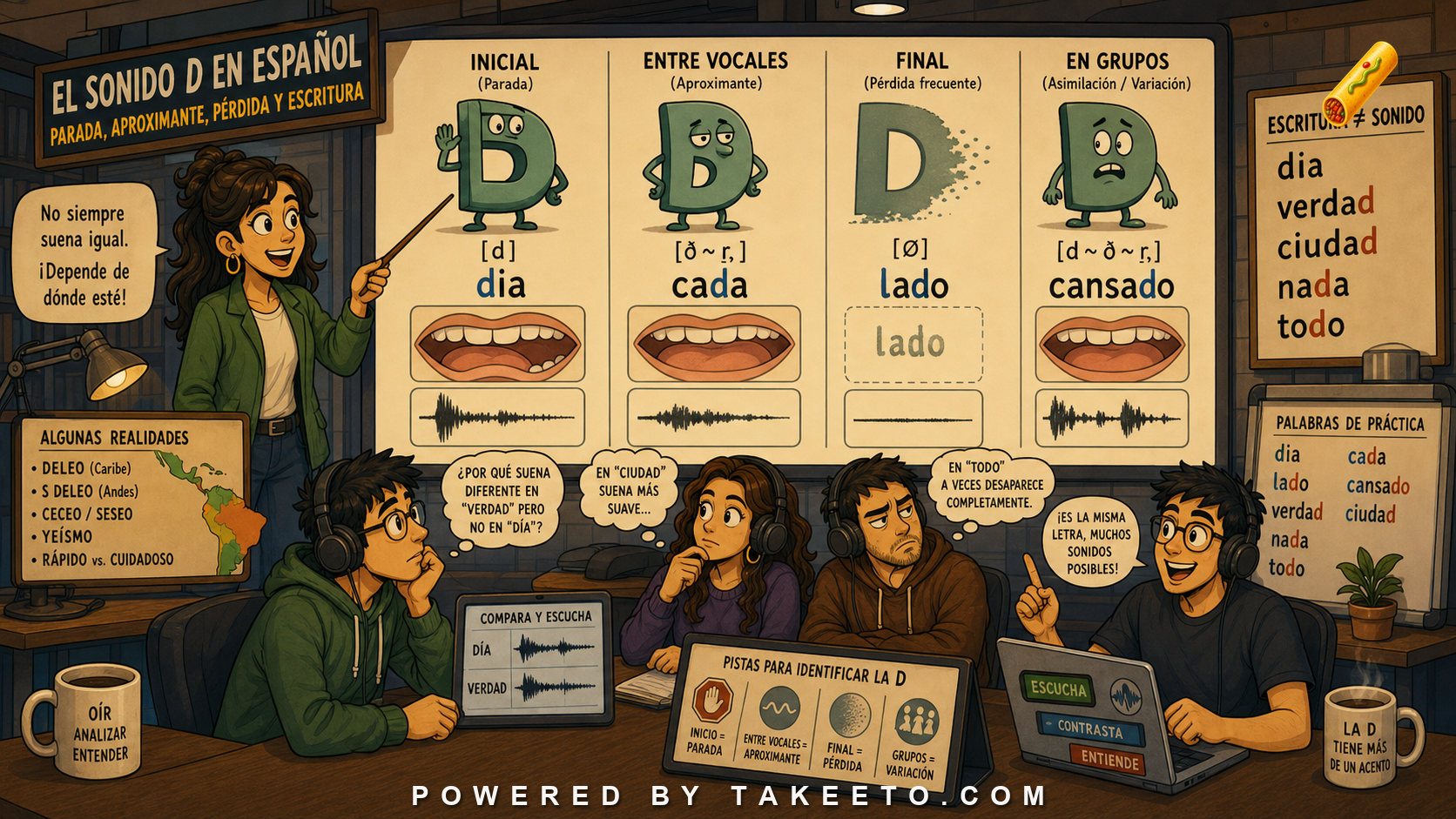
The letter d is not always one sound
Spanish learners often expect d to sound like English d. That expectation creates two problems. First, their own Spanish may sound too hard and foreign. Second, they may fail to recognize normal Spanish speech where d is softened or nearly absent.
The key principle is:
Spanish d is a sound category with several common realizations, not a single English-like consonant.
The variation is not random. It depends on position, surrounding sounds, region, register, and speech speed.
Stop d
A stop [d]-like realization is common after a pause and after certain consonants, especially n and l in many varieties.
Examples:
día
un día
el día
At the beginning of an utterance:
Día tras día...
The d may be more closed or stop-like. After n in un día, the closure is also more likely.
But this is not the whole story.
Approximant d
Between vowels, Spanish d is often a dental approximant [ð]-like sound. It is softer than English d and does not involve the same strong stop release.
Examples:
cada
lado
nada
todo
A learner who says these with a hard English-style d every time will usually be understood, but the pronunciation may sound stiff.
Practice contrast:
día
cada día
The second d in cada is usually softer than the initial d of día.
Intervocalic weakening and loss
In many varieties and registers, intervocalic d can weaken further, especially in common words and participles ending in -ado or -ada.
Written:
cansado
Natural speech may range from:
cansado
cansao
Written:
nada
May be pronounced with a soft d, and in some colloquial speech the d may be extremely weak.
This is not one global rule for all Spanish. It is a spectrum. Some speakers maintain the d more strongly. Others weaken it more. Formal speech often restores it.
Participles: -ado and -ada
Participles are especially important because they are common:
cansado
terminado
complicado
preocupada
preparada
In many informal contexts, -ado may sound like -ao:
Estoy cansao.
Learners should recognize this. Whether to produce it depends on target variety, register, and identity. A non-native learner who uses heavy reduction without control may sound affected.
Learner rule:
Recognition first, controlled production later.
Final d: verdad and ciudad
Final d varies widely.
Examples:
verdad
ciudad
Madrid
Depending on region and style, final d may be pronounced clearly, weakened, devoiced, approximant-like, or nearly absent. In some Peninsular speech, final d may have a distinct realization; in many Latin American contexts, it may be weak or absent in casual speech.
A learner reading verdad should know that natural speech may sound closer to:
verdá
in some contexts.
This is common enough that learners must recognize it, but it is not a spelling model.
Spelling mistakes versus pronunciation variation
Pronouncing cansado as something like cansao in casual speech is not the same as writing cansao in formal prose. Speech variation and orthographic standard are different layers.
Learners should avoid two bad conclusions:
- “Native speakers are pronouncing it wrong.”
- “I should write it the way it sounds.”
Neither is right. The better conclusion is:
Spanish has standard spelling and variable speech realization.
Listening strategies
When you miss a word, ask whether a weak d is involved.
Heard:
to’o
Possible underlying form:
todo
Heard:
na’a
Possible underlying form:
nada
Heard:
verdá
Underlying form:
verdad
Context will usually decide.
Example bank walkthrough
día
Initial or post-pause d may be stop-like.
Learner action: compare with softer intervocalic d.
cada
Intervocalic d.
Learner action: avoid hard English-style stop in careful practice.
lado
Soft d between vowels.
Learner action: listen for approximant quality.
cansado
Common participle with possible -ado weakening.
Learner action: recognize cansao as a reduced speech form.
verdad
Final d variation.
Learner action: expect verdad, verdá, and regional variants.
ciudad
Final d in a formal/common word.
Learner action: compare formal and casual pronunciations.
nada, todo
High-frequency words with possible weakening.
Learner action: use context to reconstruct full forms.
D-sound practice workflow
- Classify position: initial, after nasal/lateral, between vowels, final.
- Listen to multiple speakers. Do not rely on one dialect.
- Practice careful forms first. Maintain intelligibility.
- Hear softened forms. Especially cada, lado, nada, todo.
- Recognize participle reduction. -ado/-ada in casual speech.
- Keep writing standard. Do not confuse speech reduction with spelling.
- Choose production target. Match region and register intentionally.
Common learner failure: moralizing reduction
Learners sometimes hear cansao or verdá and conclude that the speaker is being careless. That reaction is unhelpful and often socially wrong. Sound weakening can be a normal feature of fluent speech, shaped by region, register, and speed.
The opposite error is also common: learners hear the reduction and immediately imitate it everywhere. That can sound forced, especially in formal speech or when the learner has not developed control over the careful form.
A better stance is:
Recognize broadly. Produce selectively.
Mini-workshop: formal-to-casual continuum
Take five words:
cansado, terminado, nada, todo, verdad
Find or imagine three pronunciations for each:
- careful/formal,
- ordinary conversational,
- strongly reduced regional/casual.
Then decide which one you should produce in a classroom presentation, with friends, in a job interview, and when listening to regional media. This makes pronunciation a register decision rather than a yes/no rule.
Common failure mode: overcorrecting d reduction
Some learners hear cansao-like forms and decide to drop every d between vowels. That is not control; it is imitation without register. Other learners do the opposite and pronounce every written d as a hard stop because they fear sounding careless. Both reactions miss the system.
The repair is three-level awareness. First, recognize careful cansado. Second, recognize normal soft cansaðo. Third, recognize casual or regional reduction. Production should lag behind recognition. You can understand a reduced form without adopting it in formal speech.
Remediation pass: treat d variation as a listening system
The Spanish d is one of the best sounds for teaching learners that pronunciation is not spelling. Many English-speaking learners produce every written d as a hard stop. Then they hear cansado, verdad, ciudad, nada, and todo in natural speech and feel that speakers are skipping letters. Both reactions come from the same problem: the learner expects one letter to equal one stable sound.
A better remediation model has three levels. Level one is the careful stop-like d, especially after a pause or certain consonants. Level two is the normal intervocalic approximant, softer than English d. Level three is stronger weakening or loss in particular dialects, registers, word endings, and high-frequency forms. The learner’s first goal is to recognize all three. Production can remain conservative until the learner has enough regional exposure.
This hierarchy prevents overcorrection. Learners should not pronounce cada with a heavy English d, but they also should not drop every d in all contexts. Control means being able to hear and choose, not adopting the most reduced form everywhere.
Before/after repair: a better note for -ado
Weak note:
“People say cansao instead of cansado.”
Stronger note:
In many casual or regional pronunciations, intervocalic d in -ado may weaken substantially or disappear: cansado → cansao. This is common enough to recognize, but it is register-sensitive. In careful speech and formal reading, a clearer d may appear.
Weak pronunciation goal:
“I should drop the d to sound native.”
Stronger pronunciation goal:
“I should avoid an English-style hard d between vowels, recognize reduced -ado forms, and choose a production style appropriate to my target variety and context.”
Mini-workshop: build a d ladder
Create a practice ladder with the same words in three contexts.
- Careful citation: día, cada, lado, cansado, verdad, ciudad.
- Phrase context: cada día, a mi lado, estoy cansado, la verdad es que, la ciudad de México.
- Natural audio context: find clips from at least two regions and mark how strong the d is.
For each token, label it as stop-like, approximant, weakened, or absent. Do not judge it as good or bad. The label itself is the training.
Orthography and social perception
Because Spanish spelling keeps the d, learners may assume the full consonant is socially required at all times. The reality is more nuanced. Some reductions are ordinary in casual speech. Some are regionally marked. Some may be stigmatized in certain formal settings. Some are so common in fast speech that noticing them is basic listening competence.
A serious article should avoid telling learners to copy reductions as a shortcut to authenticity. This can backfire socially and phonetically. A learner who drops d without the surrounding rhythm, vowel quality, and regional pattern may sound unnatural. Recognition should widen; production should be deliberate.
Diagnostic questions for d in a passage
When listening or reading aloud, ask:
- Is d word-initial, after a pause, after n/l, between vowels, or word-final?
- Is the word high-frequency, such as todo, nada, verdad, or usted?
- Is the context formal reading, casual conversation, music, comedy, or regional speech?
- Does the speaker weaken d consistently or only in certain endings?
- Would I use this reduction in my own target register?
These questions turn a sound into a system.
Editorial quality checks for this article
The article should keep spelling, phonetics, dialect, and register separate. It should name the stop/approximant distinction without drowning readers in symbols. It should include -ado/-ada, word-final d, and high-frequency words because those are the places learners most often notice variation. Most importantly, it should say clearly: hearing reduction is not the same as being required to imitate it.
Extended remediation: separate listening tolerance from speaking discipline
The most useful d training creates two different abilities. Listening tolerance means the learner can understand verdad, ciudad, cansado, lado, and nada when the d is clear, soft, weakened, or regionally variable. Speaking discipline means the learner chooses a production style that fits their context. A conservative learner can still understand very reduced speech. A highly natural speaker can still strengthen d in formal settings.
Contrast set
- over-imitation: I heard cansao, so I will drop d in every -ado word.
- controlled variation: I recognize casual -ado reduction, but I will use a clear softened d in presentations and interviews.
The contrast set should be read aloud or rewritten, not merely admired. Advanced learners often understand a correction when they see it, then fail to reproduce it when the task changes. The repair is to make the contrast portable: identify the decision, name the cue, and apply the same decision to a new sentence, clip, paragraph, or writing task.
Real-use transfer drill
- Make a list of ten d words across contexts: initial, after nasal, intervocalic, participle, final.
- Record a careful version and a connected version.
- Listen to native examples and classify each d realization.
- Mark which variants you will actively use.
- Revisit the list in a sentence, because d behavior changes in connected speech.
The deliverable is a variation table with columns for spelling, environment, heard form, register, region if known, and production choice. That table prevents both stiff spelling pronunciation and uncontrolled casual imitation.
Do not shame reduced d as lazy, and do not romanticize it as automatic authenticity. Variation is social. A learner needs awareness before adoption.
A good remediation pass ends with a usable artifact: a marked paragraph, a recording comparison, a collocation card, a frame note, a stance map, a change-claim table, or a revision pair. Without an artifact, the learner may feel enlightened but have nothing to review. With an artifact, the explanation becomes part of a study system.
Depth reinforcement: final d and social perception
Word-final d deserves special caution because it is both phonetic and social. In words such as verdad, ciudad, universidad, and libertad, speakers vary widely. Some pronounce a clear final consonant in careful speech; some weaken it substantially; some produce forms that approach loss in casual contexts. The learner should not treat one recording as a universal rule.
A strong article should therefore frame final d as a listening target before it becomes a production target. Learners need to recognize verdad even when it sounds reduced, but they do not need to force the most casual reduction in formal presentation, teaching, or professional speech. They should also avoid overcorrecting into a heavy English-like final consonant. The practical middle is careful but Spanish-like articulation, with growing passive familiarity across regional and social variation.
Applied drill: reading aloud in three registers
Practice d variation by reading the same short passage in three registers: careful public reading, ordinary conversational explanation, and casual familiar speech. The goal is not to force a dramatic difference. The goal is to feel how much articulation changes when the social setting changes.
Passage:
La ciudad ha cambiado mucho. Cada día llegan personas de otros lugares, y la verdad es que todo parece más rápido. Estoy cansado, pero contento.
In the careful version, keep the words clear without using an English-style hard d between vowels. In the ordinary version, allow the intervocalic d to soften naturally. In the casual-recognition version, listen to native audio from your target variety and notice where ciudad, verdad, todo, and cansado weaken.
Then write a production note: which version would you use in a presentation, in a conversation with friends, and in a listening-only recognition deck? The note matters because pronunciation study should produce choices, not one automatic imitation.
Suggested interactive module: d-realization spectrogram
A strong tool for this article would show visual and audio examples of d.
Suggested functions:
- Context selector: initial, intervocalic, final, participle.
- Audio examples: careful and casual versions.
- Spectrogram view: stop closure versus approximant weakening.
- Dialect notes: regional tendencies without ranking them.
- Recognition quiz: Learner maps reduced sound to written form.
- Production recorder: Compare hard, soft, and reduced variants.
Final rule
Spanish d is flexible.
Learn stop-like d, approximant d, intervocalic weakening, participle reduction, and final d variation as part of one system. Hear the variation; write the standard; imitate only with control.