
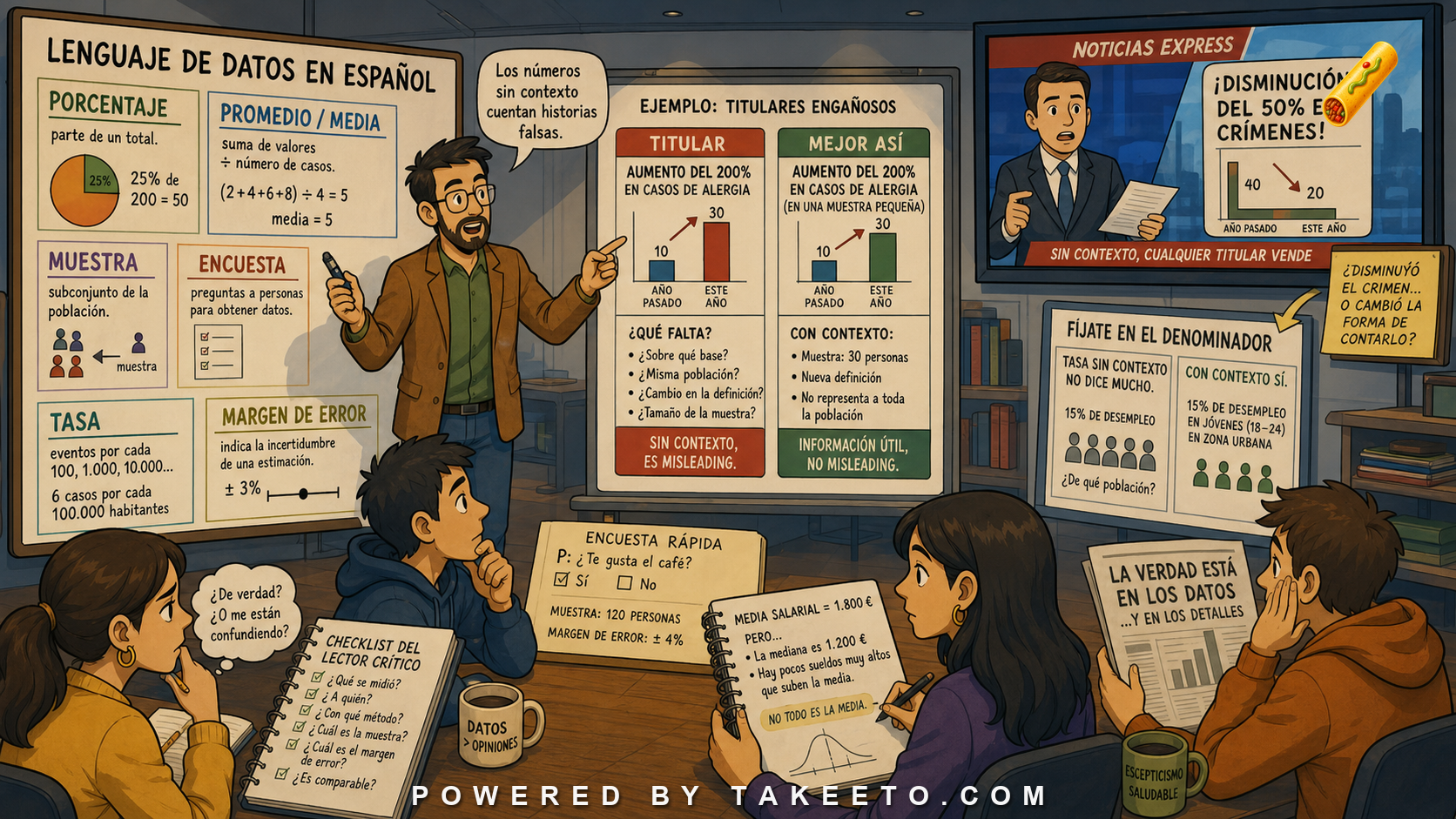
Numbers do not explain themselves
Spanish statistical language often looks easier than it is. Learners recognize porcentaje, promedio, encuesta, aumentó, and disminuyó, then assume the sentence is transparent. The danger is that statistical claims are rarely only numbers. They also include comparison, time, source, sample, uncertainty, and rhetorical framing.
Compare:
El desempleo bajó un 2%.
El desempleo bajó dos puntos porcentuales.
La tasa de desempleo bajó del 12% al 10%.
These can refer to different things. A two percent relative drop is not the same as a drop of two percentage points. Spanish media, policy writing, and institutional reports may handle these carefully, loosely, or inconsistently. A serious reader must ask what changed, from what base, over what period, and according to whom.
The key principle is:
Statistical Spanish must be read as a claim about measurement, not as a decorative number inside a sentence.
Porcentaje, punto porcentual, tasa
Porcentaje is percentage. Punto porcentual is percentage point. Tasa is rate.
El apoyo subió del 40% al 45%.
This is an increase of cinco puntos porcentuales. It is also a relative increase of 12.5% compared with 40. In ordinary journalism, the distinction may be blurred. In technical writing, it matters.
Tasa often appears with unemployment, mortality, inflation, fertility, crime, vaccination, and school completion:
tasa de desempleo
tasa de mortalidad
tasa de inflación
tasa de vacunación
tasa de alfabetización
A learner should not translate tasa only as “tax” or “fee.” In many statistical contexts it is “rate.”
Promedio, media, mediana
Promedio is the common everyday word for average. Media is often the technical term for mean. Mediana is median. Moda is mode, though it is less common in general reporting.
El ingreso promedio aumentó.
This does not tell you whether most people earn more. A few very high incomes can raise an average. A more careful sentence may say:
La mediana de ingresos se mantuvo estable.
The reader must notice the statistical measure. In educational, economic, and health texts, promedio can be useful but blunt. Media and mediana are more precise, but not always explained for general readers.
Muestra, encuesta, sondeo
A muestra is a sample. An encuesta is a survey. A sondeo is also a poll or survey, often in political or opinion contexts.
Useful phrases:
una muestra representativa
una muestra de 1.200 personas
una encuesta nacional
un sondeo de opinión
los encuestados respondieron que...
The grammar often hides responsibility through impersonal forms:
Se encuestó a 1.500 personas.
Se realizó una encuesta entre adultos mayores de 18 años.
The passive or impersonal style can sound objective, but a serious reader still asks who designed the survey, how the sample was selected, and when the data were collected.
Verbs of change
Spanish uses a rich set of change verbs:
aumentar / incrementarse
subir / elevarse
disminuir / reducirse
bajar / descender
duplicarse / triplicarse
mantenerse estable
registrar un aumento
experimentar una caída
Learners should notice register. Subir and bajar are clear and common. Incrementarse, reducirse, registrar, and experimentar sound more journalistic or institutional.
Los precios subieron.
This is plain.
El índice registró un incremento interanual del 6%.
This is report-style Spanish. It packs measure, time comparison, and institutional tone into one clause.
Comparisons and time frames
Statistical Spanish often depends on comparison words:
respecto al año anterior
en comparación con 2020
frente al trimestre previo
interanual
mensual
acumulado
en lo que va del año
Interanual means compared with the same period in the previous year, not simply “annual.” Mensual can mean monthly or month-over-month depending on context. Acumulado means accumulated over a period.
A sentence like this requires slow reading:
La inflación interanual disminuyó, aunque el índice mensual volvió a aumentar.
The annual comparison improved, but the latest monthly figure rose. Both can be true.
Margin of error and uncertainty
Opinion polling uses margen de error, nivel de confianza, estimación, and tendencia.
La encuesta tiene un margen de error de más o menos tres puntos.
A difference smaller than the margin of error should not be treated as a dramatic fact. Spanish headlines may still frame it aggressively:
El candidato A supera al candidato B por dos puntos.
A careful reader asks whether that difference is meaningful.
Misleading data language
Spanish media can mislead through:
- missing denominators,
- vague time frames,
- percentage-point confusion,
- absolute numbers without population size,
- “record” language without context,
- causal verbs for correlational data,
- graphs described with loaded adjectives.
Watch for words such as se dispara, se desploma, histórico, récord, alarma, and crisis. These may be justified, but they signal framing.
Example bank walkthrough
Porcentaje names a share out of 100. Ask: percentage of what?
Promedio gives an average. Ask whether mediana would tell a different story.
Muestra tells you who was measured. Ask whether it is representative.
Encuesta tells you the method. Ask when and how it was conducted.
Aumentó / disminuyó tell direction. Ask about baseline and time frame.
Margen de error limits certainty. Ask whether reported differences are statistically meaningful.
Tasa often means rate. Ask what numerator and denominator are implied.
Statistical claim reading workflow
- Identify the measure: percentage, rate, average, count, index.
- Identify the population: people, households, cases, firms, students.
- Identify the time frame.
- Identify the comparison point.
- Separate percentage from percentage point.
- Check source language: according to whom?
- Look for uncertainty: margin of error, estimate, projection.
- Watch for dramatic verbs.
- Translate the claim into plain language.
- Decide what the number does and does not prove.
Before/after revision drill
Weak summary:
La encuesta dice que la gente está más preocupada.
Better summary:
Según una encuesta nacional realizada en marzo, el porcentaje de personas que mencionan la inflación como principal preocupación aumentó del 28% al 34%, dentro de un margen de error de tres puntos.
The better version does not merely sound more formal. It gives source, time, measure, comparison, and uncertainty. When teaching or translating statistical Spanish, push vague claims toward measurable claims. If the Spanish source is vague, preserve that vagueness honestly instead of inventing precision.
Remediation: locate the counted thing before interpreting the number
The biggest mistake in statistical Spanish is treating the number as the meaning. In real texts, the number is only one component of the claim. The reader must identify the counted thing, the denominator, the time period, the comparison point, and the institution that produced the measurement.
A sentence such as this is not yet fully understood:
La tasa de abandono escolar aumentó un 8% en las zonas rurales.
A careful reader asks:
¿Qué se considera abandono escolar?
¿Aumentó un 8% relativo o aumentó ocho puntos porcentuales?
¿Comparado con qué año, trimestre o encuesta?
¿Quién mide las zonas rurales y con qué criterio?
¿La tasa se refiere a estudiantes matriculados, población escolar total o jóvenes de cierta edad?
These questions are not pedantry. They are the difference between reading statistics as evidence and reading statistics as decoration. Spanish media language often uses verbs such as subir, bajar, crecer, caer, repuntar, duplicarse, and reducirse. These verbs feel concrete, but they do not tell you the measurement base by themselves.
A useful remediation rule is:
Never translate aumentó or disminuyó until you know what changed and relative to what.
Mini-workshop: percentage versus percentage point
Compare three Spanish claims:
El apoyo al proyecto subió del 20% al 25%.
El apoyo al proyecto subió cinco puntos porcentuales.
El apoyo al proyecto aumentó un 25% respecto de la medición anterior.
The first sentence gives two percentages. The second names the absolute difference between them: five percentage points. The third expresses the relative increase from the earlier 20% to 25%. All three may describe the same movement, but they do not package the movement the same way.
A bad translation says:
Support rose five percent.
That is ambiguous and may be wrong. A stronger translation chooses the logic:
Support rose from 20 percent to 25 percent.
Support rose by five percentage points.
Support increased by 25 percent relative to the previous measurement.
The same distinction matters in Spanish. Por ciento, porcentaje, punto porcentual, tasa, and proporción are not interchangeable just because they all involve numbers.
Before/after: repairing a weak data sentence
Weak Spanish:
La pobreza creció mucho en los últimos años y afecta a muchas familias.
The sentence may be true, but it gives the reader little analytical control. A stronger version names measure, period, source, and affected group:
Según la encuesta nacional de hogares, la tasa de pobreza pasó del 18% al 23% entre 2020 y 2024, con mayor aumento en hogares monoparentales y zonas rurales.
Now the claim can be checked. It has a source frame, a metric, a before/after comparison, a period, and subgroup detail. This does not automatically make it correct, but it makes the statistical language more responsible.
Learners can practice by expanding vague claims:
muchos → ¿cuántos o qué proporción?
recientemente → ¿en qué periodo?
la mayoría → ¿más del 50%, casi todos, o solo el grupo más grande?
subió bastante → ¿cuánto, desde qué base, y con qué unidad?
Translation caution: average is not always promedio
Promedio is common and often translates average. Media can also mean mean/average in more technical contexts. Mediana is median. Moda is mode. A housing report that says precio medio may not use the same convention across countries or publications. A learner translating statistical prose should not replace every English average with promedio automatically.
The safe reading habit is to preserve the statistical term if the document is technical and to paraphrase only when the measure is clear:
precio promedio = average price, if the mean is intended
precio mediano = median price
ingreso medio = average or mean income, depending on document convention
When the text is public-facing, Spanish may blur these distinctions. When the text is technical, the distinctions matter. A serious reader does not pretend the text is more precise than it is.
Reader checklist for statistical Spanish
Before trusting a statistical claim, mark five items:
- Metric: tasa, porcentaje, promedio, media, número absoluto, índice.
- Population: personas, hogares, estudiantes, usuarios, empresas.
- Source: encuesta, censo, informe, registro administrativo, estudio.
- Period: año, trimestre, mes, antes/después, serie histórica.
- Uncertainty: margen de error, muestra, estimación, intervalo, tendencia.
If one of these is missing, the sentence may still be useful, but it is weaker than it looks. Statistical Spanish rewards patient readers.
Suggested interactive module: statistical-claim annotator
A strong tool for this article would let learners paste a Spanish statistical sentence and mark each part.
Suggested functions:
- Measure detector: porcentaje, tasa, promedio, media, mediana.
- Comparison highlighter: respecto a, frente a, interanual, mensual.
- Change verb labels: increase, decrease, stability, acceleration.
- Uncertainty field: margin of error, estimate, confidence.
- Plain-language rewrite: from dense report sentence to reader-safe explanation.
- Misleading-framing alert: dramatic verbs without enough context.
Mini-workshop: turning a statistic into a safe sentence
Take a sentence such as:
La pobreza bajó un 5%.
A rushed translation says, “Poverty fell by 5%.” A safer reader asks for the missing pieces. Did the poverty rate fall from 40% to 35%, which is five percentage points? Did the number of people in poverty fall by five percent? Was the measure national, regional, urban, or rural? Was the comparison monthly, yearly, or pre-pandemic?
A better plain-language rewrite might be:
Según el informe, la tasa de pobreza pasó del 40% al 35% entre 2024 y 2025.
This version identifies the source, the measure, the starting point, the ending point, and the time frame. It also avoids a common ambiguity between percentage and percentage point.
Try this with media claims. Underline the number, circle the noun it measures, and box the comparison phrase. If any of those pieces is missing, label the claim incomplete rather than false. Many Spanish statistical sentences are not wrong; they are under-specified.
Common learner mistakes
The first mistake is translating tasa as “tax” in every context. In statistical Spanish, it is often “rate.” The second is treating promedio as if it describes ordinary experience. An average can hide inequality. The third is ignoring time words such as interanual, mensual, acumulado, and respecto al trimestre anterior. These words decide what the number is being compared to.
A final mistake is upgrading cautious language. Los datos sugieren does not mean los datos demuestran. Spanish statistical prose often gives you the strength of the claim; your job is not to make it stronger in translation.
Applied reading drill: audit the statistical sentence
When a Spanish sentence contains a number, run a quick audit before translating it. Take this sentence:
La tasa aumentó un 4% respecto del año anterior, según una encuesta realizada en marzo.
A weak reading says only: “The rate increased 4%.” A stronger reading asks five questions. First, what is the tasa measuring? Second, does un 4% mean relative percent or percentage points? Third, what exactly is the baseline in respecto del año anterior? Fourth, who conducted the encuesta? Fifth, why does the month matter?
Now compare:
La tasa pasó del 10% al 14%.
Here the change is four percentage points. It is also a forty percent relative increase from the original rate. Spanish may spell that out or may not. Your job is to preserve the distinction instead of smoothing it away.
Use this mini-protocol for every statistical claim:
- Mark the number.
- Mark the unit.
- Mark the baseline.
- Mark the time period.
- Mark the source.
- Mark uncertainty or sample language.
A sentence with porcentaje, promedio, tasa, or margen de error is never just vocabulary practice. It is a compact argument about measurement.
Final rule
A Spanish statistical sentence is not just a number. It is a measurement claim with a source, population, method, comparison, and uncertainty level. Read the grammar around the number as carefully as the number itself.