
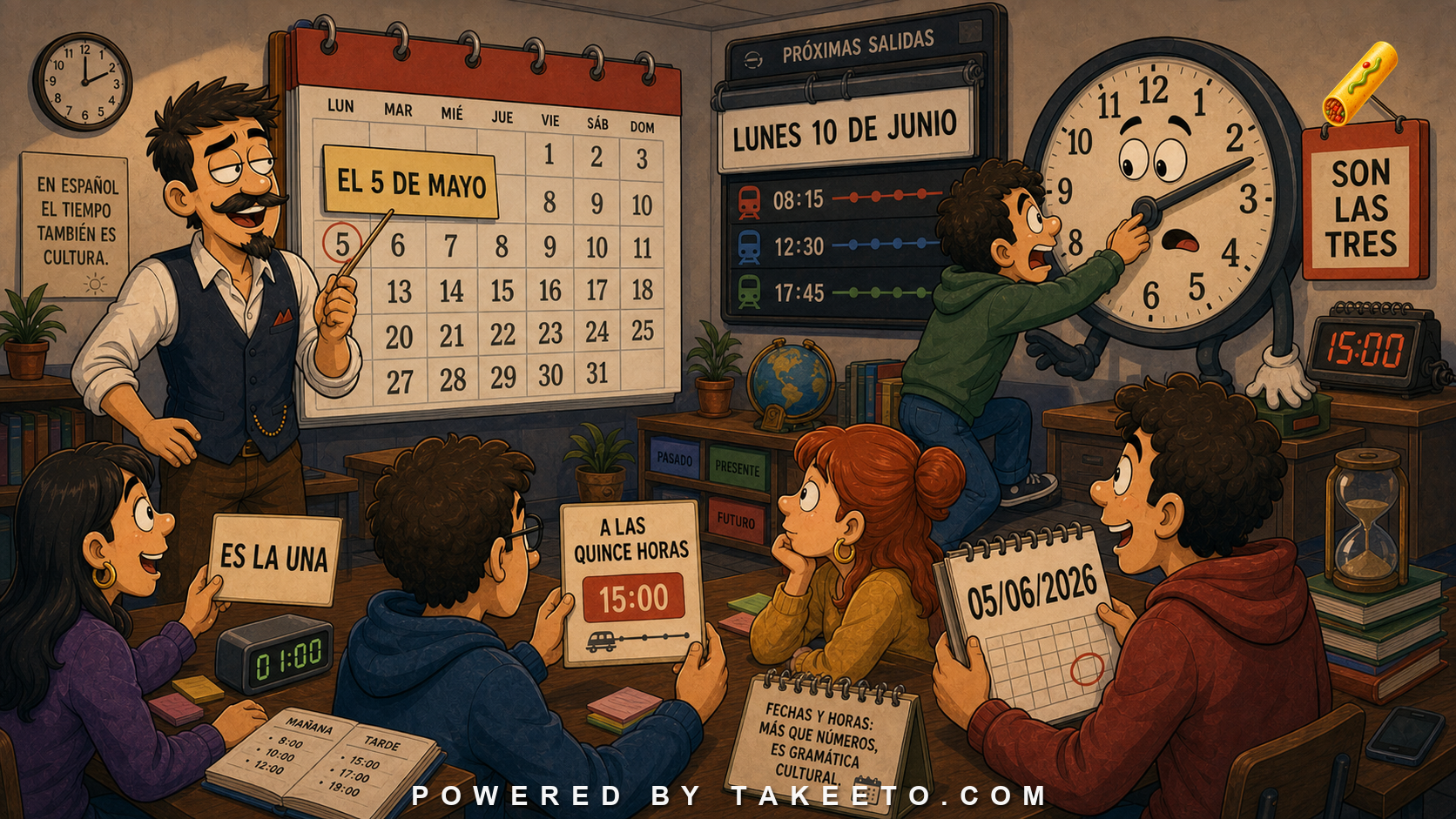
Time expressions are grammar plus convention
Dates and times look mechanical until they cause real confusion. A date such as 05/06/2026 may be read as June 5 by an American English reader and as 5 June by many Spanish-speaking readers. A time such as 15:00 may be natural in an official schedule but not in casual conversation. Spanish says son las tres but es la una. It says el 5 de mayo, not mayo 5 as a normal Spanish date phrase.
Time language is not just vocabulary. It is cultural formatting plus grammar.
The first rule:
Spanish normally orders dates from smaller unit to larger unit: day, month, year.
The second rule:
Clock time uses ser and agrees with the hour expression: es la una, son las dos.
Dates: day de month de year
The standard Spanish date phrase is:
el 5 de mayo de 2026
May 5, 2026
Literally, the structure is:
the 5 of May of 2026
Examples:
el 12 de octubre
October 12
el 27 de mayo de 2026
May 27, 2026
Nació el 3 de marzo de 1998.
He/she was born on March 3, 1998.
Spanish does not normally write:
mayo 5, 2026
in ordinary Spanish prose. Use the Spanish order.
The article in dates
Spanish commonly uses el before date numbers:
el 5 de mayo
el 20 de enero
For today’s date in a document, one may see formulaic styles:
Madrid, 27 de mayo de 2026
or:
En Madrid, a 27 de mayo de 2026
The article may be absent in some formal heading formulas, but in ordinary sentences it is common:
La reunión será el 10 de junio.
The meeting will be on June 10.
For the first day of the month, Spanish often uses primero:
el primero de enero
Cardinal uno is also possible in some varieties and contexts, especially in numerical expression, but primero is widely used in speech for the first day.
Numeric date risk
A numeric date like:
05/06/2026
is dangerous in bilingual contexts. In many Spanish-speaking settings it means 5 June 2026. In U.S. English it often means May 6, 2026.
The best practice in international contexts is to write the month in words:
5 de junio de 2026
or use an unambiguous ISO-style format when appropriate:
2026-06-05
But even ISO formats need context if the audience is not used to them. For human-facing communication, spelling the month often prevents costly errors.
Days of the week in dates
Spanish can include the day of the week:
lunes 10 de junio
Monday, June 10
el lunes 10 de junio
on Monday, June 10
In Spanish, days and months are normally lowercase unless they begin a sentence or form part of an official name or holiday. Thus:
lunes, martes, miércoles
enero, febrero, marzo
not English-style routine capitalization.
Clock time with ser
Spanish uses ser for clock time:
Es la una.
It is one o’clock.
Son las dos.
It is two o’clock.
Son las tres y media.
It is three thirty.
Why es for one and son for others? Because la una is singular and las dos/tres/cuatro are plural hour expressions.
Use a for “at” a time:
La reunión es a las tres.
The meeting is at three.
Salimos a la una.
We leave at one.
El tren llega a las ocho y cuarto.
The train arrives at quarter past eight.
Minutes: y and menos
Common time expressions include:
las tres y cinco
3:05
las tres y cuarto
3:15
las tres y media
3:30
las cuatro menos cuarto
3:45, literally quarter to four
In much of the Americas, speakers may use cuarto para:
un cuarto para las cuatro
quarter to four
Regional habits vary. Learners should understand both menos cuarto and cuarto para where relevant.
For exactness, especially in schedules, digital time is common:
15:30
quince treinta / las quince treinta in formal contexts, or three thirty in 12-hour conversational style depending on region
De la mañana, de la tarde, de la noche
Spanish often uses:
de la mañana
in the morning
de la tarde
in the afternoon/evening
de la noche
at night
Examples:
Son las nueve de la mañana.
It is nine in the morning.
La clase empieza a las cinco de la tarde.
Class starts at five in the afternoon.
Llegó a las diez de la noche.
He/she arrived at ten at night.
The boundaries between tarde and noche vary culturally and pragmatically. Do not expect exact equivalence with English “afternoon” and “evening.”
24-hour time and official contexts
Official schedules, transportation, military/police contexts, medical appointments, and forms often use 24-hour time:
14:00
18:30
22:15
In formal writing, one may see:
a las 15:00 horas
at 15:00 hours
or:
a las quince horas
Avoid mixing formats awkwardly. If writing in words, write in words. If writing in digits, keep the format consistent.
Less recommended mixed style:
las 10 de la noche
Better depending on context:
las diez de la noche
las 22:00
This is a style issue more than basic grammar, but it matters in polished writing.
Duration vs clock time
Spanish distinguishes when something happens from how long it lasts.
When:
a las tres
at three
Duration:
durante tres horas
for three hours
por tres horas
for three hours, common in some varieties/contexts
Elapsed time:
desde hace tres horas
for three hours now / since three hours ago
Deadline:
para las tres
by three
Endpoint:
hasta las tres
until three
Do not treat every English for, by, until, and at as the same preposition. Time expressions are prepositional grammar.
Time in narration
Spanish uses clock and date expressions to structure narrative:
A las ocho salimos del hotel.
At eight we left the hotel.
El lunes siguiente empezó el juicio.
The following Monday the trial began.
Tres días después recibimos la respuesta.
Three days later we received the answer.
Para entonces ya habíamos terminado.
By then we had already finished.
Time expressions do more than state facts. They order events, create expectations, and place narrative reference points.
Common learner errors
Error 1: English date order
mayo 5
Correct:
el 5 de mayo
Error 2: Capitalizing months and days by English habit
Lunes 10 de Junio in the middle of a sentence
Correct:
lunes 10 de junio
Error 3: Using estar for clock time
Está la una.
Correct:
Es la una.
Son las tres.
Error 4: Forgetting singular/plural agreement
Son la una.
Correct:
Es la una.
Error 5: Ambiguous numeric dates
For international audiences, write:
5 de junio de 2026
not only:
05/06/2026
Diagnostic workflow: distinguish date, appointment time, duration, and deadline
Spanish time expressions become easier when you classify the temporal relation.
Date:
el 5 de mayo
el lunes 10 de junio
Appointment time:
a las tres
a la una
a las 15:30
Duration:
durante tres horas
por tres horas, common in some varieties and contexts
Deadline:
para el viernes
para las cinco
Endpoint:
hasta el viernes
hasta las cinco
Starting point:
desde el lunes
desde las ocho
Current duration:
desde hace tres años
desde hace dos horas
This classification prevents preposition errors. English “for” can correspond to durante, por, or desde hace depending on meaning. English “by Friday” is para el viernes, while “until Friday” is hasta el viernes.
For clock time, remember the article and verb agreement:
es la una
son las dos
a la una
a las dos
For written dates, prefer clarity over compactness in international contexts:
6 de mayo de 2026
This avoids the 05/06 problem. If a form requires digits, follow the local or institutional format exactly.
For polished prose, avoid mixing word and digit styles without reason. Las diez de la noche and las 22:00 are cleaner than las 10 de la noche in many edited contexts, though mixed forms are common in everyday writing. The right choice depends on genre: a novel, a text message, a flight itinerary, and a legal notice do not format time the same way.
Temporal translation risk: when English categories mislead
Several English time habits create Spanish errors. The first is date order. A U.S. English speaker may see 06/07/2026 and assume June 7, while a Spanish document may intend 6 July. Whenever the audience is international, spelling out the month is safer:
6 de julio de 2026
The second risk is “on.” English uses “on Monday,” “on May 5,” and “on the weekend” in ways Spanish does not copy mechanically. Spanish often uses the article alone for days and dates:
el lunes
el 5 de mayo
But it uses en with months and many broader periods:
en mayo
en 2026
The third risk is a.m./p.m. ambiguity around noon and midnight. In critical contexts, use mediodía, medianoche, or 24-hour time rather than relying on 12 a. m. or 12 p. m. conventions that readers may interpret differently.
The fourth risk is clock-time agreement:
es la una
son las dos
This is not about the number of clocks. It is agreement with the hour expression. Learners who say son la una are mixing the plural pattern with the singular hour.
The fifth risk is register. A train schedule, wedding invitation, legal notice, WhatsApp message, and medical appointment may format time differently. A las quince horas is clear and formal; a las tres de la tarde is ordinary conversational Spanish; 15:00 h is compact schedule notation. Good Spanish time usage means choosing the format that belongs to the situation.
Deadlines, time zones, and exact endpoints
In real documents, time expressions also define legal or practical endpoints. Hasta el viernes may include Friday in ordinary interpretation, but exact deadlines should specify time if ambiguity matters.
hasta el viernes a las 17:00 h
until Friday at 5:00 p.m.
antes del 10 de junio
before June 10
a más tardar el 10 de junio
no later than June 10
International work adds time zones:
15:00 h, hora de Madrid
15:00 Madrid time
When stakes are high, do not rely on vague phrases like por la tarde or al final del día. Spanish has precise tools; use them.
Contrast lab: el lunes, para el lunes, hasta el lunes
The same calendar noun changes meaning with the preposition:
Nos vemos el lunes.
We will see each other on Monday.
Entrégalo para el lunes.
Turn it in by Monday.
La oficina está cerrada hasta el lunes.
The office is closed until Monday.
Trabajo desde el lunes.
I have been working since Monday / I work from Monday onward, depending on context.
English prepositions are not reliable guides. By Monday is not por lunes. Until Monday is not para lunes. Spanish temporal prepositions encode boundaries: para sets a deadline, hasta sets an endpoint, desde sets a starting point, and the bare article el can mark the day on which something happens.
The same applies to hours:
a las cinco = at five
para las cinco = by five
hasta las cinco = until five
desde las cinco = since/from five
This boundary logic is more useful than memorizing translations one phrase at a time.
V2 remediation refinement: date, clock time, duration, and deadline are different objects
English compresses many temporal expressions into similar-looking phrases. Spanish makes different choices depending on whether you are naming a date, reading a clock, measuring duration, or setting a deadline.
Date:
el 5 de mayo de 2026
5 May 2026 / May 5, 2026
Clock time:
a las tres
at three o’clock
Duration:
durante tres horas / por tres horas, depending on variety and context
for three hours
Deadline:
para el viernes
by Friday / for Friday
Endpoint:
hasta el viernes
until Friday
This distinction matters in real communication. La entrega es para el viernes means the deliverable is due for/by Friday. La entrega es hasta el viernes may suggest the process remains open until Friday in some varieties, but it is not the same default deadline expression everywhere.
Clock time needs its own agreement rule:
Es la una.
Son las dos.
Es la una y media.
Son las tres menos cuarto.
The singular es belongs to la una; plural son belongs to the other hours. Do not write son la una.
Official time often uses the 24-hour model:
La reunión será a las 15:30 h.
El vuelo sale a las 07:45.
Narrative prose often prefers words when exact technical precision is not central:
Llegó a las ocho de la noche.
The remediation workflow is practical: before translating, label the temporal expression as date, clock time, duration, deadline, interval, or endpoint. Then choose the Spanish structure. This prevents many errors that look small but cause missed meetings, wrong dates, and bad form entries.
Suggested interactive module: date/time parser
A useful tool would convert between formats and flag ambiguity.
Suggested functions:
- Date parser: detects whether 05/06/2026 is ambiguous by locale.
- Spanish phrase builder: el 5 de mayo de 2026.
- Clock grammar checker: es la una, son las dos, a las tres.
- Register toggle: casual speech, official schedule, legal document, travel itinerary.
- Lowercase checker: days, months, seasons.
Example input:
May 6, 2026 at 3:30 PM
Output:
el 6 de mayo de 2026 a las tres y media de la tarde or el 6 de mayo de 2026 a las 15:30, depending on register.
Final rule
Spanish dates normally run day-month-year: el 5 de mayo de 2026. Days and months are lowercase in ordinary use. Clock time uses ser: es la una, son las tres. Use a for “at” a time: a las cinco.
In bilingual contexts, do not trust numeric dates alone. Spell the month when accuracy matters.