
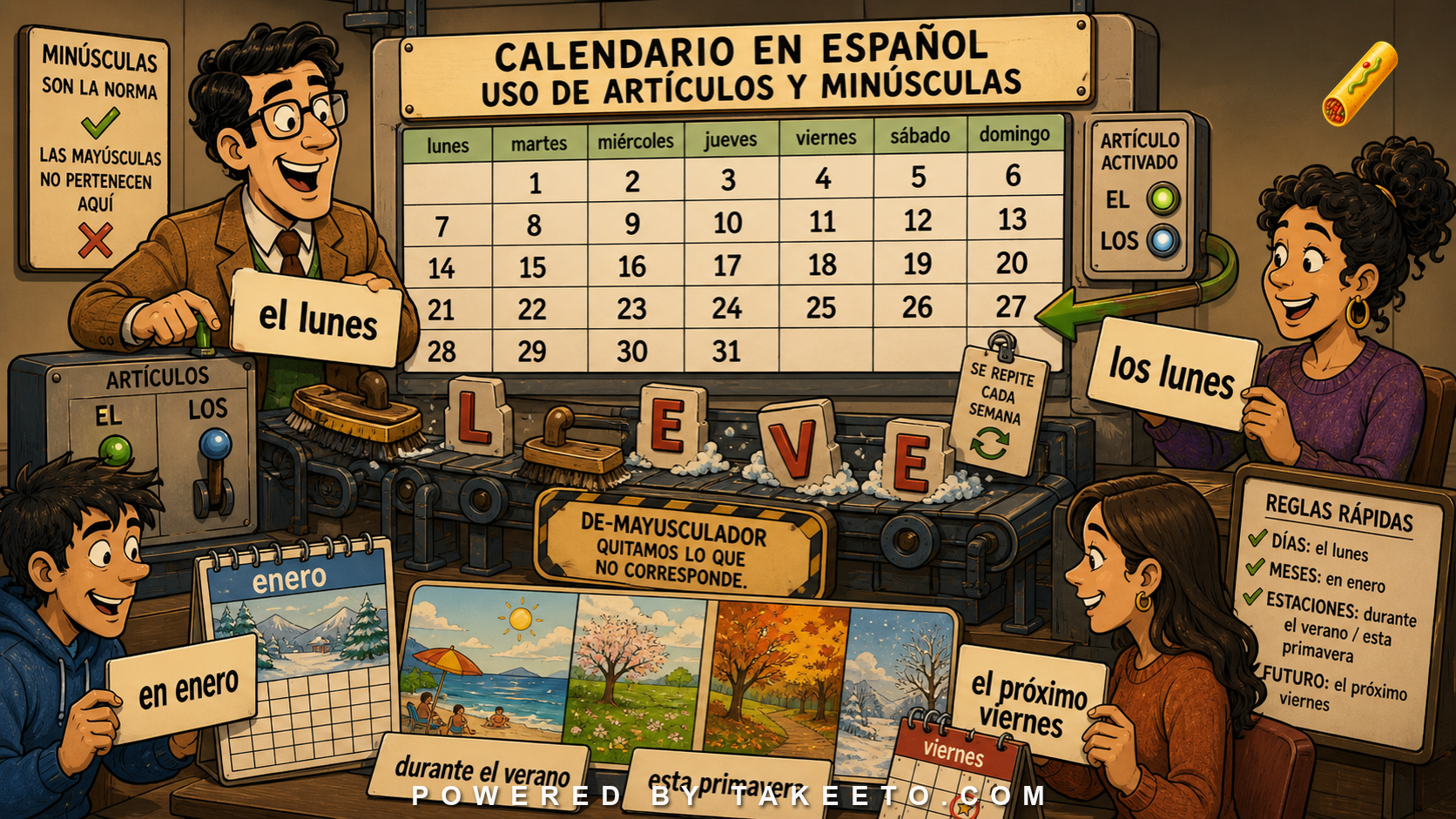
Calendar words are small but easy to anglicize
Spanish calendar vocabulary looks simple:
lunes, martes, miércoles
enero, febrero, marzo
primavera, verano, otoño, invierno
But learners often import English habits into capitalization and article use. They write Lunes and Enero in the middle of a sentence. They omit articles where Spanish expects them. They confuse el lunes with los lunes. They overuse en with days. They translate “next Friday” too mechanically.
The grammar is not difficult, but it is precise.
Two rules carry much of the system:
Days, months, and seasons are normally lowercase in Spanish.
Singular articles with days often mean one specific day; plural articles often mean habitual recurrence.
Lowercase days, months, and seasons
In ordinary Spanish writing, the names of weekdays, months, and seasons are lowercase unless they begin a sentence or form part of an official proper name.
Hoy es lunes.
Today is Monday.
Nació en enero.
He/she was born in January.
Viajaremos en verano.
We will travel in summer.
English capitalizes Monday, January, and Summer in some title contexts. Spanish does not do this routinely.
Correct:
La reunión será el martes 14 de abril.
Not ordinary Spanish style:
La reunión será el Martes 14 de Abril.
Capitalization can appear in names of holidays, events, institutions, or historical labels:
Viernes Santo
Holy Friday / Good Friday
Primavera de Praga
Prague Spring
But the ordinary words remain lowercase in normal calendar use.
Days of the week with articles
Spanish commonly uses the definite article with days of the week.
La reunión es el lunes.
The meeting is on Monday.
Salimos el viernes.
We leave on Friday.
Here el lunes and el viernes usually refer to a specific upcoming or contextually identified day.
For habitual events, use the plural article:
Trabajo los lunes.
I work on Mondays.
Tenemos clase los martes y jueves.
We have class on Tuesdays and Thursdays.
The contrast is important:
| Spanish | Meaning |
|---|---|
| Voy el lunes. | I am going on Monday. |
| Voy los lunes. | I go on Mondays. |
| La tienda cierra el domingo. | The store closes this Sunday / on the relevant Sunday. |
| La tienda cierra los domingos. | The store is closed on Sundays. |
In context, singular day expressions can also refer to habitual institutional schedules, but los lunes is the standard learner pattern for “on Mondays.”
No preposition for “on Monday”
English says “on Monday.” Spanish usually uses the article without en:
el lunes
on Monday
los viernes
on Fridays
Do not translate directly:
en lunes as the normal equivalent of “on Monday”
Use:
Nos vemos el lunes.
See you on Monday.
There are expressions with en and day names, but they have special meanings or appear in fixed contexts:
en lunes
on a Monday, with emphasis on the kind of day, often in expressions like caer en lunes
El feriado cae en lunes.
The holiday falls on a Monday.
For ordinary scheduling, use el/los.
Months with en and de
Spanish uses en for events within a month:
en enero
in January
en mayo
in May
La conferencia será en septiembre.
The conference will be in September.
In full dates, Spanish uses de:
el 5 de mayo
May 5
el 12 de octubre de 2026
October 12, 2026
Do not mix English order and Spanish prepositions:
mayo 5
en mayo 5
Correct:
el 5 de mayo
When referring to a month as a noun with modifiers, articles can appear:
el enero más frío de la década
the coldest January of the decade
But ordinary month naming uses no article:
Nació en enero.
Seasons with en, durante, and articles
Season expressions vary more than month expressions.
Common patterns include:
en primavera
in spring
en verano
in summer
en otoño
in autumn/fall
en invierno
in winter
Articles are also common depending on phrase and variety:
en el verano
in the summer
durante el invierno
during the winter
este verano
this summer
la primavera pasada
last spring
A useful learner map:
| Meaning | Common Spanish |
|---|---|
| in summer, generally | en verano |
| during the summer | durante el verano |
| this summer | este verano |
| last spring | la primavera pasada |
| next winter | el próximo invierno / el invierno que viene |
Do not assume one article rule covers every seasonal expression. Seasons behave like ordinary nouns when modified, specified, or discussed as periods.
Próximo, que viene, pasado
Spanish has several ways to say “next” and “last.”
el próximo viernes
next Friday / the coming Friday
el viernes que viene
next Friday
el viernes pasado
last Friday
la semana que viene
next week
la semana pasada
last week
Próximo can be ambiguous in some contexts, just as “next” can be ambiguous in English. If today is Wednesday and someone says el próximo viernes, do they mean this coming Friday or Friday of next week? Many speakers use it for the upcoming Friday, but context matters. Este viernes may be clearer for the nearest Friday.
Examples:
Nos vemos este viernes.
We will see each other this Friday.
Nos vemos el viernes que viene.
We will see each other next Friday / the coming Friday, depending on context.
When precision matters, use the date:
Nos vemos el viernes 29 de mayo.
Cada, todos los, and habitual schedules
Habitual recurrence can be expressed with cada or todos los/todas las.
cada lunes
every Monday
todos los lunes
every Monday / on Mondays
cada verano
every summer
todos los veranos
every summer
Cada treats occurrences one by one. Todos los emphasizes the whole repeated set. Often both are possible:
Voy al gimnasio cada martes.
I go to the gym every Tuesday.
Voy al gimnasio todos los martes.
I go to the gym every Tuesday.
In ordinary speech, todos los martes is very common for recurring schedules.
Calendar phrases in notices
Spanish notices often compress time information:
Cerrado los lunes.
Closed on Mondays.
Abierto de martes a domingo.
Open Tuesday through Sunday.
Horario de verano.
Summer hours.
Matrícula abierta hasta el 30 de junio.
Enrollment open until June 30.
These phrases may omit verbs because signage favors compact noun/preposition structures. Learners should not expect every calendar phrase to be a full sentence.
Common learner errors
Error 1: Capitalizing by English habit
Nos vemos el Lunes en Enero.
Correct:
Nos vemos el lunes en enero.
Error 2: Using en for ordinary days
Nos vemos en lunes.
Correct:
Nos vemos el lunes.
Error 3: Confusing one-time and habitual days
Trabajo el lunes.
I work on Monday.
Trabajo los lunes.
I work on Mondays.
Error 4: Overgeneralizing article rules for seasons
Both en verano and en el verano may appear depending on region and context. Learn phrases rather than forcing a single English-like rule.
Error 5: Leaving “next Friday” ambiguous in important contexts
Use a date when necessary:
el viernes 29 de mayo
Diagnostic workflow: one day, repeated day, or named date?
When translating an English day phrase, first decide whether it refers to one occurrence, a repeated schedule, or a date label.
One occurrence:
See you on Monday. → Nos vemos el lunes.
Repeated schedule:
We meet on Mondays. → Nos reunimos los lunes.
Named date:
Monday, June 10 → lunes 10 de junio
This prevents the common error of using en for all English on. Spanish ordinary scheduling uses the article:
el martes
los martes
Use en with months:
en abril
Use de inside full dates:
el 12 de abril
With seasons, choose the phrase that matches the meaning:
en verano = in summer, generally
durante el verano = during the summer
este verano = this summer
el verano pasado = last summer
For formal writing, run a capitalization check. If the word is an ordinary weekday, month, or season, keep it lowercase:
el próximo viernes de enero
durante el invierno
Capitalize only when another rule requires it: sentence beginning, official name, holiday, historical event, institution, or title.
Finally, be careful with próximo. If the timing could be ambiguous, add the date:
el próximo viernes, 29 de mayo
Calendar language is often used for appointments, deadlines, and travel. Ambiguity is not harmless. The most natural phrase is not always the safest phrase when scheduling matters.
Schedule-reading routine for real notices
Calendar phrases in real Spanish often appear without full sentences. A sign may say:
Cerrado los lunes.
Abierto de martes a sábado.
Atención al público hasta el 30 de septiembre.
To read these quickly, identify the time pattern first.
Los + day plural usually marks habitual weekly repetition:
los lunes = on Mondays
los sábados = on Saturdays
El + day singular usually marks one specific day:
el lunes = on Monday
De + day/month + a + day/month marks a range:
de lunes a viernes
de enero a marzo
Hasta + date/time marks an endpoint:
hasta el 15 de mayo
hasta las seis
Desde + date/time marks a starting boundary:
desde el 1 de junio
desde las nueve
This routine helps in museums, clinics, universities, offices, and transportation systems. It also prevents a common mistake: reading cerrado los lunes as a one-time closure. It means the place is closed every Monday.
When producing schedules, keep the same logic:
Clases los martes y jueves.
Classes on Tuesdays and Thursdays.
Inscripción abierta hasta el viernes.
Registration open until Friday.
Reuniones de marzo a junio.
Meetings from March to June.
Small calendar words carry operational meaning. In real life, that meaning affects whether you show up on the right day.
Modified calendar nouns
Calendar words often change article behavior when they are modified. Compare:
en enero
in January
en el enero más frío de los últimos años
in the coldest January of recent years
The article appears because enero is no longer just a bare month name; it is a specific characterized period. The same happens with seasons:
en verano
in summer
en el verano de 2026
in the summer of 2026
This pattern helps explain why learners see both article and no-article forms. The question is not “Does this word take an article?” but “Is the time period being named generally or specified as a particular instance?”
Applied contrast: deadlines and calendar expectations
Calendar phrases often imply expectations. Para el viernes sets Friday as a deadline or target:
Necesito el informe para el viernes.
I need the report by Friday.
El viernes simply locates the event:
Presento el informe el viernes.
I present the report on Friday.
Hasta el viernes marks the endpoint of a period:
Tienes hasta el viernes.
You have until Friday.
These differences matter in schools, workplaces, visas, rent, and medical instructions. A learner who confuses el, para, and hasta may misunderstand not just grammar but obligation.
Contrast lab: article choice with schedules
Compare these schedule statements:
La clase es el martes.
Class is on Tuesday.
La clase es los martes.
Class is on Tuesdays. This is common in many areas, though some speakers may prefer hay clase los martes or tenemos clase los martes.
Tenemos clase todos los martes.
We have class every Tuesday.
Tenemos clase cada martes.
We have class each Tuesday.
The article is not ornamental. El martes points to one Tuesday. Los martes makes the day plural and habitual. Todos los martes makes recurrence explicit. Cada martes views each occurrence individually.
For notices, Spanish often drops the full sentence:
Cerrado los lunes.
Abierto de martes a sábado.
Horario especial en agosto.
This compressed style is normal on signs. In a full email, you may prefer complete clauses:
La oficina estará cerrada los lunes de agosto.
Matching register matters as much as choosing the right article.
V2 remediation refinement: lowercase is the default, not the whole rule
The main orthographic rule is clear: Spanish writes days, months, and seasons with lowercase initials in ordinary use.
lunes
enero
primavera
The remediation pass adds the exception pattern: capitalization appears when the calendar word is part of a larger proper name, holiday, historical event, institution, street name, or title.
Compare:
Nos vemos el viernes.
We will see each other on Friday.
Viernes Santo
Good Friday
Nació en mayo.
He/she was born in May.
plaza del Dos de Mayo
Plaza del Dos de Mayo
Me gusta la primavera.
I like spring.
Primavera de Praga
Prague Spring
Learners who memorize only “lowercase always” can overcorrect proper names. Learners who import English capitalization overcapitalize ordinary dates. The real rule is default lowercase, proper-name capitalization when the calendar term belongs to a fixed name.
Article choice with days also deserves a repair table:
| Meaning | Spanish |
|---|---|
| this coming/specific Monday | el lunes |
| Mondays habitually | los lunes |
| every Monday | todos los lunes / cada lunes |
| Monday as a date label | lunes 10 de junio |
| by Monday | para el lunes |
| until Monday | hasta el lunes |
No English on is needed:
Trabajo el lunes.
Trabajo los lunes.
The article does the work that English often assigns to a preposition or plural marker. A strong learner should therefore edit calendar phrases for three things: capitalization, article choice, and deadline/endpoint meaning.
Suggested interactive module: calendar phrase builder
A useful tool would convert English calendar phrases into Spanish with article and capitalization guidance.
Suggested functions:
- One-time vs habitual selector: el lunes vs los lunes.
- Lowercase checker: days, months, seasons.
- Season phrase options: en verano, durante el verano, este verano.
- Ambiguity warning: próximo viernes vs a specific date.
- Notice style: full sentence vs sign-style phrase.
Example input:
We are closed on Mondays in August.
Output:
Cerramos los lunes en agosto or sign style Cerrado los lunes en agosto.
Final rule
Spanish days, months, and seasons are normally lowercase. Use el lunes for one specific Monday and los lunes for Mondays in general. Use en enero for months, el 5 de mayo for dates, and common seasonal phrases such as en verano, durante el invierno, and este otoño.
Calendar grammar looks small, but it is one of the places where English habits show immediately. Edit it carefully.