
A dictionary entry is a map, not a verdict
Learners often use dictionaries as if each word had one answer. They search a word, grab the first translation or definition, and move on. This works for some simple cases, but it fails quickly with Spanish. Many words have multiple meanings, regional labels, register labels, grammatical patterns, pronominal uses, and example sentences that matter more than the first gloss.
A dictionary entry may include:
lema, categoría gramatical, acepciones, marcas de uso, ejemplos, sinónimos, régimen preposicional, variantes regionales.
This is structured data. The learner’s job is to read the structure.
The key principle is:
A Spanish dictionary does not give “the meaning.” It gives organized possibilities with evidence and labels.
Lema and headword
Lema is the headword or dictionary form.
For verbs, the lemma is usually the infinitive:
hablar, comer, vivir
For nouns and adjectives, the lemma is typically masculine singular where applicable:
bonito, alto, trabajador
A learner seeing trabajadoras must know to look under trabajador. A learner seeing se arrepintió must know to look under arrepentirse or arrepentir depending on dictionary structure.
Acepción: numbered meanings
Acepción means a specific sense or meaning of a word.
A word may have several numbered definitions. The first is not always the one you need. Dictionaries may order meanings by frequency, historical development, or editorial choice.
Example with a word like banco:
financial institution
bench
sandbank / shoal
Context decides. The dictionary lists possibilities; the sentence chooses.
Category labels
Dictionaries mark part of speech:
sustantivo
noun
adjetivo
adjective
verbo transitivo
transitive verb
verbo intransitivo
intransitive verb
pronominal
pronominal
adverbio
adverb
These labels are not decoration. If a verb is transitivo, it commonly takes a direct object. If a verb is pronominal, it uses a reflexive-looking pronoun as part of its construction.
Compare:
acordar algo
to agree on something
acordarse de algo
to remember something
The dictionary label helps prevent a serious mistake.
Register labels
Register labels tell where a word fits socially.
Common labels:
coloquial
colloquial
vulgar
vulgar / coarse
formal
formal
literario
literary
despectivo
derogatory
eufemístico
euphemistic
técnico
technical
If a dictionary marks a word vulgar, do not use it because it sounds “authentic.” If it marks a word literario, it may sound strange in daily speech. If it marks despectivo, the word may carry contempt.
Regional labels
Spanish dictionaries may mark regions:
Am.
America / Latin America broadly
Méx.
Mexico
Arg.
Argentina
Chile
Chile
Esp.
Spain
Ant.
Antilles, depending on dictionary
A regional label does not always mean “only used there.” It may mean especially used there, or used with that meaning there. Dictionary labels simplify messy reality.
A learner should read them as caution, not absolute walls.
Examples are often more valuable than definitions
Definitions explain. Examples show grammar, collocation, register, and context.
A definition may say aplicar means “to apply.” But examples reveal whether Spanish uses solicitar for applying for a job or aplicar for applying a rule or cream.
Good dictionary use means reading example sentences carefully:
aplicar una norma
apply a rule
solicitar un empleo
apply for a job
The example prevents translationese.
Synonyms are not interchangeable
Sinónimo means synonym, but synonyms differ by register, region, grammar, and collocation.
Words like casa, hogar, vivienda, and domicilio can overlap, but they are not identical.
casa
house/home in everyday speech
hogar
home with emotional/social sense
vivienda
housing/dwelling in policy or legal contexts
domicilio
legal or administrative address/residence
A synonym list is a starting point, not permission to substitute freely.
Monolingual, bilingual, learner, and corpus dictionaries
Different dictionaries serve different tasks.
Bilingual dictionaries help with initial translation but can hide usage.
Monolingual dictionaries help with Spanish definitions, register, and senses.
Learner dictionaries often provide clearer examples and grammar patterns.
Corpus dictionaries or corpus-linked tools show real usage frequency and collocations.
A serious learner uses more than one kind.
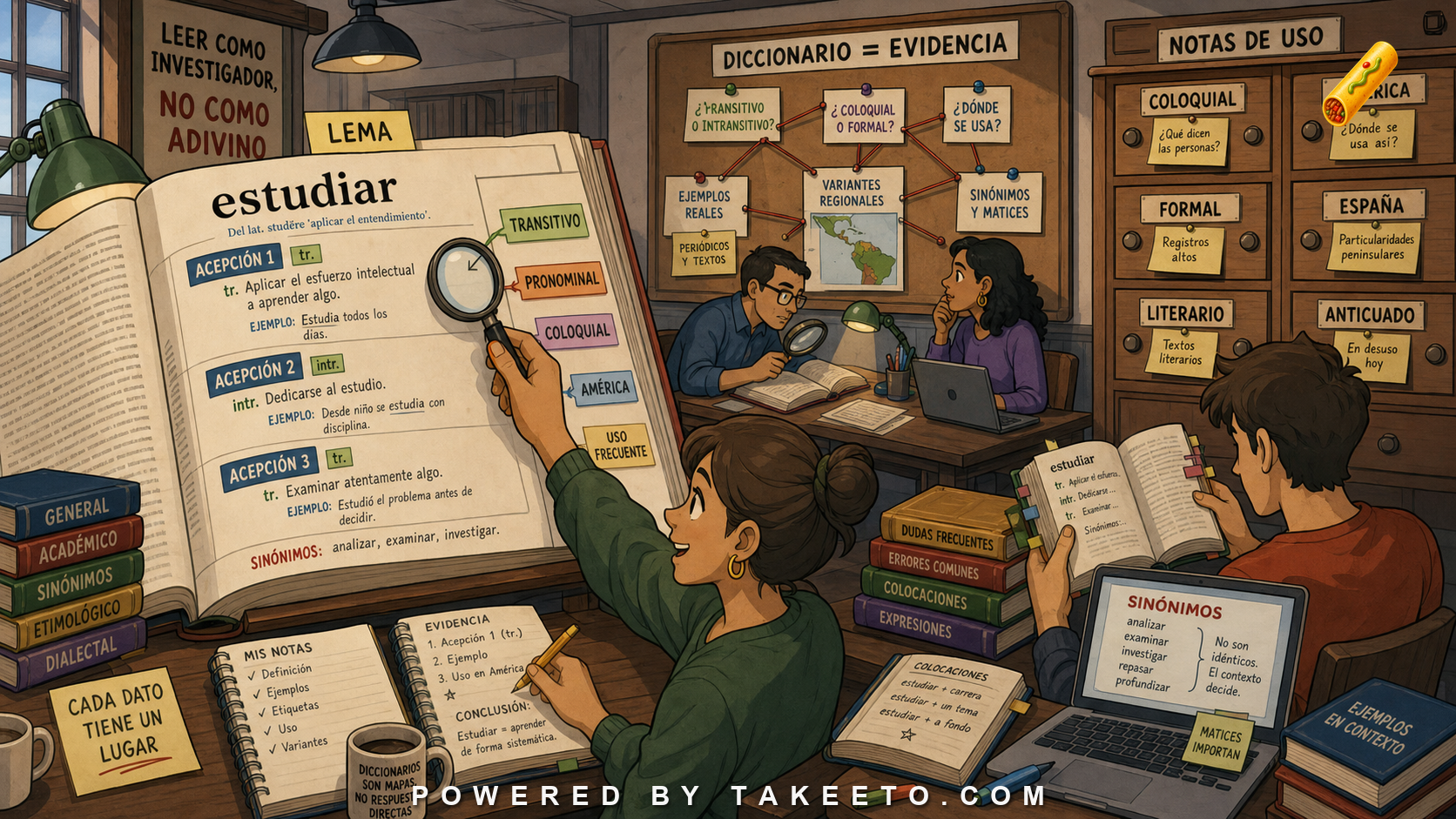
Example bank walkthrough
Lema is the dictionary headword.
Acepción is one numbered sense.
Transitivo tells you the verb usually takes a direct object.
Pronominal tells you the pronoun is part of the construction.
Coloquial warns about informal register.
América or country labels warn about regional distribution.
Ejemplo shows real or model usage.
Sinónimo suggests related words, not automatic replacements.
Dictionary-entry reading workflow
- Identify the lemma.
- Confirm part of speech.
- Read all relevant senses, not only the first.
- Check register labels.
- Check region labels.
- Read examples.
- Notice grammar patterns and prepositions.
- Compare synonyms cautiously.
- Check a second source for high-stakes use.
- Save the word in a phrase, not alone.
Mini-workshop: read below the first definition
Choose a common word with multiple meanings, such as banco, planta, carta, or cuenta. Read all numbered senses and write one sentence for each meaning. Then mark register and region labels. This simple exercise cures the habit of grabbing the first definition. It also shows why context is not optional: the dictionary lists possibilities, but the sentence chooses the meaning.
Dictionary-entry audit
Before using a new word in writing, audit the entry. Ask: What is the part of speech? Is the word transitive, intransitive, or pronominal? Is there a preposition pattern? Are there regional labels? Is the register safe? Are examples close to my intended context?
For verbs, this is especially important. Fijarse en, acordarse de, soñar con, depender de, consistir en, and carecer de cannot be learned from a single English gloss. The dictionary entry may show the construction directly. If it does, copy the construction, not just the translation.
For nouns, note countability, gender, and domain. El capital and la capital differ. El cólera and la cólera differ. La orden and el orden differ. A dictionary entry can save you from errors that no synonym list will fix.
The remediation habit is simple: every lookup should end with a phrase you can trust.
Remediation drill: read one dictionary entry as a map
Pick a common word such as quedar, llevar, tratar, falta, cargo, or cuenta. Do not look for the English equivalent. Instead, map the entry. Write the headword, part of speech, major senses, pronominal uses, regional labels, register labels, and example phrases.
For quedar, you may find uses involving location, remaining, agreement to meet, result, fit, impression, and pronominal forms. Examples matter:
Quedamos a las seis.
Me queda bien.
Quedan tres entradas.
La casa queda lejos.
A bilingual gloss cannot handle that range. A dictionary map can.
Now return to a real sentence and select the sense. Do not carry every possible meaning into the context. If the sentence is Me queda bien la chaqueta, the relevant sense concerns fit or suitability, not remaining quantity or meeting arrangement.
For production, collect collocations from examples. A dictionary that gives darse cuenta de, tener en cuenta, a cargo de, or echar en falta is giving you ready-made Spanish behavior. Put those phrases into your notes as phrases, not isolated nouns.
This is how dictionary work becomes advanced study instead of emergency lookup.
Editorial remediation note
Dictionary literacy is one of the cleanest ways to move beyond intermediate guessing. The article should train the reader to slow down at precisely the moment they want speed. Look at labels. Compare senses. Read examples. Notice pronominal uses and regional notes. Then return to the sentence. The dictionary is not a vending machine for English equivalents; it is a structured map of usage.
Suggested interactive module: dictionary-entry anatomy diagram
A strong tool would teach dictionary literacy by annotation.
Suggested functions:
- Entry parser: lemma, category, sense, labels, examples.
- Label glossary: colloquial, vulgar, regional, technical, pronominal.
- Sense-selection quiz: choose meaning from context.
- Collocation field: common verb-noun and preposition patterns.
- Synonym warning: why related words differ.
- Corpus check link: sample real sentences by register.
- Learner note export: phrase, meaning, region, register.
Applied dictionary drill: do not choose the first sense
Suppose you look up banco. You may see senses for financial institution, bench, shoal, database bank, or workbench depending on the dictionary. In the sentence:
Nos sentamos en un banco frente al museo.
The sense is bench, not bank. In:
El banco aprobó el préstamo.
The sense is financial institution. The dictionary did not change; the context selected the sense. This is why acepción matters. Serious dictionary use is sense selection, not word recognition.
Remediation focus: reading dictionary entries as structured evidence instead of quick answer boxes
A dictionary entry is not just a translation. It is a compact data structure. It may include lema, part of speech, pronunciation, inflection, definitions, numbered senses, region labels, register labels, examples, collocations, synonyms, antonyms, etymology, and usage notes. Learners who scan only the first equivalent often choose the wrong word.
The remediation task is to slow down and read the entry architecture. If banco has multiple senses, the first one may not be the one in your sentence. If a term is labeled coloquial, despectivo, vulgar, Am., Méx., Esp., p. us., or tecn., the label is part of the meaning. Dictionary literacy is reference literacy.
Common failure modes to repair
- Choosing the first bilingual equivalent: Bilingual dictionaries list possibilities, not commands.
- Skipping part of speech: A noun sense cannot always solve a verb context. A pronominal verb may not behave like a simple transitive verb.
- Ignoring labels: Region and register labels prevent embarrassing or inaccurate use.
- Treating examples as decorative: Examples show syntax, collocation, and register more reliably than isolated definitions.
Before/after: repair a dictionary-based word choice
Weak version:
I applied for a job → Apliqué para un trabajo.
Stronger version:
I applied for a job → Solicité un empleo / Presenté una solicitud de empleo.
A dictionary may show aplicar in some contexts, but standard Spanish for job applications often uses solicitar or presentar una solicitud. The entry must be checked for sense, region, and collocation.
Upgrade workshop: dictionary-entry workflow
- Identify the lemma. For verbs, look up the infinitive; for inflected forms, recover the base form.
- Check part of speech before meaning.
- Read all senses that could fit the context, not only the first.
- Check labels for region, register, domain, and usage.
- Study examples and copy one collocation into your notes.
- If writing, confirm the candidate in a corpus or reputable examples.
Quality-control checklist
- Does tr., intr., or prnl. change the construction?
- Does the entry distinguish literal and figurative senses?
- Does the example sentence match your register?
- Is the word common in the target country?
- Does a monolingual entry reveal a meaning that the bilingual equivalent hides?
Applied remediation drill: use labels before choosing a dictionary equivalent
Use this source-style excerpt:
colar. tr. Pasar un líquido por un colador. prnl. Introducirse en un lugar o fila sin permiso. coloq.
A fast but weak reading might say:
Colar means to strain or sneak in, so both meanings are equally neutral.
That reading is incomplete. A stronger reading says:
The transitive sense means to strain a liquid through a strainer. The pronominal colloquial sense colarse means to get into a place or line without permission. Construction and register differ.
The repair comes from five checks:
- tr. marks a transitive use: someone strains something.
- prnl. marks pronominal use: colarse.
- The example domain changes from kitchen action to social behavior.
- coloq. warns that the second sense is colloquial.
- A bilingual equivalent must preserve both construction and register.
Make two cards from the entry, not one. Card one: Colé el caldo antes de servirlo — I strained the broth. Card two: Se coló en la fila — He/she cut into the line, colloquial. This is how dictionary reading becomes usable study: one entry can produce multiple construction-specific notes.
Final rule
A dictionary is not an answer box. It is a structured map of use.
Read lema, acepción, transitivo, pronominal, coloquial, América, ejemplo, and sinónimo as signals. The best dictionary work ends not with a single translation, but with a sentence you can trust.