
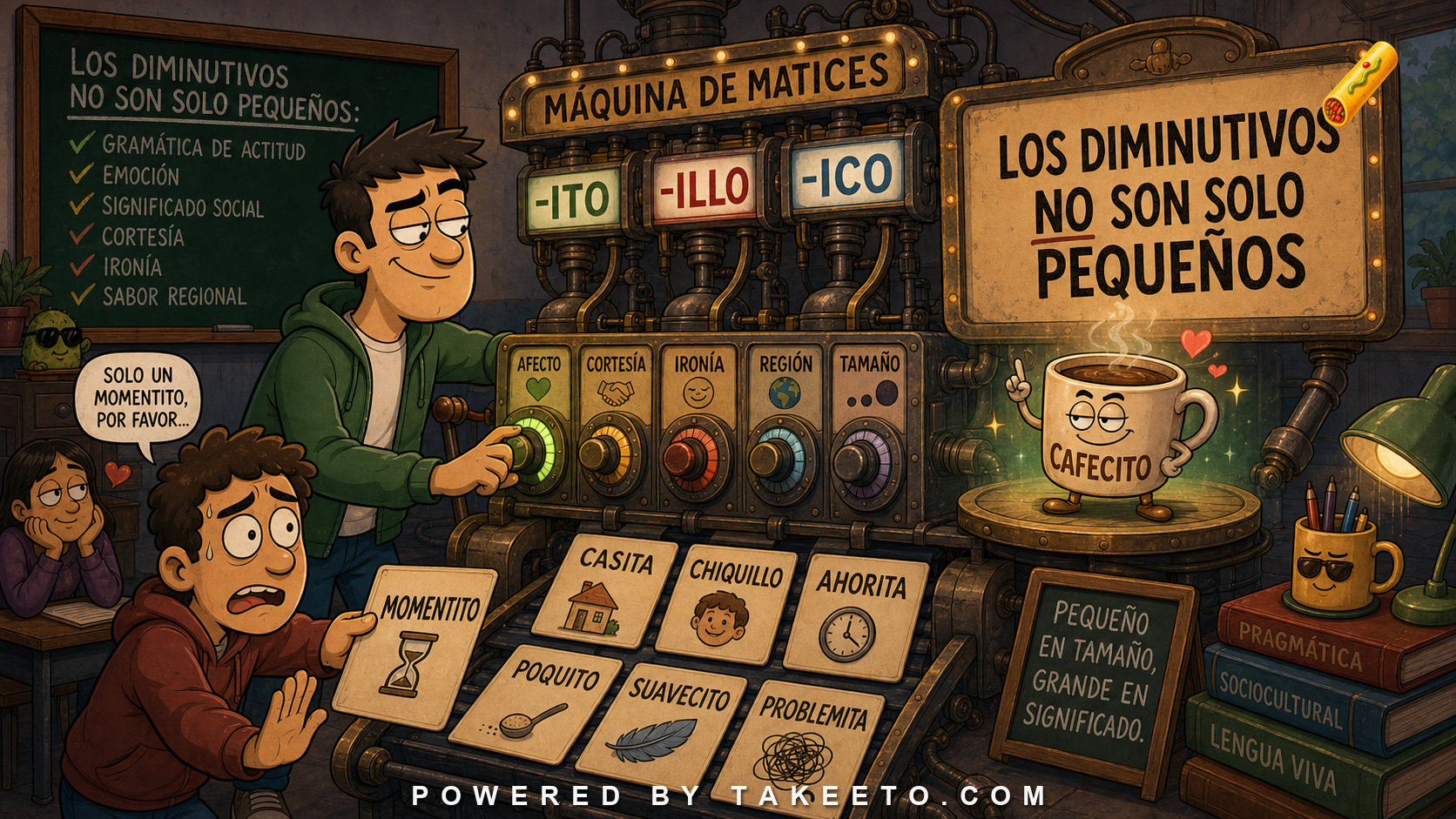
Diminutives do not simply mean “small”
Spanish diminutives are often introduced as “little” forms:
casa → casita
house → little house
That is true, but it is only the beginning. Diminutives can mark smallness, affection, politeness, softening, irony, approximation, intimacy, regional identity, or condescension.
un cafecito
a little coffee / a coffee, warmly or casually offered
un momentito
just a moment
ahorita
right now, soon, in a little while, depending heavily on region and context
problemita
little problem, perhaps genuinely small, perhaps minimized, perhaps ironic
A diminutive is not a measurement. It is a stance marker.
The practical rule:
Diminutives change the speaker’s relationship to the word, not only the word’s size.
Basic formation with -ito/-ita
The most widely taught diminutive suffix is -ito/-ita.
casa → casita
perro → perrito
libro → librito
mesa → mesita
The suffix agrees with the noun’s gender and number:
el perro → el perrito
la casa → la casita
los perros → los perritos
las casas → las casitas
For many nouns ending in unstressed -o or -a, the final vowel drops before -ito/-ita:
gato → gatito
amiga → amiguita
Spelling changes preserve sounds:
poco → poquito
chico → chiquito
largo → larguito, with gu preserving the hard g sound
Many forms are learned by exposure because morphology, stress, regional preference, and lexicalization interact.
-cito/-ecito and phonological shape
Some words use -cito/-cita or -ecito/-ecita:
café → cafecito
pan → pancito / panecito, depending on region
joven → jovencito
flor → florecita / florcita, depending on region and usage
suave → suavecito
gentle/soft → softish, nice and soft
Learners should not try to derive every form from a single mechanical rule. Spanish diminutives are productive, but the preferred form can vary by region.
For practical learning, store common forms:
cafecito
momentito
poquito
chiquito
suavecito
despacito
Smallness
The literal meaning is real:
una casita
a small house
un perrito
a small dog / puppy-like dog
una mesita
a small table
un librito
a small book/booklet
But even literal smallness may carry affection or evaluation. Perrito can mean a physically small dog, a puppy, or a beloved dog. Context tells you.
Affection and intimacy
Diminutives often express warmth:
abuelita
grandma, with affection
hermanito
little brother, or affectionate brother
hijita
little daughter/dear daughter
mi casita
my little home, often affectionate
This use can be tender in family and friendship contexts. But it can also sound intrusive or patronizing if used with the wrong person.
A waiter saying:
¿Un cafecito?
may sound friendly. A stranger calling an adult woman mamita may sound affectionate in some communities, offensive in others, flirtatious, patronizing, or inappropriate. Diminutives are social tools. Use them with care.
Softening and politeness
Diminutives often soften requests or reduce imposition:
Un momentito, por favor.
Just a moment, please.
¿Me das una firmita aquí?
Could you give me a little signature here? This can sound friendly or manipulative depending on context.
Espera tantito.
Wait just a little bit, in some varieties.
The diminutive makes the request feel smaller, easier, or less demanding. This can be polite, but it can also be strategic.
Compare:
Espere un momento.
Please wait a moment.
Espere un momentito.
Please wait just a little moment.
The second sounds softer, but also more colloquial.
Approximation
Diminutives can express approximation or reduced degree:
cerquita
pretty close / nearby
tempranito
quite early / early-ish, often with affective tone
ahorita
now-ish, right now, soon, presently, region-dependent
poquito
a little bit
Ahorita is especially region-sensitive. In some places it means immediately. In others, it may mean soon or in a vague near future. It can even be used in ways that frustrate outsiders because the exact timing is pragmatic, not dictionary-fixed.
This is a perfect example of why diminutives are stance markers. Ahora gives a time. Ahorita gives a socially interpreted time.
Irony, minimization, and condescension
Diminutives can minimize seriousness:
Es un problemita.
It is a little problem.
This may genuinely reassure. It may also downplay a serious issue.
Tiene un caractercito.
He/she has quite a little personality/temper.
This may be affectionate or critical.
Qué listillo.
What a clever little guy / smart aleck, depending on variety.
Diminutives can sting because they make something sound small while actually evaluating it.
In professional or academic contexts, careless diminutives can sound unserious:
Tenemos un problemita con el presupuesto.
Maybe the speaker is softening. Maybe the problem is not little at all. The choice affects credibility.
Regional suffixes: -ito, -illo, -ico, -ín
Spanish-speaking regions differ in diminutive preferences.
-ito/-ita is widespread:
casita, perrito, cafecito
-illo/-illa is common in many areas and can be affectionate, lexicalized, or sometimes pejorative depending on word and region:
chiquillo
child, kid, boy
mesilla
small table/nightstand in some varieties
-ico/-ica is associated with certain regions, including parts of Colombia, Central America, the Caribbean, Spain, and elsewhere depending on word and environment:
ratico
a little while
momentico
a little moment
-ín/-ina appears in some regions:
pequeñín
little one
poquitín
a tiny bit
Do not rank these as better or worse. They are part of regional Spanish. But learners should avoid scattering regional diminutives randomly without understanding who uses them.
Lexicalized diminutives
Some diminutive-looking words have become ordinary lexical items.
bolsillo
pocket, not simply “little bag” in everyday analysis
ventanilla
small window / service window, ticket window
mesilla
small table/nightstand in some varieties
palillo
toothpick/stick-like item
These words may no longer feel like spontaneous diminutives. They are dictionary words with their own meanings.
This matters because learners should not always reverse-engineer a word from a base. Sometimes the diminutive form has become a new noun.
Common learner errors
Error 1: Assuming every diminutive means physically small
cafecito may be about warmth, offer, or social tone, not the cup size.
Error 2: Using diminutives in formal contexts without purpose
In a legal or academic document, problemita will usually sound inappropriate unless quoted or analyzed.
Error 3: Ignoring regional meaning
Ahorita is not identical everywhere. Ask what local speakers mean.
Error 4: Using diminutives with people in risky ways
Words like mijita, mamita, gordito, flaquita can be affectionate in some relationships and offensive in others. Do not copy them blindly.
Error 5: Overproductive formation
Not every noun takes the diminutive form you expect. Check common usage.
Diagnostic workflow: separate form, literal meaning, and social effect
When you meet a diminutive, analyze it in three layers.
First, identify the base and suffix:
cafecito = café + -cito
casita = casa + -ita
momentito = momento + -ito
Second, ask whether the meaning is literal, lexicalized, or pragmatic.
Literal:
mesita = small table
Lexicalized:
ventanilla = service window / small window, depending on context
Pragmatic:
un momentito = a softened “one moment”
Third, ask what stance the speaker is taking. Is the diminutive affectionate, polite, minimizing, ironic, childish, regional, or condescending?
A phrase like un cafecito in an invitation may be warm and hospitable. A phrase like tu trabajito may be affectionate in one relationship and dismissive in another. Problemita may genuinely mean a minor problem, or it may be a way to downplay something serious.
Context signals include speaker relationship, setting, tone, and genre. Diminutives in family speech are not the same as diminutives in a formal report. Diminutives used by a local speaker in a regional pattern are not the same as a learner sprinkling them randomly.
For active use, start with safe and common forms:
un poquito
un momentito
cafecito, in friendly contexts
Be more careful with diminutives applied to people, bodies, age, ethnicity, or social status. They can sound intimate, patronizing, flirtatious, insulting, or simply inappropriate.
The goal is not to avoid diminutives. They are central to many varieties of Spanish. The goal is to hear the stance before copying the form.
Pragmatic safety: when not to use a diminutive
Diminutives are tempting because they sound expressive and “Spanish.” But they are not neutral flavoring. They imply a relationship between speaker, listener, and object. Before using one, ask whether you have the social right to soften, shrink, tease, or evaluate the referent.
With children, family, pets, food, invitations, and casual service encounters, diminutives may be warm:
¿Quieres un juguito?
Ven, perrito.
Tomamos un cafecito.
In professional contexts, the same strategy can sound unserious or patronizing:
Necesito su firmita.
Depending on region and relationship, this could sound friendly, overly familiar, salesy, or disrespectful. A receptionist who says it with the right tone may be normal. A student writing to a professor should probably choose firma.
Diminutives applied to people require even more caution. Doctorcito, mujercita, jefecito can be affectionate in a private joke or insulting in public. The suffix can reduce status.
Regional learning is essential. In some communities, diminutives are frequent and socially expected; in others, heavy use may sound childish or manipulative. The safest active-use path is to begin with fixed, common items:
poquito
momentito
cafecito
ahorita, if you understand the local meaning
Then expand only after listening to how speakers around you use the forms. Diminutives are not merely morphology; they are relationship management.
Lexicalized diminutives and meaning drift
Some words look diminutive historically or morphologically but no longer function as live diminutives in everyday interpretation.
ventanilla
ticket window / small window, depending on context
bolsillo
cuchillo
knife
A speaker does not necessarily hear bolsillo as “little bag” in ordinary conversation. It is simply the word for pocket. Other forms remain transparent:
casita
little/charming house
perrito
little/dear dog
A learner should therefore ask whether the suffix is active in the context. If a speaker says un cafecito, the stance is probably live: friendliness, smallness, invitation, or softening. If the word is bolsillo, treat it as vocabulary unless the context deliberately plays with morphology.
This live-versus-lexicalized distinction prevents both underreading and overreading. Some diminutives are social signals; others are just words now.
Applied contrast: diminutives with adjectives and adverbs
Diminutives do not attach only to nouns. They can appear with adjectives and adverbs in many varieties:
chiquito
pequeñito
cerquita
prontito
despacito
These forms often soften degree or create a friendly tone. Despacito can mean “slowly, gently, little by little,” not merely “a little slowly.” Cerquita means “very near” or “right nearby,” often with warmth or reassurance.
Again, the suffix does not simply shrink the meaning. Sometimes it intensifies closeness or tenderness. Learners should treat these forms as common vocabulary items with pragmatic color.
Contrast lab: pequeño, chico, and -ito
Spanish has several ways to express smallness, and they do different jobs.
una casa pequeña
a small house, neutral description
una casa chica
a small house, common in many varieties, with regional distribution
una casita
a little house, possibly small, affectionate, modest, or charming
The diminutive adds stance. It may include size, but it also frames the speaker’s attitude.
Now compare a professional context:
Tenemos un problema menor.
We have a minor problem.
Tenemos un pequeño problema.
We have a small problem.
Tenemos un problemita.
We have a little problem.
The last may sound friendly, minimizing, or evasive. In a serious report, problema menor is often safer. In a casual conversation, problemita may be perfectly natural.
Diminutives also interact with politeness:
Espere un momento.
Wait a moment.
Espere un momentito.
Wait just a little moment.
The second softens the request, but it can also sound formulaic. A receptionist may use it naturally. A legal contract should not.
The lesson is not “avoid diminutives.” The lesson is “choose the social effect intentionally.”
Diminutives in teaching and translation
Teachers and translators should be careful with diminutives because the closest English equivalent is often not “little.” In a menu, cafecito may simply suggest a friendly coffee break. In a customer-service exchange, un momentito is a softened request for patience. In dialogue, pobrecito can express pity, tenderness, irony, or condescension.
A translation should preserve function, not suffix shape. Un momentito may become “just a moment.” Perrito may be “little dog,” “puppy,” or a pet name. Ahorita may require a regional interpretation rather than a dictionary equivalent. The translator’s question is: what stance does the suffix create here?
For learners, this is also a listening skill. When native speakers use diminutives frequently, they are not constantly discussing tiny objects. They are managing tone, intimacy, urgency, and social smoothness.
V2 remediation refinement: diminutives are social acts
The first draft treats diminutives as stance markers. The remediation pass makes that practical: a diminutive is often something you do socially, not just a size description.
A diminutive can soften a request:
¿Me esperas un momentito?
Could you wait a little moment?
It can create affection:
mi hermanita
my little/dear sister
It can minimize a problem:
Es un problemita.
It is a little problem.
That minimization may be comforting, dishonest, dismissive, or sarcastic depending on context.
It can also sound patronizing:
Tráeme el papelito.
Said warmly to a child, it may be affectionate. Said to an adult employee, it can feel belittling. The suffix does not carry one stable social meaning by itself; the relationship between speakers matters.
Regional interpretation is crucial. Ahorita can mean “right now,” “soon,” “in a little while,” or function as a softened time expression depending on country and situation. A learner should not force one universal translation.
Formation also needs a careful repair. Many words do not simply add -ito to the full written form:
| Base | Common diminutive |
|---|---|
| café | cafecito |
| pan | pancito / panecito, depending on region |
| flor | florecita |
| pez | pececito |
| poco | poquito |
Multiple forms may coexist regionally. The goal is not to memorize every possibility at once, but to avoid inventing forms mechanically in formal writing.
The production advice is conservative: use diminutives freely only after you have heard how the local speech community uses them. In writing for a broad audience, use neutral adjectives when the social tone could be misread:
un momento breve
una pequeña cantidad
un problema menor
Diminutives are powerful because they are personal. That is also why they are risky.
Suggested interactive module: diminutive meaning spectrum
A strong tool would show possible meanings by context and region.
Suggested functions:
- Formation helper: casa → casita, café → cafecito, poco → poquito.
- Meaning spectrum: smallness, affection, politeness, approximation, irony, condescension.
- Regional labels: common suffixes by region where reliable.
- Register warning: casual, affectionate, risky, formal-inappropriate.
- Lexicalization flag: bolsillo, ventanilla, palillo.
Example input:
problemita in a workplace email
Output:
Possible effect: softening or minimizing. In a formal email, problema menor or pequeño problema may be clearer and less patronizing.
Final rule
Spanish diminutives are not just smallness markers. They are stance markers. Casita may be small or beloved. Momentito softens a request. Ahorita depends on region. Problemita may reassure, minimize, or irritate.
Use diminutives after listening to how a community uses them. They are powerful because they are social.