
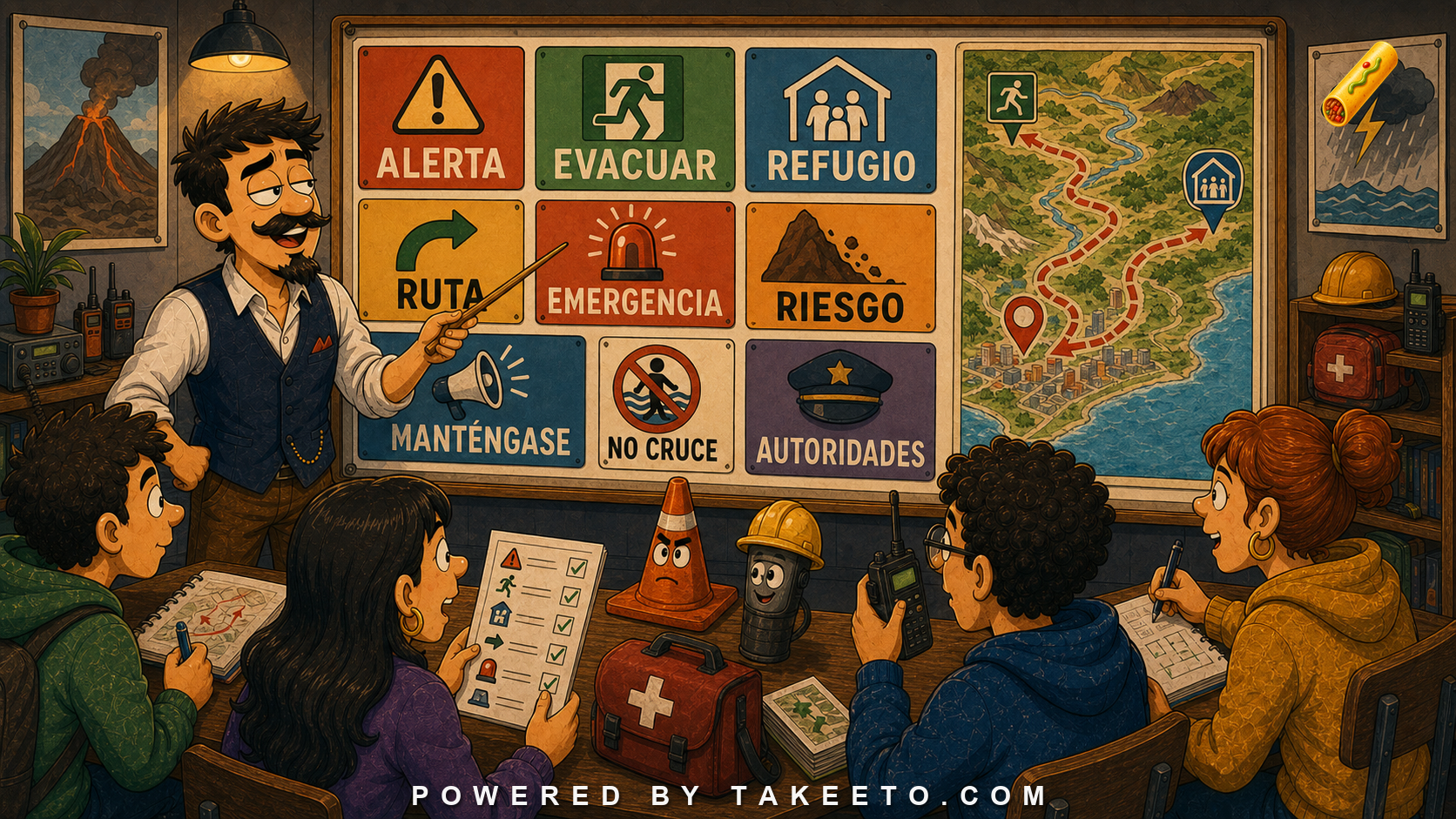
Emergency Spanish is designed for action, not literary style
Disaster and emergency alerts use compressed language because the reader may have little time, high stress, poor signal, or limited context. The message may appear as a phone notification, radio announcement, siren message, municipal post, weather alert, transit notice, or police instruction.
A typical alert may say:
Alerta roja por lluvias intensas. Evacúe las zonas bajas y diríjase al refugio más cercano. No cruce cauces ni calles inundadas. Siga las indicaciones de las autoridades.
This is not hard because the vocabulary is exotic. It is hard because every word may matter. Alerta, evacúe, refugio, no cruce, and autoridades are action terms. A reader must not spend the first minute admiring the grammar.
The key principle is:
In emergency Spanish, extract the action before you analyze the style.
Alerta, aviso, advertencia
Emergency texts use several warning words.
alerta
alert
aviso
notice / warning
advertencia
warning
emergencia
emergency
riesgo
risk
peligro
danger
In weather contexts, alerta amarilla, alerta naranja, and alerta roja often mark increasing severity, though exact systems vary. A learner should treat color-coded alerts as local systems, not universal grammar.
A message may also use nivel:
nivel de riesgo alto
high risk level
nivel de alerta máxima
maximum alert level
Evacuar and shelter language
Evacuar means evacuate. It can be transitive or intransitive in public language:
Evacúe la zona.
Evacuate the area.
Se ordenó evacuar a la población.
Evacuation of the population was ordered.
La evacuación es obligatoria.
Evacuation is mandatory.
Shelter vocabulary includes:
refugio
shelter
albergue
shelter / temporary lodging
centro de evacuación
evacuation center
zona segura
safe area
punto de encuentro
meeting point
The instruction is often a route plus destination:
Diríjase al refugio habilitado en la escuela municipal.
Habilitado means set up, authorized, or made available for use.
Imperatives under urgency
Emergency alerts use formal imperatives, especially usted forms:
Manténgase alejado de la zona.
No cruce el puente.
Diríjase a un lugar seguro.
Siga las rutas señalizadas.
Llame al número de emergencias.
They may also use infinitives in signs or lists:
No cruzar.
Evitar la zona.
Mantener la calma.
Or impersonal commands:
Se recomienda permanecer en casa.
Se prohíbe el paso.
Manténgase is a reflexive formal command from mantenerse. In alerts, it often means “stay” or “keep yourself” in a certain condition or location.
No cruce: negative commands matter
Negative commands often carry the highest safety value:
No cruce calles inundadas.
No toque cables caídos.
No use elevadores.
No regrese hasta que las autoridades lo indiquen.
A learner should train negative emergency commands as fixed action units. No cruce is not a grammar exercise during a flood. It is a behavior instruction.
Hazard domains
Emergency Spanish changes by hazard.
Weather:
lluvias intensas, tormenta, granizo, vientos fuertes, ola de calor
Earthquake:
sismo, terremoto, réplica, zona de seguridad, estructura dañada
Fire:
incendio, humo, evacuación, vía de escape, material inflamable
Flood:
inundación, cauce, desbordamiento, zona baja, corriente
Infrastructure:
corte de energía, fuga de gas, derrumbe, cierre de vía, accidente
Public safety:
operativo, perímetro, zona restringida, toque de queda, emergencia sanitaria
The grammar may be similar, but the action differs.
Authority and source
Emergency alerts rely on authority:
autoridades
authorities
protección civil
civil protection / emergency management
bomberos
firefighters
policía
police
servicio meteorológico
weather service
municipio / alcaldía / ayuntamiento
municipality / city government
Phrases such as siga las indicaciones de las autoridades tell the reader that instructions may change. In fast-moving emergencies, the source of the message is part of the message.
Time and location
A good emergency alert should specify:
desde las 18:00 horas
from 6:00 p.m.
hasta nuevo aviso
until further notice
en la zona costera
in the coastal area
en un radio de dos kilómetros
within a two-kilometer radius
las colonias afectadas
affected neighborhoods
If the Spanish message does not make location and time clear, the reader may need official maps or local channels. Do not generalize an alert beyond its area.
Example bank walkthrough
Alerta means an official or semi-official warning state. Ask severity and area.
Evacuar means leave an unsafe area. Ask whether it is ordered or recommended.
Refugio is a shelter or safe place.
Ruta is the route to follow. In emergencies, improvised shortcuts can be dangerous.
Emergencia means urgent hazardous situation, not just inconvenience.
Riesgo names potential harm. Look for level and cause.
Manténgase is a formal command: stay, keep away, remain.
No cruce is a negative safety command; obey before translating elegantly.
Autoridades names the officials or agencies whose instructions govern the response.
Emergency alert extraction workflow
- Identify the hazard.
- Identify severity: alert level, color, warning category.
- Identify location.
- Identify time frame.
- Extract direct actions: evacuate, shelter, avoid, call, stay.
- Mark negative commands.
- Identify official source.
- Look for route or shelter information.
- Separate confirmed facts from forecasts.
- Convert the alert into a personal action checklist.
Mini-workshop: five-second extraction drill
Read an emergency alert and answer five questions as fast as possible: What is the hazard? Where is it? What action is required? What should not be done? Who issued the alert? Do this before translating the full message. A learner who can extract inundación, zonas bajas, evacúe, no cruce, and Protección Civil has already captured the safety core. Elegant translation can come later; urgent comprehension comes first.
Emergency register under audio pressure
Many emergency alerts are heard, not read. Announcements in stations, phones, radio, sirens with voice messages, or loudspeakers reduce the time available for analysis. Learners should train short recognition chunks: evacúe, manténgase alejado, no cruce, diríjase a, permanezca en, siga las instrucciones, servicio suspendido, zona de riesgo, refugio habilitado.
The remediation drill is audio-first. Play or read a notice once and allow only three notes: action, place, time. Then replay for details. This reverses the usual classroom habit of translating every clause before acting.
Written emergency Spanish also uses impersonal authority: se informa, se ordena, se recomienda, queda suspendido, ha sido habilitado. The actor may be official but grammatically hidden. The learner should still ask: which authority issued it? Civil protection, weather service, municipality, transit agency, school, hospital? In emergencies, source credibility is part of comprehension.
Remediation drill: reduce an alert to commands
Take one emergency alert and rewrite it as numbered commands. Do not begin with vocabulary. Begin with action. For example:
Debido al aumento del caudal del río, se ordena la evacuación preventiva de las viviendas ubicadas en la zona baja. Diríjase al punto de reunión más cercano y lleve documentos esenciales.
Command version:
- Evacuate homes in the low-lying area.
- Go to the nearest meeting point.
- Bring essential documents.
- The reason is rising river level.
This reverse order is intentional. Emergency reading prioritizes what to do before why the grammar looks that way.
Now mark force. Se ordena is stronger than se recomienda. Evacuación preventiva does not mean optional tourism-like movement; it means evacuation before harm becomes immediate. Diríjase is a formal command, not a descriptive verb.
For listening practice, rehearse common alert chunks aloud: manténgase informado, siga las indicaciones de las autoridades, no cruce zonas inundadas, evite desplazamientos innecesarios, cierre el suministro de gas, tenga preparada una mochila de emergencia. Emergency Spanish uses repeated formulas because repetition saves time.
A strong learner can do two things at once: obey the action quickly and later analyze the grammar. Do not reverse those priorities.
Suggested interactive module: alert-to-action extractor
A strong tool would turn urgent Spanish into safe action units.
Suggested functions:
- Hazard tagger: weather, earthquake, fire, flood, public safety, infrastructure.
- Instruction extractor: evacuate, shelter, avoid, call, wait.
- Negative-command highlighter: no cruce, no toque, no regrese.
- Location/time fields: affected area, start time, expiration, until further notice.
- Authority field: source agency and credibility flag.
- Plain-action output: a short checklist for the reader.
- False-friend warning: local terms that may vary by country.
Applied reading drill: extract the emergency card
For any alert, make a five-line card:
Who? Residents of the coastal area.
Hazard? Storm surge and flooding.
Action? Evacuate.
Destination? Municipal shelter.
Deadline/source? Before 18:00, Civil Protection.
Now apply it to Spanish:
Protección Civil ordenó evacuar la zona costera antes de las 18:00 y dirigirse al albergue municipal.
The grammar is not hard, but the stakes are high. A learner who extracts action quickly has understood the alert better than one who can explain every verb form but misses the deadline.
Remediation focus: extracting action fast while preserving conditions, authority, and geography
Emergency-alert Spanish is not meant to be admired. It is meant to be acted on. The reading task is therefore different from ordinary comprehension. The learner must extract hazard, location, time, severity, authority, and required action quickly. A beautiful translation produced too late is useless.
The remediation problem is that alerts often combine compressed grammar with life-relevant consequences. Manténgase alejado, no cruce, evacúe, refúgiese, suspenden clases, se habilitan albergues, riesgo de deslizamientos. The verbs may be imperative, impersonal, passive, or nominal. The action is what matters.
Common failure modes to repair
- Treating alerta, aviso, and advertencia as decorative synonyms: Different institutions may use alert levels. The exact label can affect urgency and procedure.
- Ignoring negative commands: No cruce, no regrese, no toque cables, and no use ascensores are primary safety instructions, not side notes.
- Missing geography: Municipality, neighborhood, river basin, highway segment, coastal zone, and shelter location determine relevance.
- Overtranslating before acting: In an emergency, extract action first: leave, avoid, shelter, call, wait, boil water, close gas, charge phone.
Before/after: turn an alert into an action card
Weak version:
Hay alerta por tormentas fuertes y las autoridades piden precaución.
Stronger version:
Alerta naranja por tormentas entre las 18:00 y las 23:00 en la zona costera. Evite circular, no cruce calles inundadas y diríjase al refugio municipal si su vivienda está en área baja.
The stronger version gives level, time window, area, prohibited action, and conditional shelter instruction.
Upgrade workshop: five-field emergency extraction
- Hazard: storm, fire, earthquake, heat, flood, chemical leak, infrastructure failure.
- Place: exact municipality, route, neighborhood, river, coast, station, school, or building.
- Time: start, duration, deadline, “hasta nuevo aviso,” or immediate order.
- Action: evacuate, shelter, avoid, boil, disconnect, call, report, do not cross.
- Authority: civil protection, meteorological agency, municipality, health ministry, transport operator, police.
Quality-control checklist
- Does the alert use color levels or named phases?
- Is the instruction mandatory, recommended, or conditional?
- Are vulnerable groups named: elderly, children, pregnant people, people with disabilities, outdoor workers?
- Is there a second action after the first, such as registering, bringing documents, or avoiding return?
- Does the alert warn against misinformation or unofficial routes?
Applied remediation drill: extract instructions from an alert in under one minute
Use this source-style excerpt:
Protección Civil ordenó la evacuación preventiva de las viviendas ubicadas junto al río. No cruce puentes anegados y diríjase al albergue municipal con documentos personales y medicamentos esenciales.
A fast but weak reading might say:
Civil Protection recommends people near the river be careful and go to a shelter.
That reading is incomplete. A stronger reading says:
Civil Protection ordered a preventive evacuation for homes next to the river. People should not cross flooded bridges and should go to the municipal shelter with personal documents and essential medication.
The repair comes from five checks:
- Ordenó marks obligation, not gentle advice.
- Evacuación preventiva means leave before conditions worsen; danger may be anticipated rather than already visible.
- Viviendas ubicadas junto al río defines the affected area.
- No cruce is a critical negative command.
- The item list — documents and medication — is part of the instruction, not extra information.
Practice turning this into a spoken emergency summary: If you live next to the river, evacuate now. Do not cross flooded bridges. Go to the municipal shelter. Bring ID documents and essential medication. The translation is plain because emergency comprehension should reduce complexity. In this domain, elegance loses to action clarity.
Final rule
Emergency Spanish is not a place to be clever. It is a place to extract action.
Read alerta, evacuar, refugio, ruta, emergencia, riesgo, manténgase, no cruce, and autoridades as operational signals. Find hazard, place, time, source, and instruction. Then act according to official guidance.