Recognition is not mastery
A learner reads aunque sea difícil and understands it. Later, they write:
Aunque es difícil, voy a intentarlo.
This sentence can be correct if the difficulty is asserted as fact. But if the learner means “even if it is difficult,” they need aunque sea difícil. Recognition did not automatically become production.
This is why Spanish learning needs feedback loops.
The key principle:
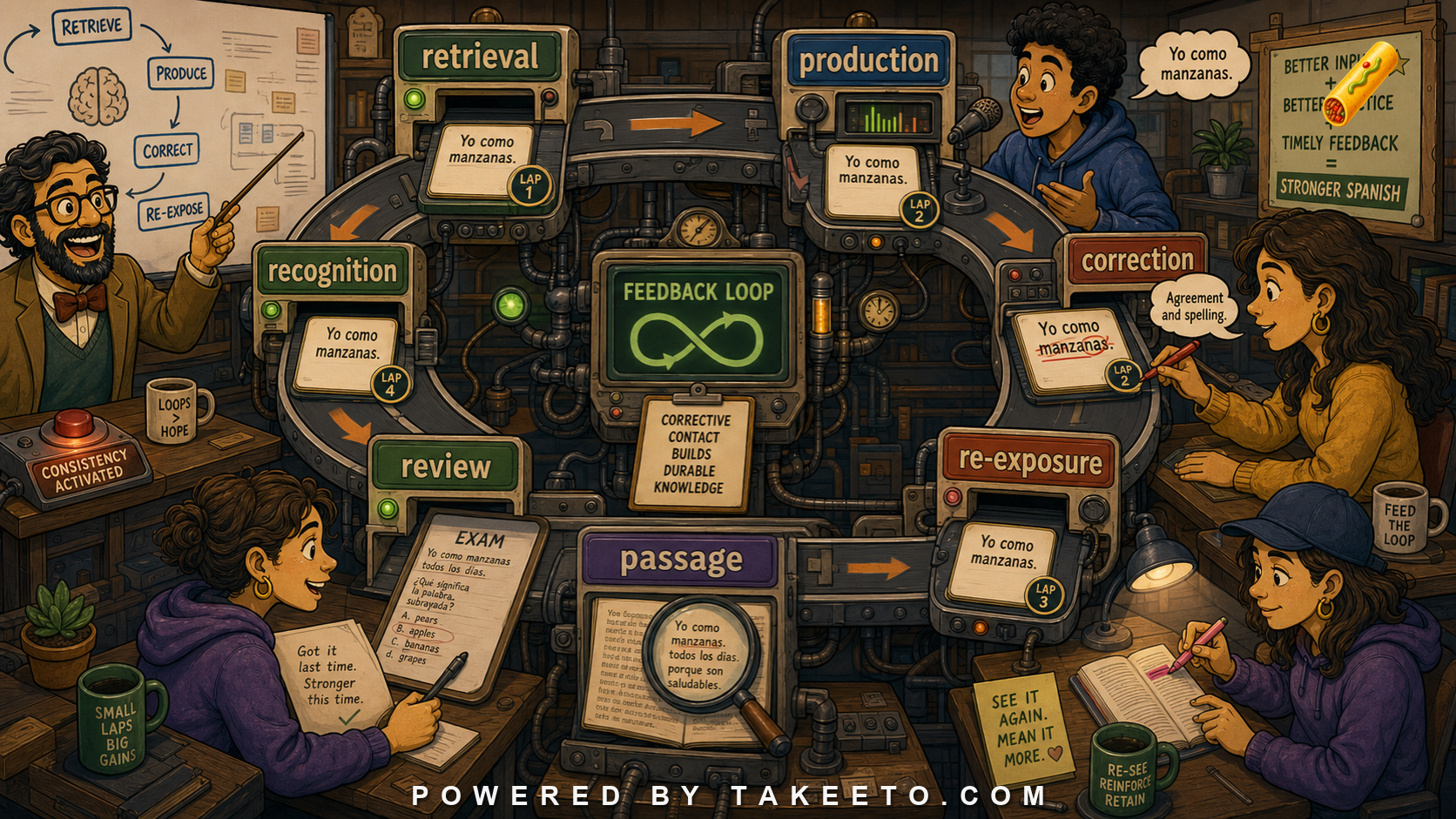
Durable Spanish knowledge forms when recognition, retrieval, production, feedback, and re-exposure repeatedly meet the same pattern.
Reading alone is not enough. Flashcards alone are not enough. Correction alone is not enough. The loop matters.
Retrieval strengthens memory
Retrieval means pulling knowledge from memory, not simply seeing it again.
Passive exposure:
You read me gusta in a sentence.
Retrieval:
You see “I like coffee” and produce me gusta el café.
Hard retrieval exposes what is actually available. It also strengthens access. If you can only recognize a form when it is printed in front of you, you do not yet control it.
Retrieval can happen through:
- flashcards,
- short translation prompts,
- cloze deletions,
- oral answers,
- writing prompts,
- post-reading quizzes,
- self-explanation,
- error repair.
Production reveals hidden gaps
Production forces decisions:
Is it por or para?
Me gusta or me gustan?
hablo or habló?
quiero salir or quiero que salgas?
si tengo or si tenga?
A learner may understand all options in reading and still fail during production. That failure is useful. It tells the system where to focus.
Production should not be delayed forever. Waiting until you “know enough” often means avoiding the very pressure that reveals your gaps.
Feedback must be specific
Feedback like “wrong” is weak. Feedback should show the pattern.
Weak:
Wrong: Yo gusto el café.
Better:
Use me gusta el café. In this construction, el café is the subject, so the verb agrees with the liked thing.
Even better:
Singular: me gusta el café. Plural: me gustan los libros. Now produce three more examples.
Feedback should connect correction to future production.
Re-exposure prevents correction from evaporating
Correction fades if the learner never meets the pattern again.
A strong loop returns the learner to the same item in different contexts:
- Read a passage containing me gusta / me gustan.
- Answer a recognition question.
- Produce the phrase from English.
- Get corrected.
- Hear sentence audio.
- Review the card tomorrow.
- See the pattern again in a new passage.
- Use it in writing.
The same pattern becomes more stable because it appears across modes.
Spacing beats cramming
A single intense session may feel productive. But Spanish forms need repeated contact across time. Spaced review makes retrieval harder in a useful way. The learner must rebuild the form after partial forgetting.
For language learning, spacing is especially valuable because forms are confusable:
por / para
ser / estar
saber / conocer
pedir / preguntar
preterite / imperfect
If review is too easy and too immediate, it may create false confidence. If review is too delayed, the learner may fail completely. A good system adjusts intervals based on performance.
A complete Spanish learning loop
A robust loop might look like this:
- Passage: meet forms in context.
- Glossary: clarify meaning and grammar.
- Audio: connect text to sound.
- Card review: retrieve individual items.
- Production: translate or answer prompts.
- Exam: test mixed recognition and recall.
- Feedback: correct with explanation.
- Re-exposure: see missed items again in later passages.
- Writing: use forms in self-generated sentences.
- Audit: identify recurring error clusters.
This is not busywork. It is a memory architecture.
The loop must include success, not just correction
A feedback loop that only catches failure can make learners cautious and resentful. The loop should also show what is becoming stable. When a learner repeatedly retrieves me gusta el café correctly after once saying yo gusto, that success deserves recognition because it shows the system has changed.
This is especially important for advanced learners. They may feel they are only discovering new weaknesses. A good review system can show movement from recognition to controlled production to freer use. For example, an item can be marked as recognized in passages, retrieved on cards, produced in sentence prompts, and then used in a short writing task.
The point is not to flatter the learner. The point is to make progress visible enough that the learner keeps engaging with difficult forms. Correction repairs the path. Successful retrieval strengthens it.
Example bank walkthrough
retrieval
Pulling Spanish from memory.
Learner action: test yourself before looking.
spacing
Review across time.
Learner action: revisit forms after forgetting begins.
feedback
Correction with information.
Learner action: ask what pattern the correction teaches.
production
Creating Spanish.
Learner action: write or speak before you feel perfectly ready.
recognition
Understanding Spanish when seen or heard.
Learner action: do not confuse recognition with active control.
review
Repeated contact.
Learner action: review missed items in varied contexts.
passage
Contextual input.
Learner action: use passages to see grammar and vocabulary in living use.
exam
Structured retrieval.
Learner action: treat exams as learning events, not punishment.
Why passages and exams should talk to each other
A passage-based system becomes much stronger when exams are not separate from reading. If a learner sees deberá presentar in a passage, the later exam can ask for recognition, production, and interpretation:
What does deberá presentar require the person to do?
Translate “You must submit the form.”
Choose between debe presentar, debería presentar, and podría presentar.
If the learner misses the item, the system can return them to the original passage line. This reconnects retrieval with context. The learner does not just learn that one answer was wrong; they see how the form functioned in an actual document-like sentence.
Remediation notes: feedback loops need context, pressure, and return
The repair for this article is to prevent a mechanical version of learning science. Retrieval, feedback, spacing, and re-exposure are powerful, but they do not work as slogans. A Spanish feedback loop must make the learner retrieve under realistic discrimination, receive specific information, and meet the form again in context.
Recognition is the weakest form of success. Seeing me gusta in a passage and understanding it does not mean the learner can produce me gustan los libros under pressure. A good loop moves from context to retrieval: read the sentence, hide it, answer a prompt, produce a variant, receive feedback, and then meet the same pattern later in a new sentence. That sequence is what turns exposure into control.
Feedback timing should match the task. During first learning, immediate feedback prevents the learner from rehearsing a bad form. During later review, delayed or brief feedback may be useful because the learner has to commit before checking. For Spanish, the key is not only when feedback arrives, but what it says. Incorrect is weak. Use pedir for requests and preguntar for questions is stronger. Translate: I asked for help / I asked what time it was is stronger still because it creates the next retrieval contrast.
Re-exposure should not repeat the exact same card forever. If the learner missed aunque + subjunctive, the next appearances should include a short explanation, a passage line, a contrast with aunque + indicative, an audio example, and a production prompt. Same pattern, varied context.
The loop also needs recovery from frustration. A learner who repeatedly fails the same item should not simply receive more of the same prompt. The system should diagnose: unknown vocabulary, grammar contrast, listening problem, spelling problem, or production pressure. Then it should step back and rebuild.
Production target: for every failed item, create a next action: reread, contrast, produce, listen, or delay and return. A feedback loop is real only when the error changes the learner’s next encounter with Spanish.
Suggested interactive module: learning loop diagram
A strong tool for this article would show how one item moves through learning modes.
Suggested functions:
- Item path: passage → card → audio → exam → feedback → review.
- Recognition/production split: track separately.
- Error trigger: missed item creates contrast practice.
- Spacing scheduler: next review based on difficulty.
- Context re-entry: missed items reappear in future passages.
- Feedback note: short explanation attached to error.
- Mastery caution: high recognition does not equal high production.
Final rule
Spanish sticks when knowledge cycles through context, retrieval, production, correction, and re-exposure.
Do not mistake seeing for knowing. Retrieve, produce, receive specific feedback, and meet the form again after time has passed. The loop is where durable Spanish is built.