
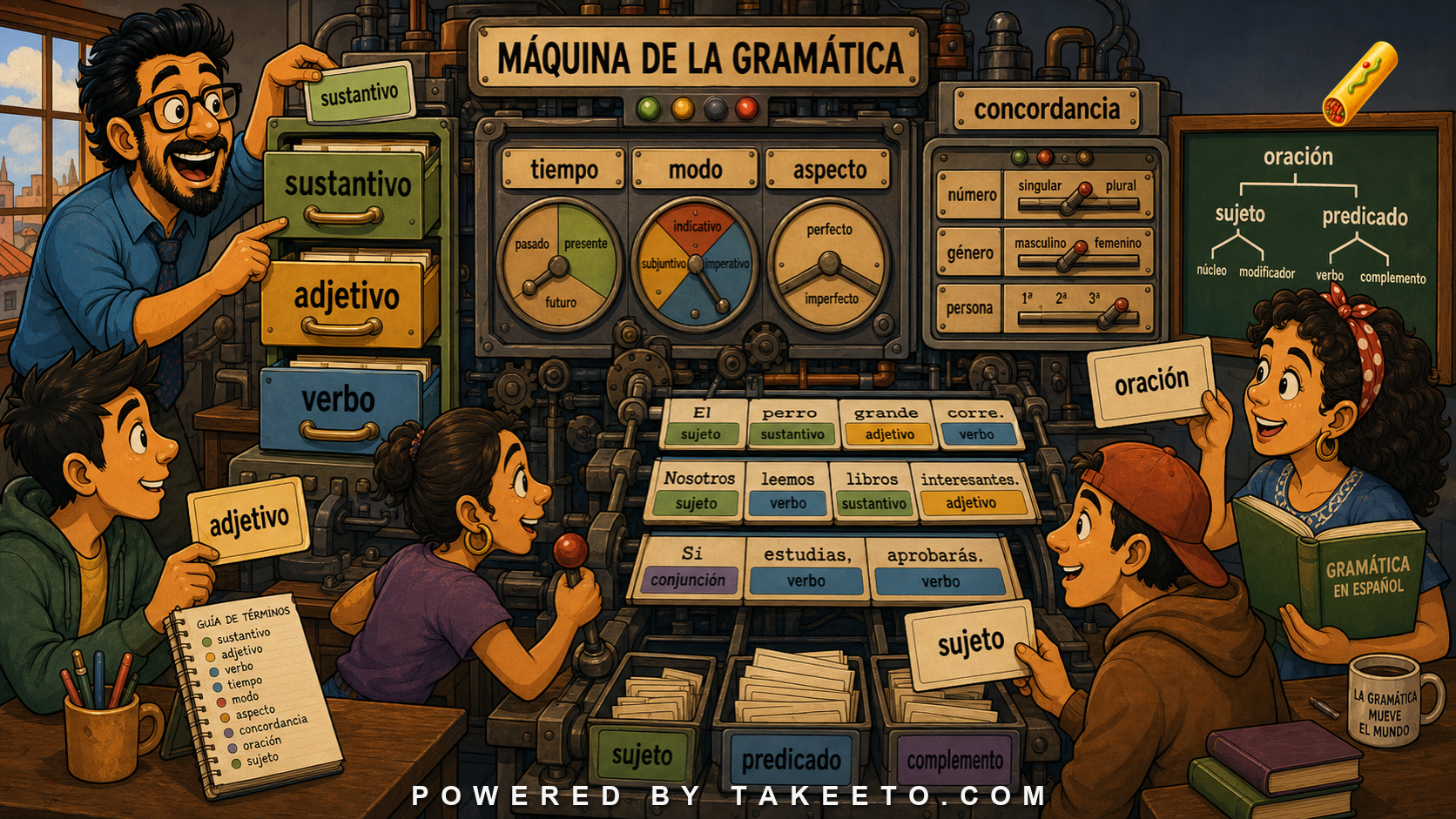
Learning grammar through Spanish requires a second vocabulary
A learner may understand many Spanish sentences but still feel lost when reading a grammar explanation in Spanish:
El adjetivo concuerda en género y número con el sustantivo al que modifica.
The sentence is not about daily communication. It is metalinguistic: Spanish being used to explain Spanish. This requires a technical vocabulary.
The key principle is:
Grammar terminology in Spanish is a tool for reading explanations, not a replacement for examples.
A learner does not need to become a grammarian first. But knowing the main terms unlocks dictionaries, textbooks, teacher feedback, grammar notes, and exam explanations.
Parts of speech
Core terms include:
sustantivo / nombre
noun
adjetivo
adjective
verbo
verb
adverbio
adverb
pronombre
pronoun
preposición
preposition
conjunción
conjunction
determinante
determiner
artículo
article
In some school traditions, nombre may be used where linguistic texts use sustantivo. Determinante is a broader category including articles, demonstratives, possessives, and quantifiers in many frameworks.
Gender, number, agreement
Important agreement terms:
género
gender
número
number
masculino / femenino
masculine / feminine
singular / plural
singular / plural
concordancia
agreement
concordar
to agree
Example:
Las casas blancas.
A Spanish explanation may say:
El artículo y el adjetivo concuerdan con el sustantivo en género y número.
This means las and blancas match casas.
Verb terminology: tense, mood, aspect
Verb explanations use:
tiempo
tense
modo
mood
aspecto
aspect
persona
person
número
number
conjugación
conjugation
infinitivo
infinitive
gerundio
gerund/present participle form
participio
participle
Tiempo names forms like present, preterite, imperfect, future. Modo includes indicative, subjunctive, imperative. Aspecto concerns how an event is viewed: completed, ongoing, habitual, perfect, etc.
Many learner problems come from confusing these categories. Subjuntivo is a mood, not a tense. Pretérito perfecto combines tense/aspect terminology differently across traditions.
Indicativo, subjuntivo, imperativo
Mood terms:
indicativo
indicative
subjuntivo
subjunctive
imperativo
imperative
A grammar book might say:
Se usa el subjuntivo en oraciones subordinadas que expresan deseo, duda o valoración.
This requires several terms: subjuntivo, oraciones subordinadas, expresan, deseo, duda, valoración.
The learner should translate the explanation into examples:
Quiero que vengas.
Dudo que sea cierto.
Es importante que estudies.
Terminology points; examples teach.
Oración, frase, cláusula
Spanish grammar terminology varies here.
oración
sentence or clause with a conjugated verb, depending on tradition
frase
phrase, expression, or sentence in everyday language
sintagma
phrase in linguistic grammar
cláusula
clause, especially in some modern or translated linguistic contexts
proposición
clause/proposition in some school grammars
A school grammar may use oración subordinada for subordinate clause. A linguistic grammar may prefer cláusula subordinada in some contexts.
Learners should not panic when terms shift. Watch examples.
Sujeto, predicado, complemento
Sentence analysis uses:
sujeto
subject
predicado
predicate
complemento directo
direct object
complemento indirecto
indirect object
complemento circunstancial
circumstantial complement / adverbial
atributo
subject complement with copular verbs
núcleo
head
Example:
María le dio el libro a Juan ayer.
A traditional analysis may identify:
sujeto: María
complemento indirecto: le / a Juan
complemento directo: el libro
complemento circunstancial: ayer
This terminology helps with pronouns and word order.
School grammar versus linguistic grammar
Spanish grammar explanations differ by audience. School grammar may use traditional categories. Linguistic grammar may use more precise but less familiar terms. A learner grammar may simplify.
Example differences:
pretérito indefinido / pretérito perfecto simple
two labels for the same main tense in many contexts
objeto directo / complemento directo
direct object terms
pronombre átono / clítico
unstressed pronoun / clitic
A serious learner should build a bilingual glossary and tolerate parallel labels.
Example bank walkthrough
Sustantivo names nouns.
Adjetivo modifies nouns and often agrees.
Verbo carries conjugation, tense, mood, aspect, person, and number.
Tiempo is tense; modo is mood; aspecto is event perspective.
Concordancia is agreement.
Oración often means a sentence or clause with a finite verb.
Sujeto is the subject, but Spanish subjects may be omitted.
Grammar-term reading workflow
- Identify whether the text explains form, meaning, or use.
- Circle the grammatical terms.
- Translate each term into a known example.
- Note labels that have synonyms.
- Separate rule from example.
- Check whether the explanation is simplified.
- Build a personal glossary.
- Compare terms across sources.
- Do not memorize terminology without sentences.
- Use terms to ask better questions.
Mini-workshop: attach every term to an example
Build a small grammar glossary where no term is allowed to stand alone. Sustantivo must have a noun. Concordancia must have a matching phrase. Subjuntivo must have a sentence. Complemento directo must have an example with a direct object. This rule keeps terminology from becoming empty memorization. A term that cannot point to an example is not yet useful to the learner.
Metalanguage card system
Grammar terminology should be studied with cards that require analysis, not translation only. Weak card:
complemento directo = direct object
Better card:
Identify the complemento directo: María compró un libro.
Answer: un libro. It is what María bought.
Another useful card:
Convert the explanation into an example: El adverbio modifica al verbo.
Answer:
Corre rápidamente.
Rápidamente modifies corre.
This system makes Spanish grammatical explanations readable because every term is tied to an operation: identify, classify, transform, compare, or explain. It also avoids the trap of bilingual equivalence. Knowing that modo can be “mood” is less useful than recognizing indicativo, subjuntivo, and imperativo in real forms.
For advanced learners, add source notes: school grammar term, linguistic term, abbreviation, and example. The goal is not to win terminology arguments. The goal is to read explanations without losing the sentence.
Remediation drill: translate the grammar explanation both ways
Take one Spanish grammar explanation and produce three outputs: literal translation, functional explanation, and example. For example:
El pronombre átono precede al verbo conjugado, pero puede posponerse al infinitivo.
Literal translation:
The unstressed pronoun precedes the conjugated verb, but can be placed after the infinitive.
Functional explanation:
With a conjugated verb, Spanish usually puts me, te, lo, la, le, nos, se before the verb. With an infinitive, the pronoun can attach after it.
Examples:
Lo quiero ver.
Quiero verlo.
Now the terminology has become usable. Pronombre átono, verbo conjugado, and infinitivo are no longer abstract labels.
Do this with terms like sintagma nominal, complemento directo, oración subordinada, modo indicativo, concordancia, perífrasis verbal, and antecedente. Each term should have an example and a test question.
For remediation, never let a grammar note end with only a definition. Add “How do I recognize it?” and “What does it change?” If a term does not help you parse, choose, translate, or produce Spanish, you have not finished learning it.
This is the bridge from reading grammar books in English to reading Spanish grammar written for Spanish speakers.
Editorial remediation note
This article should prevent terminology from becoming decorative. Grammar terms are valuable only when they make analysis easier. Every term should answer a question: What category is this? What does it agree with? What clause depends on what? What choice does this form create? Learners who can ask those questions in Spanish are ready to use Spanish-language references with far less dependence on English explanations.
Suggested interactive module: grammar-term bilingual glossary
A strong tool would connect terminology to examples.
Suggested functions:
- Term cards: Spanish term, English equivalent, plain explanation.
- Example field: one Spanish sentence with annotation.
- Synonym labels: sustantivo/nombre, complemento/objeto.
- Framework note: school grammar, learner grammar, linguistic grammar.
- Search by confusion: tense versus mood, phrase versus clause.
- Mini-parser: highlights subject, verb, object, adjective, agreement.
- User glossary export: personal reference list.
Applied terminology drill: annotate one grammar sentence
Sentence:
El verbo concuerda con el sujeto en persona y número.
Labels:
- verbo: verb.
- concuerda: agrees.
- sujeto: subject.
- persona: first, second, third person.
- número: singular or plural.
Example:
Nosotros hablamos.
Hablamos agrees with nosotros: first person plural. This drill turns metalanguage into visible grammar. Without the example, the terminology stays abstract.
Remediation focus: using Spanish grammar terminology as a map rather than a wall
Spanish grammar explanations written in Spanish can intimidate learners who already understand the concept in English. The problem is often not grammar itself but metalanguage. Sustantivo, adjetivo, verbo, adverbio, preposición, conjunción, oración, proposición, sujeto, predicado, complemento, tiempo, modo, and aspecto are tools. They should help locate the phenomenon, not become a second language barrier.
The remediation move is to connect every grammar term to one example sentence. A learner should not memorize complemento directo as a definition only. They should be able to point to el libro in Compré el libro, replace it with lo, and understand why that matters. Spanish metalanguage becomes useful when it predicts what the sentence can do.
Common failure modes to repair
- Confusing school grammar and linguistic grammar: Traditional labels may differ from modern linguistic analysis. Both can be useful if you know the system being used.
- Assuming English categories transfer perfectly: Terms such as tense, aspect, mood, object, and clause do not always map one-to-one across languages.
- Memorizing labels without examples: A term that cannot be attached to a sentence has low study value.
- Ignoring regional classroom terminology: Different educational traditions may prefer pretérito perfecto simple, pretérito indefinido, or other labels.
Before/after: turn a definition into a usable note
Weak version:
El subjuntivo expresa duda, deseo o posibilidad.
Stronger version:
El subjuntivo aparece en estructuras como quiero que vengas, es posible que llueva y no creo que sea cierto; no expresa “duda” por sí solo, sino que depende de la construcción que lo activa.
The stronger note keeps the label but anchors it in structures. That makes it testable.
Upgrade workshop: grammar-term card repair
- Write the Spanish term and a short English gloss only as a starting point.
- Add one original Spanish example.
- Underline the word or phrase the term names.
- Add one contrast example where the term does not apply.
- Write the practical consequence: agreement, pronoun choice, tense choice, word order, punctuation, or mood.
Quality-control checklist
- Does oración mean sentence or clause in this source?
- Does modo refer to indicative/subjunctive/imperative, not emotional mood?
- Does concordancia involve gender, number, person, or tense sequence?
- Does se receive a specific label: reflexive, passive, impersonal, pronominal, aspectual?
- Can the learner use the term to parse a new sentence?
Applied remediation drill: translate grammar terminology through function
Use this source-style excerpt:
En la oración “No creo que sea necesario”, la subordinada sustantiva funciona como complemento directo del verbo principal y aparece en subjuntivo por la negación del verbo de creencia.
A fast but weak reading might say:
The sentence says the subordinate noun clause is the direct object and uses subjunctive because of negative belief.
That reading is incomplete. A stronger reading says:
The clause que sea necesario functions as what is not believed. Because the main clause negates a belief verb — no creo — Spanish presents the subordinate proposition with the subjunctive sea.
The repair comes from five checks:
- Oración here refers to the full sentence.
- Subordinada sustantiva names a clause functioning like a noun phrase.
- Complemento directo explains the role of the subordinate clause in relation to creo.
- Verbo principal is creo, not sea.
- The grammar label matters because it predicts mood choice in similar constructions.
Turn the explanation into learner-friendly Spanish: La parte “que sea necesario” completa la idea de “no creo”. Como la frase principal niega la creencia, usamos subjuntivo: “sea”, no “es”. The goal is not to avoid technical terms forever. The goal is to make sure each term points to a visible function in the sentence.
Final rule
Grammar terminology is not the goal. It is a key.
Learn sustantivo, adjetivo, verbo, tiempo, modo, aspecto, concordancia, oración, and sujeto so you can read explanations in Spanish. Then return to examples, because examples are where grammar becomes language.