
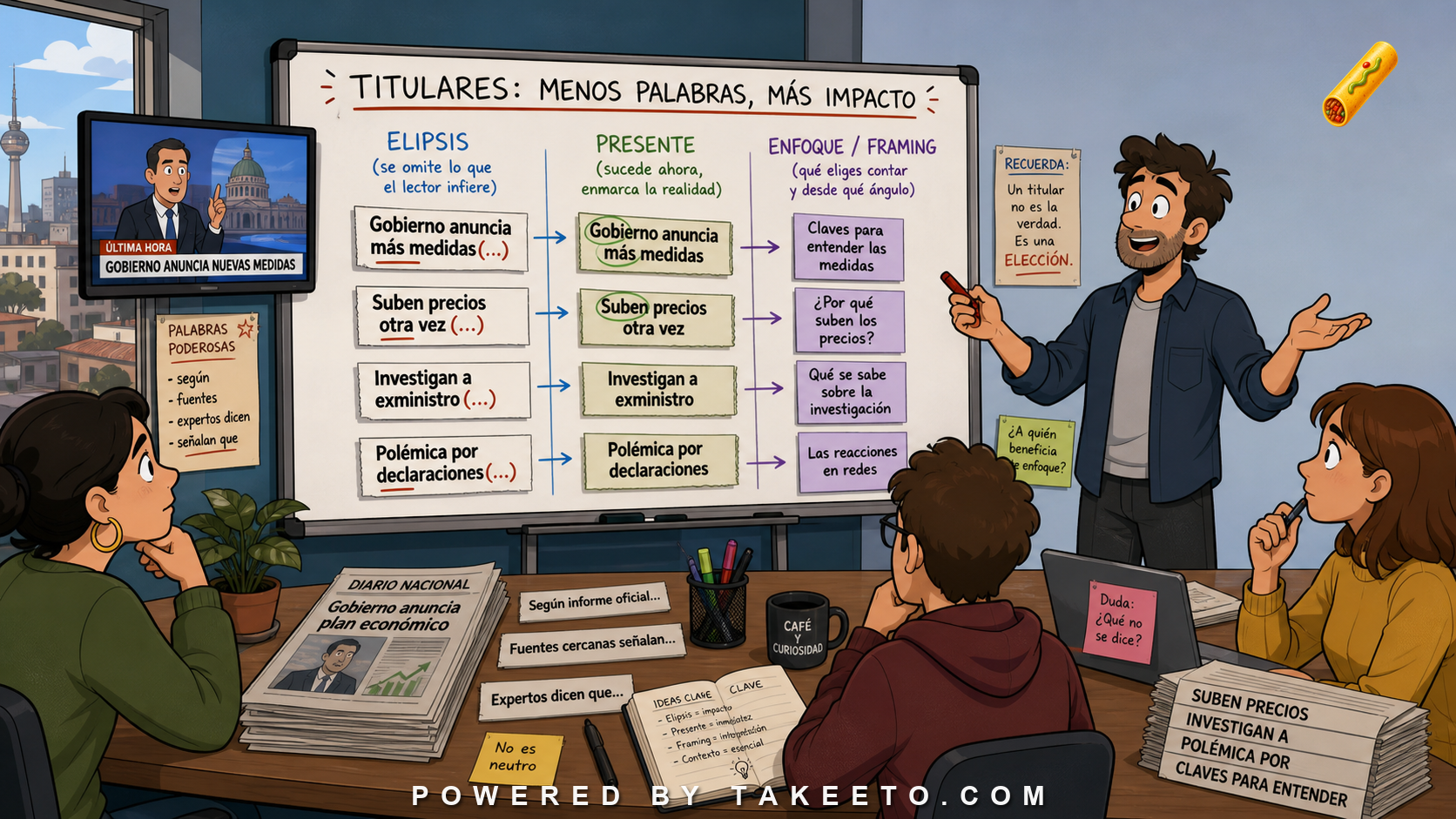
Headlines are compressed arguments
A Spanish headline is not just a short sentence. It is a compressed frame.
It tells the reader what happened, who matters, what is new, and sometimes how to feel about it. To save space and create impact, headlines omit articles, use present tense for recent events, hide agents, quote fragments, and choose nouns that carry evaluation.
Example:
Gobierno anuncia nuevas medidas
Expanded:
El Gobierno anunció nuevas medidas.
But expansion is only the first step. The headline also frames the government as active and the measures as the object of attention. Another headline could frame the same event differently:
Nuevas medidas generan críticas
Now the focus is reaction, not announcement.
The key principle is:
To read headlines well, restore the missing grammar and inspect the frame.
Headline ellipsis
Spanish headlines often omit articles and auxiliary material.
Headline:
Presidente firma ley de vivienda
Fuller sentence:
El presidente firmó la ley de vivienda.
Headline:
Protestas en varias ciudades por subida de precios
Fuller sentence:
Hubo protestas en varias ciudades por la subida de precios.
Headline:
Claves para entender la reforma
Fuller sentence:
Estas son algunas claves para entender la reforma.
The omissions are not random. Headlines keep nouns, verbs, actors, conflict words, and topic anchors.
Present tense for recent events
News headlines often use the present tense to report recent or current events.
Gobierno anuncia nuevas medidas
La oposición critica el plan
Suben los precios del transporte
Investigan a tres funcionarios
This present tense gives immediacy. It does not always mean the action is happening at this exact second. In English, headlines also use present tense for recent events: “Government announces...”
Learner action:
Do not automatically translate headline present as ordinary present. Ask whether it refers to a recent completed event.
Agency hiding
Headlines can hide or blur the agent.
Suben precios de alimentos
Who raised them? The market? Companies? A government policy? Inflation? The headline foregrounds the event and avoids assigning direct responsibility.
Investigan a tres funcionarios
Who is investigating? Police, prosecutors, an internal office? Spanish can use third-person plural without an explicit subject to focus the action.
Se aprueba nueva norma
The se construction can make the institutional action sound procedural and agentless.
Learner action:
When a headline lacks an agent, ask whether the article later identifies one. Agency omission is a framing choice.
Evaluative nouns
Some nouns carry stance.
polémica
crisis
escándalo
avance
fracaso
giro
choque
tensión
Compare:
Debate por la reforma educativa
versus:
Polémica por la reforma educativa
Debate sounds more neutral or institutional. Polémica implies public controversy and possibly conflict. The factual event may be similar, but the frame differs.
Quotation fragments
Headlines often use short quote fragments to inject stance.
“No hubo irregularidades”, afirma el ministro
The quote gives a claim. The verb afirma attributes it. The headline may not say whether the claim is true.
Another version:
Ministro niega irregularidades
Now the focus is denial. Denial implies an accusation or suspicion exists.
Learner action:
Quoted words in headlines are not necessarily facts. They are attributed claims.
Según and evidential distance
Spanish headlines often use según to mark source:
La economía crecerá este año, según el informe
This means the headline is not directly asserting the forecast as fact. It is attributing it to a report.
Depending on source and context, según can create credibility, distance, or caution.
A stronger headline:
La economía crecerá este año
A more cautious one:
La economía crecería este año, según analistas
The conditional crecería adds more distance.
Infinitive headlines
Spanish headlines and service journalism often use infinitives:
Cómo renovar el pasaporte
Claves para entender la nueva ley
Qué hacer ante una alerta meteorológica
Dónde consultar los resultados
These are not incomplete learner sentences. They are article-title structures used for guides, explainers, and practical information.
Headline rewrites
Headline:
Suben precios del transporte y crece malestar ciudadano
Neutral expansion:
Los precios del transporte subieron y aumentó el malestar ciudadano.
Agency-focused rewrite:
Las autoridades aprobaron una subida de precios del transporte, lo que generó malestar ciudadano.
Reaction-focused rewrite:
Usuarios critican la subida de precios del transporte.
Each version chooses a frame.
Headline:
Polémica por dichos del alcalde
Expansion:
Se produjo una polémica por las declaraciones del alcalde.
More precise rewrite:
Las declaraciones del alcalde generaron críticas de varios sectores.
The original is compact and vague. The rewrite clarifies action and actors.
Example bank walkthrough
Gobierno anuncia
Present-tense headline structure.
Learner action: expand to el Gobierno anunció/anuncia depending on timing.
suben precios
Agentless event frame.
Learner action: ask who or what caused the increase.
investigan a
Unspecified investigators.
Learner action: look in the article for prosecutors, police, ministry, or internal authority.
claves para entender
Explainer headline formula.
Learner action: expect a guide or analysis, not breaking-news narration.
polémica por
Conflict frame.
Learner action: identify who is criticizing whom and why.
según
Source attribution.
Learner action: separate the claim from the source that makes it.
Headline unpacking routine
For any Spanish headline:
- Restore omitted articles and verbs. Make it a full sentence.
- Identify tense. Is present tense reporting a recent event?
- Find the actor. Who acts? Is the actor missing?
- Find the affected party. Who receives the action?
- Mark attribution. según, afirmó, denunció, fuentes.
- Mark evaluative words. polémica, crisis, avance, choque.
- Rewrite neutrally. Remove framing and state the proposition.
- Compare frames. What would change if the headline focused another actor?
Headline grammar is a set of controlled losses
A full news sentence might be:
El Gobierno anunció nuevas medidas para reducir el precio de la energía.
A headline may become:
Gobierno anuncia medidas para reducir precio de la energía
The headline drops the article before Gobierno in some styles, uses present tense, compresses the noun phrase, and foregrounds the actor. The result is not ordinary prose. It is a compact signal.
Spanish headlines often remove:
- articles;
- auxiliary verbs;
- background clauses;
- explicit subjects when the institution is obvious;
- hedges that appear in the article body;
- full attribution;
- temporal detail.
The reader must rebuild the proposition before judging it.
Present tense does not always mean present time
A headline such as:
Detienen a tres personas por fraude
usually reports a recent event, not an eternal present. A full sentence might be:
La policía detuvo a tres personas por presunto fraude.
Or:
Tres personas fueron detenidas por presunto fraude.
The headline present makes the news feel immediate. It is conventional, but it can mislead learners who expect tense to map directly to time.
Agency hiding and agency highlighting
Compare:
Suben los precios de la gasolina
with:
El Gobierno sube el impuesto a la gasolina
and:
Las empresas suben el precio de la gasolina
The first headline presents price increases almost as an event without a responsible actor. That may be appropriate if the article is about market movement. It may be evasive if the cause is policy or corporate decision. Spanish headlines often hide agency through plural verbs, passives, or impersonal structures:
Investigan irregularidades en el contrato.
Se investigan irregularidades en el contrato.
Polémica por el contrato.
Each version reduces or shifts responsibility differently.
A media-literate reader asks:
Who did what, to whom, according to whom, and with what evidence?
Evaluative nouns frame the story
Headlines often use nouns that frame interpretation before the article begins:
crisis, polémica, escándalo, avance, golpe, caos, tensión, fracaso, récord, amenaza
Compare:
Polémica por la reforma educativa
with:
Debate por la reforma educativa
and:
Críticas a la reforma educativa
Polémica suggests conflict and public controversy. Debate is more institutional. Críticas points to one side’s reaction. None of these is neutral in exactly the same way.
Rewriting headlines into neutral prose
Take:
Claves para entender la polémica por la nueva ley
Expanded neutral version:
El artículo explica los principales puntos de una controversia pública relacionada con la nueva ley.
Take:
Gobierno defiende reforma pese a críticas
Expanded:
El Gobierno defendió la reforma, aunque distintos actores la criticaron.
Take:
Investigan a exfuncionario por presunto fraude
Expanded:
Las autoridades investigan a un exfuncionario por un supuesto caso de fraude.
The expanded versions are less punchy, but they reveal the grammar hidden in the headline.
Headline reading routine
For each headline, write a full sentence:
- Add missing articles.
- Identify the finite verb.
- Recover the subject if absent.
- Convert headline present into event time if necessary.
- Mark attribution: who says this?
- Mark legal caution: presunto, supuesto, según.
- Replace evaluative nouns with neutral descriptions.
- Ask what the headline foregrounds and what it hides.
A headline is not just a summary. It is a framing device. Learning to expand it is one of the fastest ways to read Spanish news more intelligently.
Practice: restore the missing sentence
Take a headline and write the full version it implies.
Headline:
Suben las tarifas del transporte
Questions:
- Who raised them?
- Where?
- When?
- By how much?
- According to whom?
- Is the increase approved, proposed, or already in effect?
Possible full sentence:
Las autoridades municipales aprobaron un aumento de las tarifas del transporte público que entrará en vigor el próximo mes.
Another possible sentence:
Las empresas de transporte aumentaron sus tarifas esta semana, según informaron medios locales.
The headline alone does not tell us which version is true. The exercise teaches the reader to withhold judgment until the body of the article supplies agency, evidence, and time.
Headline production warning
Learners should not imitate headline compression in ordinary writing. A headline may say Gobierno anuncia medidas. A normal sentence usually needs El Gobierno anunció nuevas medidas or El Gobierno ha anunciado nuevas medidas, depending on region and news style. Headline grammar is a special register, not a general shortcut.
Suggested interactive module: headline expander
A strong tool for this article would turn compressed headlines into annotated propositions.
Suggested functions:
- Headline input: Suben precios y crece malestar.
- Grammar expansion: Los precios subieron y creció el malestar.
- Actor detector: no explicit actor.
- Tense annotation: headline present or recent-event present.
- Frame labels: agency hidden, reaction foregrounded, evaluative noun.
- Neutral rewrite: Se registró una subida de precios.
- Alternative frames: government action, consumer reaction, market context.
Final rule
Spanish headlines compress grammar and frame events.
Restore the missing sentence, then inspect tense, agency, attribution, and evaluative nouns. A headline is not just information. It is a doorway into a particular version of the story.
Read the headline, then read the frame.