
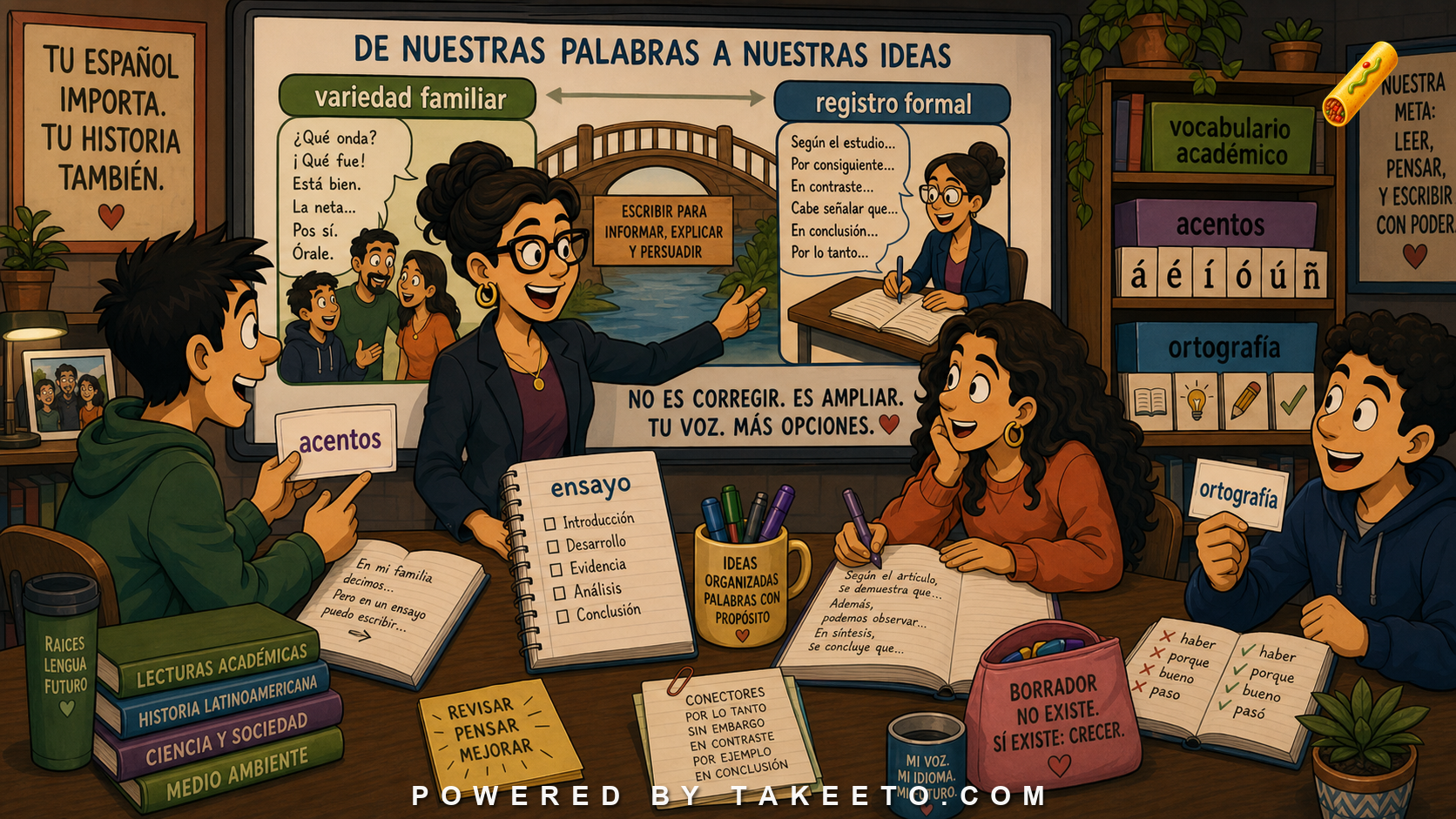
Heritage Spanish is not broken Spanish
A heritage learner of Spanish may understand family conversation, speak comfortably at home, follow community humor, and manage everyday interaction. The same learner may struggle with formal essays, accent marks, academic vocabulary, spelling, or public-register writing.
That profile is not failure. It is a domain mismatch.
A learner can have strong oral Spanish and weaker academic Spanish because schooling, reading, and writing happened mostly in another language. A learner can use a legitimate family dialect and still need access to standard academic register. These are different issues.
The key principle:
Heritage Spanish instruction should expand range, not erase identity.
Start with strengths
Heritage learners often bring strengths that L2 learners spend years trying to build:
- real listening exposure,
- natural rhythm,
- discourse routines,
- pragmatic intuition,
- family vocabulary,
- cultural references,
- idioms and humor,
- regional pronunciation,
- emotional connection to the language.
A course or self-study plan that treats the learner only as “incorrect” wastes these strengths. The better question is:
Which domains does the learner already control, and which domains need expansion?
A home Spanish speaker may know ándale, mijo, mande, qué pena, ahorita, chamba, vos, or ustedes in a real community context. That knowledge is linguistic knowledge.
Academic register is a new domain
Academic Spanish requires tools that may not appear often in home conversation:
por consiguiente
cabe señalar
se argumenta que
el propósito de este ensayo
los datos sugieren
en cambio
no obstante
It also requires literacy conventions:
- accent marks,
- punctuation,
- paragraph structure,
- thesis statements,
- source integration,
- formal connectors,
- nominalizations,
- precise vocabulary,
- citation style.
A heritage learner does not need “real Spanish” instead of family Spanish. The learner needs more registers.
Orthography deserves respect, not shame
Accent marks and spelling can be emotional for heritage learners. A student may speak Spanish fluently and then feel humiliated by written corrections:
porque vs por qué
esta vs está
mi mama vs mi mamá
hablo vs habló
The solution is not to ignore orthography. Written precision matters. But correction should be framed as literacy expansion, not proof that the learner's Spanish is fake.
A useful routine:
- Collect recurring spelling patterns.
- Group them by rule: stress, accent marks, homophones, verb endings.
- Practice in meaningful sentences.
- Reread personal writing aloud.
- Build an edit checklist.
Orthography is a writing skill, not an identity trial.
Dialect respect and standard access can coexist
A heritage learner may say:
¿Qué ocupas?
Ahorita vengo.
Se me hace que no.
La troca está afuera.
¿Vos querés?
Depending on region and community, these may be normal, expressive, and appropriate. A formal essay, job application, academic presentation, or public-service translation may require different choices.
The goal is register control:
I know how my family and community speak. I also know how to write a formal essay, fill out a government form, and read academic prose.
That is addition, not replacement.
Vocabulary expansion should be text-based
Academic vocabulary is best learned through reading, not isolated lists alone.
Instead of memorizing analizar, desarrollar, plantear, sostener, evidencia, criterio, enfoque, and proceso as loose items, read paragraphs where they function:
Este ensayo analiza la relación entre bilingüismo e identidad. Primero, se plantea el problema de la educación monolingüe. Luego, se examinan datos sobre el uso del español en contextos familiares y académicos.
Then rewrite:
Mi familia habla español en casa. En la escuela, aprendí sobre todo en inglés. Este ensayo analiza cómo esa diferencia afecta mi forma de usar el español.
The learner connects lived experience to formal expression.
Academic register should be taught with genre, not only vocabulary
It is tempting to teach academic Spanish as a list of formal replacements: pero becomes sin embargo, también becomes asimismo, dice becomes señala. That helps, but it is not enough. Academic register is also genre control.
A literature essay, a lab report, a policy memo, a history response, and a personal reflection do not organize evidence the same way. Heritage learners need models of the actual genres they are expected to write. A strong lesson can compare a family narrative with an academic paragraph about the same topic. The content may overlap, but the structure changes: thesis, evidence, interpretation, citation, and conclusion.
This approach avoids the false message that formal words automatically improve writing. Por consiguiente in a weak paragraph does not create logic. Academic Spanish is not decoration. It is disciplined organization of ideas in a register that readers in school and professional settings recognize.
Example bank walkthrough
registro formal
Formal register.
Learner action: learn it as an added style for specific domains, not as “better Spanish” in all situations.
ortografía
Spelling and writing conventions.
Learner action: build an edit checklist from real mistakes.
acentos
Accent marks.
Learner action: connect them to stress and meaning distinctions.
ensayo
Essay.
Learner action: practice thesis, paragraph structure, evidence, and conclusion.
vocabulario académico
Academic vocabulary.
Learner action: learn through reading and rewriting.
variedad familiar
Family variety.
Learner action: respect it while adding standard and formal registers.
Study plan for heritage academic Spanish
A productive weekly plan:
- Read one formal paragraph on a topic that matters to you.
- Underline connectors and academic verbs.
- Rewrite the paragraph in your own Spanish.
- Write a personal response using three formal expressions.
- Edit for accent marks and agreement.
- Compare family/register alternatives without shaming either.
- Record yourself reading the final version aloud.
This creates a bridge from oral fluency to academic literacy.
Assessment without deficit framing
Heritage learners still need rigorous assessment. Respect does not mean avoiding standards. It means assessing the right thing.
A useful profile separates domains:
- home conversation,
- academic reading,
- formal writing,
- spelling and accent marks,
- presentation speech,
- professional email,
- dialect awareness,
- grammar terminology.
This prevents one weak area from being misread as global deficiency. A learner may be highly competent in oral narrative but inexperienced with essay structure. Another may write formally but feel insecure in family conversation. The instructional plan should identify actual domains and build outward from them.
The strongest feedback says: “This form works in your community context; here is the form expected in academic writing.” That gives access without humiliation.
Remediation notes: academic register is an expansion project, not identity correction
The repair for this article is to make its heritage-learner stance more explicit. Academic Spanish should be taught as an added repertoire, not as a replacement for family Spanish. A learner who says pa in speech, uses a local word such as lonche, or recognizes U.S. Spanish institutional terms may still need para, almuerzo/comida, solicitud, plazo, matrícula, tesis, and argumento in formal writing. The goal is range.
Academic register has multiple layers. Orthography is one layer: accent marks, capitalization, punctuation, and paragraphing. Vocabulary is another: plantear, sostener, evidencia, hipótesis, desarrollo, conclusión. Genre is another: a literary analysis, lab report, policy memo, history essay, and scholarship application do not organize evidence the same way. A learner cannot build academic Spanish from word lists alone. They need model texts and rewrite practice.
The article should also distinguish error correction from register coaching. Correcting haiga to haya may be necessary for formal writing, but the teacher should explain the target context: En conversación familiar puedes oír X; en escritura académica se espera Y. This gives the learner control instead of shame. Similarly, a local community word can be logged as community/useful locally while a broader or formal alternative is added for public writing.
Heritage learners often have strong oral discourse skills: storytelling, humor, stance, rhythm, family roles, and pragmatic nuance. Academic instruction should leverage those strengths. For example, a family story can become an academic paragraph by adding thesis, evidence, citation, and conclusion. The learner sees continuity rather than replacement.
Production target: build a heritage literacy notebook with four columns: mi forma familiar, forma formal, dónde usarla, and ejemplo en una oración académica. This turns correction into expansion. A serious curriculum should give heritage learners access to prestige registers without asking them to reject the Spanish that made them bilingual.
Suggested interactive module: heritage literacy growth map
A strong tool for this article would map domains rather than rank people.
Suggested functions:
- Domain profile: home, school, work, public services, academic reading, formal writing.
- Strength inventory: oral fluency, listening, cultural vocabulary, pronunciation, pragmatics.
- Register expansion tasks: casual to formal rewrites.
- Orthography clinic: accent marks, homophones, verb endings.
- Dialect note field: family forms with regional labels.
- Essay builder: thesis, evidence, paragraph connectors.
- Identity-safe feedback: correction framed as expansion.
Final rule
Heritage Spanish should not be treated as damaged Spanish.
Build academic register by adding literacy, orthography, formal vocabulary, and writing control while respecting family variety. The goal is range: home Spanish, community Spanish, public Spanish, academic Spanish, and professional Spanish.