
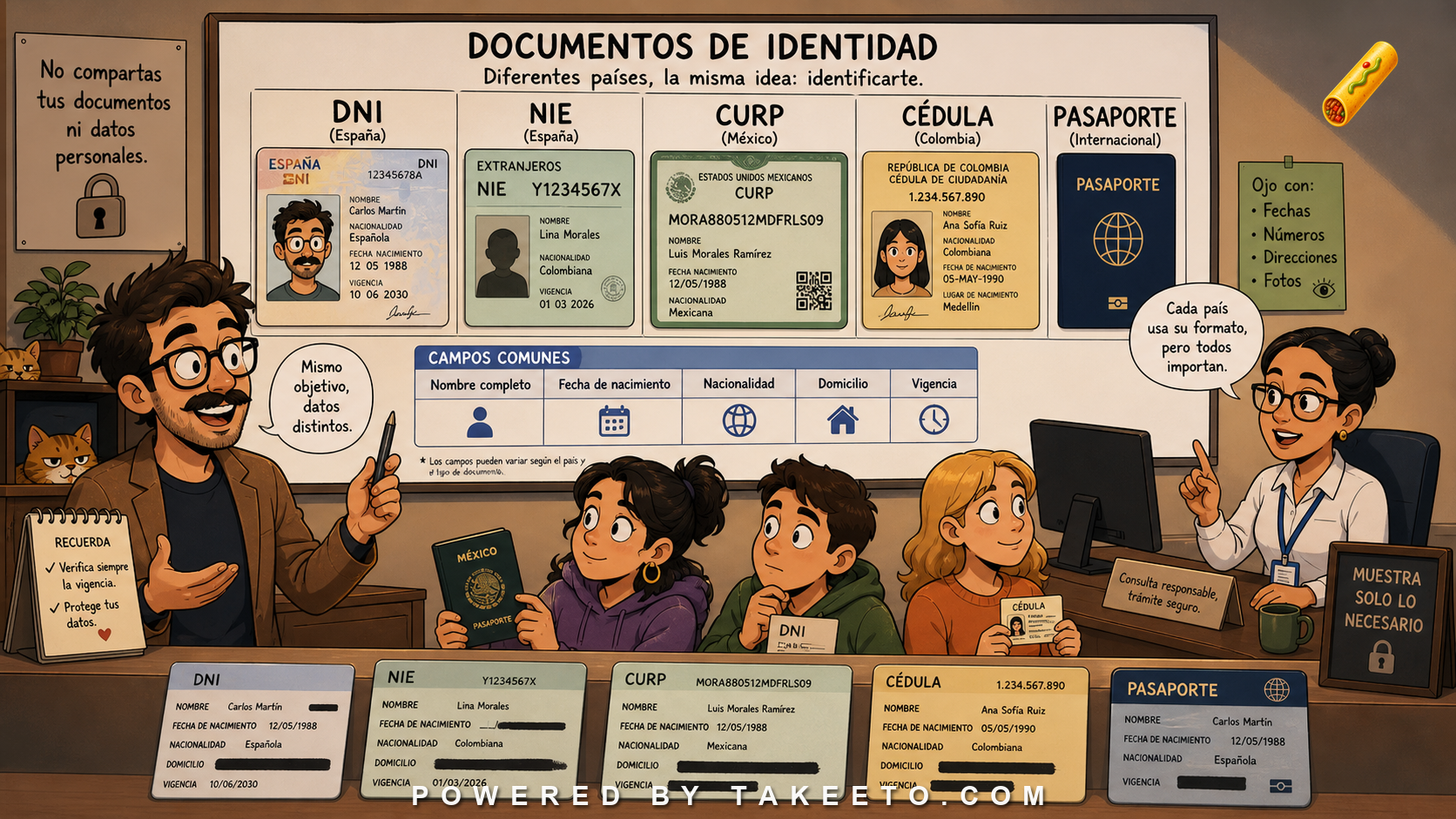
Identity-document Spanish is country-specific by design
Spanish-speaking countries do not use one unified identity-document system. Spain has DNI and NIE. Mexico uses CURP. Many countries use some form of cédula. All use pasaporte for international travel, but passport fields and administrative phrasing differ.
The key principle is:
Identity-document Spanish must be read by country and document type before translating individual fields.
Common document labels
Frequent labels include:
documento de identidad
DNI
NIE
CURP
cédula
cédula de identidad
pasaporte
credencial
licencia
tarjeta de residencia
DNI usually refers to a national identity document in some countries, especially Spain and Argentina with country-specific systems. NIE in Spain identifies foreigners administratively. CURP is a Mexican population registry code. Cédula is widely used in Latin America, but exact form varies.
A learner should not treat abbreviations as generic words.
Personal fields
Common fields:
nombre
apellidos
nombres y apellidos
fecha de nacimiento
lugar de nacimiento
nacionalidad
sexo
género
estado civil
domicilio
dirección
Apellidos are surnames. In many Spanish-speaking contexts, people may have two surnames. Systems may ask for primer apellido and segundo apellido. Domicilio is official address/residence. Dirección is also address but may be used more generally.
Issue and validity language
Important administrative terms:
fecha de expedición
fecha de emisión
expedido por
emitido por
válido hasta
vigencia
vencimiento
caducidad
número de documento
Expedir and emitir both relate to issuing. Vigencia is validity period. Vencimiento or caducidad indicates expiration.
Documento vigente hasta el 15/08/2030.
This means the document is valid until that date.
Number, code, and folio
Documents may include:
número
código
folio
clave
registro
expediente
Folio can mean page, record number, or administrative reference depending on document. Clave can be key/code, not only password.
Sex, gender, and form sensitivity
Documents may use sexo, género, or markers such as M/F, depending on country and system. These categories are administratively and socially sensitive. A learner should read the field label precisely and not impose one document’s category on another.
Translation of identity markers can matter in legal, medical, travel, and immigration contexts.
Privacy and high-stakes caution
Identity documents contain sensitive personal data. Even understanding the vocabulary does not mean one should casually copy, translate, store, or share it. Forms may ask for numbers that can be used for banking, government services, travel, or tax matters.
Useful caution phrases:
datos personales
documento oficial
copia simple
copia certificada
uso indebido
protección de datos
A learner should know when a text is asking for official identity information and treat it seriously.
Example bank walkthrough
DNI: national identity document in certain systems; country-specific.
NIE: foreigner identification number in Spain.
CURP: Mexican population registry code.
Cédula: identity card in many Latin American countries; meaning varies.
Pasaporte: passport.
Fecha de nacimiento: birth date.
Nacionalidad: nationality.
Domicilio: official address/residence.
Vigencia: validity.
Identity-document reading workflow
- Identify the country.
- Identify the document type.
- Separate personal fields from administrative fields.
- Read names carefully, especially surnames.
- Identify issue and expiration dates.
- Identify document number versus registry code.
- Watch domicilio versus temporary address.
- Treat sex/gender fields with precision.
- Do not share sensitive numbers unnecessarily.
- For official use, verify with the relevant authority or certified translator.
Before/after revision drill
Weak translation:
Enter your date and address.
Source Spanish:
Indique fecha de expedición, fecha de vencimiento y domicilio.
Better translation:
Provide the issue date, expiration date, and official address/residence.
The better version distinguishes issue and expiration dates. Identity-document fields are not interchangeable. A wrong date in an official form can be more serious than a grammatical error.
Remediation: identity-document Spanish is field logic
Identity documents are not paragraphs. They are structured data with labels, numbers, dates, and institutional formulas. The reader’s job is to identify fields accurately and avoid guessing.
Common fields include:
nombre / nombres
apellidos
fecha de nacimiento
lugar de nacimiento
nacionalidad
sexo / género
domicilio
número de documento
fecha de expedición
fecha de vencimiento / caducidad
autoridad emisora
firma
A learner may understand each word separately and still confuse the document if they do not see the field relationships. Expedición is issue, not expedition in the travel sense. Vigencia is validity period. Domicilio may be legal address, not simply where someone happens to be staying.
Country labels are not interchangeable
Different countries use different identity-document systems and labels:
DNI in Spain and other countries = national identity document, but details vary.
NIE in Spain = foreigner identity number.
CURP in Mexico = population registry code.
cédula in many Latin American contexts = identity card/document, but exact system varies.
pasaporte = passport.
RUT, CUIT, RFC, and similar codes may be tax or registry identifiers depending on country.
Do not convert these into a generic “ID” when legal precision matters. In casual explanation, “ID number” may be enough. In document handling, preserve the original label.
Mini-workshop: field-by-field reading
Sample field set:
Apellidos: García López
Nombres: Ana María
Fecha de nacimiento: 14/03/1998
Nacionalidad: mexicana
Fecha de expedición: 10/06/2021
Vigencia: 10/06/2031
Reading:
Apellidos includes family names, possibly two.
Nombres includes given names.
Date format may be day/month/year; verify local format.
Nacionalidad is nationality, not ethnic identity.
Expedición is when the document was issued.
Vigencia tells validity through a date or period.
The common learner error is rearranging names into an English-style first-name/last-name model without checking the document’s field labels.
Privacy caution
Identity-document Spanish is sensitive. It may include personally identifiable information: full name, document number, birth date, address, nationality, sex/gender marker, photo, signature, QR code, and machine-readable zone. Learners should not upload, share, or translate such documents casually. Redaction matters.
Useful privacy vocabulary:
datos personales
documento vigente
copia simple
copia certificada
número de identificación
tratamiento de datos
consentimiento
verificación de identidad
When a form asks for documento vigente, it usually means the document must not be expired. When it asks for copia legible, the image must be readable. When it asks for anverso y reverso, it wants front and back.
Before/after: translating fields responsibly
Too loose:
ID: Ana García, born 3/14/98, valid 2031.
Better:
Surnames: García López. Given names: Ana María. Date of birth: 14 March 1998. Date of issue: 10 June 2021. Valid until: 10 June 2031.
The better version preserves field logic and avoids collapsing two surnames or changing date order silently.
Identity-document checklist
Before interpreting a document, mark:
- Country/system: DNI, NIE, CURP, cédula, passport, tax ID.
- Person fields: names, birth date, nationality, sex/gender, address.
- Document fields: number, issue date, expiry, authority.
- Validity: vigente, vencido, caducado, renovado.
- Copy status: original, copy, certified copy, front/back.
- Privacy risk: information that must be redacted or protected.
Identity-document Spanish is not the place for confident guessing. Read labels exactly.
Additional remediation drill: slow the document down
If this article still feels like vocabulary, turn one authentic-looking sentence into a four-line analysis before translating it. Write the original sentence. Then list the actor, the action, the object, and the condition or consequence. Only after that, produce a plain-language paraphrase.
This drill matters because domain Spanish often compresses too much into noun phrases. The learner sees familiar words and moves too quickly. Slowing the sentence down reveals whether the reader understands the document logic or only recognizes terms. For article 272, the safest practice is to treat each key term as a field in a larger system: who is acting, what status is changing, what evidence or condition controls the action, and what the reader should do with the information.
A useful production rule is: do not write a polished sentence until you can write a plain one. Plain Spanish is not inferior; it is the diagnostic layer that proves comprehension.
Suggested interactive module: identity-document field comparison chart
A useful tool would compare common fields across systems.
Suggested functions:
- Country/document selector: DNI, NIE, CURP, cédula, pasaporte.
- Field labels: name, birth date, nationality, address, validity.
- Issue/expiration decoder: expedición, emisión, vencimiento, vigencia.
- Privacy warning: sensitive data fields.
- Translation note mode: official versus informal translation.
Mini-workshop: identifying document fields without oversharing
Form request:
Ingrese número de documento, fecha de nacimiento, nacionalidad y domicilio actual.
Identify the fields:
- document number,
- birth date,
- nationality,
- current address.
Now classify sensitivity. All four are personal data. The form may be legitimate, but the language tells you it is requesting identity information. A learner’s goal is not only to understand the Spanish; it is to notice risk.
Common learner mistakes
One mistake is treating DNI, NIE, CURP, and cédula as interchangeable. They belong to different systems. Another is confusing fecha de expedición with fecha de nacimiento. One is when the document was issued; the other is when the person was born.
A third mistake is skipping vigencia. A document can be real but expired. If a form asks for a documento vigente, validity matters as much as identity.
Applied reading drill: distinguish personal identity from document status
An identity form might ask for:
Nombre completo, fecha de nacimiento, nacionalidad, número de documento, fecha de expedición y vigencia.
Separate the fields into two groups. Personal identity fields include nombre completo, fecha de nacimiento, and nacionalidad. Document-status fields include número de documento, fecha de expedición, and vigencia.
This distinction helps prevent common mistakes. Fecha de nacimiento belongs to the person. Fecha de expedición belongs to the document. Vigencia tells whether the document is currently valid. A person’s identity does not expire, but a document can.
Privacy also matters. The more fields a form requests, the more sensitive the exchange is. A request for número de documento plus fecha de nacimiento plus domicilio should make you ask whether the website, office, or email is legitimate.
For learners, document literacy includes both comprehension and risk awareness. Understanding the Spanish is only step one; knowing that the information is sensitive is step two.
Final rule
Identity-document Spanish is not universal Spanish. It is administrative Spanish tied to a specific country and system. Decode the document type first, then the fields.