More modes are not automatically better
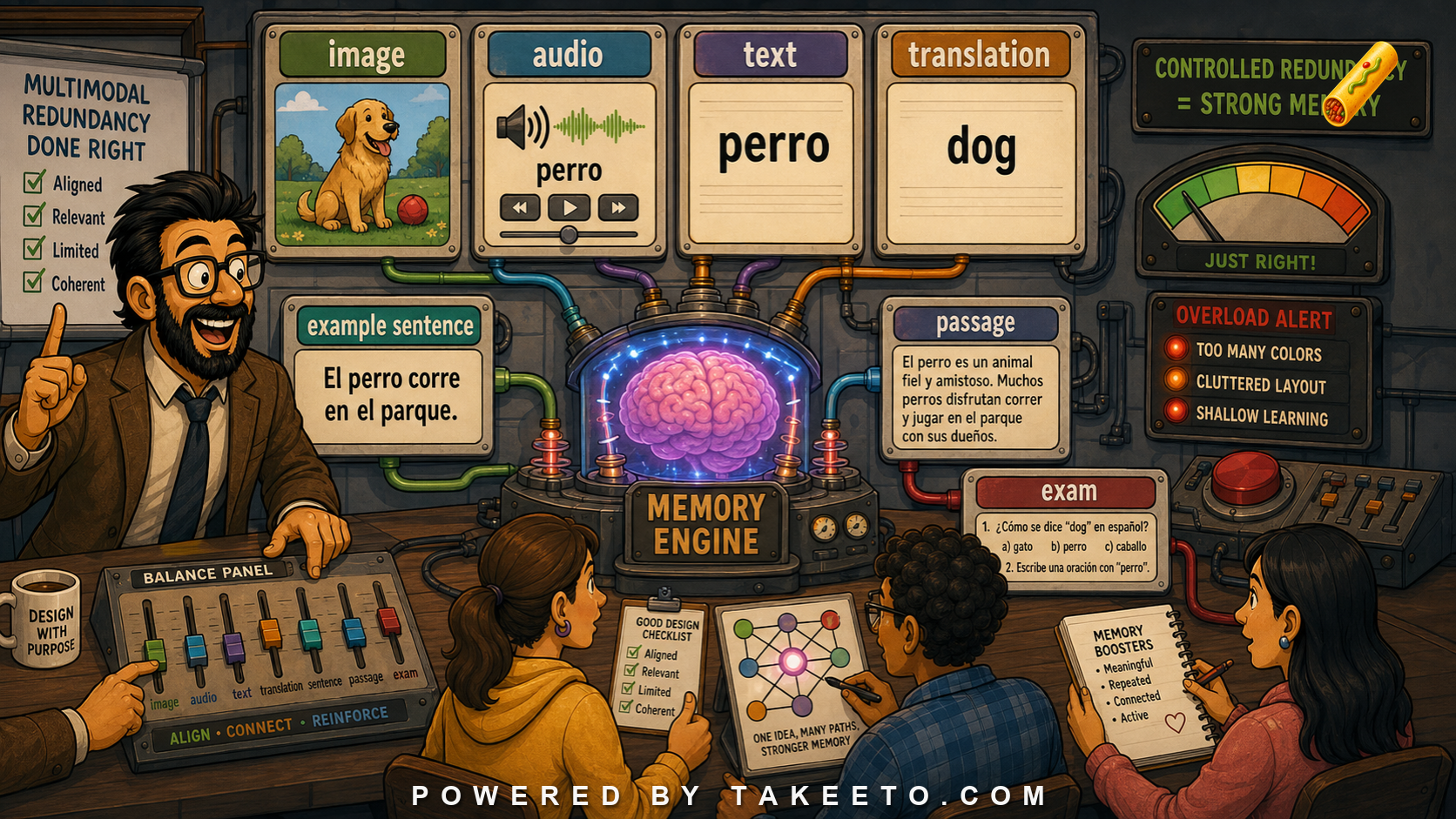
A Spanish learning card can include text, audio, image, translation, example sentence, passage link, grammar note, and exam prompt.
That can be powerful. It can also become clutter.
Multimodal learning works when each mode contributes something distinct. Spanish text shows spelling, accents, gender, agreement, and word order. Audio teaches pronunciation, stress, rhythm, and listening. Translation supports meaning. Images can cue memory and create a semantic anchor. Example sentences show use. Passages provide discourse. Exams retrieve knowledge.
But if every mode repeats the same obvious information, the learner receives noise. A picture of a book beside libro may help a beginner. A picture for aunque, por consiguiente, or se me olvidó may be vague or misleading. A translation can help; it can also become a crutch if it appears too early in every task. Audio can reinforce pronunciation; it can also distract if triggered constantly.
The design question is:
What does this mode add for this item at this moment?
Images are cues, not definitions
Images work well for concrete nouns and some actions.
| Good image candidates | Weak image candidates |
|---|---|
| la manzana | aunque |
| el tren | sin embargo |
| la llave | subjuntivo |
| correr | responsabilidad |
| abrir la puerta | darse cuenta |
| café con leche | por lo tanto |
Even for concrete words, images are not full definitions. A picture of a dog can cue perro, but it does not teach masculine gender, plural perros, the contrast with perra, idioms, or pronunciation. A picture of a key can cue llave, but it does not teach regional y/ll pronunciation or adjective agreement.
Images should be treated as retrieval cues. They are not replacements for language.
Audio carries information images cannot
An image cannot teach the difference between pero and perro. It cannot teach stress in público versus publicó. It cannot teach the rhythm of se lo mandé. It cannot show whether llave is pronounced with a given regional sound. It cannot convey question intonation.
Audio is essential for:
- stress;
- vowel quality;
- r/rr contrast;
- y/ll variation;
- c/z/s variation;
- connected speech;
- sentence rhythm;
- intonation;
- listening recognition;
- pronunciation imitation.
For many Spanish items, audio is more important than images.
Translation carries meaning efficiently
Translation is sometimes treated as a weakness, as if serious learners should avoid it entirely. That is too simplistic.
A good translation can quickly establish meaning and let the learner focus on Spanish form. The problem is not translation itself. The problem is overreliance or bad alignment.
For me quedan tres páginas, a translation helps:
I have three pages left.
But a note should preserve Spanish structure:
The remaining things, tres páginas, control the plural verb quedan.
For se le cayó el vaso:
He/she dropped the glass.
Note:
Spanish frames it as an accidental event: the glass fell, affecting someone.
Translation gives access. Notes protect structure.
Redundancy should be complementary
Useful redundancy means the learner meets the same item through different evidence.
Example item: plazo.
| Mode | Contribution |
|---|---|
| Text | el plazo; masculine noun; spelling with z. |
| Audio | Stress and pronunciation. |
| Translation | deadline/time limit. |
| Image | Calendar with marked deadline, optional. |
| Example sentence | El plazo termina mañana. |
| Passage | Application story where the deadline creates urgency. |
| Exam | Recall from English, cloze in context, listening recognition. |
The modes reinforce one another without doing identical work.
Example item: sin embargo.
| Mode | Contribution |
|---|---|
| Text | Connector spelling and word boundaries. |
| Audio | Prosodic transition in a sentence. |
| Translation | however/nevertheless. |
| Image | Usually unnecessary or abstract. |
| Example sentence | Contrast between two clauses. |
| Passage | Argument structure in paragraph. |
| Exam | Choose connector or interpret contrast. |
Here the image may be omitted. That is good design.
Clutter is a learning cost
Every element on a card competes for attention.
A card with a large image, Spanish word, phonetic hint, translation, grammar note, example sentence, passage excerpt, three audio buttons, tags, streak badge, and navigation icons may feel rich. It may also make the learner stop seeing the target item.
Designers should control reveal order.
Possible sequence:
- Prompt: image or English or Spanish, depending on exam direction.
- Learner attempts recall.
- Reveal Spanish text and audio.
- Show translation.
- Show example sentence.
- Show grammar note only if needed or expanded.
- Link to passage/article.
The learner should not receive all support before trying.
Multimodal design by item type
| Item type | Best primary modes | Notes |
|---|---|---|
| Concrete noun | image + text + audio | Add gender and plural. |
| Abstract noun | text + translation + example | Image may be metaphorical and weak. |
| Verb | text + audio + example sentence | Image can help for physical actions. |
| Grammar construction | example + note + cloze | Image rarely enough. |
| Connector | passage context + translation + audio | Show discourse relation. |
| Pronunciation contrast | audio + minimal pair text | Image irrelevant. |
| Register item | example + label + translation | Image may distract. |
| Idiom | example + note + translation | Avoid literal image unless pedagogically useful. |
The mode should fit the item.
Reveal order protects retrieval
Multimodal design should not give every answer away before the learner has tried.
If a card shows a picture, Spanish text, English translation, audio, example sentence, and grammar note all at once, the learner may recognize the item without retrieving it. Recognition is not useless, but it is weaker than recall. The interface should decide what appears before the attempt and what appears after.
Possible reveal orders:
| Task | Before attempt | After attempt |
|---|---|---|
| Spanish-to-English recognition | Spanish text + optional audio | Translation, example, note |
| English-to-Spanish recall | English prompt | Spanish text, audio, example |
| Image recall | Image only or image + context | Spanish, translation, audio |
| Listening recognition | Audio only | Text, translation, replay |
| Cloze grammar | Sentence with blank | Answer, grammar explanation |
The same item can appear in multiple task modes over time. The point is not to hide support forever. The point is to place support after effort when retrieval is the goal.
Multimodal profiles by Spanish item
Different Spanish items deserve different profiles.
For la llave:
- image: useful;
- audio: useful for ll/y exposure;
- text: must include article for gender;
- example: No encuentro la llave de la puerta;
- exam: image recall and translation both work.
For aunque:
- image: usually weak;
- audio: useful for sentence flow;
- text: essential;
- example: Aunque estaba cansado, terminó el informe;
- passage: very useful because concession is discourse-level;
- exam: cloze or connector-choice works better than image recall.
For me queda bien:
- image: possible if clothing context is clear;
- audio: useful for chunk rhythm;
- translation: “it fits me / it looks good on me” depending context;
- note: queda agrees with the thing;
- exam: sentence production is better than isolated word recall.
For por consiguiente:
- image: not useful;
- audio: useful in formal sentence;
- passage: essential because it marks logical consequence;
- register label: formal/written;
- exam: choose the connector that fits the argument.
The product should not use the same media recipe for every item.
Redundancy can repair weak memory
Multimodal design is especially useful after mistakes.
If a learner repeatedly confuses pero and perro, the system should not simply show the translation again. It should add minimal-pair audio, waveform or tap/trill explanation, and contrastive examples. If a learner confuses pedir and preguntar, an image will not help much; contrastive sentences will. If a learner misses plazo, a calendar image plus formal application passage may help. If a learner misses se me olvidó, a diagram of affected participant and forgotten item may help more than any picture.
This suggests a remediation principle:
Add the mode that addresses the failure, not the mode that is easiest to display.
A listening failure needs audio. A collocation failure needs examples. A grammar failure needs a note or diagram. A meaning failure may need translation or image. A discourse failure needs passage context.
Avoid decorative media debt
Every image and audio file creates maintenance work. If an image is vague, culturally odd, too childish, or mismatched to the item, it becomes debt. If audio is generated without QA, it becomes debt. If translations are too free, they become debt. If all cards receive images because the template allows images, the product becomes visually busy without becoming more educational.
A serious curriculum should be willing to say “no image for this item.” That is not a missing feature. It is good judgment.
Sometimes the best modality is the one you hide first
Multimodal design should also control sequence. Showing every cue at once can turn a Spanish task into a recognition shortcut. If the learner sees the English translation, a literal image, and the Spanish word together, they may never retrieve the Spanish form. The product should decide which cue appears first and which appears only after effort.
For a recognition task, Spanish text can appear first and the learner can produce meaning. For a recall task, English or an image can appear first and the learner must produce Spanish. For a listening task, audio can play before text appears. For a reading passage, the learner may first read Spanish with highlights, then reveal the translation, then inspect notes. The same modalities are present, but the order changes the cognitive work.
This matters for Spanish grammar items. An image cannot prompt aunque llueva reliably, but a scenario plus English prompt can. Audio-first practice can reveal whether the learner hears habló or hablo. Text-first practice can reveal whether the learner notices the accent mark. Translation-after-response can prevent the English from doing all the work.
A mature multimodal system therefore has display rules, not just asset slots. It knows when to show, when to hide, when to reveal after an answer, and when to link to a deeper note.
V2 remediation refinement: multimodal redundancy should be complementary, not repetitive clutter
The first draft warned that more modes are not automatically better. The remediation pass adds a more concrete design test: each mode should contribute a different kind of evidence for the same item. If text, image, audio, translation, and example sentence all merely repeat a shallow label, the learner gets clutter, not reinforcement.
For a concrete noun such as la llave, an image can be strong. The article la teaches gender, the audio teaches pronunciation, the sentence teaches use, and the translation confirms meaning. For an abstract connector such as sin embargo, an image is usually weak; a paragraph contrast and translation alignment matter more. For se me olvidó, a picture of a person looking worried is not enough; the learner needs sentence structure, note, audio rhythm, and contrast with olvidé.
A useful modality matrix asks:
| Item type | Best primary mode | Supporting modes |
|---|---|---|
| concrete noun | image + article | audio, sentence, plural/gender note |
| verb | sentence/action context | audio, conjugation note, cloze |
| connector | paragraph context | translation, discourse label, rewrite exercise |
| grammar construction | annotated sentence | audio, contrast card, article link |
| register item | paired examples | note, domain passage, translation warning |
| pronunciation contrast | audio | waveform/stress mark, minimal-pair exam |
Reveal order matters too. Showing the English translation before retrieval can turn a production task into recognition. Showing an image before a Spanish prompt may help meaning but hide form. Playing audio before a listening exam can cue the answer. Multimodal design should define when each cue appears, not just whether it exists.
The upgraded rule is: add a mode only when it changes what the learner can perceive, retrieve, or repair.
Suggested interactive module: multimodal item card anatomy
A useful tool would let designers choose modes for each item and flag overload.
Fields:
| Field | Question |
|---|---|
| Item type | noun, verb, connector, construction, idiom, pronunciation target? |
| Image value | Does an image cue meaning accurately? |
| Audio need | Is pronunciation, stress, or rhythm central? |
| Translation need | Does English establish meaning efficiently? |
| Example need | Does the item require collocation or grammar context? |
| Passage link | Has the item appeared in discourse? |
| Exam direction | Should the item be tested by recognition, recall, listening, image, or cloze? |
| Clutter score | Are too many supports visible before retrieval? |
The tool could recommend: “Use image” for la llave, “avoid image” for sin embargo, “audio required” for perro/pero, “example required” for darse cuenta de que.
Final rule
Multimodal Spanish learning works when each mode earns its place.
Text, audio, images, translation, examples, passages, and exams should reinforce the same item from different angles. Images are retrieval cues, not full definitions. Audio teaches what text and images cannot. Translation supports meaning but should not erase structure. The interface should reveal help in a way that preserves retrieval.
More modes are useful only when they make memory richer, not when they make the screen louder.