
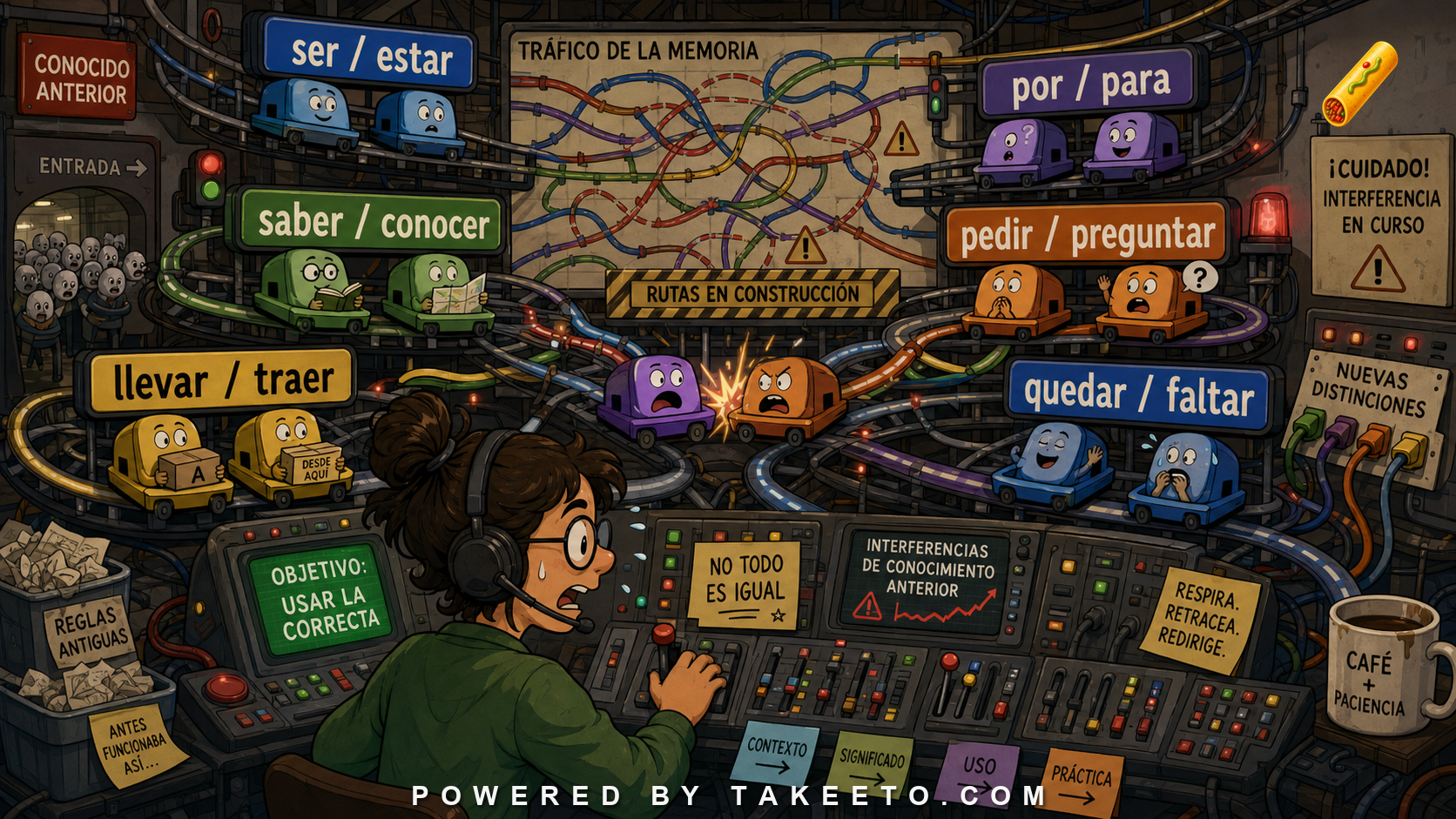
The problem is often similarity, not ignorance
A learner who confuses saber and conocer is not starting from zero. They know both words are related to “knowing.” That similarity is precisely the problem.
Spanish learning is full of near-neighbors:
ser / estar
por / para
pedir / preguntar
saber / conocer
llevar / traer
quedar / faltar
The learner's brain stores them close together. In production, the wrong neighbor jumps out.
The key principle:
Interference happens when similar forms, meanings, or contexts compete during retrieval.
The cure is not more vague exposure. The cure is contrastive practice.
Proactive and retroactive interference
Proactive interference happens when old knowledge interferes with new learning.
Example:
A learner first learns ser = to be and overuses it later:
Soy cansado.
They need estoy cansado when describing current tiredness.
Retroactive interference happens when new knowledge disrupts old knowledge.
Example:
A learner finally learns estar and then overcorrects:
Está médico.
They need es médico for profession/identity.
The learner has not become worse. The system is reorganizing. But without contrast, forms continue to fight.
Confusable grammar needs paired examples
Studying por today and para next week is often not enough. The learner needs them in contrast.
Trabajo para una empresa mexicana.
I work for a Mexican company.
Trabajo por necesidad.
I work out of necessity.
Este regalo es para Ana.
This gift is for Ana.
Lo hice por Ana.
I did it for Ana / because of Ana / on Ana's behalf.
Paired examples teach boundaries. Isolated examples teach familiarity.
Interference can be semantic
Some words overlap in translation but differ in Spanish meaning.
Pedir / preguntar:
Pedí ayuda.
I asked for help.
Pregunté la hora.
I asked the time.
Saber / conocer:
Sé la respuesta.
I know the answer.
Conozco a la profesora.
I know the professor.
Quedar / faltar:
Quedan tres días.
Three days remain.
Faltan tres días.
Three days are left / three days are missing until the event.
The learner should not ask, “What does this word mean in English?” but “What contrast does Spanish make?”
Interference can be morphological
Similar forms can also interfere:
hablo
I speak
habló
he/she spoke
llegue
present subjunctive or command context
llegué
I arrived
Accent marks, endings, and stress patterns matter. Written Spanish uses small marks to encode real distinctions.
Interference can be pragmatic
Forms may be grammatically correct but socially wrong for the situation.
Dame el documento.
Give me the document.
¿Podría enviarme el documento?
Could you send me the document?
Learners may overuse one politeness formula everywhere. Too direct can sound rude. Too indirect can sound unnatural or unclear. The interference is not grammar; it is register competition.
Remediation routine
For a confusable pair, use four steps:
- Define the contrast in one sentence.
- Build paired examples.
- Practice mixed retrieval.
- Write an error trigger.
Example:
Pedir requests something. Preguntar asks a question.
Paired examples:
Pedí una cita.
Pregunté si había citas.
Mixed retrieval:
I asked for information. → Pedí información.
I asked what time it was. → Pregunté qué hora era.
Error trigger:
If I can answer with an object/service/help, probably pedir. If I can answer with information, probably preguntar.
Interference often appears under speed
A learner may choose correctly on a worksheet and still fail in conversation. That does not mean the worksheet was useless. It means the contrast has not yet become fast enough. Interference increases when attention is divided: speaking, listening, writing under time pressure, or reading a dense document.
This is why contrastive practice should gradually increase pressure. Start with slow, obvious choices. Then use shorter prompts. Then use sentences. Then use audio. Then use timed retrieval. Finally, use free production where the learner must choose the form without being warned that a contrast is coming.
The final stage matters. If every exercise is titled por vs para, the learner is being told what to think about. Real Spanish does not announce the contrast. Mastery means choosing the form when the problem appears unannounced.
Example bank walkthrough
ser/estar
Classification vs state/location framing.
Learner action: study counterexamples, not slogans.
por/para
Cause/route/exchange vs destination/purpose/recipient/deadline tendencies.
Learner action: drill paired contexts.
saber/conocer
Facts/skills vs familiarity/acquaintance.
Learner action: include preterite meanings supe and conocí.
pedir/preguntar
Request vs question.
Learner action: never use preguntar just because English says “ask.”
llevar/traer
Motion/transfer relative to perspective.
Learner action: draw speaker, listener, object, destination.
quedar/faltar
Remaining, fitting, arrangement vs lacking/missing/time until.
Learner action: compare real calendar and inventory examples.
Contrastive notebook method
A learner can build a simple interference notebook. Each page has one confusable pair or cluster.
Format:
Pair: llevar / traer
Core contrast: movement relative to the speaker/hearer or deictic center.
Example 1: Trae el libro aquí.
Example 2: Lleva el libro a la oficina.
My error: Trae el libro a tu casa when speaking from my own house.
Repair trigger: Where is the object going relative to the speaker?
This notebook is especially useful for intermediate learners who keep making the same mistakes despite understanding explanations. The act of writing the contrast forces a boundary.
Remediation notes: interference requires discrimination practice, not more explanation alone
The main repair is to make interference practical. Learners often understand two explanations separately and still fail when both options compete. They can explain saber and conocer, but under time pressure they say the wrong one. They can define por and para, but free production collapses the boundary. The cure is not another isolated lecture. It is discrimination practice.
Blocked practice creates false confidence. If a learner completes ten sentences about saber in a row, the task becomes predictable. Real Spanish does not announce that today is saber day. Mixed retrieval is harder because the learner must identify the contrast. A good sequence is: separate explanation, side-by-side contrast, mixed examples, timed prompts, passage reading, audio recognition, and free writing.
The article should also distinguish proactive and retroactive interference in Spanish terms. English may proactively interfere with preguntar/pedir, traer/llevar, asistir/atender, or actualmente/actually. New Spanish knowledge may retroactively disrupt older knowledge when the learner overcorrects: after learning estar, they may stop using ser confidently; after learning subjunctive, they may insert it everywhere after que. Interference can move both directions.
Contrast sets need specific triggers. Por often answers cause, route, exchange, duration, agent, and motive. Para often answers destination, deadline, purpose, recipient, standard, and intended use. A learner should not memorize a giant list equally. They should identify the trigger that caused their own mistake: cause/purpose, duration/deadline, recipient/exchange, motion/destination, or opinion standard.
Production target: build a one-page contrast card for each stubborn pair. Include meaning boundary, two minimal Spanish examples, my common wrong sentence, the trigger, and a mixed drill. Review the card only after trying to choose under pressure. Interference fades when the learner practices choosing, not when they merely reread definitions.
Suggested interactive module: confusable-items contrast trainer
A strong tool for this article would train pairs in mixed retrieval.
Suggested functions:
- Contrast card: one-sentence distinction.
- Paired examples: side-by-side Spanish sentences.
- Mixed quiz: random prompts requiring choice.
- Error clustering: track which pair causes repeated mistakes.
- Context builder: learner writes two sentences using both forms.
- Register layer: grammar vs politeness vs dialect contrast.
- Review scheduler: repeated contrast after errors.
Final rule
Interference is not solved by studying items separately.
When Spanish forms compete, put them in the same room. Compare them, contrast them, retrieve them in mixed practice, and attach each to clear contexts. Confusion fades when boundaries become stronger than similarity.