
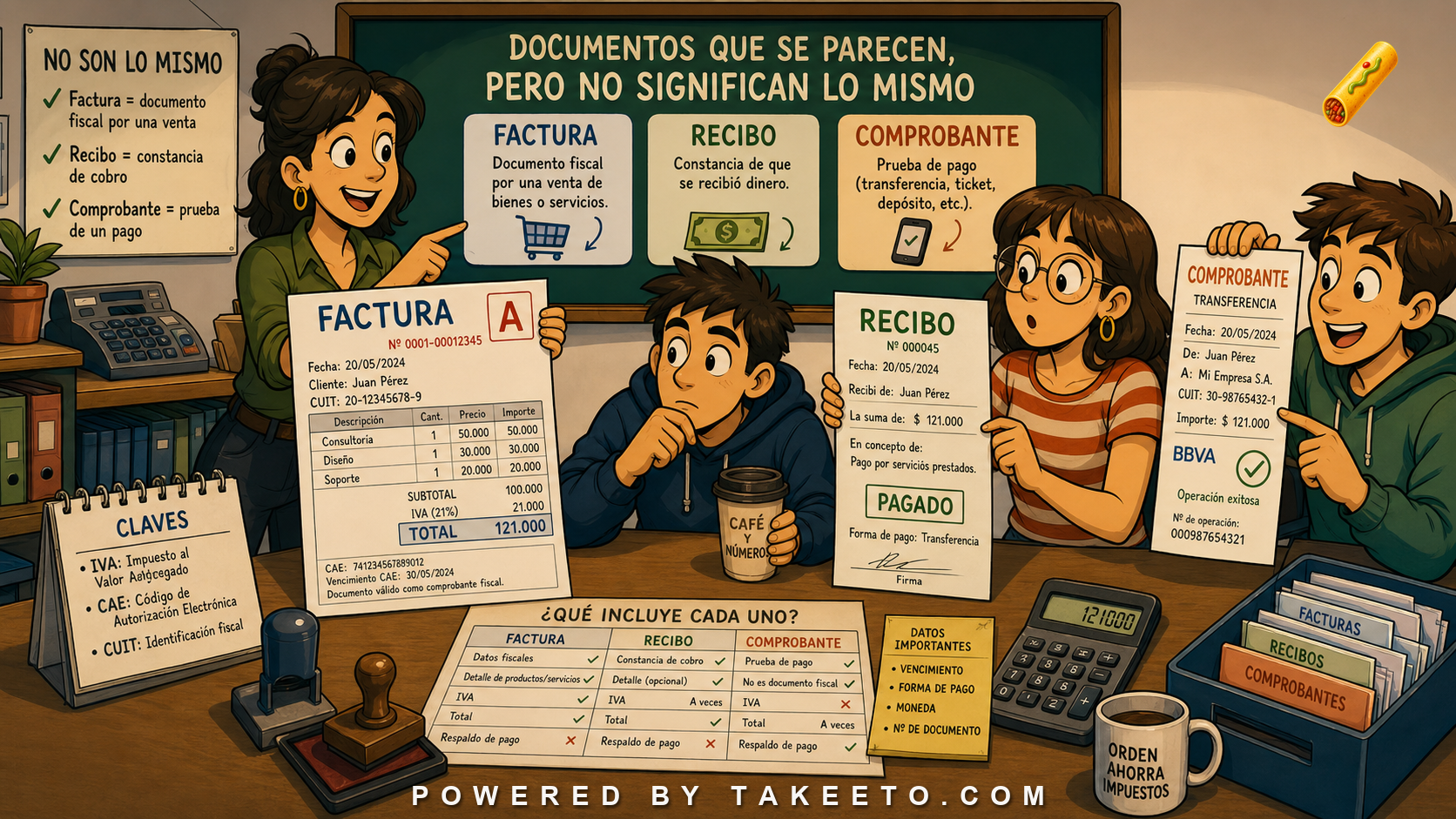
Not every payment document does the same job
Spanish uses several words for payment documents: factura, recibo, comprobante, ticket, justificante. Learners often translate all of them as “receipt.” That is dangerous. Some documents request payment. Some prove payment. Some have tax value. Some are informal. Some are required for reimbursement or accounting.
The key principle is:
Read Spanish payment documents by function: charge, proof, tax record, or transaction evidence.
Factura
A factura is generally an invoice or tax invoice, depending on country and system. It often includes seller data, buyer data, tax ID, date, itemized goods/services, subtotal, tax, and total.
Common fields:
factura número
fecha de emisión
emisor
receptor
NIF / CIF / RFC / RUC / CUIT
concepto
cantidad
precio unitario
subtotal
IVA
total
Tax ID labels vary by country. IVA is value-added tax in many systems, but tax names and rates vary.
Recibo
A recibo often acknowledges that money was received.
Recibí de... la cantidad de...
It can be formal or informal depending on context. Rent, services, school fees, and small business payments may use recibo.
A recibo may or may not be a tax-valid invoice. Do not assume.
Comprobante, ticket, justificante
Comprobante is proof or transaction record. It may prove payment, transfer, purchase, or deposit.
Ticket is often a retail receipt or small purchase slip. In some contexts it may not be enough for tax deduction.
Justificante is proof/supporting document, often used in Spain:
justificante de pago
justificante bancario
justificante de transferencia
The function is evidence.
Payment and due-date fields
Important terms:
vencimiento
fecha de vencimiento
forma de pago
método de pago
pagado
pendiente
adeudo
saldo
anticipo
abono
Vencimiento is due date or expiration. Pendiente means pending/unpaid. Adeudo is amount owed/debt. Anticipo is advance payment. Abono can be partial payment, credit, or deposit depending on country.
Fecha de vencimiento: 30/06/2026.
Pay by that date if it is an invoice.
Taxes and totals
Common fields:
subtotal
impuesto
IVA
retención
descuento
recargo
total
importe
Importe means amount. Retención is withholding. Recargo is surcharge. Descuento is discount.
Subtotal: 100
IVA: 21
Total: 121
This structure is straightforward, but local tax rates and labels are not universal.
E-invoicing and digital documents
Many countries use electronic invoicing systems with terms such as:
factura electrónica
CFDI
XML
código QR
sello digital
timbrado
validación
folio fiscal
These are country-specific. A learner should recognize that factura electrónica is not just a PDF. It may be a structured tax document validated through a government system.
Example bank walkthrough
Factura: invoice/tax invoice; may request or document payment.
Recibo: receipt acknowledging money received.
Comprobante: proof or transaction record.
IVA: value-added tax or VAT-like tax in many systems.
Subtotal: before tax/charges.
Total: final amount.
Vencimiento: due date.
Forma de pago: payment method.
Document-reading workflow
- Identify document type: factura, recibo, comprobante, ticket.
- Identify seller/emitter and buyer/receiver.
- Find issue date and due date.
- Read tax ID fields by country.
- Check itemized concepts.
- Separate subtotal, tax, discounts, surcharges, and total.
- Identify payment status: paid, pending, due.
- Check payment method.
- Determine whether it has tax or accounting value.
- Save official digital files if required.
Before/after revision drill
Weak translation:
Receipt total 100, expires tomorrow.
Source Spanish:
Factura pendiente de pago. Total: 100. Fecha de vencimiento: 28/05/2026.
Better translation:
Invoice pending payment. Total: 100. Due date: May 28, 2026.
The improved version recognizes that factura pendiente de pago is not proof of payment. It is an amount still owed. Payment-document vocabulary is functional, not decorative.
Remediation: factura, recibo, comprobante, and ticket are not the same object
Spanish financial-document words vary by country and system, but learners need the basic distinction: a document may request payment, prove payment, support tax reporting, or simply record a retail purchase.
Broadly:
factura often means invoice and may be a tax document.
recibo often means receipt or proof that money was received.
comprobante is proof/supporting document and can be broad.
ticket may be a retail receipt, ticket, or platform term depending on region.
justificante may mean supporting proof, especially in administrative contexts.
Do not translate all of them as receipt. A factura pendiente de pago is not proof that payment has been made. A recibo de pago is closer to evidence of payment. A comprobante fiscal has tax significance in some systems.
Mini-workshop: invoice-field parsing
Document fields:
Fecha de emisión: 02/05/2026
Fecha de vencimiento: 16/05/2026
Subtotal: 1.000,00
IVA: 210,00
Total: 1.210,00
Forma de pago: transferencia bancaria
Reading:
fecha de emisión = date issued.
fecha de vencimiento = due date, not expiration in the food sense.
subtotal = amount before tax or adjustments.
IVA = value-added tax or similar tax label in many contexts.
total = amount due/total amount.
forma de pago = payment method.
This is field logic. Do not infer payment status from the presence of an invoice. Look for pagado, pendiente, vencido, cancelado, abonado, or payment confirmation.
Payment-status language
Useful terms:
pendiente de pago = unpaid/pending payment.
pagado = paid.
vencido = overdue/expired, depending on context.
abonado = paid/credited, context-dependent.
saldo pendiente = outstanding balance.
recargo = surcharge/late fee.
descuento = discount.
nota de crédito = credit note.
anulada/cancelada = voided/canceled, but country and accounting system matter.
A learner should read vencimiento carefully. On an invoice, it usually means due date. On an ID document, it means expiration. On food packaging, it may mean best-before or expiration depending on label.
Before/after: document translation precision
Too loose:
Send me the receipt.
Better choices:
Envíeme la factura, si necesito un documento fiscal.
Envíeme el recibo de pago, si necesito comprobar que pagué.
Envíeme el comprobante de transferencia, si necesito probar the bank transfer.
Envíeme el ticket, if the context is a retail purchase.
In Spanish production, the exact noun tells the other person what document you need. In English translation, preserve that difference when it matters.
Tax and business caution
Invoice vocabulary is country-specific. IVA, RFC, NIF, CUIT, RUC, NIT, CFDI, and similar labels belong to particular fiscal systems. A general Spanish learner should recognize them as tax or identification fields but should not treat them as interchangeable.
When invoices are used for reimbursement, accounting, immigration evidence, or tax filing, informal translation is not enough. Keep original labels and consult local rules.
Invoice-reading checklist
Mark:
- Document type: factura, recibo, comprobante, ticket, nota de crédito.
- Issuer: business/person issuing.
- Recipient: client/customer/buyer.
- Tax ID fields: if present.
- Items/services: description, quantity, unit price.
- Amounts: subtotal, tax, discount, total.
- Dates: issue date, service date, due date, payment date.
- Status: paid, unpaid, canceled, overdue.
- Payment method: cash, card, transfer, platform.
- Official validity: electronic signature, stamp, authorization code, if relevant.
Financial Spanish rewards exact nouns. Guessing creates real-world confusion.
Additional remediation drill: slow the document down
If this article still feels like vocabulary, turn one authentic-looking sentence into a four-line analysis before translating it. Write the original sentence. Then list the actor, the action, the object, and the condition or consequence. Only after that, produce a plain-language paraphrase.
This drill matters because domain Spanish often compresses too much into noun phrases. The learner sees familiar words and moves too quickly. Slowing the sentence down reveals whether the reader understands the document logic or only recognizes terms. For article 276, the safest practice is to treat each key term as a field in a larger system: who is acting, what status is changing, what evidence or condition controls the action, and what the reader should do with the information.
A useful production rule is: do not write a polished sentence until you can write a plain one. Plain Spanish is not inferior; it is the diagnostic layer that proves comprehension.
Suggested interactive module: invoice field highlighter
A useful tool would label invoice fields and explain function.
Suggested functions:
- Document type classifier: factura, recibo, comprobante.
- Field labels: issuer, receiver, tax ID, concept, total.
- Tax field parser: IVA, retención, recargo.
- Payment status detector: pagado, pendiente, vencido.
- Country-specific tax ID notes.
Mini-workshop: deciding what document you have
Document heading:
Factura electrónica
This suggests a tax invoice, often with official fields. Now compare:
Recibo de pago
This suggests proof that a payment was received. Now compare:
Comprobante de transferencia
This suggests evidence of a bank transaction. All three may relate to money, but they do not have the same accounting or tax function.
Common learner mistakes
The biggest mistake is translating factura, recibo, ticket, and comprobante all as “receipt.” That loses function. A second mistake is ignoring vencimiento. If a factura has a due date, it may be requesting payment, not proving payment.
A third mistake is skipping tax ID labels because they are country-specific. RFC, RUC, CUIT, NIF, and similar fields may be essential in their systems. Do not erase them in translation.
Applied reading drill: identify what the document proves
Suppose someone sends three files:
factura_123.pdf
comprobante_transferencia.pdf
recibo_pago.pdf
Do not assume they prove the same thing. The factura may show that money is owed or that a taxable sale occurred. The comprobante de transferencia may show that a bank transfer was initiated or completed. The recibo de pago may acknowledge that payment was received.
The practical question is:
What does this document prove, and to whom?
An invoice may be necessary for accounting but insufficient to prove payment. A transfer receipt may prove that you sent money but not that the seller delivered goods. A retail ticket may prove purchase but may not meet tax-document requirements. A factura electrónica may require validation code, QR, or XML file depending on country.
For each document, mark: issuer, recipient, date, amount, tax, payment status, and verification method. That prevents the common mistake of treating every payment-related PDF as a “receipt.”
Final rule
Do not translate every payment document as “receipt.” In Spanish, factura, recibo, comprobante, and ticket answer different questions: who charged, who paid, what tax applies, and what proof exists.