
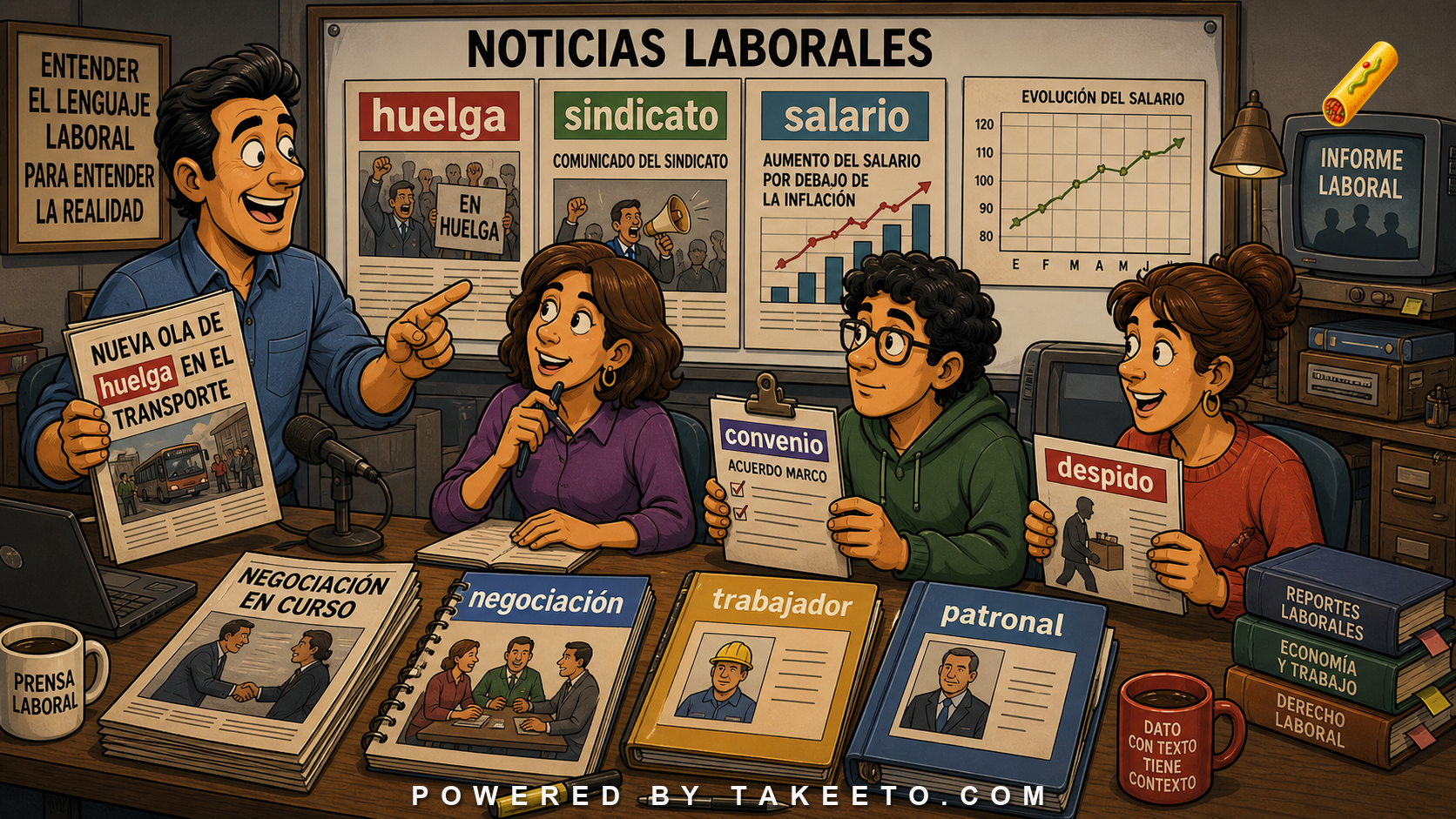
Labor news is actor-heavy Spanish
Labor reporting in Spanish is not just vocabulary about jobs. It is a field of actors: trabajadores, sindicatos, empresa, patronal, gobierno, ministerio, juzgado, comité, mesa de negociación. Each actor speaks with a stance. A union denuncia, a company asegura, a ministry media, a court resuelve, a group of workers convoca or mantiene a strike.
The key principle is:
To read labor Spanish, map the actors before you translate the conflict.
Without the actor map, huelga, salario, convenio, and despido float without political or institutional meaning.
Huelga, paro, protesta, movilización
Common protest terms overlap but are not identical.
huelga
strike
paro
stoppage, strike, work stoppage; in some countries also unemployment depending on context
protesta
protest
movilización
mobilization, collective action
manifestación
demonstration
Huelga usually centers on labor stoppage. Paro can mean a stoppage or unemployment. Movilización is broader and often includes marches, assemblies, public pressure, or coordinated action.
Example:
Los trabajadores convocaron una huelga de 48 horas.
This tells us actor, action, and duration.
Convenio, contrato, acuerdo
Labor Spanish uses convenio heavily.
convenio colectivo
collective bargaining agreement
contrato laboral
employment contract
acuerdo
agreement
negociación colectiva
collective bargaining
A convenio is not just a casual agreement. In labor contexts, it may define wages, hours, benefits, categories, protections, and procedures for a sector or workplace. Negociar el convenio means negotiating the framework under which many workers operate.
Wages and compensation
Core wage vocabulary:
salario
sueldo
remuneración
paga
aumento salarial
pérdida de poder adquisitivo
salario mínimo
horas extra
prestaciones
Salario and sueldo often overlap, but salario is common in policy and labor rights. Poder adquisitivo is purchasing power; it appears when wages rise less than prices.
Example:
El sindicato exige una subida salarial acorde con la inflación.
The union is not only asking for more money; it frames the demand as protection against inflation.
Layoffs and job security
Terms for job loss and restructuring:
despido
despido colectivo
recorte de plantilla
suspensión
cierre
reestructuración
indemnización
reincorporación
A company may describe layoffs as reestructuración or ajuste. A union may call the same event despidos injustificados or recorte de derechos. The words frame responsibility.
Patronal and institutional actors
Patronal refers to employer associations or the employer side as an organized actor. It is not simply “boss” in every context.
La patronal rechazó la propuesta sindical.
This sentence frames the conflict as organized bargaining between employers and unions.
Other actors:
sindicato
comité de empresa
trabajadores
plantilla
dirección
empresa
ministerio
inspección laboral
Plantilla means workforce/staff, not a template in this context.
Attribution verbs in labor reporting
Labor news is filled with stance verbs.
el sindicato denuncia
la empresa asegura
la patronal advierte
el gobierno sostiene
los trabajadores exigen
la dirección niega
el ministerio media
These verbs are not neutral labels. Denunciar frames a wrong. Asegurar presents a claim with firmness. Advertir implies risk or warning. Negar signals conflict over facts.
Learner action: build a quote chain. Who says what, and with what verb?
Headlines compress conflict
Labor headlines often omit articles and verbs:
Huelga indefinida en el transporte por el convenio.
Sindicatos denuncian despidos y exigen negociación.
La patronal rechaza la subida salarial.
Expand them into full propositions:
Los trabajadores del sector del transporte iniciarán o mantienen una huelga indefinida debido a un conflicto sobre el convenio.
Headline expansion prevents you from missing cause and actor.
Example bank walkthrough
huelga
Strike.
Learner action: identify duration, sector, actor, and demands.
sindicato
Union.
Learner action: note whether it is quoted, organizing, negotiating, or denouncing.
salario
Wage/salary.
Learner action: connect to inflation, minimum wage, raise, purchasing power.
convenio
Collective agreement in labor contexts.
Learner action: do not translate as generic convention.
despido
Dismissal/layoff.
Learner action: watch for collective, unjustified, procedural, or negotiated forms.
negociación
Negotiation/bargaining.
Learner action: identify who sits at the table.
trabajador
Worker.
Learner action: note singular worker, workforce, unionized workers, or affected workers.
patronal
Employer side or employer association.
Learner action: translate by institutional role.
Labor-news reading workflow
- Identify the sector.
- Identify each actor.
- Mark demands: wages, hours, layoffs, conditions, rights.
- Mark the action: strike, negotiation, protest, legal filing.
- Track attribution verbs.
- Separate employer, union, government, and worker claims.
- Note timeline: announced, ongoing, suspended, resolved.
- Watch for euphemisms such as reestructuración.
- Expand headlines into full sentences.
- Translate convenio by labor context.
Mini-workshop: rewrite a partisan paragraph neutrally
Take one labor-news paragraph and mark every actor in a different role: union, employer, government, court, workers, public. Then rewrite the paragraph without stance verbs such as denunció, acusó, rechazó, or advirtió unless you attribute them clearly. For example, el sindicato denunció precariedad becomes el sindicato afirmó que las condiciones laborales son precarias. This does not make the union wrong or the employer right. It simply separates the claim from the fact pattern, which is the first step toward responsible reading.
Actor-claim matrix
For labor news, build a four-column matrix: actor, claim, evidence, next action. Fill it before translating.
Example:
El sindicato denunció incumplimientos del convenio, mientras la empresa aseguró que ha respetado todos los acuerdos. El Ministerio convocó a ambas partes a una mesa de diálogo.
Actor one: sindicato. Claim: incumplimientos del convenio. Evidence: not provided in the sentence. Actor two: empresa. Claim: respected all agreements. Evidence: not provided. Actor three: Ministerio. Action: convened dialogue.
The matrix shows that the paragraph contains conflicting claims, not settled facts. It also prevents a common translation error: turning denunció into definitive proof or turning aseguró into neutral truth.
For writing, the same matrix helps avoid biased compression. Instead of la empresa incumplió y el sindicato reaccionó, write el sindicato denunció incumplimientos; la empresa negó la acusación if that is all the article establishes. Labor Spanish is precise when responsibility and allegation remain visible.
Remediation drill: make an actor-pressure-outcome chart
For one labor article, draw four columns: actor, verb, demand, response. Put sindicato, trabajadores, plantilla, empresa, patronal, ministerio, tribunal, or mediador in the actor column. Put verbs such as denuncia, exige, convoca, rechaza, sostiene, advierte, negocia, acuerda in the verb column. Then identify the demand and the response.
Example:
El sindicato exige una subida salarial del 8%, mientras la patronal ofrece un 3% y argumenta que el sector atraviesa una caída de ingresos.
Chart:
Union: demands 8% wage increase.
Employer side: offers 3%.
Employer argument: revenue decline.
Conflict point: salary adjustment.
This chart stops the learner from flattening the article into “workers are unhappy.” It also reveals whether the news article is reporting an active negotiation, a strike announcement, a court dispute, or a political statement.
For remediation, rewrite any loaded noun into a neutral description before translating. Recortes may be “cuts” with a negative frame. Ajustes may be “adjustments” with a managerial frame. Flexibilización laboral may sound modern to one actor and threatening to another. Precarización is openly critical. Labor Spanish is not only about employment vocabulary; it is about who gets to name the conflict.
A serious summary should therefore preserve both material facts and language frames:
Los trabajadores describen la medida como precarización, mientras la empresa la presenta como flexibilización necesaria.
That is the kind of sentence that shows advanced comprehension.
Suggested interactive module: labor-dispute actor map
A strong tool would convert a labor article into a conflict diagram.
Suggested functions:
- Actor extraction: union, employer, workers, government, court.
- Demand labels: wage, schedule, layoffs, safety, contract.
- Attribution verb scale: denounces, claims, warns, admits, denies.
- Timeline tracker: called strike, begins strike, resumes talks, reaches agreement.
- Headline expander.
- Stance comparison: union wording versus employer wording.
Applied reading drill: build the dispute chain
Start with a sentence like:
El sindicato denunció despidos injustificados, mientras la empresa aseguró que se trata de una reestructuración necesaria.
Do not translate it as one flat event. Build the chain:
- Union claim: the dismissals are unjustified.
- Company claim: the dismissals are necessary restructuring.
- Conflict word: mientras marks contrast.
- Stance verbs: denunció frames wrongdoing; aseguró frames confidence.
Now ask what is missing: number of workers, legal procedure, negotiation status, government involvement, and worker response. Labor reporting is usually a contested record, not one neutral story.
Remediation focus: mapping labor conflict instead of memorizing strike vocabulary
Labor news is rarely neutral vocabulary practice. It is a battlefield of actors and frames. A huelga may be described by workers as a defense of rights, by employers as a disruption, by government as a negotiation problem, and by consumers as a service interruption. The Spanish itself changes with the stance: exigir, denunciar, reclamar, advertir, ofrecer, rechazar, acatar, desconvocar.
The remediation task is to make the actor map visible before translating. Who called the strike? Who is negotiating? Who claims legality? Who is affected? Who is quoted directly? Who is described indirectly? In labor Spanish, nouns such as sindicato, patronal, empresa, trabajadores, plantilla, gremio, and autoridades create the structure of the story.
Common failure modes to repair
- Treating paro and huelga as always identical: They can overlap, but usage varies by country and context. Paro may describe a work stoppage; huelga often names strike action more formally.
- Forgetting collective nouns: La plantilla, el sindicato, la patronal, and el gremio may act grammatically as singular entities while representing groups.
- Missing attribution bias: Denunció, advirtió, alegó, afirmó, and reconoció frame credibility and conflict differently.
- Reading wage language too narrowly: Salario, sueldo, remuneración, prestaciones, beneficios, bono, and convenio may all affect compensation.
Before/after: neutralize a labor-news paragraph
Weak version:
Los trabajadores paralizaron la ciudad porque no quieren aceptar la propuesta responsable de la empresa.
Stronger version:
El sindicato convocó una huelga de 24 horas tras rechazar la propuesta salarial de la empresa, que la dirección calificó de responsable. La medida afectó el transporte urbano y abrió una nueva ronda de negociación.
The stronger version removes editorial judgment, attributes the company’s stance, names the duration, identifies the effect, and keeps the dispute open.
Upgrade workshop: build the labor-dispute chain
- List the actors: sindicato, trabajadores, empresa, patronal, ministerio, usuarios, tribunal.
- Mark the action verbs attached to each actor.
- Separate demands from offers. Exigir is not proponer; rechazar is not negociar.
- Find the status of the action: announced, ongoing, suspended, extended, declared illegal, resolved.
- Translate only after the chain is clear: demand → response → escalation → effect → next step.
Quality-control checklist
- Are layoffs called despidos, recortes, bajas, or reestructuración?
- Does convenio mean a collective bargaining agreement, a general agreement, or another institutional document?
- Is salario mínimo legal, negotiated, proposed, or campaign rhetoric?
- Does the article state who will lose pay, who will maintain essential services, and who enforces them?
- Are quotes balanced, or does one side receive more direct speech?
Applied remediation drill: separate the strike action from the reporting frame
Use this source-style excerpt:
La patronal acusó al sindicato de mantener una huelga injustificada, mientras los trabajadores denunciaron que la empresa incumplió el convenio firmado el año pasado.
A fast but weak reading might say:
The employers say the union is wrong, and workers say the company broke the agreement.
That reading is incomplete. A stronger reading says:
The sentence contains opposing attributed claims: the employers frame the strike as unjustified, while the workers accuse the company of failing to comply with last year’s collective agreement.
The repair comes from five checks:
- La patronal acusó frames the employer side as making a charge, not as neutral fact.
- Huelga injustificada is the employer’s evaluative label.
- Mientras sets up competing frames, not merely simultaneous events.
- Denunciaron signals a public accusation or complaint by workers.
- Incumplió el convenio points to an alleged breach of a specific labor agreement.
Rewrite the sentence for a neutral news brief: La patronal calificó la huelga de injustificada; el sindicato, por su parte, sostuvo que la empresa incumplió el convenio firmado el año anterior. The revised version keeps both positions attributed. It avoids letting injustificada become the narrator’s own judgment and avoids turning denunciaron into proven breach. This is essential in labor reporting, where each side uses language to claim legitimacy.
Final rule
Labor Spanish is not just about jobs; it is about organized conflict, institutional actors, and negotiated rights. Start with the actor map. Then read the verbs. A sentence about huelga, salario, convenio, or despido is usually also a sentence about power.