
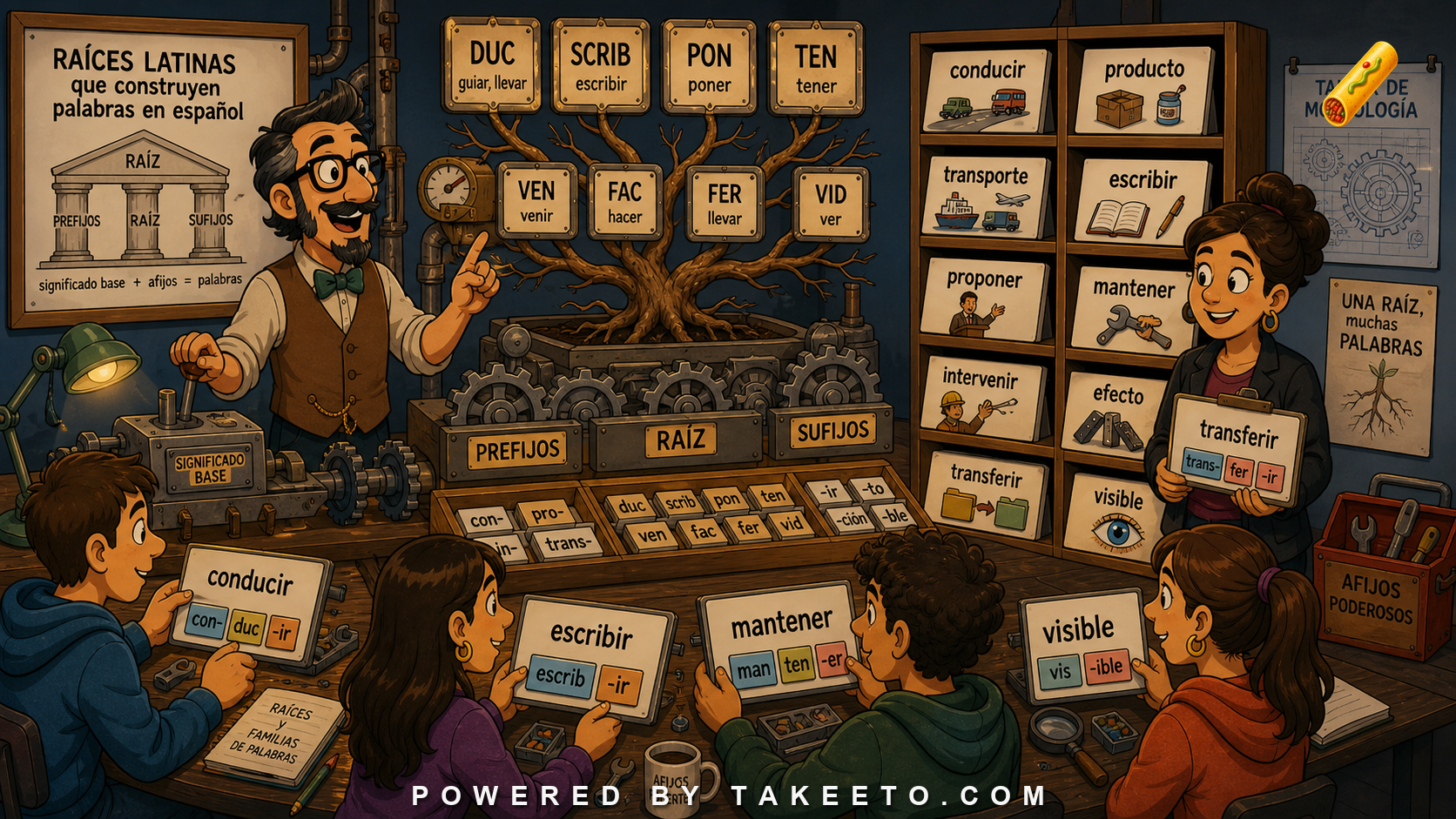
Advanced vocabulary is not a list of isolated words
Academic Spanish is full of large, formal words that seem difficult until their internal structure becomes visible. Many belong to Latin-root families. Once you recognize the root, prefixes and suffixes start to make sense.
The key principle is:
Roots are semantic anchors. They let you learn vocabulary in families instead of as isolated items.
This does not mean every word can be guessed perfectly. Meaning changes over history. But root awareness gives serious learners leverage.
duc-: leading and bringing
Family examples:
conducir
producir
reducir
introducir
traducción
producto
The root relates broadly to leading, bringing, or causing movement, though modern meanings are specialized.
Examples:
conducir un vehículo
producir un resultado
reducir el riesgo
introducir una idea
Learner action: connect verbs and nouns:
producir → producto → producción
traducir → traducción → traductor
port-: carrying
Family examples:
transportar
importar
exportar
aportar
comportar
transporte
The core idea of carrying or bringing appears in different domains:
importar datos
exportar productos
aportar pruebas
transporte público
Do not force one literal meaning. Use the root as a memory anchor.
scrib-/script-: writing
Family examples:
escribir
describir
inscribir
suscribir
manuscrito
inscripción
Academic and administrative Spanish uses this family constantly:
describir el proceso
inscribirse en un curso
suscribir un contrato
presentar una inscripción
Learner action: note both verb forms and noun forms.
pon-/pos-/puest-: placing
Family examples:
poner
proponer
componer
imponer
exponer
supuesto
propuesta
This family is large and irregular because poner is high-frequency and productive.
Examples:
proponer una solución
exponer un argumento
imponer una sanción
componer un texto
ten-/tend-/tent-: holding
Family examples:
tener
mantener
sostener
contener
obtener
retener
tendencia
Academic prose uses these for states, arguments, possession, and containment:
sostener una hipótesis
mantener una postura
contener información
obtener resultados
ven-/vent-: coming
Family examples:
venir
intervenir
prevenir
convenir
provenir
evento
Examples:
intervenir en el debate
prevenir enfermedades
provenir de una fuente
convenir en un acuerdo
Learner action: watch prepositions with root families. The root helps meaning; the construction must still be learned.
fac-/fic-/fect-/hech-: making and doing
Family examples:
hacer
efecto
efectivo
afectar
factible
beneficio
hecho
This family is historically rich and not always transparent.
Examples:
tener efecto
afectar a la población
una medida efectiva
un hecho relevante
fer-/lat-: carrying, bearing, transferring
Family examples:
transferir
referir
diferir
inferir
conferencia
referencia
Examples:
transferir fondos
referirse a un tema
diferir de una opinión
inferir una conclusión
Do not assume all -fer- words behave alike grammatically. Learn their prepositions.
vis-/vid-: seeing
Family examples:
visible
visión
prever
revisar
evidencia
supervisar
Examples:
una diferencia visible
revisar un documento
prever consecuencias
evidencia empírica
Root awareness helps connect academic vocabulary to ordinary perception.
stat-/est-/stit-: standing, state, setting
Family examples:
estar
estado
establecer
institución
constituir
estabilidad
estadística
Examples:
establecer criterios
constituir un problema
mantener la estabilidad
analizar el estado actual
This family is especially useful in policy, law, and academic writing.
Inherited versus learned forms
Spanish contains inherited everyday words and learned formal words. Sometimes they are historically related but look different:
hacer / efecto
poner / posición
ver / visión
A learner should not expect every family member to be obvious. Formal vocabulary often preserves Latin-looking forms.
Example bank walkthrough
conducir
Root family around duc-.
Learner action: connect to conductor, conducción, producir, reducir.
producto
Result noun connected historically to producir.
Learner action: learn noun and verb together.
transporte
Root port- with movement/carrying.
Learner action: connect to transportar, importar, exportar.
escribir
Root scrib-.
Learner action: build family with describir, inscripción, manuscrito.
proponer
From poner family.
Learner action: connect to propuesta, exposición, imponer.
mantener
From tener family.
Learner action: learn collocations such as mantener una postura.
intervenir
From venir family with prefix inter-.
Learner action: learn construction intervenir en.
efecto
From making/doing family.
Learner action: learn collocations: tener efecto, surtir efecto, efectos secundarios.
transferir
From fer- family.
Learner action: note domain: money, data, responsibility, knowledge.
visible
From seeing family.
Learner action: connect to visión, evidencia, revisar.
Root-family study method
- Choose one root. Do not collect everything at once.
- Build verbs, nouns, adjectives. Include prefixes and suffixes.
- Write one example per item. Context prevents false guessing.
- Mark register. Everyday, formal, technical, academic.
- Track prepositions. depender de, intervenir en, referirse a.
- Review by family. Ask how words relate and differ.
- Add corpus examples. Real usage beats invented lists.
Common learner failure: overguessing from roots
Roots are powerful, but they are not magic. A learner who sees vis- and decides every related word means “see” will soon make mistakes. Evidencia, revisión, previsto, and visible are related historically or semantically in useful ways, but each has a modern usage that must be learned.
Root study should support memory, not replace dictionary and corpus checking.
Use this rule:
Root gives a clue; context gives the meaning; usage gives the limits.
Mini-workshop: build one family deeply
Choose poner and build a family:
poner, proponer, imponer, exponer, componer, disponer, propuesta, exposición, imposición, disposición
For each item, add:
- one natural collocation,
- one register label,
- one example sentence,
- one warning if English transfer is tempting.
This depth beats collecting fifty roots shallowly. A word family becomes useful only when its members can be used in sentences.
Common failure mode: overtrusting roots
Root study is powerful, but it can become dangerous when learners assume that root meaning fully determines modern meaning. Importar is related historically to carrying inward, but in ordinary Spanish it often means “to matter.” Convenir does not simply mean “come together” in a transparent way; it can mean be advisable or agree. Roots are anchors, not full definitions.
Use roots to make vocabulary memorable, then confirm actual usage through examples. A good root-family note should include at least one sentence for each word. Without context, root study becomes elegant guessing.
Remediation pass: roots are maps, not definitions
Latin-root study can unlock academic Spanish, but only if learners use roots as orientation tools rather than as automatic meanings. Duc-, port-, scrib-, pon-, ten-, ven-, fac-, fer-, vis-, and stat- help a learner notice family resemblance, but modern words have histories, registers, and collocations that cannot be guessed from the root alone.
The remediation model should therefore use three layers. First, identify the root and broad semantic field. Second, list actual Spanish words in the family. Third, attach each word to examples that show modern use. Without the third layer, root study becomes elegant guessing.
For example, tener, mantener, sostener, retener, and contener are historically and semantically related, but they do not behave identically. Mantener una conversación, sostener una hipótesis, retener información, and contener una crisis belong to different collocational worlds. The root helps memory; the sentence teaches use.
Before/after repair: from root chart to usage web
Weak vocabulary note:
duc- = lead. conducir, producir, reducir, traducir.
Stronger vocabulary note:
duc- relates broadly to leading, bringing, or carrying through historical development, but each modern verb must be learned in its own frame: conducir un coche, producir resultados, reducir costos, traducir un texto. The family helps recognition, not full usage.
Weak note:
port- = carry, so importante means carrying in.
Stronger note:
Port- helps connect transportar, importar, exportar, and comportamiento historically, but importar in modern Spanish often means “to matter” or “to import.” Usage must be confirmed through examples.
Mini-workshop: build a root-family page
Choose one root and create a one-page family map.
For pon-, include:
poner, proponer, suponer, disponer, imponer, componer, exponer, posición, propuesta, disposición, imposición, exposición.
For each item, write:
- part of speech,
- one natural collocation,
- one sentence,
- register note if relevant,
- false-friend or overguessing warning.
Example:
exponer: exponer un argumento, exponer datos, exponer a alguien a un riesgo. Not just “put out”; it has argument, display, and risk meanings.
This converts the root from a memory trick into a vocabulary architecture.
Inherited versus learned forms
A deeper article should explain, lightly, that Spanish contains inherited forms and learned or semi-learned forms that may look closer to Latin. This helps explain why word families sometimes have surprising shapes. Learners do not need a full historical phonology lesson, but they benefit from knowing that not every related word will look perfectly transparent.
For example, families may include everyday verbs, formal nouns, and technical adjectives. A learner should expect spelling shifts, prefix changes, and register differences. The root is a center of gravity, not a guarantee of visible sameness.
Root study and reading speed
The biggest value of roots appears during reading. When a learner meets intervención, transferencia, disposición, efectivo, or estatal, root awareness gives a first hypothesis about the semantic field. That hypothesis should then be checked against syntax and context.
This creates a healthy order:
- Root gives an initial orientation.
- Prefix and suffix refine the category.
- Sentence context decides the actual meaning.
- Collocation confirms usage.
Learners who reverse the order often misread. They guess from the root and ignore the sentence.
Editorial quality checks for this article
The article should not become a list of impressive etymologies. It should teach a method. Each root family should include verbs, nouns, adjectives, and at least one warning about overextension. The visual tool should let a learner click from a root to real usage examples, not just to a family tree. The final reader should feel empowered to use roots for memory and recognition while still respecting modern Spanish as a living system with its own collocations and registers.
Extended remediation: combine morphology with corpus-like example habits
Root study becomes serious when it borrows a corpus mindset: do not ask only what the root means; ask how the word appears in actual sentences. Conducir, conducta, producción, inducir, and deducir share historical material, but their syntactic behavior and register differ. The learner should collect example patterns: what subject appears, what object appears, what preposition follows, and what domain uses the word.
Contrast set
- root-only memory: duc- means lead, so I can guess all related words.
- usage-rich family: Conducir un vehículo, deducir una conclusión, inducir un cambio, conducta del paciente, producción industrial: each item has its own pattern.
The contrast set should be read aloud or rewritten, not merely admired. Advanced learners often understand a correction when they see it, then fail to reproduce it when the task changes. The repair is to make the contrast portable: identify the decision, name the cue, and apply the same decision to a new sentence, clip, paragraph, or writing task.
Real-use transfer drill
- Choose one root family and collect ten words.
- For each word, write one real or natural collocation.
- Mark part of speech and register.
- Add one false friend, semantic drift, or unpredictable meaning if present.
- Review by producing sentences, not by reciting the root meaning.
The output should look like a small lexical map with examples attached to every branch. A root without examples is a memory hook; a root with examples is a reading tool.
Do not use roots to bluff meaning in high-stakes contexts. In legal, medical, academic, or financial Spanish, a plausible root-based guess can be dangerously wrong.
A good remediation pass ends with a usable artifact: a marked paragraph, a recording comparison, a collocation card, a frame note, a stance map, a change-claim table, or a revision pair. Without an artifact, the learner may feel enlightened but have nothing to review. With an artifact, the explanation becomes part of a study system.
Applied drill: root family with register sorting
Choose one root family and sort the words by register as well as meaning. For stat- / est-, a learner might collect:
estar, estado, estatal, estatuto, estable, establecer, estabilidad, institución establecida.
Now tag each item:
- everyday core verb,
- administrative noun,
- legal or institutional adjective,
- academic abstract noun,
- common collocation,
- technical or historical term.
Then write a short paragraph using three words from the family without sounding forced. This last requirement is important. Root study often creates vocabulary lists that no real paragraph would use. A good family map should help reading and production, not tempt the learner to cram related words into unnatural prose.
For extra control, add a “false transparency” note. Estado can mean state, condition, or government entity depending on context. The root helps you recognize the family, but syntax and domain choose the meaning.
Suggested interactive module: root-family explorer
A strong tool for this article would display Spanish words as families.
Suggested functions:
- Root selector: duc, port, scrib, pon, ten, ven, fac, fer, vis, stat.
- Family graph: verbs, nouns, adjectives, idioms.
- Prefix layer: pro-, re-, inter-, con-, trans-.
- Register tags: everyday, academic, legal, technical.
- Collocation examples: tomar medidas, establecer criterios.
- False-friend warning: root meaning is not full meaning.
- Review mode: build from root to sentence.
Final rule
Do not memorize academic Spanish as disconnected vocabulary.
Roots let you see relationships. Prefixes and suffixes build families. Collocations and prepositions make those families usable. Learn words as systems and advanced vocabulary becomes less intimidating.