
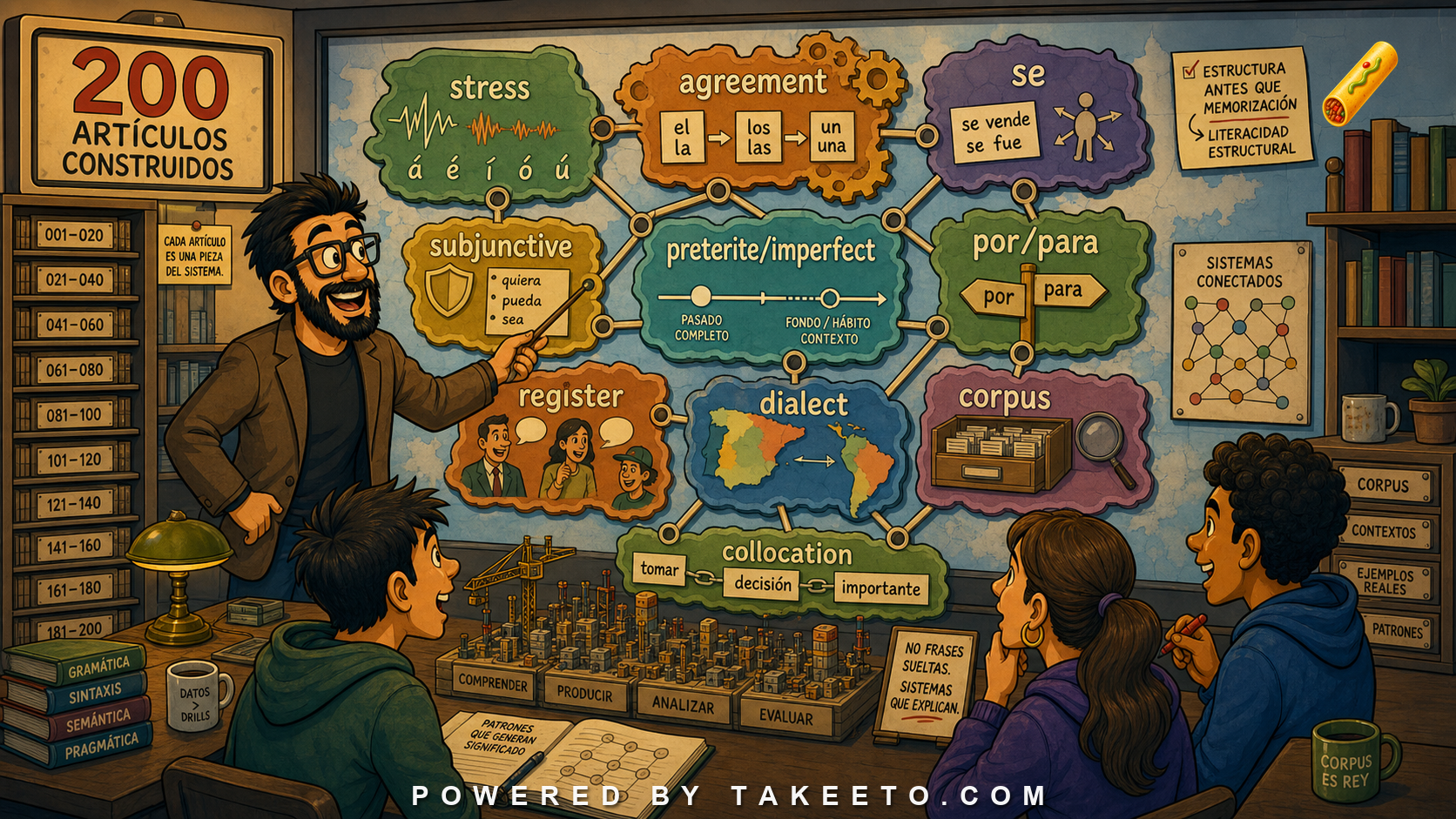
The goal was never just “more Spanish facts”
A learner can memorize thousands of Spanish facts and still feel lost. They may know verb charts, travel phrases, vocabulary lists, and scattered rules, yet fail to read a document, follow a regional conversation, choose ser or estar, understand se, interpret a subjunctive, write a formal email, or hear why a sentence sounds unnatural.
The first 200 Takeeto Spanish articles build something larger than facts. They build structural literacy.
Structural literacy means knowing how the language is organized: sound, spelling, stress, morphology, syntax, tense, aspect, mood, pronouns, discourse, register, dialect, vocabulary networks, and real-world domains. It is the difference between collecting answers and understanding systems.
The key principle is:
Serious Spanish learning is cumulative structural literacy, not phrase accumulation.
Phrases are useful. But phrases without structure leave the learner dependent on memory. Structure lets the learner interpret new sentences.
Sound and spelling came first for a reason
Spanish spelling is more transparent than English spelling, but not automatic. Stress rules, accent marks, syllable division, b/v, c/s/z, g/j, ll/y, silent h, diphthongs, hiatus, and punctuation all shape reading and pronunciation.
A learner who ignores stress will mispronounce words. A learner who ignores accent marks will confuse forms:
hablo / habló
esta / está
publico / publicó / público
A learner who ignores regional pronunciation will misunderstand seseo, yeísmo, aspiration, final consonant weakening, or Caribbean reduction. Sound and spelling are not beginner trivia. They are the foundation for listening, reading, and writing.
Agreement and morphology built sentence control
Spanish forces agreement everywhere:
el libro rojo
la casa roja
los libros rojos
las casas rojas
Nouns, adjectives, determiners, participles, and pronouns carry gender and number. Verb endings carry person, tense, mood, and aspect. Clitics attach or move. Reflexive and reciprocal forms reshape argument structure.
This is why structural literacy must include morphology. You cannot read Spanish well if endings look like decoration. Endings are information.
Ser, estar, haber, tener, and hacer built conceptual grammar
Early learners often want one-to-one translations:
ser = be
estar = be
haber = there is
tener = have
hacer = do/make
But Spanish distributes meaning differently. Ser classifies and identifies. Estar locates and presents states. Hay introduces existence. Tener expresses possession, age, obligation in tener que, and many states. Hacer builds weather, time expressions, causation, and light-verb constructions.
These verbs are not just common. They are grammatical architecture.
Se was a whole universe
Few Spanish topics reveal structural literacy more than se.
Se lava.
Se venden casas.
Se me cayó el vaso.
Se lo di.
Se habla español.
Se fue.
A phrasebook learner sees one word and panics. A structural learner asks which system is active: reflexive, reciprocal, passive-like, impersonal, accidental, pronominal verb, indirect-object replacement, or lexicalized construction.
The goal was not to reduce se to one meaning. The goal was to build a classifier.
Tense and aspect built time literacy
The preterite/imperfect contrast is not a “completed versus ongoing” trick. It is viewpoint.
Ayer llovió.
Ayer llovía cuando salí.
The future and conditional are not merely time forms. They also mark probability, politeness, conjecture, and reported stance. The present can describe habits, current events, scheduled futures, and narrative immediacy. The perfect varies by region. The pluperfect anchors earlier pasts.
Structural literacy means seeing tense as a way to organize time, evidence, viewpoint, and discourse.
The subjunctive built stance literacy
The subjunctive is not “uncertainty” only. It appears in desire, influence, emotion, denial, evaluation, purpose, concession, future time clauses, relative clauses with non-specific antecedents, and counterfactuality.
Quiero que venga.
Busco a alguien que hable japonés.
Aunque sea difícil, lo haré.
Cuando llegue, avísame.
Ojalá hubiera venido.
A structural learner stops asking “Is this uncertain?” and starts asking:
What relationship does the main clause create with the subordinate event?
That is a deeper question.
Prepositions and connectors built discourse literacy
Por and para are not simply “for.” De, a, en, con, sin, sobre, entre, and hasta build relationships of source, goal, location, path, instrument, topic, limit, and association. Connectors such as aunque, sin embargo, por lo tanto, ya que, a pesar de, and en cambio build argument structure.
Spanish learning becomes serious when the learner reads not just words, but relations.
Vocabulary became architecture
The later articles moved beyond word lists into vocabulary systems:
- verb families: poner, hacer, dar, llevar, traer,
- achievement verbs: lograr, conseguir, alcanzar,
- perception verbs: ver, mirar, oír, escuchar,
- speech verbs: decir, contar, hablar, pedir, preguntar,
- collocations: tomar una decisión, cometer un error, prestar atención,
- idioms and locutions,
- domain vocabulary for finance, housing, immigration, medicine, law, travel, education, public services.
Vocabulary is not a bag of equivalents. It is a network of constructions, partners, domains, and registers.
Register and dialect made the language real
Spanish does not exist as one neutral classroom voice. It varies by region, class, context, medium, age, institution, and identity.
A learner must understand:
tú / usted / vos / ustedes / vosotros
Spain and Latin American differences
Mexican, Caribbean, Rioplatense, Andean, Chilean, Colombian, Central American variation
leísmo, laísmo, loísmo
formal requests, apologies, email register
academic, journalistic, legal, medical Spanish
This does not mean a learner must produce every dialect. It means they should stop treating variation as error.
Corpus and sources built evidence literacy
The corpus and RAE/ASALE articles introduced another skill: learning how to check usage responsibly.
A serious learner asks:
- Is this common?
- In which region?
- In which register?
- In speech or writing?
- In current usage or older texts?
- In formal norm or informal practice?
- In a corpus, dictionary, grammar, style guide, or random web page?
Frequency lists help but do not define curriculum. Corpora help but require interpretation. Dictionaries help but do not replace context. Standards help but do not erase dialects.
Structural literacy includes source literacy.
Heritage, contact, and history completed the first 200
The final block added heritage Spanish, code-switching, U.S. Spanish, Indigenous and Arabic influence, Latin and Greek layers, Romance comparison, Iberian multilingualism, names, colors, spatial language, temporal adverbs, and synthesis.
This matters because Spanish is not only a grammar system. It is a world language with histories of conquest, migration, contact, standardization, stigma, education, literature, bureaucracy, and identity.
A learner who studies only “standard grammar” misses real Spanish. A learner who studies only “real speech” without structure misses the system. The goal is both.
How Takeeto can support this model
Takeeto’s deck passages, review, audio, exams, and article architecture can support structural literacy if used deliberately.
A strong learning cycle:
- Read an article for the system.
- Study annotated examples.
- Add example sentences to review.
- Listen to audio for pronunciation and rhythm.
- Practice production with constraints.
- Take exams that test transfer, not memorization.
- Return to real texts: messages, forms, articles, stories, conversations.
- Update rules when dialect/register evidence requires it.
The best learning tools do not merely ask, “Did you remember the answer?” They ask, “Can you analyze a new case?”
What the first 200 articles have built
They have built a map:
- Phonology: stress, accent, pronunciation, rhythm.
- Orthography: spelling, punctuation, capitalization, abbreviations.
- Morphology: gender, number, verb endings, pronouns.
- Syntax: clauses, subordination, control, word order.
- Mood: indicative, subjunctive, imperative, conditional stance.
- Aspect: preterite, imperfect, perfect, progressive, result states.
- Semantics: ser/estar, motion, possession, becoming, perception.
- Pragmatics: politeness, requests, apologies, greetings, email style.
- Discourse: connectors, concession, reported speech, journalism, academic prose.
- Register: informal, formal, legal, medical, academic, bureaucratic.
- Dialectology: region, address systems, pronoun variation, voseo, leísmo.
- Lexicon: collocations, idioms, historical layers, technical roots.
- Sociolinguistics: heritage Spanish, code-switching, standard language, identity.
- Research method: corpus thinking, frequency lists, institutional sources.
That is structural literacy.
Example bank walkthrough
stress
Stress is the foundation of pronunciation and accent marks.
Learner action: mark stress before memorizing pronunciation.
agreement
Agreement makes Spanish sentence structure visible.
Learner action: track gender and number across the noun phrase.
se
A multi-system pronoun and marker.
Learner action: classify the construction before translating.
subjunctive
Mood of relation, stance, nonassertion, influence, desire, evaluation, and future dependency.
Learner action: ask what triggers the subordinate clause.
preterite/imperfect
Viewpoint contrast in past narration.
Learner action: choose based on event framing, not English tense labels.
por/para
Relationship prepositions, not one-word translations of “for.”
Learner action: identify cause, path, exchange, purpose, recipient, deadline, standard.
register
Language choice by context and relationship.
Learner action: produce not only grammatical Spanish, but appropriate Spanish.
dialect
Systematic regional and social variation.
Learner action: respect dialects while choosing a production target.
corpus
Evidence from real usage.
Learner action: ask narrow questions and interpret results cautiously.
collocation
Natural word partnership.
Learner action: learn cometer un error, not just hacer un error by English transfer.
Remediation notes: the synthesis must become a study method
The capstone needs an operational repair. “Structural literacy” should not remain a slogan. It should become a way to study any new Spanish sentence.
Use a five-pass method. First, sound and spelling: stress, accent marks, syllable shape, pronunciation, and punctuation. Second, morphology: gender, number, person, tense, mood, clitics, agreement, and derivation. Third, syntax: subject, verb, complements, subordinate clauses, prepositions, and information structure. Fourth, discourse: stance, contrast, concession, evidence, register, politeness, and genre. Fifth, variation and source: country, dialect, formality, domain, and whether the example comes from conversation, literature, law, media, forms, or a corpus.
This method prevents shallow fluency. A learner may understand the gist of Aunque no haya llegado todavía, ya figura como inscrito en el sistema. Structural literacy asks more: aunque + subjunctive marks concession with nonasserted status; todavía tracks continuation; ya marks a changed administrative state; figura como belongs to institutional register; inscrito is a participial status; en el sistema points to procedural domain language. That is what “seeing more structure” means.
The remediation also needs humility. No 200-article sequence “finishes” Spanish. It builds a map. The next stage should deepen translation, advanced regional literacy, professional domains, literature, corpus method, speech perception, and writing feedback. But the foundation is now different: learners have categories for asking better questions.
Production target: after reading any Spanish text, write three notes: one grammar observation, one register or dialect observation, and one collocation or phrase worth saving. Then rewrite one sentence in a different register. This turns articles into habits. Spanish learning becomes cumulative when every example strengthens the system, not just the day’s vocabulary list.
Suggested interactive module: learning architecture map
A strong tool for this article would connect the first 200 articles into a navigable system.
Suggested functions:
- Knowledge map: phonology, spelling, morphology, syntax, mood, discourse, register, dialect, lexicon.
- Dependency paths: accent marks before written precision; agreement before advanced noun phrases; subjunctive before concessive clauses.
- Example search: find all articles involving se, que, por, subjunctive, register.
- Diagnostic quiz: identify weak systems, not just wrong answers.
- Review deck builder: turn article examples into spaced repetition.
- Audio integration: sound, stress, dialect, and listening practice.
- Real-text mode: apply systems to forms, emails, news, stories, and conversations.
- Next-block preview: specialized domains, translation, regional literacy, advanced reading, research methods.
Final rule
The first 200 articles have not built a pile of tips. They have built a model of Spanish as a structured, variable, historical, social language.
Keep learning phrases, but do not stop there. Learn systems. Learn examples. Learn register. Learn dialect. Learn sources. Learn how to ask better questions.
Spanish fluency is not only speaking faster. It is seeing more structure in every sentence.