
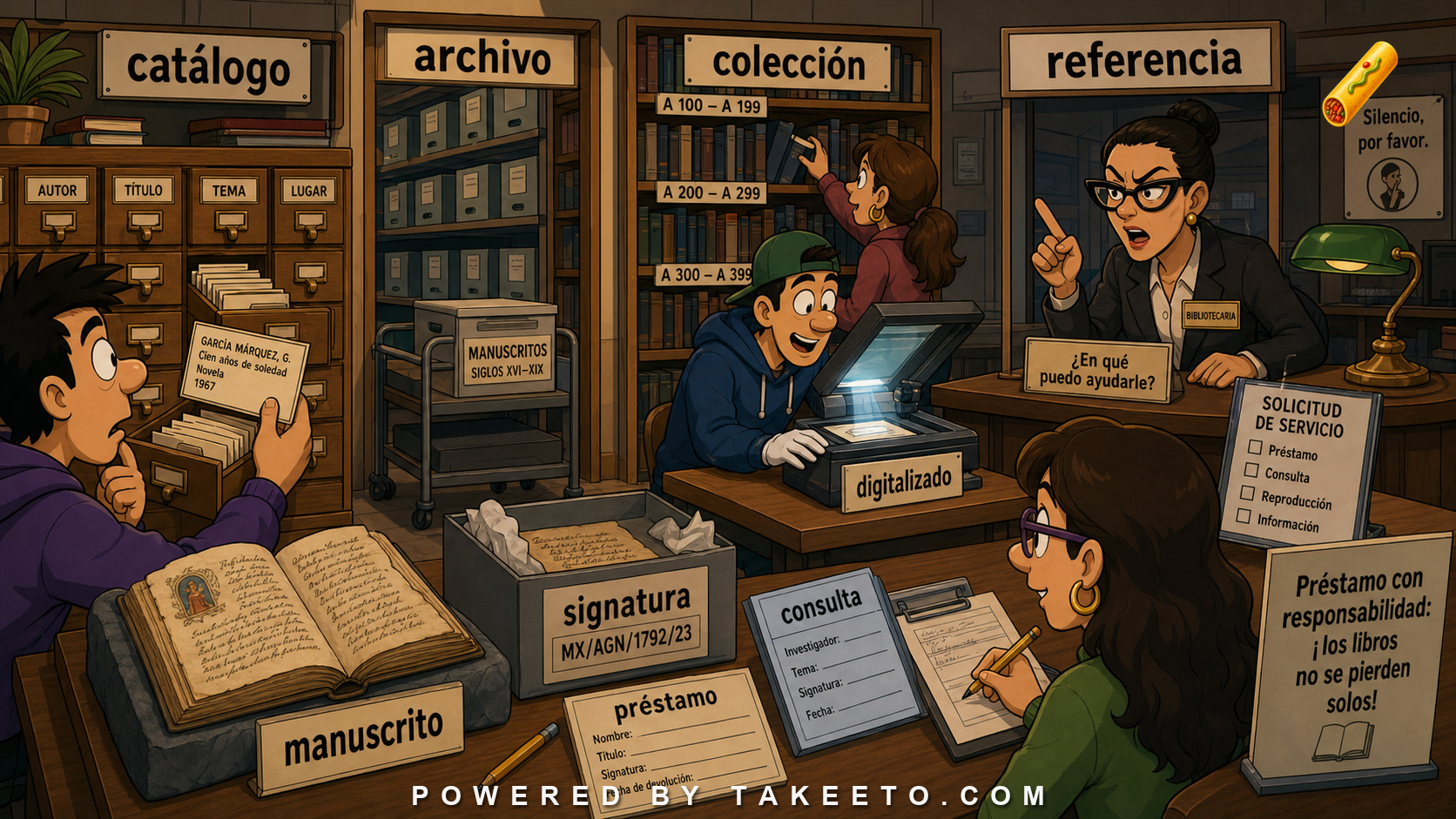
Library and archive Spanish is navigation language
Libraries and archives are built around systems: catalogs, collections, call numbers, access rules, loans, reading rooms, digitized materials, metadata, requests, and citations. A learner may know libro and biblioteca, but still struggle to request a manuscript, interpret a catalog entry, or understand why an item is available for consultation but not for loan.
The key principle is:
Library and archive Spanish tells you how a source is described, located, accessed, and cited.
You are not only reading content. You are reading infrastructure.
Biblioteca and archivo
Biblioteca is library. Archivo can mean archive as institution, archive collection, file, or digital file depending on context.
biblioteca universitaria — university library
biblioteca pública — public library
archivo histórico — historical archive
archivo municipal — municipal archive
archivo digital — digital archive/file repository
archivo PDF — PDF file
Do not assume archivo always means “archive” as a building. In everyday technology Spanish, archivo often means file.
Example:
El archivo conserva documentos del siglo XIX.
The archive preserves nineteenth-century documents.
Descargue el archivo adjunto.
Download the attached file.
Catálogo, registro, ficha
Catalog language is central.
catálogo — catalog
registro — record/catalog record
ficha — catalog card/record entry, also form
búsqueda — search
búsqueda avanzada — advanced search
palabra clave — keyword
autor — author
título — title
materia — subject
fecha — date
idioma — language
Example:
El catálogo permite buscar por autor, título o materia.
The catalog allows searching by author, title, or subject.
Materia in cataloging means subject, not physical matter.
Collection vocabulary
Items belong to collections.
colección — collection
fondo — fonds/collection/holdings, especially archives
serie — series
sección — section
legajo — bundle/file group, archive term
expediente — file/case file
caja — box
carpeta — folder
manuscrito — manuscript
impreso — printed item
Fondo is important. In archive Spanish, it can mean a body of records from a person, institution, or source—not simply “background” or “fund.”
Example:
El documento pertenece al fondo del Ayuntamiento.
The document belongs to the municipal council fonds/collection.
Signatura and call numbers
Signatura is one of the most useful archive/library words. It often means shelfmark, call number, or archival reference code.
signatura topográfica — shelfmark/call number
referencia — reference
código de referencia — reference code
número de clasificación — classification number
Example:
Para solicitar el manuscrito, indique la signatura completa.
To request the manuscript, provide the full shelfmark/reference code.
Do not translate signatura as signature in this context. It is not a handwritten signature; it locates the item.
Access: consulta, préstamo, sala
Library and archive access terms:
consulta — consultation/access for reading
préstamo — loan/borrowing
préstamo externo — external loan/check-out
préstamo interbibliotecario — interlibrary loan
sala de lectura — reading room
acceso restringido — restricted access
usuario / usuaria — user
investigador / investigadora — researcher
carné / credencial — library card/ID
Example:
El material está disponible solo para consulta en sala.
The material is available only for consultation in the reading room.
This means you can read it there but not borrow it.
Digital materials and metadata
Modern catalogs include digitized materials.
digitalizado — digitized
disponible en línea — available online
texto completo — full text
metadatos — metadata
descripción — description
resumen — abstract/summary
derechos de uso — usage rights
licencia — license
descarga — download
visor — viewer
Example:
La colección está parcialmente digitalizada.
The collection is partially digitized.
Digitalizado does not always mean freely reusable. A scan may be viewable but restricted by rights, citation requirements, or download limits.
Formal request language
To request materials, write clearly and politely.
Useful phrases:
Quisiera consultar...
I would like to consult...
Solicito información sobre...
I request information about...
¿Podrían indicarme si el documento está disponible?
Could you tell me whether the document is available?
Adjunto la referencia completa.
I attach/include the full reference.
¿Es necesario solicitar cita previa?
Is it necessary to request an appointment in advance?
Agradezco de antemano su ayuda.
Thank you in advance for your help.
Example request:
Estimado equipo del archivo:
Quisiera consultar el expediente identificado con la signatura AH-1923-45. ¿Podrían indicarme si está disponible para consulta en sala y si es necesario solicitar cita previa?
Muchas gracias por su ayuda.
Atentamente,
Laura Méndez
This is concise and actionable.
Citation language
When citing archival or library materials, include enough information to locate the source again.
Possible fields:
archivo/biblioteca
fondo/colección
serie
caja
expediente
signatura
título/description
date
folio/page
URL or digital identifier if applicable
Terms:
folio — folio/sheet
recto / verso — front/back of a folio
f. / fol. — folio abbreviation
ff. — folios
página / p. / pp. — page/pages
Archive citations vary by institution. Follow the archive’s recommended citation format when available.
Manuscripts and special collections
Special collections may have stricter rules.
manuscrito — manuscript
incunable — incunabulum/early printed book
libro antiguo — rare/old book
material reservado — restricted/special material
reproducción — reproduction/copy
permiso — permission
conservación — preservation
guantes — gloves
lápiz — pencil
Example:
Por razones de conservación, el manuscrito no puede fotocopiarse.
For preservation reasons, the manuscript cannot be photocopied.
Do not argue with preservation rules. They exist to protect materials.
Example bank walkthrough
catálogo
Catalog.
Learner action: search by author, title, subject, date, keyword.
archivo
Archive or file.
Learner action: determine institution vs digital file.
colección
Collection.
Learner action: identify grouping of materials.
manuscrito
Manuscript.
Learner action: expect access and preservation rules.
signatura
Shelfmark/call number/reference code.
Learner action: do not translate as signature.
préstamo
Loan/borrowing.
Learner action: distinguish from consulta en sala.
consulta
Consultation/access.
Learner action: often means reading on-site.
digitalizado
Digitized.
Learner action: not necessarily free to reuse.
referencia
Reference/citation/reference code.
Learner action: provide complete information in requests.
Library/archive research workflow
- Define the research question.
- Search catalog by author, title, subject, keyword, date.
- Record full reference and signatura.
- Check access status: loan, consultation, restricted, digitized.
- Identify collection/fondo and series.
- Request appointment if needed.
- Ask about reproduction rules.
- Take careful citation notes.
- Respect handling and preservation rules.
- Follow institutional citation format.
Remediation: libraries and archives are not the same task
Libraries and archives both help researchers find materials, but the Spanish used around them differs because the materials and access systems differ. A library often organizes published items: books, journals, ebooks, databases. An archive often preserves unique or institutional records: manuscripts, letters, administrative files, photographs, maps, notarial records, collections, and fonds.
Useful contrast:
biblioteca = published or circulated materials, catalog, loans, reading spaces, databases.
archivo = records, fonds, collections, consultation rules, finding aids, preservation, access restrictions.
There is overlap. Some libraries hold manuscripts. Some archives have printed books. But the reader should not treat catálogo, fondo, colección, signatura, and consulta as interchangeable.
Signatura, fondo, colección, expediente
Signatura is one of the most important terms. It is a call number, shelfmark, or archival reference code that lets staff locate an item. It is not simply “signature.”
Fondo in archives can refer to a body of records created or accumulated by a person, family, or institution. This is a major false friend because learners may think of “fund” or vague “background.”
Colección may be a collection assembled by theme, owner, donor, or institution. Expediente is a file or dossier. Legajo may refer to a bundle/file group, especially in archival contexts. Manuscrito is handwritten or manuscript material; impreso is printed.
Mini-workshop: decode a catalog record
Record:
Título: Cartas de María Luisa Pérez
Fecha: 1898–1902
Fondo: Familia Pérez
Serie: Correspondencia
Signatura: FP-3-12
Estado: Digitalizado parcialmente
Condiciones de consulta: Requiere solicitud previa
Annotations:
Título = description assigned to the item/file.
Fecha = date range.
Fondo = archival body of records.
Serie = subdivision by function/type.
Signatura = reference code.
Digitalizado parcialmente = only part is digitized.
Requiere solicitud previa = access requires advance request.
A researcher should not arrive asking only for “the letters.” The actionable request includes fondo, series, signatura, date, and consultation need.
Formal request language
A strong archive request is concise and specific:
Estimado equipo del archivo:
Estoy investigando la correspondencia de la familia Pérez entre 1898 y 1902. En el catálogo aparece el fondo Familia Pérez, serie Correspondencia, signatura FP-3-12. Quisiera saber si es posible consultar el material digitalizado y, en caso de existir restricciones, cuáles son los requisitos para solicitar acceso.
This gives staff enough information to help.
Useful request phrases:
quisiera consultar, solicito información sobre, aparece en el catálogo, la signatura es, ¿podrían indicarme?, condiciones de acceso, reproducción digital, cita previa, sala de consulta, restricciones, derechos de reproducción.
Digital materials and metadata
Digitalizado means digitized, not necessarily freely available online. Disponible en línea means available online. Metadatos are descriptive data about an item; they are not the content itself. Resumen, descripción, and alcance y contenido may summarize material without reproducing it.
A learner should distinguish:
record exists in catalog,
item is digitized,
item is viewable online,
item is downloadable,
item can be reproduced or quoted,
item requires permission.
These are separate access states.
Citation and reproduction caution
Archives often have citation rules. They may require a specific format including archive name, fondo, series, box, folder, document, and signatura. They may also distinguish consultation from publication rights. Being allowed to read an item does not automatically mean being allowed to reproduce an image in a book or website.
A good research note records:
institution, collection/fondo, series, signatura, box/folder if relevant, document title, date, page/folio, URL or access date for digital records, reproduction conditions.
Research workflow
For Spanish library/archive work:
- Search broad terms in the catalog.
- Record exact titles and signaturas.
- Identify whether the item is library, archive, manuscript, printed, or digital.
- Check access conditions.
- Write a specific request.
- Keep citation data from the start.
- Separate metadata from evidence.
A Takeeto archive module should make the learner fill a request form from a catalog record. That is more useful than memorizing twenty nouns without knowing how to act on them.
Remediation drill: distinguish availability from permission
A catalog may say an item is digitalizado, but that does not always mean it can be reused freely. It may be viewable online, downloadable, restricted to personal research, or subject to reproduction fees or rights review.
Look for:
acceso abierto
uso restringido
derechos reservados
reproducción permitida
solo consulta
previa autorización
cita obligatoria de la fuente
A learner should separate three questions:
- Can I view it?
- Can I copy/download it?
- Can I publish or reuse it?
Reference completeness
When writing to an archive, include enough data to prevent extra back-and-forth:
institution
collection/fonds
series
box/caja
file/expediente
folio/image if known
title/description
date range
your request
Weak:
Quiero el manuscrito de 1890.
Better:
Solicito información sobre el manuscrito identificado con la signatura MS-1890-14, fechado aproximadamente en 1890, perteneciente a la Colección X.
Precision is courtesy in archive Spanish.
Suggested interactive module: library/archive catalog field decoder
A strong tool for this article would turn catalog records into a research action plan.
Suggested functions:
- Catalog field labels: author, title, subject, date, language.
- Archive hierarchy map: fondo, serie, caja, expediente, folio.
- Signatura highlighter: call number/reference code.
- Access status decoder: loan, consultation, restricted, digitized.
- Request email builder: reference, availability, appointment, reproduction.
- Citation generator: institution-specific fields.
- Rights note: view, download, reproduce, publish.
Final rule
Library and archive Spanish is the language of finding, requesting, handling, and citing sources.
Learn catálogo, archivo, colección, fondo, manuscrito, signatura, consulta, préstamo, digitalizado, and referencia as research tools. A good researcher does not only read Spanish sources; they can locate them, request them, describe them, and cite them accurately.