A menu tells you how a place wants to be understood
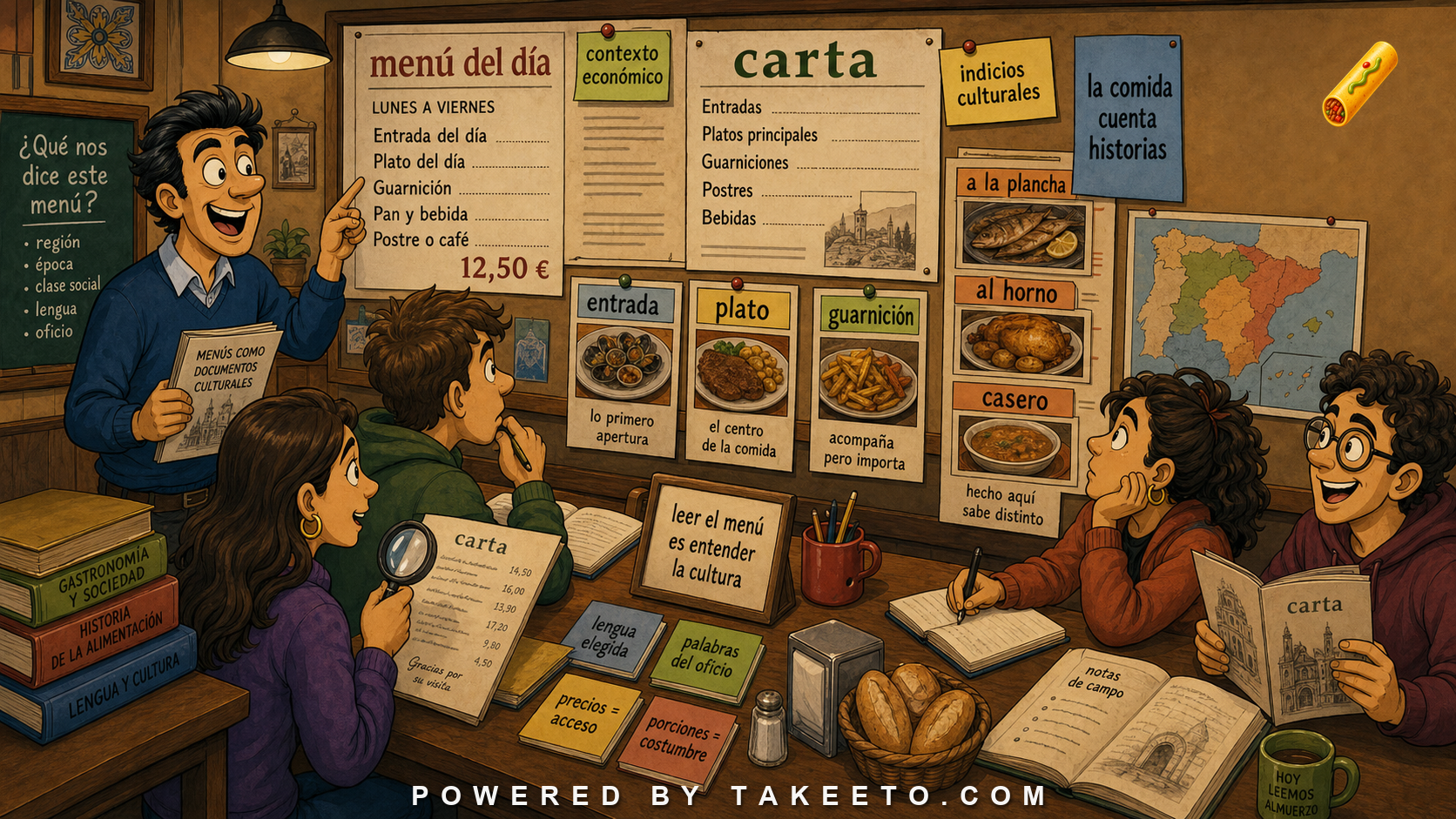
A Spanish menu gives information about food, but also about region, formality, price, identity, season, and audience. It may tell you whether a restaurant is local, tourist-facing, traditional, experimental, family-style, or fast casual.
Compare:
Menú del día: primero, segundo, postre y bebida.
Tartar de atún rojo con emulsión cítrica y crujiente de maíz.
The first signals everyday meal structure. The second signals modern restaurant register. Both are menu Spanish, but they belong to different worlds.
The key principle is:
A menu is a cultural document disguised as a list of dishes.
Menu structure
Common sections include:
entradas
entrantes
aperitivos
primeros
segundos
platos principales
guarniciones
postres
bebidas
vinos
menú del día
carta
Carta means menu in many restaurant contexts, not letter. Menú can mean menu, set meal, or daily menu depending on context. Menú del día usually refers to a fixed-price daily meal, especially in Spain and some other contexts.
Entrada may be appetizer, but in some countries it can be ambiguous with entrance. Context decides.
Preparation methods
Menus rely on compact preparation phrases:
a la plancha
al horno
frito
asado
guisado
al vapor
a la parrilla
en salsa
confitado
marinado
A la plancha means cooked on a griddle or flat grill. Al horno means baked or roasted. A la parrilla is grilled. Guisado suggests stew-like cooking.
Merluza a la plancha con verduras.
This is not a full sentence. It is a noun phrase: hake cooked on a griddle with vegetables.
Ingredients and regional names
Food names vary widely:
patata / papa
judía / frijol / poroto / habichuela
aguacate / palta
maíz / choclo / elote
camarón / gamba / langostino
calabacín / zucchini / zapallito
A menu can be difficult because the same ingredient may have several regional names and the same name may refer to different preparations.
Learners should build regional awareness rather than expecting universal vocabulary.
Adjectives and menu persuasion
Menus use adjectives to create expectation:
casero
artesanal
fresco
tradicional
crujiente
cremoso
suave
intenso
de temporada
local
Casero means homemade or home-style, but it can be promotional. Artesanal suggests craft production. De temporada indicates seasonal. These words shape value, not just description.
Adjective placement can matter:
vino tinto
tarta casera
pescado fresco
clásica tortilla española
The adjective may classify, evaluate, or market.
Allergens, restrictions, and service terms
Menus increasingly include:
alérgenos
gluten
lactosa
frutos secos
mariscos
vegetariano
vegano
sin azúcar
sin gluten
suplemento
servicio incluido
Frutos secos can include nuts. Mariscos are shellfish/seafood depending on context. Suplemento means extra charge, often for certain dishes in a fixed menu.
A learner with dietary restrictions should not rely on partial recognition. Ask directly and clearly.
Price and formality signals
A simple café menu may use short labels:
bocadillos
tortilla
café con leche
menú del día
A higher-end menu may use long ingredient chains:
Lomo de cordero con puré de berenjena ahumada, reducción de vino tinto y hierbas frescas.
Longer descriptions often signal premium positioning. They may also use French, English, indigenous, or regional terms to create identity.
Example bank walkthrough
Menú del día: daily fixed-price meal. Ask what is included.
Carta: full menu or list of dishes.
Plato: dish or course.
Entrada: appetizer/starter in many contexts.
Guarnición: side dish.
A la plancha: cooked on griddle/flat grill.
Al horno: baked/roasted.
Casero: homemade/home-style, often promotional.
Menu reading workflow
- Identify country/region.
- Identify whether it is a carta, menú del día, tasting menu, or specials board.
- Separate dish name, preparation, ingredients, garnish, and sauce.
- Watch regional ingredient vocabulary.
- Identify allergens or dietary labels.
- Check included items and supplements.
- Notice adjective register: simple, traditional, gourmet, tourist-facing.
- Ask when a term is local or unclear.
- Translate dish function, not only words.
- Treat the menu as cultural evidence.
Before/after revision drill
Weak translation:
Homemade grilled fish with potatoes.
Source Spanish:
Pescado a la plancha con guarnición de patatas y salsa casera.
Better translation:
Griddled fish with a potato side dish and house-made/home-style sauce.
This version places casera with the sauce, not the whole dish, and translates guarnición as side. Menu translation should respect attachment: which adjective describes which part?
Remediation: menus describe food, business model, and identity at once
A Spanish menu is not only a list of dishes. It signals region, price level, service style, formality, dietary assumptions, and sometimes national or local identity. Menú del día, carta, raciones, tapas, entrada, primer plato, segundo, guarnición, postre, and bebida incluida tell the reader how the meal is organized.
A learner who only translates dish names may still misunderstand the dining situation. Menú can mean set meal, not the whole menu. Carta often refers to the à la carte list. Plato fuerte, principal, segundo, and fondo vary by region. Entrada can be appetizer in many contexts, but not every country organizes meals the same way.
The first rule is:
Read menu structure before reading dish vocabulary.
Preparation phrases matter
Many menu items are built from a base ingredient plus preparation:
pescado a la plancha
pollo al horno
verduras salteadas
carne guisada
papas fritas
arroz con mariscos
sopa de lentejas
ensalada mixta
The prepositions matter. A la plancha describes method. Al horno describes cooking environment. Con introduces accompaniment or ingredient. De may indicate main ingredient, filling, flavor, or style. En salsa tells how the dish is served.
A poor translation of menus treats every preposition as “of.” A better reader asks whether the phrase names ingredient, method, origin, garnish, sauce, or style.
Mini-workshop: parse a menu item
Item:
Lomo de cerdo en salsa de ciruela con puré de camote y verduras al vapor.
Parsing:
lomo de cerdo = main protein/cut.
en salsa de ciruela = sauce/flavor.
con puré de camote = accompaniment.
y verduras al vapor = second accompaniment and preparation method.
Plain explanation:
Pork loin served with plum sauce, sweet-potato purée, and steamed vegetables.
This is straightforward once the roles are marked. Without roles, the item becomes a chain of nouns.
Allergen and dietary language
Menus increasingly include allergen and dietary labels:
contiene gluten
puede contener trazas de frutos secos
sin lactosa
apto para vegetarianos
vegano
picante
mariscos
huevo
lácteos
High-stakes reading requires caution. Sin gluten is a claim about gluten-free preparation, but cross-contact depends on kitchen practices. Puede contener trazas means traces may be present. Apto para vegetarianos does not always imply vegan. Mariscos may include shellfish, seafood, or a narrower local category depending on context.
When allergies are involved, menu Spanish is not enough; confirm with staff.
Before/after: turning menu poetry into plain language
Menu prose:
Nuestra ensalada de la huerta combina hojas frescas, queso de cabra, nueces caramelizadas y vinagreta de la casa.
Plain reading:
Salad with greens, goat cheese, caramelized walnuts, and house vinaigrette.
Menu prose often uses words like de la casa, artesanal, casero, de temporada, selección, especialidad, tradicional, and fresco. These words signal style and appeal. Some are meaningful; some are generic. A good reader appreciates the register without confusing it with objective detail.
Regional dish names
Dish names can be opaque even to native speakers from other countries. Tortilla, empanada, arepa, tamal, pastel, tostada, chile, mole, ceviche, asado, guiso, and menudo vary widely. Do not assume that a familiar name means the dish you know from another country.
Menus are cultural documents because they preserve local naming. When in doubt, ask what the dish contains and how it is prepared:
¿Qué lleva?
¿Cómo se prepara?
¿Es picante?
¿Viene con guarnición?
¿Tiene frutos secos o lácteos?
A menu teaches Spanish, but it also teaches place.
Additional remediation drill: slow the document down
If this article still feels like vocabulary, turn one authentic-looking sentence into a four-line analysis before translating it. Write the original sentence. Then list the actor, the action, the object, and the condition or consequence. Only after that, produce a plain-language paraphrase.
This drill matters because domain Spanish often compresses too much into noun phrases. The learner sees familiar words and moves too quickly. Slowing the sentence down reveals whether the reader understands the document logic or only recognizes terms. For article 268, the safest practice is to treat each key term as a field in a larger system: who is acting, what status is changing, what evidence or condition controls the action, and what the reader should do with the information.
A useful production rule is: do not write a polished sentence until you can write a plain one. Plain Spanish is not inferior; it is the diagnostic layer that proves comprehension.
Suggested interactive module: menu item parser
A strong tool would break menu lines into parts.
Suggested functions:
- Dish structure: main ingredient, method, sauce, garnish.
- Regional term notes: papa/patata, gamba/camarón.
- Allergen alerts: gluten, lactosa, frutos secos.
- Price and supplement detector.
- Register label: home-style, formal, promotional, regional.
Mini-workshop: parsing one menu item
Menu line:
Pollo a la plancha con puré de patatas y salsa de limón.
Break it into parts:
- main ingredient: pollo
- preparation: a la plancha
- side: puré de patatas
- sauce: salsa de limón
Now compare:
Pollo crujiente con emulsión cítrica y patata rústica.
The second line signals a more styled or modern menu register. Crujiente, emulsión, and rústica are not only information; they create restaurant identity.
Common learner mistakes
One mistake is treating carta as “letter.” In restaurants it usually means the menu or full list of dishes. Another is assuming menú always means the physical menu. Menú del día is often a fixed-price meal structure.
A third mistake is ignoring regional food words. Patata/papa, frijol/poroto/judía, gamba/camarón, and aguacate/palta can change by country. Menus reward local vocabulary awareness. When dietary restrictions matter, do not guess from partial recognition; ask clearly.
Applied reading drill: parse one menu item grammatically
Take a menu item like:
Merluza a la plancha con verduras de temporada y salsa de limón.
This is not just “fish with vegetables.” It has a structure. Merluza is the main ingredient. A la plancha is the cooking method. Con verduras de temporada names the side or accompaniment. Salsa de limón names the sauce.
A menu parser can label it this way:
- Main item: merluza.
- Preparation: a la plancha.
- Accompaniment: verduras de temporada.
- Sauce/flavor: salsa de limón.
This method helps with unfamiliar dishes. You may not know every ingredient, but you can still identify what role each phrase plays. Prepositions are the key: de often names ingredient or composition, con adds accompaniment, a la/al often names method or style, and en may introduce sauce or preparation context.
Menus become less intimidating when you stop treating them as long noun piles and start treating them as structured descriptions.
Final rule
A Spanish menu does more than identify food. It displays region, class, style, season, and persuasion. Learn to read the dish and the restaurant at the same time.