
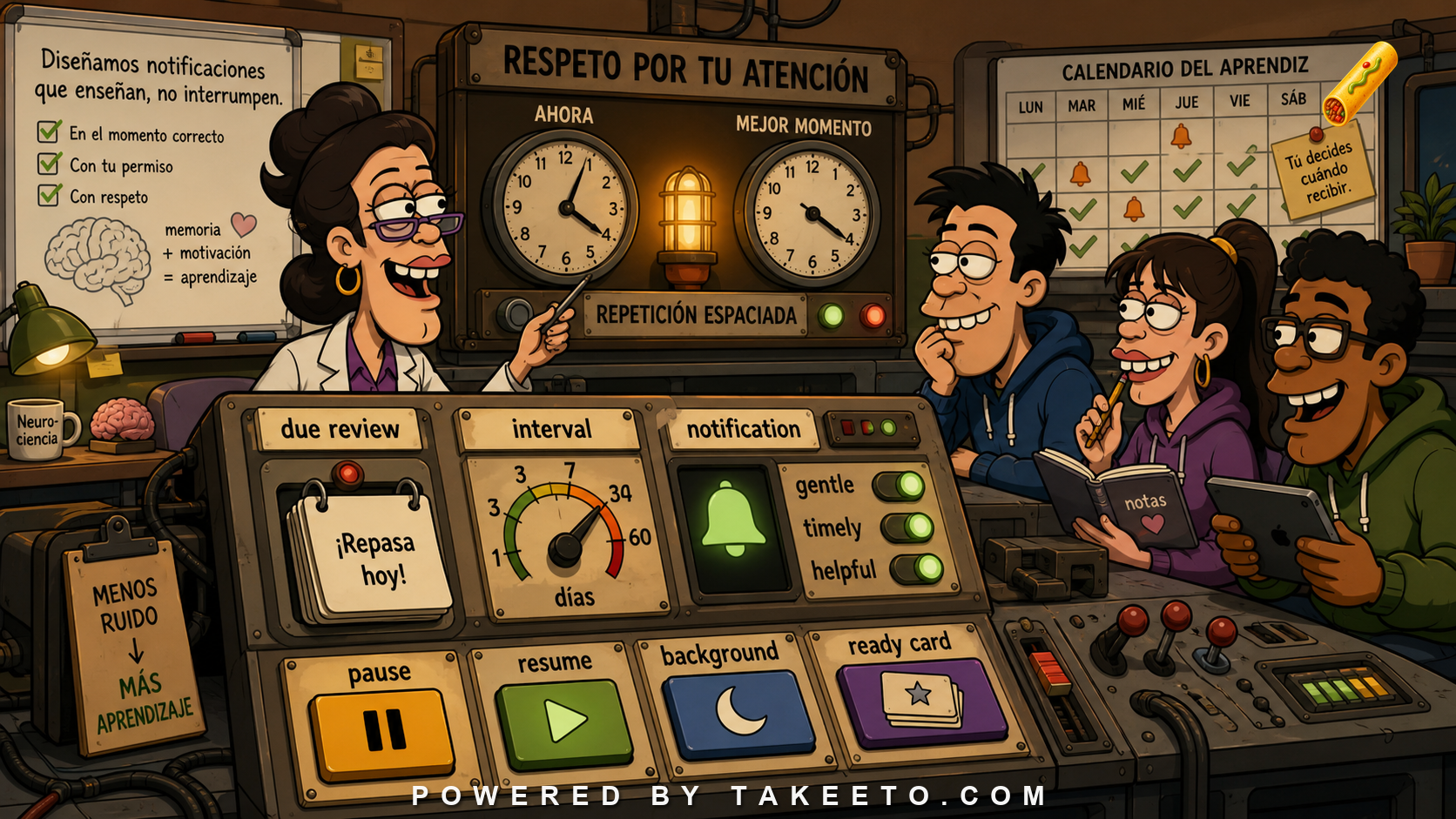
Notifications teach a relationship to memory
A notification is not a neutral ping. In a learning product, it is a claim on attention. It tells the learner that now is a good time to return. If notifications are sent merely to preserve engagement metrics, they become noise. If they correspond to meaningful review moments, they can support memory.
Spanish learning needs repeated retrieval over time. But the learner also has a life. Ethical notification design must balance timing, agency, interruption cost, and respect. A reminder that arrives when review is due can be useful. A stream of generic nudges can train annoyance or guilt.
The practical rule for this article is simple:
A Spanish learning notification should be a timed invitation to useful retrieval, not a demand for attention.
That rule is easy to state and hard to implement. It requires a curriculum designer, teacher, or serious independent learner to look past the visible artifact and ask what the artifact is doing in the learning system. A card, passage, note, audio button, PDF, notification, or metric is never just a feature. It is part of the learner's encounter with Spanish.
Due review, learner agency, and interruption cost
The pedagogical reason for notifications is spaced retrieval. An item should return when the learner is likely to benefit from recalling it again. That does not mean the schedule must be perfect. It means notifications should be tied to readiness: cards due, passage ready for reread, exam ready after a session, audio review available, or a missed review window that can be resumed.
Agency is equally important. Learners should control notification frequency, quiet hours, study days, and pause/resume behavior. Someone preparing for an exam may want frequent prompts. Someone with a demanding job may want a single daily review window. A respectful product does not punish the learner for disabling noise. It lets them shape the schedule.
Notifications should also distinguish reminders from retrieval prompts. “Come back!” is vague. “12 Spanish cards are ready for review” is more honest. “Review por/para contrast before it cools down” is even more pedagogical if accurate. The notification should tell the learner why now matters.
The strongest design habit is to separate the learner-facing experience from the hidden support structure. The learner may see a clean passage, a small note, a speaker button, and a short exam. Behind that simplicity should be clear metadata: item identity, grammar role, register, audio status, review status, translation alignment, and assessment purpose. Good learning design often feels simple because the complexity has been organized, not because it has been ignored.
Annotated notification-timing map
| Design element | What it checks or supports | Spanish-learning consequence |
|---|---|---|
| Due review | Item or set is ready for spaced retrieval. | Pedagogically meaningful prompt. |
| Session continuation | Learner paused a session. | Useful if user-controlled. |
| Post-session exam | Assessment ready after exposure. | Supports consolidation. |
| Quiet hours | No notifications during protected times. | Respects attention and context. |
| Pause/resume | Learner can suspend prompts. | Supports real life without shame. |
| Generic engagement ping | No learning reason. | High risk of annoyance and distrust. |
The table is not meant to turn learning into bureaucracy. It is meant to prevent vague praise. A curriculum artifact should be able to answer concrete questions: What does this teach? What does it assume? What can go wrong? What evidence would show that it is working? Where does the learner receive help if the item fails?
Spanish-specific stakes
Spanish makes these design decisions visible because the language is full of contrasts that cannot be solved by exposure alone. Learners need repeated contact with ser/estar, por/para, preterite/imperfect, object pronouns, se, agreement, article use, register, and regional variation. A product or curriculum that treats every item as an isolated translation will underprepare the learner for real text.
The issue is not that Spanish is uniquely impossible. The issue is that Spanish has structure. The learner must be given enough of that structure to make input intelligible and enough retrieval to make knowledge durable. A passage without review becomes a reading experience that fades. A card without context becomes a brittle memory. Audio without text may not teach spelling. Text without audio may teach silent mispronunciation. Explanations without examples become abstractions. Examples without explanations can create false rules.
The cure is integration. A Spanish item should move through several linked forms: it appears in context, receives a translation or gloss, is heard, is reviewed, is tested, and returns later in a different context. Each contact should add something. Repetition alone is not the same as cumulative design.
Edge cases and mature design questions
Notification ethics become more important when the learner is struggling. A confident learner may enjoy reminders. A frustrated learner may experience them as proof of failure. Copy matters. “You are falling behind” and “Five review cards are ready when you are” create different relationships with the learner.
A respectful system should also recognize re-entry. After a long absence, the right move is not to dump every overdue item at once. It is to rebuild momentum with a manageable recovery session and a transparent reset of intervals.
| Edge case | Why it matters | Better handling |
|---|---|---|
| Learner returning after absence | Large overdue queues can discourage re-entry. | Offer a recovery session and reschedule gradually. |
| Emotional tone | Reminder copy can motivate or shame. | Use task-focused, nonjudgmental language. |
| Context sensitivity | Travel, illness, exams, and work change availability. | Let learners pause and adjust goals without penalty language. |
Edge cases are useful because they reveal whether the model is real. A shallow rule works only in the clean example. A strong curriculum principle survives versioning, regional variation, learner differences, and product constraints. For Spanish, this matters because the learner will eventually meet forms outside the first example bank: another accent, another register, another tense, another passage genre, another medium.
A mature design does not need to solve every edge case in the first lesson. It does need to know where the edges are. When the course chooses not to explain something yet, that should be a deliberate sequencing decision, not ignorance disguised as simplicity.
Diagnostic workflow
- Every notification should have a visible learning reason.
- Let learners choose frequency, quiet hours, and pause duration.
- Distinguish due reviews from motivational messages.
- Use notification text that states the task, not vague pressure.
- Avoid guilt language when a learner misses a day.
- Feed notification outcomes back into scheduling without overpunishing delay.
This workflow works best when it is used before publication rather than after learners complain. Retrofitting quality is expensive. It requires finding the passage, rewriting the sentence, updating the translation, changing the glossary, regenerating audio, revising the PDF, and rebuilding exams. Early diagnostic habits keep the curriculum from accumulating hidden debt.
Common failure patterns
- Optimizing for opens instead of learning: A notification that boosts taps but harms trust is bad pedagogy.
- Sending reminders before items are ready: Premature review can waste attention.
- Ignoring interruption cost: A learner may be driving, working, caring for children, or resting.
- Punishing pauses: A pause feature should not become a hidden penalty.
- Using manipulative streak language: Consistency is useful; guilt is not a curriculum.
These mistakes share one cause: treating the visible feature as the whole product. A learner does not experience a Spanish item only once. They meet it in a deck, a passage, an example, a translation, a voice, a note, an exam, and a review queue. If those encounters disagree, the learner pays the price through confusion. If they reinforce one another, the learner gains a stable model.
A concrete curriculum scenario
Weak notification: “Don’t lose your streak!” It may drive a tap, but it says nothing about learning. Stronger: “8 review cards are ready: ser/estar and por/para.” Better still, if true: “You missed yesterday’s preterite/imperfect review; resume with 6 cards.” The notification respects the learner by naming the task and the reason. It invites study rather than scolding.
Notice the larger principle: the best design choice is usually the one that makes the next learning contact better. A good example sentence prepares better audio. Good audio prepares better listening review. A good glossary note prepares better reading. A good exam mistake prepares better spaced review. The curriculum should behave like a system rather than like a collection of assets.
What the reader should be able to do after this article
After working through this article, the reader should be able to inspect a Spanish-learning artifact and ask sharper questions. They should be able to identify the learning purpose, name the likely failure mode, and propose a repair that improves the next learner encounter. In practical terms, that means moving from vague judgments such as “this feels good” or “this is confusing” to specific diagnoses: the example is unnatural, the audio is mismatched, the translation hides the construction, the review prompt tests recognition rather than recall, or the note explains too much at the wrong moment.
The deeper habit is accountability. Every piece of a serious Spanish curriculum should be able to justify its presence. If it cannot, it should be revised, moved, linked, hidden, or removed.
Implementation checklist
For this topic, implementation should start with the article's own example bank: due review, interval, notification, pause, resume, background, ready card. Choose one representative item or artifact and trace it through the system. It should have a learner-facing purpose, a hidden data representation, a place in review, and a remediation path if something goes wrong. If the topic is not a single vocabulary item, trace a unit-level artifact instead: a passage, PDF, notification, metric, audio control, or exam.
- Name the learner action this design supports: reading, listening, retrieval, production, diagnosis, or long-term review.
- Name the hidden metadata needed to support that action: item ID, form, register, variety, audio status, version, prerequisite, or mistake link.
- Name the failure that would most damage trust, then build the audit check that catches it before publication.
A design is not mature because it has many parts. It is mature when those parts can be inspected, repaired, and explained.
V2 remediation refinement: distinguish review readiness from interruption strategy
The first draft framed notifications around timing, agency, and respect. The v2 repair separates two ideas that products often blur: review readiness and interruption strategy. Review readiness is a memory question: is an item due for retrieval based on prior performance and spacing? Interruption strategy is a UX and ethics question: should the product ask for attention now?
An item can be ready while the learner should not be interrupted. The learner may be asleep, working, driving, in class, or on a scheduled pause. Conversely, a learner may open the app when few items are optimally due; the product can still offer light reading, review of fragile items, or a short listening activity without pretending it is a due-review moment.
A good notification system has layers:
| Layer | Design question |
|---|---|
| memory state | which items are due or becoming fragile? |
| learner state | has the learner allowed notifications, quiet hours, or pauses? |
| session context | did the learner recently stop mid-review or finish a deck? |
| message content | does the notification name a useful action, not merely guilt? |
| feedback loop | did the notification lead to retrieval, dismissal, or opt-out? |
Language-learning notifications should avoid shame. “Don’t lose your streak” may produce short-term reopening, but it teaches the learner to serve the app. A better prompt is specific and respectful: “Five Spanish items are ready for review,” “Your passage audio is downloaded for offline listening,” or “Two missed por/para contrasts are ready.”
Agency is not a decoration. Pause, resume, quiet hours, frequency controls, and clear notification categories protect trust. The learner should feel that notifications support memory, not that memory is being used as a pretext for interruption.
Suggested interactive module: Notification timing flowchart
Notification timing flowchart. The tool would decide whether to notify based on due items, learner settings, quiet hours, recent activity, interruption limits, and task value. It would preview copy and classify it as review prompt, session resume, post-session exam, or generic reminder. Designers could audit whether messages are educationally justified.
A useful implementation would also preserve an audit trail. When a designer changes a sentence, the tool should reveal downstream effects: translation, highlights, audio, PDF, exams, and review data. When a learner misses an item, the tool should reveal upstream causes: weak example, poor contrast, missing audio, or a misleading note. The module should not merely display content. It should make relationships inspectable.
Final rule
A Spanish learning notification should be a timed invitation to useful retrieval, not a demand for attention. Respect the learner, name the task, and let memory—not engagement anxiety—drive the ping.
For serious Spanish learning, quality is not one decision. It is the alignment of content, explanation, sound, retrieval, assessment, and learner trust. When those parts agree, the learner can spend attention on Spanish instead of fighting the curriculum.