A nickname is not just a shorter name
Spanish personal names often have diminutives, affectionate forms, shortened forms, family names, public names, compound names, and conventional nicknames that are not obvious to learners.
A learner may see:
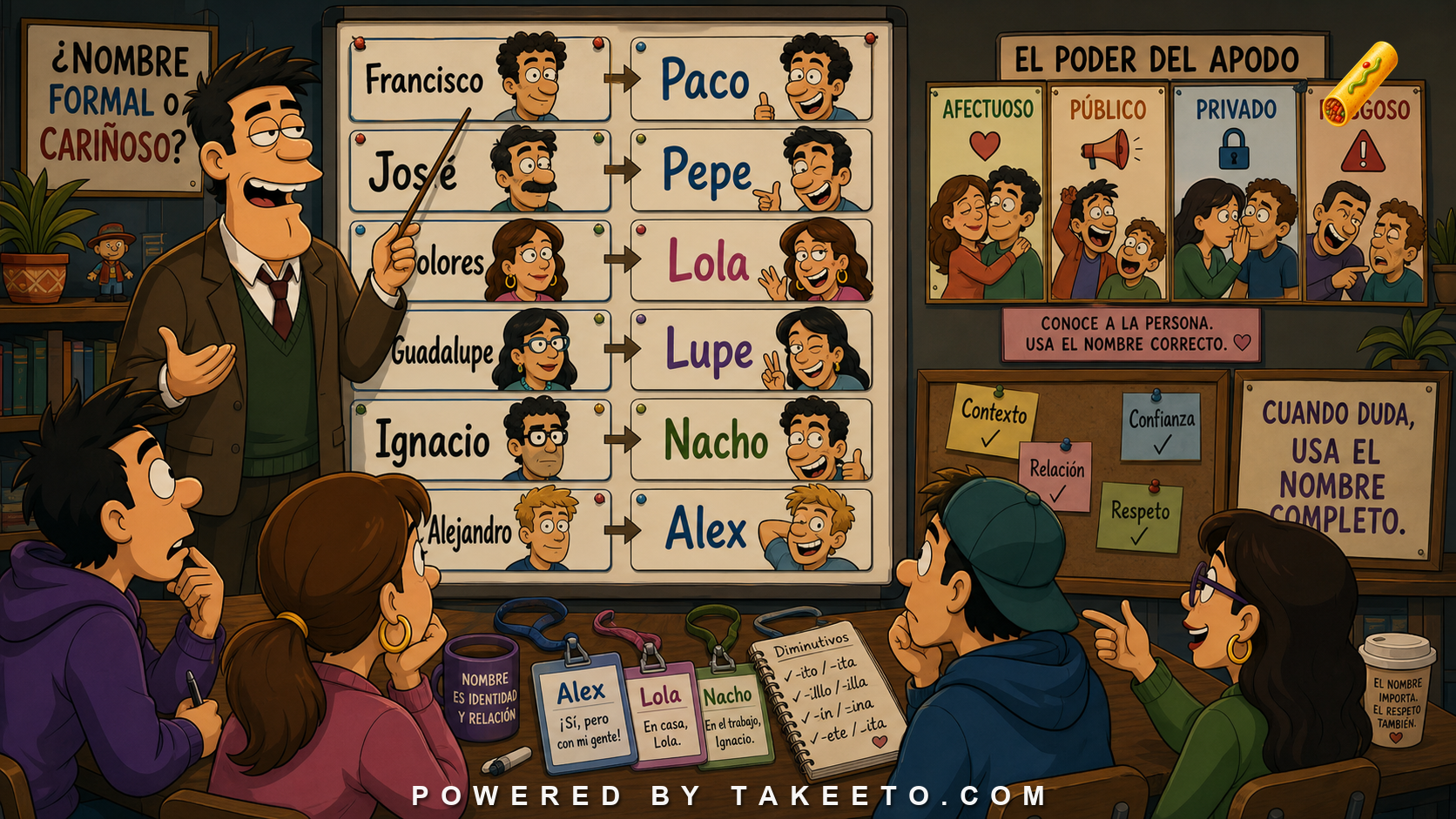
Francisco → Paco
José → Pepe
Dolores → Lola
Guadalupe → Lupe
Ignacio → Nacho
Alejandro → Álex
Some forms are transparent. Others are historically conventional. All of them carry social meaning.
The key principle is:
Spanish nicknames are relationship language. Recognizing one is useful; using one requires social permission.
A form that sounds warm in the family can sound intrusive from a stranger.
Diminutives and affection
Spanish can form affectionate or diminutive versions of names with endings such as -ito/-ita, -cito/-cita, -illo/-illa, and regional variants.
Examples:
Juan → Juanito
Ana → Anita
Carmen → Carmencita
Miguel → Miguelito
These forms may mark affection, youth, intimacy, tenderness, irony, condescension, or family habit. Context decides. Calling a child Juanito may be warm. Calling an adult colleague Juanito without invitation may be patronizing.
Learner action: do not use diminutive names unless the person uses them or invites you to.
Hypocoristics: conventional familiar forms
A hypocoristic is a familiar or affectionate name form. Some Spanish hypocoristics are historically conventional and not predictable from modern spelling.
Examples:
Francisco → Paco
José → Pepe
Dolores → Lola
Ignacio → Nacho
Guadalupe → Lupe
Enrique → Quique/Kike
Antonio → Toño
Jesús → Chuy/Chus depending on region
These forms vary by country, generation, family, and personal preference. A person named Francisco may use Paco, Pancho, Fran, Curro, Cisco, or the full Francisco depending on region and identity.
Learner action: treat nicknames as personal data, not automatic conversions.
Compound names
Spanish personal names often include compounds:
José Luis
María José
Juan Carlos
María del Carmen
José Antonio
A person may use the full compound, one part, initials, or a nickname. María del Carmen may be Carmen, Maricarmen, Mamen, or another family form. José María can be a male name in many contexts. English assumptions about first/middle names do not always work.
Learner action: copy the name the person gives you. Do not split, shorten, or reorder it based on English habits.
Public identity versus family identity
A person may use one name professionally and another at home. A writer may publish as José Emilio Pacheco, a friend may say Pepe, and an official form may require full legal names and surnames. A teacher may introduce herself as Dra. Morales in class but Lupita with family.
The same individual can have several name layers:
- legal name,
- professional name,
- family nickname,
- childhood nickname,
- social media handle,
- artistic name,
- shortened everyday form.
Learner action: match the setting. Professional contexts usually call for the name or title the person uses publicly.
Social risk
Nicknames can signal closeness. That makes them dangerous when misused. A learner who calls José “Pepe” without invitation may sound overfamiliar. A manager using a diminutive for an employee can sound belittling. A stranger using a family nickname may feel invasive.
On the other hand, refusing to use a chosen nickname can be cold or disrespectful. If someone says “Me llamo Francisco, pero todos me dicen Paco,” then Paco is the appropriate social name in that context.
Learner action: ask politely or follow introduction cues: ¿Prefieres que te diga Francisco o Paco?
Example bank walkthrough
Francisco / Paco
A conventional nickname pair, but not automatic for every Francisco.
Learner action: use Paco only if the person uses it.
José / Pepe
Common familiar form.
Learner action: recognize it in family and social contexts.
Dolores / Lola
Conventional shortened/familiar form.
Learner action: remember that a nickname may become a public identity.
Guadalupe / Lupe
Common shortened form, especially in Mexican and U.S. contexts.
Learner action: check individual preference.
Ignacio / Nacho
Common hypocoristic, also a word with other meanings in English contexts.
Learner action: do not joke about names.
Alejandro / Álex
Transparent modern shortening with accent in Spanish when written as Álex.
Learner action: note spelling and personal preference.
Remediation notes: nicknames require permission, not just vocabulary knowledge
The repair for personal names is social. Knowing that Francisco may become Paco, José may become Pepe, Dolores may become Lola, Guadalupe may become Lupe, and Ignacio may become Nacho does not give a learner permission to use those names for anyone. A hypocoristic is often relational. It may be for family, close friends, childhood contexts, public artistic identity, or a person’s chosen everyday name.
Diminutives are also not automatically affectionate. Juanito, Anita, Carlitos, Lupita, or Miguelito can be warm, patronizing, playful, intimate, infantilizing, or regionally normal depending on speaker, relationship, age, and tone. A boss using a diminutive may sound friendly or condescending. A stranger using one may sound intrusive. A family member using one may sound loving.
Compound names need more care. María José, José Luis, Juan Carlos, Ana María, and María del Carmen may be treated as full given-name units. Shortening without permission can misidentify the person. In administrative settings, preserve the full legal name exactly as written, including particles and accent marks.
Learners should distinguish public name, legal name, preferred name, username, artistic name, and family nickname. A writer known publicly as Lola may have a formal name Dolores; a person legally named Francisco may never use Paco; a person may choose an English nickname in one setting and a Spanish name in another. The person decides.
Production target: ask or follow the person’s own usage. ¿Cómo prefieres que te llame? works among peers. In formal settings, use the name supplied in the email signature, form, or introduction. Do not translate, shorten, or “Spanish-ify” someone’s name as a joke. Names carry intimacy and identity; handle them carefully.
Suggested interactive module: name-to-nickname map
A strong tool for this article would show name forms with social context labels.
Suggested functions:
- Name card: legal/full form, common nicknames, regional variants.
- Context labels: family, friends, professional, public, childhood, artistic.
- Permission prompt: use only when introduced or invited.
- Compound-name parser: María del Carmen, José Luis, Juan Carlos.
- Diminutive generator: possible forms plus caution labels.
- Formality examples: Estimada Dra. García / Hola, Lupe.
Final rule
Spanish nicknames are not mechanical abbreviations. They are social signals.
Recognize Paco, Pepe, Lola, Lupe, Nacho, and Álex. But use the name the person gives you. In names, accuracy is respect and overfamiliarity is a real mistake.