
A word learned without context is fragile
A flashcard can teach a word quickly. It can also create brittle knowledge. A learner sees:
solicitar — to request
They pass the card. Later they read:
Para completar el trámite, deberá solicitar una cita y adjuntar el comprobante correspondiente.
Now solicitar is not just “request.” It belongs to administrative procedure. It takes an object. It appears near trámite, cita, adjuntar, comprobante. It has a register.
The key principle:
A reading passage gives vocabulary a world before a card asks the learner to retrieve it.
Flashcards are stronger when the learner has already seen the item doing work in a sentence.
Passages create semantic neighborhoods
A well-designed Spanish passage can introduce a deck's focus items while reviewing previous material.
For a public-services deck, one passage might include:
cita previa
trámite
solicitud
expediente
resolución
adjuntar
firmar
presentar
These items belong together. A passage can show their relationships:
Marta pidió una cita previa para presentar una solicitud. Antes de ir a la oficina, revisó los requisitos, firmó el formulario y adjuntó una copia de su pasaporte. Dos semanas después, recibió una resolución sobre su expediente.
A flashcard list teaches pieces. A passage teaches a situation.
Context improves retrieval quality
If the learner first reads a passage, later card review activates context:
resolución → official decision, not just “resolution” in the English abstract sense.
expediente → case file, record, administrative file.
adjuntar → attach documents, often in forms/email.
presentar → submit/present, depending on domain.
This reduces false translation.
The card is still useful. But it retrieves a memory anchored in reading.
Review items make curriculum cumulative
A passage should not contain only new words. It should recycle earlier items.
New focus items might be highlighted strongly. Review items might be highlighted differently or quietly repeated.
Example:
New:
expediente, resolución, adjuntar
Review:
fecha, documento, oficina, enviar, recibir
This creates cumulative learning. Spanish does not grow by finishing one deck and abandoning its vocabulary. It grows when old items keep reappearing in new contexts.
Translation supports, but should not replace reading
A passage may include an English translation. The translation should help comprehension, not become the main activity.
Good translation support:
- clarifies the situation,
- preserves important structures when useful,
- notes idioms or nonliteral phrases,
- prevents wrong guesses,
- allows rereading Spanish with confidence.
Bad translation support:
- encourages reading only English,
- erases Spanish structure completely,
- hides register differences,
- turns every phrase into a one-to-one equivalent.
The best design lets the learner read Spanish first, consult support, and return to Spanish.
Audio turns passages into listening material
Passage audio matters because reading and listening are different skills. A learner may understand deberá presentar in writing and fail to catch it in speech.
Audio can be staged:
- Slow audio for segmentation.
- Natural audio for rhythm and reduction.
- Sentence replay for difficult lines.
- Item audio for focus vocabulary.
The passage becomes a bridge between reading and listening.
PDFs extend study beyond the app
A printable passage packet can include:
- Spanish passage,
- English translation,
- glossary,
- focus/review item list,
- note space,
- audio reference or QR code.
Paper study supports annotation, rereading, classroom use, and offline review. The app handles retrieval and scheduling. The PDF handles slow reading and marking.
The passage is also a diagnostic tool
A passage does more than introduce items. It reveals what the learner cannot yet process in connected Spanish. A learner may know every word in a list but stumble when those words appear inside relative clauses, pronouns, tense shifts, or bureaucratic noun phrases. That stumble is valuable.
For example, solicitud, adjuntar, and plazo may be known separately. But in la solicitud que debe adjuntarse antes del plazo indicado, the learner must process a relative clause, passive/impersonal se, and a participle. The passage exposes integration problems that cards hide.
A strong curriculum should use this diagnostic information. If many learners tap the same glossary item or reread the same sentence, the passage may need a note, audio support, or a preparatory lesson. Context is not only input. It is evidence.
Example bank walkthrough
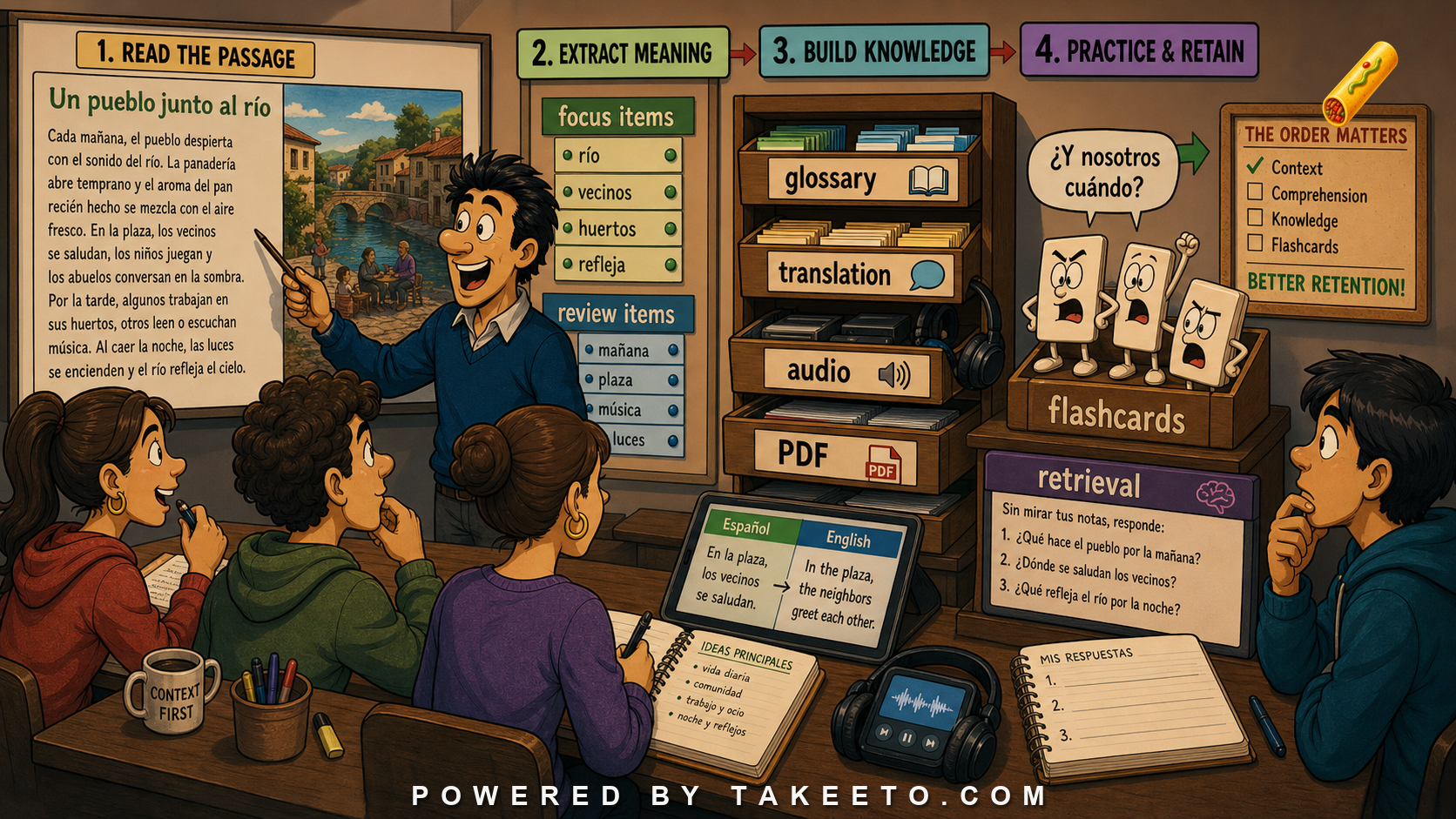
focus items
New target items in the current deck.
Learner action: read them in context before drilling cards.
review items
Previously learned items reused in new passages.
Learner action: welcome repetition as curriculum glue.
glossary
Support for meaning, register, grammar, and form.
Learner action: use it to return to Spanish, not avoid Spanish.
translation
Comprehension support.
Learner action: compare Spanish and English when structure matters.
audio
Listening layer.
Learner action: read, listen, then reread aloud.
Printable artifact.
Learner action: annotate and revisit outside the app.
flashcards
Retrieval tool.
Learner action: use cards after context has introduced the items.
retrieval
Memory pull.
Learner action: test active recall after reading.
Passage length and density
A passage should be long enough to create a real situation and short enough that the learner can reread it. A two-sentence passage may feel efficient but often cannot show discourse, repetition, or review items naturally. A very long passage may bury the deck targets.
Good density means the target items appear in meaningful positions:
- not all in one unnatural sentence,
- not separated from useful context,
- not repeated mechanically,
- not hidden behind too many unknown words.
A strong passage feels like a real piece of Spanish written under constraints. The constraint is curriculum coverage. The craft is making that coverage invisible enough that the learner is still reading, not decoding a word list in disguise.
Remediation notes: context before cards does not mean stuffing every item into a paragraph
The central repair is to protect passage-based curriculum from bad passage writing. A reading passage is not a word-list container. If every sentence exists only to include a deck item, the passage becomes unnatural and the learner learns that Spanish is a sequence of forced targets. Context should make items meaningful, not merely visible.
A strong passage has a communicative reason to exist: a notice, message, story, dialogue, report, recipe, complaint, schedule, email, form instruction, or short explanation. Focus items should appear because the situation needs them. Review items should support the scene without crowding it. If the deck contains plazo, adjuntar, solicitud, firmar, and comprobante, a coherent passage might be a municipal-office notice. It should not be a bizarre story in which every administrative word appears once for no reason.
The article should add a coverage/coherence tradeoff. Full coverage is attractive to product builders, but forcing every item into one passage may damage naturalness. Sometimes the right design is two shorter passages, a passage plus example sentences, or a primary passage with a follow-up review note. Coverage metrics are useful, but they cannot replace editorial judgment.
Translation also needs a boundary. An aligned English translation can help learners understand the passage, but it should not become the main task. The Spanish should come first. The translation should explain difficult constructions and preserve enough alignment to support learning, without becoming awkward English.
A passage-centered system should feed later retrieval. If a learner first meets deberá presentar in a document-like passage, a later card can ask for recognition, reverse translation, or a fill-in prompt. If the learner fails, the system can return them to the passage line. That connection is the real value of context before cards.
Production target: audit every passage with four questions: Does it sound like something someone would actually write or say? Are the focus items necessary to the situation? Are review items helpful rather than noisy? Does every later card point back to a meaningful context? If not, rewrite the passage before adding more cards.
Suggested interactive module: passage-to-card learning flow diagram
A strong tool for this article would show the learning sequence for one deck.
Suggested functions:
- Passage view: focus and review highlights.
- Glossary tap: short notes, not textbook overload.
- Translation toggle: sentence-by-sentence support.
- Audio buttons: slow and natural speed.
- Card transition: passage items become flashcards.
- Exam link: passage exposure feeds retrieval tests.
- PDF export: printable packet with notes.
- Reappearance tracker: show where review items return later.
Final rule
Flashcards retrieve best when context has already built meaning.
Use reading passages to introduce vocabulary, grammar, register, and semantic neighborhoods. Then use cards, audio, exams, and PDFs to strengthen retrieval. Context before cards makes Spanish less brittle.