
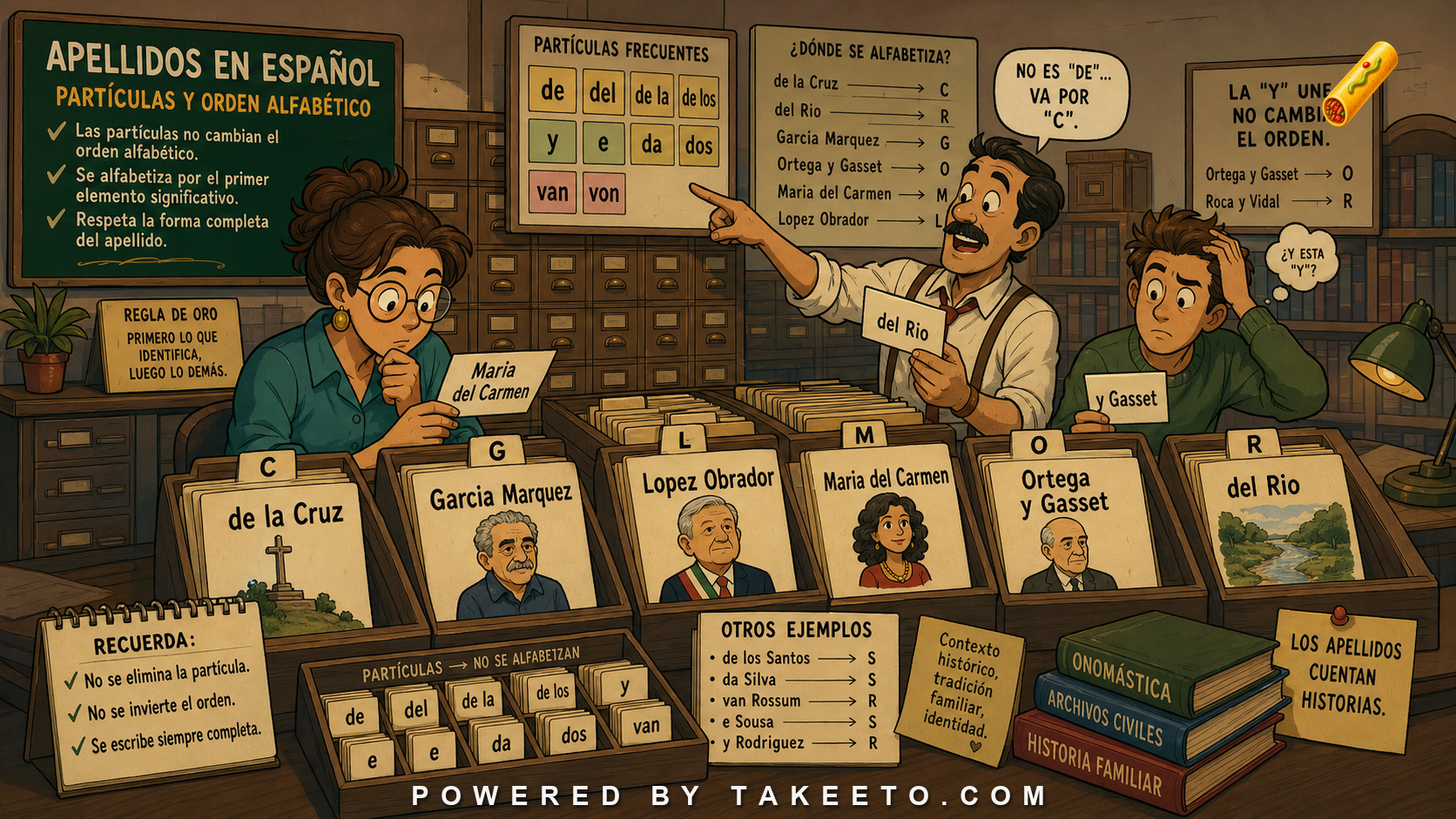
Small words in names are not small mistakes
Spanish names may include particles such as de, del, de la, de los, and y. These elements can appear in surnames, compound surnames, given names, place names, and public names.
The key principle is:
Name particles are part of the name structure. Preserve them unless a specific cataloging or legal rule tells you how to index them.
Dropping de la from de la Cruz or treating García Márquez as if only Márquez matters is not a harmless simplification in many contexts.
De, del, and de la
De and de la can appear in surnames:
de la Cruz
de la Torre
de los Santos
Del is the contraction of de + el:
del Río
In ordinary grammar these words have meanings, but inside a name they function as name material. Do not translate them in documents. Do not delete them in display names. Do not assume they are optional.
Y in surnames
The conjunction y can appear in a surname or public name:
Ortega y Gasset
Historically, y can join or distinguish surname elements. In a modern name, treat it as part of the public form unless a formal indexing rule says otherwise.
Compound surnames
A compound surname may contain multiple words in one surname position.
Fernández de Calderón
García-Iglesias
de la Peña
This is why spaces do not always equal separate surname fields. A person can have a compound first surname and a separate second surname. A database with one “last name” field may not represent the structure well.
Learner rule:
If the name matters legally, academically, or professionally, rely on the person’s own usage or the official record, not your guess.
García Márquez and López Obrador
Two surnames may be used together as a public identifying form.
Gabriel García Márquez
Andrés Manuel López Obrador
The second surname is not automatically optional. In public and academic reference, the conventional full surname combination may be the clearest and most respectful form.
English-style “last word = last name” logic fails here.
María del Carmen is a given name
María del Carmen contains del, but it is a compound given name, not a surname example.
This matters because particle detection alone is not enough. You must first know which part of the full name is the given-name portion and which part is the surname portion.
Alphabetization depends on the system
There is no single learner-safe rule that covers every library, school, government database, airline, and bibliography. Still, several practical principles hold:
- Do not file by the final word automatically.
- Keep compound surnames together when they are compound surnames.
- Preserve particles in display.
- Follow the institution’s indexing rules for de, del, de la, and y.
- Use authority records or source metadata for authors and public figures.
In ordinary Spanish reference, the first surname often carries primary weight. But cataloging, bibliography, and legal systems may have more specific conventions.
Married-name conventions
In many Spanish-speaking contexts, women do not replace their surnames with a spouse’s surname in the same way common in some English-speaking naming traditions. You may see older, traditional, or regional forms using de + spouse’s surname, such as María Pérez de García, but this is not a universal modern rule.
Practical rule:
Use the name the person uses and the name required by the document.
Do not add or remove married-name particles on your own.
Digital systems and name damage
Digital forms commonly damage Spanish names by:
- dropping de, del, or de la,
- removing accents,
- treating the second surname as a middle name,
- splitting compound surnames,
- sorting by the final word,
- accepting only one surname.
These errors can affect travel, citations, payments, identity verification, and search.
Common learner errors
The first error is deleting particles:
de la Cruz
should not casually become Cruz in official use.
The second is filing by the last word automatically:
García Márquez
should not be treated mechanically as Márquez.
The third is confusing given-name particles with surname particles:
María del Carmen
is a compound given name.
The fourth is assuming all Spanish-speaking countries and institutions sort names the same way. They do not.
Remediation notes: particles, capitalization, and filing systems
Spanish surname particles create two separate tasks: preserving the display name and understanding how a particular system files or indexes it. Those tasks are not always identical.
In ordinary display, particles remain part of the name:
María de la Cruz
Luis del Río
Ortega y Gasset
In running text, particles such as de, del, de la, de los, and y are often lowercase when preceded by a given name. At the beginning of an entry or when the surname is used alone, capitalization may follow the style of the source or cataloging system:
Juan de la Cruz
De la Cruz, Juan
But filing rules vary across libraries, databases, countries, and style manuals. That is why a learner should not invent alphabetization from intuition. Academic citation, legal identity, passport data, library cataloging, and journalistic naming may each have conventions.
Compound surnames also need caution. Spaces do not automatically mean separate surnames:
Fernández de Calderón
de la Peña
García-Iglesias
A person may have a compound first surname plus a second surname. A one-field “last name” box can destroy that structure.
Married-name conventions require special care. In some countries and generations, a married woman may socially use a form with de plus the spouse’s surname. In other settings this may be old-fashioned, optional, socially marked, or not the legal surname. Do not impose it. Do not “correct” a person’s name into it. Follow the person’s own usage and the legal document when precision matters.
Public figures add another layer. García Márquez, López Obrador, and Ortega y Gasset are not solved by taking the final word only. Conventional public usage tells readers which name form identifies the person. The English instinct “last word = last name” is unreliable.
The practical rule is to maintain two records in your mind: display form and filing key. Display form preserves the person’s name as written. Filing key follows a specific system. When you do not know the system, preserve rather than simplify.
Example bank walkthrough
de la Cruz
Surname with particle.
Learner action: preserve de la in display and official handling.
del Río
Surname with contraction and accent.
Learner action: preserve both particle and accent.
García Márquez
Two-surname public form.
Learner action: do not reduce by English last-word logic.
Ortega y Gasset
Name with y.
Learner action: treat y as part of the name form.
María del Carmen
Compound given name.
Learner action: do not parse del Carmen as a surname automatically.
López Obrador
Two-surname public form.
Learner action: follow conventional public usage.
Suggested interactive module: surname sorting and citation tool
A strong tool for this article would separate identity fields from display and indexing.
Suggested functions:
- Particle detector: de, del, de la, de los, y.
- Name-field mode: given names, first surname, second surname.
- Compound surname mode: preserve multiword surname units.
- Display vs filing view: show name as written and possible filing key.
- Citation mode: warn against last-word assumptions.
- Database-risk alert: accents, particles, one last-name box.
- Married-name caution: do not impose de forms.
- Preferred-name field: ask how the person publishes or signs.
Final rule
Spanish surname particles are name structure.
Preserve de, del, de la, y, accents, and compound forms unless a specific rule tells you how to index them. English last-name instincts are not safe here.
Names are language, data, and respect.