
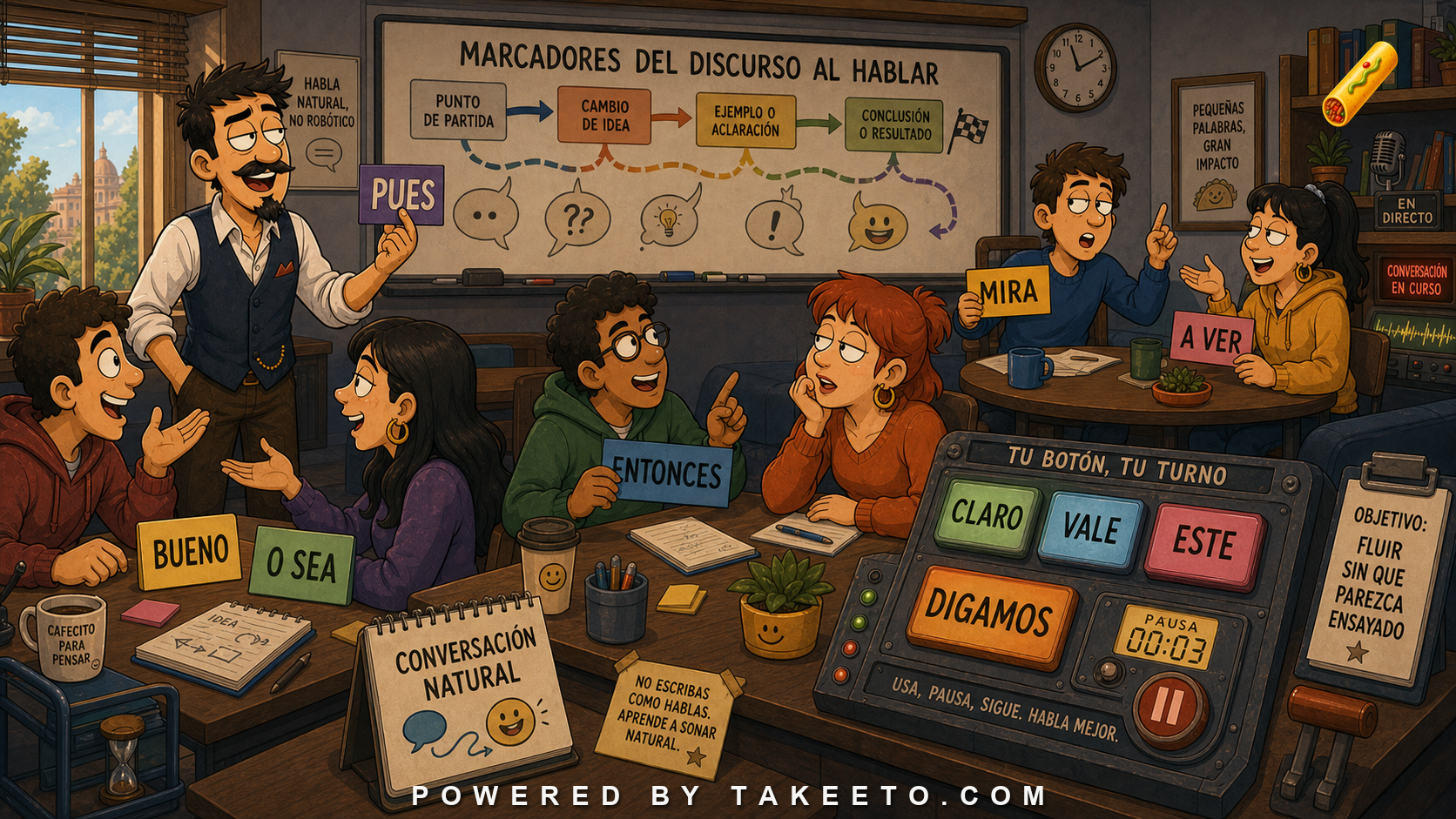
The learner problem is real
Learners often hear pues, bueno, o sea, and entonces as noise. Native speakers hear turn management, stance, repair, sequencing, and social positioning.
That reaction is understandable. Spanish is close enough to English and other European languages to reward pattern recognition, but different enough that pattern recognition can become overconfidence. The stronger habit is to treat each form as evidence. Ask what shape the word or sentence has, what job that shape is doing, and what context would make it natural.
The working rule for this article is simple:
Discourse markers are not empty. They organize conversation, signal attitude, buy time, soften disagreement, repair meaning, and guide the listener.
This rule matters because the topic is not only a small grammar point. It is a reading strategy, a writing strategy, and a way to keep learner Spanish from becoming a translation of English with Spanish-looking words.
The central pattern
A discourse marker is a word or phrase whose job is not mainly to name a thing or event, but to manage the conversation. Bueno can open an answer, soften a refusal, mark a transition, or signal resignation. Pues can connect to what was said, introduce a response, mark consequence, or simply give the speaker a moment to organize speech. O sea reformulates: “that is,” “I mean,” “in other words.” Entonces can sequence events or mark a conclusion.
These markers are highly regional. Vale is common in Spain as agreement or acknowledgment; in many American varieties it is less central or has different distribution. Este is a frequent hesitation marker in several American varieties. A ver can invite attention, begin a problem-solving move, or prepare correction. Mira and mire manage attention and stance, sometimes warmly and sometimes sharply.
The learner's mistake is to erase all these words from listening practice. If you remove discourse markers, you may preserve the propositional content but lose the social mechanics. Bueno, no sé is not the same conversational move as No sé. O sea, no es imposible is not identical to No es imposible. The markers frame how the utterance should be received.
The pattern is useful precisely because it is not mechanical. A mechanical rule lets you produce a few classroom examples and then fails in real prose. A durable pattern lets you inspect unfamiliar material, make a reasonable hypothesis, and then verify it with context.
Annotated contrast table
| Form or pattern | Example | What the learner should notice |
|---|---|---|
| bueno | Bueno, podemos intentarlo | transition, concession, softened opening |
| pues | Pues no lo sé | response launch, consequence, hesitation, regional functions |
| o sea | O sea, no fue un error técnico | reformulation or clarification |
| entonces | Entonces, ¿qué hacemos? | sequence, conclusion, next-step management |
| mira / mire | Mira, te explico | attention and stance marker |
| a ver | A ver, revisemos el archivo | attention, planning, repair, evaluation |
| claro | Claro, entiendo | agreement, acknowledgment, sometimes ironic |
| este | Este, no estoy seguro | hesitation marker in many American varieties |
Tables like this are not meant to replace reading. They train attention. Once the contrast is visible in short examples, the learner can notice it inside longer sentences, forms, articles, transcripts, and essays.
How to read it in context
A good reader does not translate from left to right as if each word were independent. A good reader first identifies the structure. In this topic, that means asking what is being built, modified, asserted, evaluated, connected, or backgrounded before choosing an English equivalent.
Consider the difference between a dictionary match and a contextual interpretation. A dictionary can give a gloss. It cannot by itself tell you whether a word sounds bureaucratic, whether a pronoun is attached because the verb is an infinitive, whether a relative clause describes a known person or a desired category, or whether a familiar-looking word is a false friend. Those decisions come from structure plus context.
The safest habit is to annotate one layer at a time. First mark the visible form. Then mark the grammatical relation. Then mark register or discourse function. Only after those steps should you settle on a translation or write your own sentence.
Diagnostic workflow
Use this checklist when you meet the pattern in real Spanish:
- Ask whether the marker changes the facts or the conversational frame.
- Identify its job: opening, hesitation, repair, contrast, conclusion, attention, agreement, or softening.
- Listen for intonation; the same marker can be warm, impatient, ironic, or neutral.
- Notice regional distribution before imitating a marker heavily.
- Practice with transcripts, not isolated word lists.
The point is not to slow down forever. The point is to slow down enough times that your eye starts doing the work automatically. Spanish becomes easier when you stop treating each example as a separate exception.
Common learner traps
| Trap | Better analysis |
|---|---|
| Calling every marker filler | A marker may be semantically light but pragmatically important. |
| Imitating one country everywhere | A marker natural in Madrid may not sound equally natural in Bogotá, Buenos Aires, or Mexico City. |
| Translating literally | Pues is not always “well,” and bueno is not always “good.” |
| Overusing markers to sound fluent | Too many markers can make learner speech vague or caricatured. |
The traps all have the same source: translating too early. If you first ask what the Spanish form is doing, many apparent exceptions become predictable.
Production practice
Compare three responses. No puedo is direct. Bueno, no puedo softens or frames the refusal. Pues, no puedo connects the refusal to prior context and may sound explanatory or resigned. O sea, no puedo suggests reformulation: perhaps the speaker is clarifying after a misunderstanding. The core content is similar; the conversation move is different.
For writing, build sentences around real contexts rather than isolated forms. A learner who writes only bare examples can produce a correct phrase and still miss the register, discourse function, or argument structure. A better practice sentence includes a speaker, a listener or reader, a purpose, and enough surrounding language to make the grammar meaningful.
One useful exercise is to write three versions of the same idea: a neutral spoken version, a careful written version, and a formal or technical version. The differences reveal which parts of the pattern are grammatical and which parts belong to style. This is especially important in articles 081-100, where morphology, word choice, discourse, word order, clitics, commands, and subjunctive mood all interact with register.
Deepening the pattern: from recognition to control
Recognition is the first stage. Control begins when the learner can explain why a neighboring form would change the interpretation. For Spoken Spanish Discourse Markers: Pues, o sea, bueno, entonces, the essential habit is to keep three questions separate: what form is visible, what relation that form creates, and what discourse effect follows from it. When those questions collapse into one vague translation, the pattern becomes fragile. When they are separated, the learner can handle new examples without waiting for a memorized phrase.
Start with the example bank: pues, bueno, o sea, entonces, mira, a ver, claro, vale, este, digamos. Do not treat those items as decorative vocabulary. Treat them as test cases. For each one, ask what the form contributes that would disappear if the sentence were rewritten with a simpler, more English-like structure. Sometimes the answer is grammatical, as with agreement, clitic placement, or mood. Sometimes it is lexical, as with derivational families, false friends, loanwords, or register choices. Sometimes it is textual, as with connectors, discourse markers, word order, or formal nominalization. The same visible Spanish form can therefore carry information about grammar, vocabulary, stance, and genre at once.
| Control test | Example | What changes if the learner ignores it |
|---|---|---|
| bueno | Bueno, podemos intentarlo | transition, concession, softened opening |
| pues | Pues no lo sé | response launch, consequence, hesitation, regional functions |
| o sea | O sea, no fue un error técnico | reformulation or clarification |
| entonces | Entonces, ¿qué hacemos? | sequence, conclusion, next-step management |
A useful self-check is the replacement test. Replace the form with the nearest English-looking option and ask what breaks. If nothing breaks grammatically, ask what changes stylistically. If the sentence remains possible but sounds more bureaucratic, more colloquial, more regional, more emphatic, or less precise, the difference still matters. Serious Spanish learning is not only avoiding ungrammatical sentences. It is learning why one grammatical sentence fits a context better than another. That final comparison is where mature command develops: the learner stops asking only whether a sentence is allowed and starts asking whether it is the sentence a competent speaker or writer would choose here.
This is also where translation discipline matters. English often hides distinctions that Spanish marks openly, and English sometimes marks distinctions that Spanish leaves to context. A literal translation may therefore produce the right dictionary meaning while losing the Spanish architecture. In this article's topic, the learner should practice moving in both directions: Spanish to analysis, then analysis to natural English; English intention to Spanish structure, then Spanish structure to a context where it sounds credible.
Applied editing drill
Use the topic as an editing lens. Take a paragraph that already communicates a basic message and revise it once for grammar, once for register, and once for discourse flow. In the grammar pass, look for visible evidence: endings, articles, pronouns, prepositions, mood, word order, and agreement. In the register pass, ask whether the vocabulary belongs to speech, academic writing, administrative prose, journalism, technical explanation, or intimate conversation. In the discourse pass, ask whether the sentence introduces information, contrasts it, reformulates it, softens it, commands action, evaluates it, or presents it as asserted or nonasserted.
For teachers and curriculum designers, the practical sequence is diagnosis before production. First ask learners to identify the form. Then ask them to explain the role. Only after that should they generate original examples. Production without diagnosis often creates lucky correct answers. Diagnosis followed by production creates transfer. For independent learners, the notebook method should be the same: record the example, label the structure, write the contrast, and add one original sentence with context.
For translators and heritage speakers, the main danger is different. They may understand the message quickly but underestimate the formal signal. A connector, suffix, clitic position, or subjunctive choice may feel obvious in context, yet that small signal is exactly what gives the sentence its written polish or regional flavor. Slow analysis is still useful even when the meaning is already clear.
V2 remediation refinement: discourse markers are functions, not filler words
The article now needs a sharper listening method. Words such as pues, bueno, o sea, entonces, mira, a ver, claro, vale, este, and digamos should not be translated one by one. They manage the conversation.
| Marker | Common function | Example effect |
|---|---|---|
| bueno | opens, softens, redirects, accepts with hesitation | “Well / okay, but...” |
| pues | connects to prior context, delays, frames an answer | “So / well / then” depending region |
| o sea | reformulates, clarifies, corrects | “That is / I mean” |
| entonces | sequences, resumes, draws conclusion | “Then / so” |
| mira | gets attention or frames stance | “Look...” |
| a ver | organizes thinking, requests attention, softens correction | “Let’s see...” |
| claro | confirms, concedes, or marks obviousness | “Of course / right” |
| vale | accepts or closes a step, especially common in Spain | “Okay” |
| este | hesitation marker in several American varieties | pause-management |
The remediation also adds the transcript rule: tag the marker by what happens immediately before and after it. If bueno appears before disagreement, it may soften disagreement. If bueno appears after a long explanation, it may close a turn. If o sea introduces a simpler version of the same point, it is reformulation. If it introduces a correction, it is repair.
Learners should avoid two bad habits. The first is deleting all discourse markers as meaningless filler. That removes stance and interaction. The second is inserting them randomly to sound fluent. That creates noise. A marker belongs where the speaker needs to manage a turn, repair an idea, show alignment, buy time, or change direction.
The article’s tool concept should therefore tag function, not translation: opener, hesitation, reformulation, conclusion, correction, attention call, concession, confirmation, or turn close.
Suggested interactive module: Conversation transcript marker tagger
Conversation transcript marker tagger. The tool would load a short dialogue and color discourse markers by function: turn opener, repair, conclusion, attention, agreement, hesitation, contrast. It would include regional labels and audio so learners hear intonation rather than memorizing dictionary translations.
Suggested functions:
- Structure detection: identify the relevant form or construction automatically.
- Role labels: mark meaning, grammar, discourse function, and register separately.
- Contrast mode: show a nearby form that looks similar but behaves differently.
- Correction mode: let the learner repair common English-shaped errors.
- Context export: generate a short annotated example for study notes.
Final rule
Spoken Spanish is not just grammar plus vocabulary. It is interaction. Discourse markers are the steering wheel of conversation.