
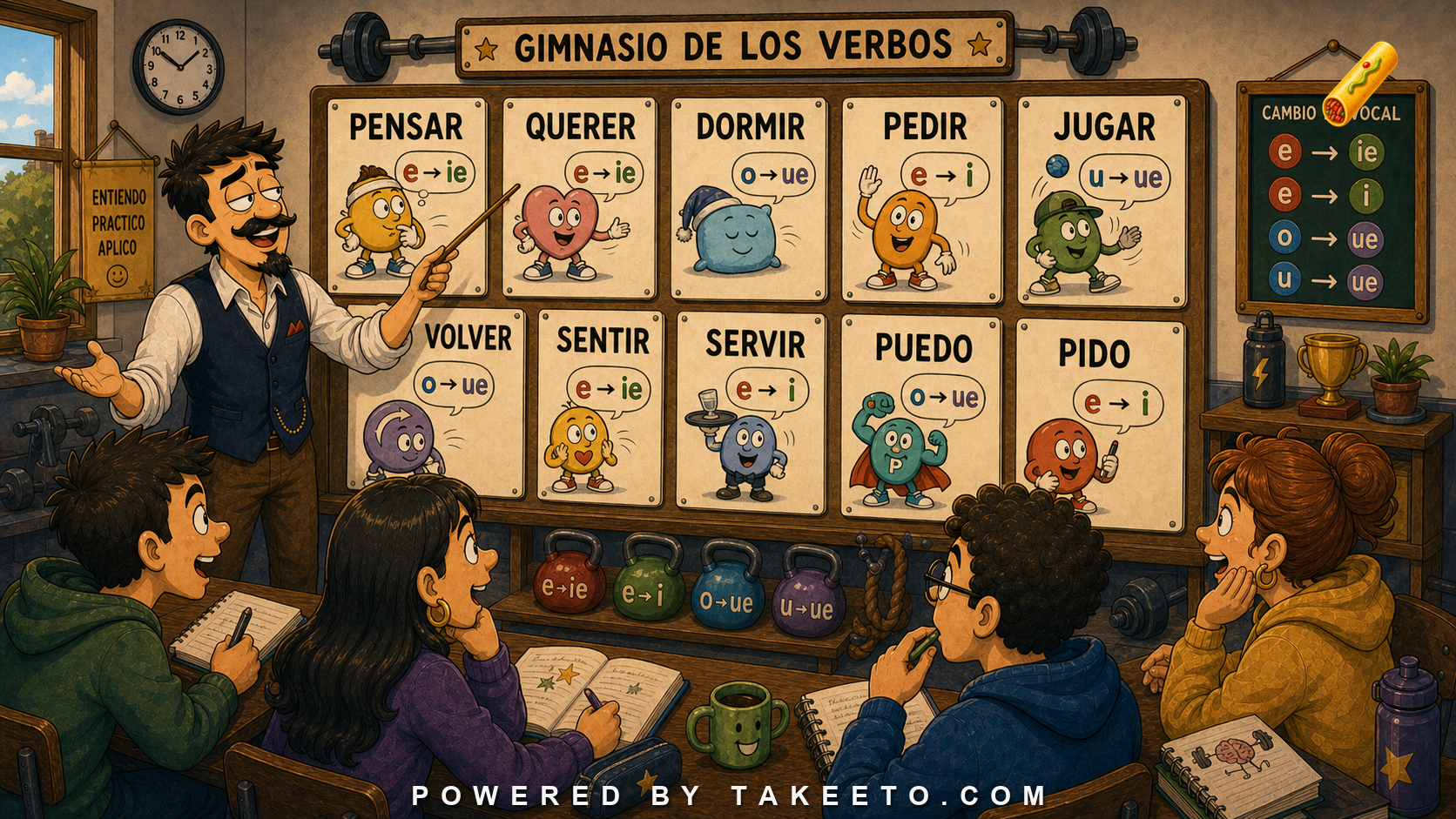
Stem changes are patterned irregularity
Spanish learners often meet forms like these:
pensar → pienso
querer → quiero
dormir → duermo
pedir → pido
jugar → juego
At first, they look like arbitrary exceptions. Why not penso, quero, dormo, pedo, jugo?
The answer is that many Spanish verbs belong to stem-changing classes. These classes are irregular in the sense that they do not follow the simplest regular stem pattern. But they are not random. The changes are tied to stress, vowel quality, and inherited verb families.
A durable rule:
In many present-tense stem-changing verbs, the stem changes when the stem vowel is stressed.
This is the famous “boot” pattern in the present indicative: all forms except nosotros/as and vosotros/as for many verbs.
The basic present-tense boot pattern
Take pensar:
| Person | Form |
|---|---|
| yo | pienso |
| tú | piensas |
| él/ella/usted | piensa |
| nosotros/as | pensamos |
| vosotros/as | pensáis |
| ellos/ellas/ustedes | piensan |
The changed forms make a boot shape in traditional classroom charts: pienso, piensas, piensa, piensan. The unchanged forms are pensamos and pensáis.
The reason is stress. In pienso, the stem vowel is stressed. In pensamos, the stress falls later, outside the stem vowel. The stem change appears where the relevant stem vowel bears stress.
This stress explanation is not the entire historical story, but it gives learners a powerful pattern.
E → IE verbs
Common e → ie verbs include:
| Infinitive | Present yo | Meaning |
|---|---|---|
| pensar | pienso | to think |
| querer | quiero | to want/love |
| entender | entiendo | to understand |
| empezar | empiezo | to begin |
| cerrar | cierro | to close |
| sentir | siento | to feel |
| preferir | prefiero | to prefer |
Examples:
Pienso en el problema.
I think about the problem.
Quiero café.
I want coffee.
No entiendo la pregunta.
I do not understand the question.
La clase empieza a las nueve.
The class begins at nine.
Notice that empezar also has a spelling adjustment in some forms to preserve the /s/ sound before e:
empezar → empiezo
subjunctive: empiece, empieces, empiece
The stem change and spelling adjustment are different processes that may appear in the same verb.
O → UE verbs
Common o → ue verbs include:
| Infinitive | Present yo | Meaning |
|---|---|---|
| poder | puedo | can, be able |
| dormir | duermo | to sleep |
| volver | vuelvo | to return |
| encontrar | encuentro | to find |
| contar | cuento | to count/tell |
| recordar | recuerdo | to remember |
| costar | cuesta | to cost |
Examples:
No puedo salir.
I cannot leave.
Duermo poco.
I sleep little.
Vuelvo mañana.
I return tomorrow.
El libro cuesta veinte euros.
The book costs twenty euros.
Again, the present indicative usually follows the boot:
puedo, puedes, puede, podemos, podéis, pueden
duermo, duermes, duerme, dormimos, dormís, duermen
E → I verbs
A smaller but very important class changes e → i:
| Infinitive | Present yo | Meaning |
|---|---|---|
| pedir | pido | to ask for/order |
| servir | sirvo | to serve |
| repetir | repito | to repeat |
| seguir | sigo | to follow/continue |
| conseguir | consigo | to get/achieve |
| vestir | visto | to dress |
Examples:
Pido ayuda.
I ask for help.
Este restaurante sirve comida peruana.
This restaurant serves Peruvian food.
Repito la frase.
I repeat the sentence.
These are often -ir verbs, and that matters later because -ir stem-changers have additional behavior in the preterite and subjunctive.
U → UE: jugar
The main common verb with u → ue is jugar:
| Person | Form |
|---|---|
| yo | juego |
| tú | juegas |
| él/ella/usted | juega |
| nosotros/as | jugamos |
| vosotros/as | jugáis |
| ellos/ellas/ustedes | juegan |
Examples:
Juego al fútbol.
I play soccer/football.
Los niños juegan en el parque.
The children play in the park.
In many regions and styles, jugar a is used for playing games or sports:
jugar al tenis
jugar a las cartas
The stem change is a morphological feature of the verb, not something you can infer from meaning alone.
Stem changes must be learned with the verb
You cannot reliably predict from the infinitive alone whether a verb stem-changes. Compare:
| No stem change | Stem change |
|---|---|
| pretender → pretendo | entender → entiendo |
| responder → respondo | volver → vuelvo |
| aprender → aprendo | perder → pierdo |
| comer → como | poder → puedo |
This is why vocabulary cards should include the key stem-changing form:
pensar, pienso
volver, vuelvo
pedir, pido
dormir, duermo
jugar, juego
Do not store only the infinitive and English meaning. Store the stem pattern.
Present subjunctive patterns
Stem changes also appear in the present subjunctive, but the pattern depends on verb class.
For many -ar and -er verbs, the boot pattern remains:
pensar → piense, pienses, piense, pensemos, penséis, piensen
volver → vuelva, vuelvas, vuelva, volvamos, volváis, vuelvan
For many -ir stem-changers, the nosotros/as and vosotros/as forms also change, but often to a reduced vowel:
pedir → pida, pidas, pida, pidamos, pidáis, pidan
dormir → duerma, duermas, duerma, durmamos, durmáis, duerman
sentir → sienta, sientas, sienta, sintamos, sintáis, sientan
This is one reason -ir stem-changing verbs deserve special attention. They carry stem changes into more of the paradigm than many learners expect.
Preterite behavior of -ir stem-changers
In the preterite, -ar and -er stem-changing verbs do not keep the present-tense boot change:
pensar → pensé, pensaste, pensó
volver → volví, volviste, volvió
But many -ir stem-changers show a change in the third person:
| Infinitive | él/ella/usted | ellos/ellas/ustedes |
|---|---|---|
| pedir | pidió | pidieron |
| dormir | durmió | durmieron |
| sentir | sintió | sintieron |
| servir | sirvió | sirvieron |
Examples:
Pidió ayuda.
He/she asked for help.
Durmieron ocho horas.
They slept eight hours.
Sintió miedo.
He/she felt fear.
This is sometimes called a “sandal” pattern because only the third-person preterite forms change. The important learner point is that -ir stem-changing verbs are not finished after the present tense.
Stem changes are not stress marks
Stem changes and written accent marks are different phenomena.
pienso has no written accent, but it has a stem change.
pidió has a written accent and an e → i stem change.
pensó has a written accent but no stem change.
Do not assume that an accent mark causes a stem change. The accent mark records stress according to Spanish spelling rules. The stem change is part of the verb’s morphology.
Meaning can shift across related verbs
Stem-changing forms sometimes belong to verbs with broad meanings:
contar → cuento
to count; to tell a story; to count on someone when used with con.
volver → vuelvo
to return; to do again with volver a + infinitive.
sentir → siento
to feel; in lo siento, to be sorry.
Examples:
Cuento hasta diez.
I count to ten.
Cuento una historia.
I tell a story.
Cuento contigo.
I’m counting on you.
The stem change tells you the form, not the exact meaning. Context and complements still matter.
Common learner errors
Error 1: Applying the change to nosotros/vosotros in the present indicative
Nosotros piensamos.
Use:
Nosotros pensamos.
Error 2: Forgetting stem changes outside the present
Pidió is correct, not pedió, because pedir is an -ir stem-changer with preterite third-person change.
Error 3: Overgeneralizing to similar verbs
entender → entiendo, but pretender → pretendo.
You must learn stem-changing status with the verb.
Error 4: Treating stem changes as pronunciation decoration
Puedo and podo are not stylistic variants. Puedo is the standard present form of poder.
Stem changes and lexical storage
Stem-changing verbs should be stored with a diagnostic form, usually the yo form or third-person singular present:
| Weak entry | Strong entry |
|---|---|
| pensar = to think | pensar, pienso |
| volver = to return | volver, vuelvo |
| pedir = to ask for | pedir, pido |
| dormir = to sleep | dormir, duermo |
| jugar = to play | jugar, juego |
A strong entry lets you generate many forms and recognize the family in real text. A weak entry forces you to rediscover the same “exception” every time.
Do not confuse stem change with meaning change
The stem change does not create a new meaning by itself. Pido is not a more intense version of pedir; it is simply the required present form. Duermo is not a special kind of sleeping; it is the first-person singular present of dormir.
Meaning shifts come from the verb and construction:
vuelvo a estudiar
I study again
cuento con Ana
I count on Ana
siento frío
I feel cold
The stem change tells you the shape of the verb. Complements, prepositions, and idioms tell you the meaning in context.
A practical drill sequence
For each stem-changing verb, drill three layers:
- Present boot: pienso, piensas, piensa, pensamos, pensáis, piensan.
- One sentence with meaning: Pienso en mi familia.
- Related forms that matter: pensé has no stem change; piense has subjunctive stem change.
This prevents the most common failure: learning a chart without connecting it to real use.
Stem-changing verbs and stress in listening
Stem changes are also listening clues. If you hear puedo, you know the verb is poder, not a regular verb poder conjugated as podo. If you hear piden, you should recognize pedir, not search for an infinitive pidir.
This matters in fast speech because the changed vowel may be the clearest clue to the verb family. Learners who only memorize infinitives often fail to recognize common present forms in audio. A balanced study routine should move both directions:
poder → puedo
puedo → poder
Recognition is as important as production.
Stem changes and compounds
Derived verbs often preserve the stem behavior of their base:
volver → vuelvo
devolver → devuelvo
pedir → pido
impedir → impido
sentir → siento
consentir → consiento, though meaning and register differ
This can help recognition, but do not apply it blindly. Always confirm the verb’s actual conjugation.
Study checkpoint
A stem-changing verb is mastered only when you can move in both directions: pensar → pienso and pienso → pensar. Production without recognition is fragile; recognition without production is passive. Train both.
Why the boot image is useful but limited
The boot diagram helps with the present indicative, but it should not become the whole theory. The moment you move to preterite, subjunctive, commands, or derived verbs, you need the deeper idea: stem alternation belongs to lexical verb families and interacts with stress and conjugation class. Use the boot as an entry point, not as the final explanation.
Diagnostic refinement: the boot pattern is a starting map, not the whole territory
The “boot” diagram is useful for the present indicative because it shows where stress falls on the stem:
| pensar | Present indicative |
|---|---|
| yo | pienso |
| tú | piensas |
| él/ella/usted | piensa |
| nosotros/as | pensamos |
| vosotros/as | pensáis |
| ellos/ellas/ustedes | piensan |
But learners get into trouble when they carry the boot image into every tense without adjustment. Stem changes are tied to lexical class, stress, and tense/mood patterns. The present subjunctive, imperative, and preterite of -ir stem-changers require their own attention.
Compare:
| Verb type | Present indicative | Present subjunctive note | Preterite note |
|---|---|---|---|
| pensar e→ie | pienso, pensamos | piense, pensemos | no stem change: pensé |
| volver o→ue | vuelvo, volvemos | vuelva, volvamos | no stem change: volví |
| pedir e→i | pido, pedimos | pida, pidamos | third-person change: pidió, pidieron |
| dormir o→ue/u | duermo, dormimos | duerma, durmamos | third-person change: durmió, durmieron |
| jugar u→ue | juego, jugamos | juegue, juguemos | spelling + regular preterite: jugué |
This is why article 030 should not teach stem-changing verbs as “irregular but easy.” The present tense is only the first layer. -ir stem-changing verbs are especially important because their stem alternations reappear in the preterite third person and across subjunctive patterns.
A good card for a stem-changing verb should include more than the infinitive and the yo form:
pedir — pido, pidió, pidamos
dormir — duermo, durmió, durmamos
pensar — pienso, pensé, piense
volver — vuelvo, volví, vuelva
That small cluster teaches the learner where the change lives and where it disappears.
Suggested interactive module: boot-pattern conjugation diagram
A useful tool would show a conjugation chart with stress marks and stem highlights.
For pensar:
- changed: pienso, piensas, piensa, piensan;
- unchanged: pensamos, pensáis;
- explanation: stem vowel stressed in changed forms.
For pedir:
- present: pido, pides, pide, pedimos, pedís, piden;
- preterite: pedí, pediste, pidió, pedimos, pedisteis, pidieron;
- subjunctive: pida, pidas, pida, pidamos, pidáis, pidan.
The tool should let learners compare pensar, poder, pedir, dormir, and jugar side by side, with labels for e → ie, o → ue, e → i, and u → ue.
Final rule
Stem-changing verbs are patterned irregularity. They must be learned as lexical classes, but once learned, their behavior is predictable across large parts of the paradigm.
In the present indicative, many stem changes occur where the stem vowel is stressed: pienso/pensamos, puedo/podemos, pido/pedimos, juego/jugamos.
For -ir stem-changers, keep watching beyond the present: forms like pidió, durmió, sintamos, and durmamos show that the pattern reaches into the preterite and subjunctive.
Do not memorize pienso as an isolated exception. Learn pensar → pienso as a system.