
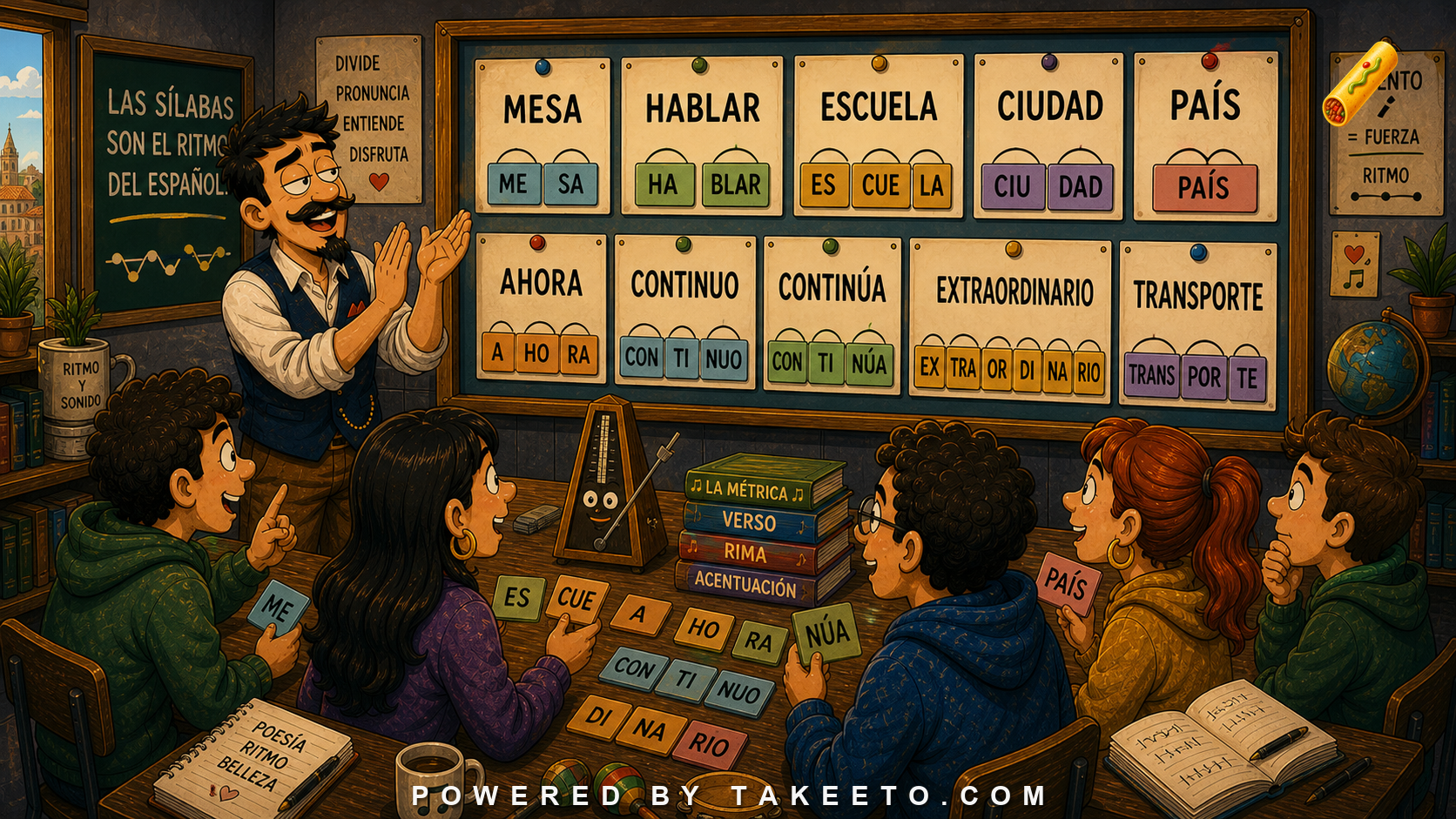
Syllables are not just classroom clapping
Many learners meet syllables as a children’s exercise: clap the word, count the beats, move on.
That undersells the topic.
In Spanish, syllables sit underneath stress, accent marks, pronunciation, verse, song, line breaking, and the rhythm of connected speech. If you cannot see how Spanish syllables are built, accent marks feel arbitrary. If you cannot hear syllable boundaries, fast speech sounds like a blur. If you read poetry, lyrics, or formal recitation, syllable behavior becomes even more important because vowels can merge across word boundaries and written divisions do not always match poetic counts.
For learners, the first goal is practical:
Syllabification tells you where Spanish words hold together and where stress can land.
Spanish likes open syllables, but it is not limited to them
An open syllable ends in a vowel. Spanish has many open syllables:
- me-sa
- ca-sa
- co-mi-da
- te-lé-fo-no
- es-cue-la
This gives Spanish much of its clear rhythmic feel. But Spanish also has closed syllables ending in consonants:
- ha-blar
- pa-pel
- ciu-dad
- trans-por-te
- ins-truc-ción
The learner’s job is not to force every syllable open. It is to understand how consonants attach to neighboring vowels.
A simple pattern helps:
A single consonant between vowels usually goes with the following vowel.
Examples:
| Word | Syllables |
|---|---|
| mesa | me-sa |
| casa | ca-sa |
| comida | co-mi-da |
| natural | na-tu-ral |
| problema | pro-ble-ma |
The consonant starts the next syllable when Spanish allows it.
Consonant clusters: what can begin a syllable?
When two consonants appear between vowels, the split depends on whether the second cluster can naturally begin a Spanish syllable.
Spanish allows many clusters formed with a stop or f plus l or r:
- pr, br, tr, dr, cr, gr, fr
- pl, bl, cl, gl, fl
Examples:
| Word | Syllables | Reason |
|---|---|---|
| libro | li-bro | br can start a syllable |
| hablar | ha-blar | bl can start a syllable |
| problema | pro-ble-ma | bl can start a syllable |
| madre | ma-dre | dr can start a syllable |
| otro | o-tro | tr can start a syllable |
| regla | re-gla | gl can start a syllable |
But many other consonant pairs split:
| Word | Syllables |
|---|---|
| alto | al-to |
| carne | car-ne |
| tarde | tar-de |
| transporte | trans-por-te |
| concepto | con-cep-to |
For three or more consonants, the split usually tries to preserve a possible onset for the next syllable while leaving earlier consonants behind:
- trans-por-te
- ins-truc-ción
- pers-pec-ti-va
You do not need to master every technical rule at once, but you should learn to ask: which consonants can begin the next syllable in Spanish?
Diphthongs and hiatus
Spanish syllabification depends heavily on vowel sequences.
Traditional school explanations distinguish strong vowels and weak vowels.
Strong vowels: a, e, o Weak vowels: i, u
A weak vowel next to a strong vowel often forms a diphthong if the weak vowel is not stressed:
| Word | Syllables | Vowel behavior |
|---|---|---|
| ciudad | ciu-dad | weak + weak sequence often grouped in pronunciation |
| tierra | tie-rra | ie as one syllabic unit |
| bueno | bue-no | ue as one unit |
| causa | cau-sa | au as one unit |
| aire | ai-re | ai as one unit |
| escuela | es-cue-la | ue as one unit |
A sequence of two strong vowels normally forms hiatus, meaning the vowels belong to separate syllables:
| Word | Syllables |
|---|---|
| teatro | te-a-tro |
| poeta | po-e-ta |
| caer | ca-er |
| aéreo | a-é-re-o |
A written accent on a weak vowel often forces hiatus:
| Word | Syllables | Why |
|---|---|---|
| país | pa-ís | stressed í separates from a |
| día | dí-a | stressed í separates from a |
| baúl | ba-úl | stressed ú separates from a |
| continúa | con-ti-nú-a | stressed ú separates from a |
This is why syllabification is inseparable from accent marks. You cannot reliably apply stress rules if you do not know how many syllables the word has.
The letter h does not usually block vowel behavior
Written h is normally silent in Spanish, and it generally does not behave like a pronounced consonant between vowels.
Compare:
| Word | Practical syllable issue |
|---|---|
| ahora | a-ho-ra, but h is silent; speech often links vowels closely |
| prohibir | pro-hi-bir; h does not create an audible consonant |
| alcohol | al-co-hol in spelling tradition, with no spoken h |
| zanahoria | za-na-ho-ria; h is orthographic, not a pronounced barrier |
In careful school syllabification, written divisions may preserve orthographic structure, but pronunciation does not insert an /h/ sound in ordinary words. Learners should not pronounce ahora with an English h.
Stress depends on syllable count
Stress rules require syllables.
Consider:
| Word | Syllables | Stress |
|---|---|---|
| casa | ca-sa | CA-sa |
| papel | pa-pel | pa-PEL |
| rápido | rá-pi-do | RÁ-pi-do |
| ciudad | ciu-dad | ciu-DAD |
| país | pa-ís | pa-ÍS |
| continuo | con-ti-nuo | con-TI-nuo or related adjective/noun forms depending on word |
| continúa | con-ti-nú-a | con-ti-NÚ-a |
The contrast between continuo and continúa is not just accent decoration. The accent changes the stress and the syllable structure. In a verb form such as continúa, the written accent on ú shows hiatus and stress.
Syllables in connected speech
Words do not live alone.
Spanish often links vowels across word boundaries. A final vowel and an initial vowel may be pronounced closely together, especially in rapid speech, song, and poetry.
Examples:
- mi amigo
- la escuela
- de enero
- tiene hambre
In ordinary speech, this linking helps Spanish flow. In poetry, it becomes a formal counting principle called sinalefa, where vowels across word boundaries can count within one metrical syllable.
A learner does not need to become a poet to benefit from this. The practical point is that written word spaces do not always create strong acoustic breaks. Spanish rhythm is built from syllables, but syllables can connect across words.
Why syllabification matters for pronunciation
1. It protects stress
If you divide ciudad incorrectly, you may stress it incorrectly. If you do not see the hiatus in país, you may pronounce it as one syllable.
2. It improves consonant timing
A word like transporte becomes easier when broken as trans-por-te. You can avoid inserting extra vowels, a common English-speaker habit.
3. It reduces panic in long words
Spanish long words are often transparent when syllabified:
- ex-tra-or-di-na-rio
- res-pon-sa-bi-li-dad
- in-ter-na-cio-nal
- co-mu-ni-ca-ción
Long does not mean unpronounceable. It means you need a syllable plan.
4. It helps spelling
Accent rules, plural changes, and vowel sequences all depend on syllables.
A learner-facing syllable algorithm
Use this practical procedure.
Step 1: Identify vowel nuclei
Every syllable needs a vowel nucleus. Diphthongs may group two vowel letters into one nucleus.
- mesa → e, a → two syllables
- bueno → ue, o → two syllables
- país → a, í → two syllables because í is stressed
Step 2: Attach a single consonant between vowels to the following vowel
- ca-sa
- me-sa
- co-mi-da
Step 3: Check consonant clusters
If the cluster can begin a Spanish syllable, keep it together:
- ha-blar
- li-bro
- ma-dre
- o-tro
If not, split it:
- al-to
- car-ne
- con-cep-to
Step 4: Watch written accents on weak vowels
- país = pa-ís
- día = dí-a
- continúa = con-ti-nú-a
Step 5: Apply stress rules
Only after syllabifying should you decide where stress lands.
Common learner mistakes
Mistake 1: Adding English helper vowels
English speakers may pronounce transporte as if there were extra vowels between consonants. Spanish does not need them.
Better: trans-por-te.
Mistake 2: Ignoring vowel sequences
País is not the same syllable pattern as pais would suggest. The accent matters.
Mistake 3: Treating h as a spoken wall
Ahora does not have an English h sound. Do not pronounce it like “a-HOR-a.”
Mistake 4: Breaking allowed clusters
Problema is pro-ble-ma, not prob-le-ma in ordinary Spanish syllabification for pronunciation.
Mistake 5: Thinking poetry uses different Spanish
Poetry uses Spanish syllable behavior more consciously. It does not invent it from nothing. Song and verse sharpen patterns that also exist in speech.
Suggested interactive module: syllable parser with stress overlay
A useful tool for this article would parse Spanish words and show how syllables, stress, and accent marks interact.
Suggested functions:
- Syllable division: break words into likely syllables.
- Vowel-sequence labels: diphthong, hiatus, triphthong where relevant.
- Stress overlay: show default stress and written accent logic.
- H behavior alert: flag silent h in words like ahora and prohibir.
- Poetry mode: show possible sinalefa across word boundaries.
- Audio alignment: display waveform pulses for syllable timing.
Example input:
continúa
Possible output:
- Syllables: con-ti-nú-a
- Stress: nú
- Accent function: stressed weak vowel creates hiatus
- Related contrast: continuo / continúa
Final rule
Syllables are not a beginner side topic. They are the scaffolding behind Spanish stress, accent marks, rhythm, and much of pronunciation.
When a word looks long, divide it. When an accent mark looks surprising, check the syllables. When fast speech sounds blurry, listen for how syllables connect.
Spanish becomes much less mysterious when you stop seeing words as strings of letters and start seeing them as structured syllable sequences.