
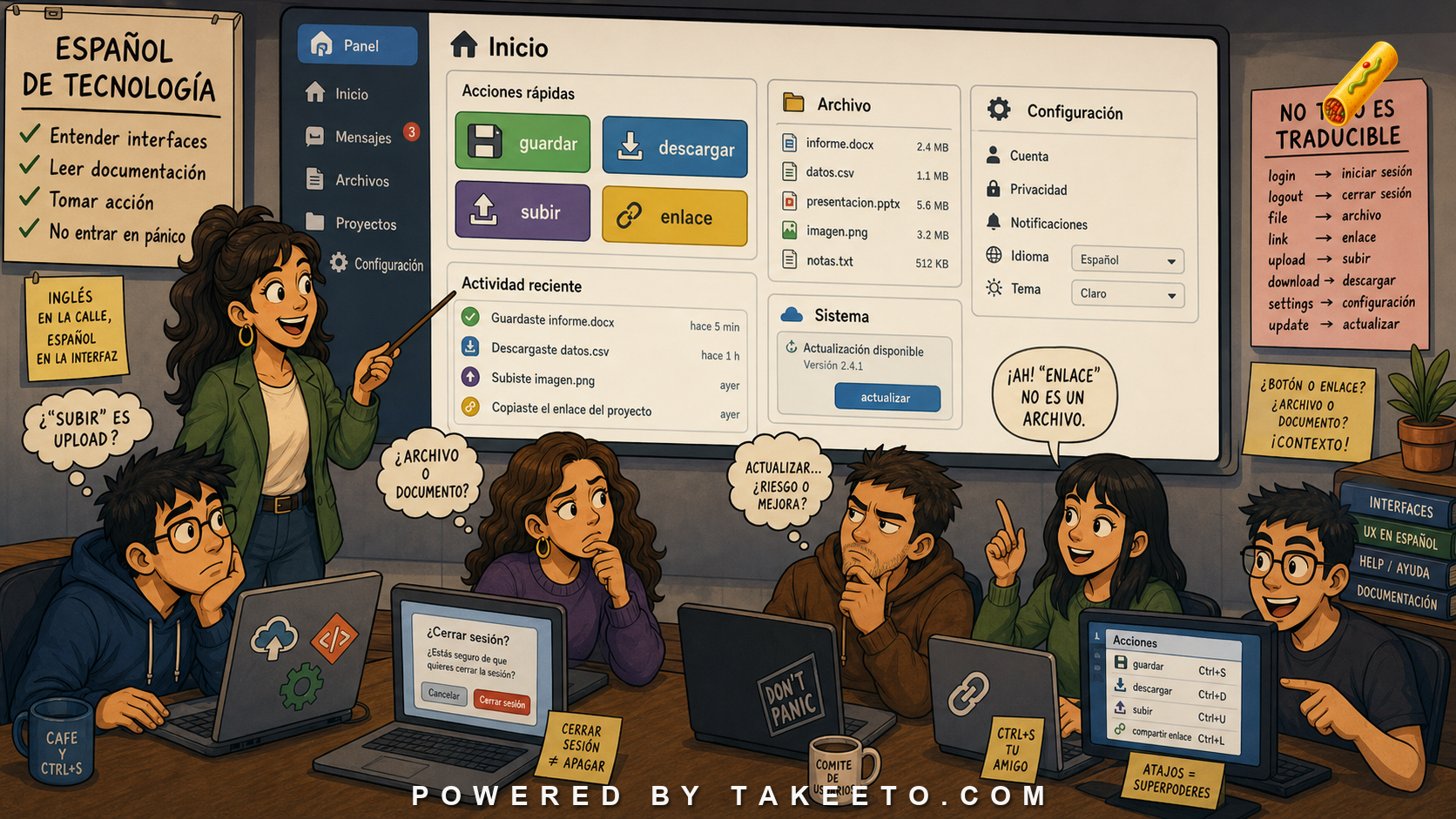
Interface Spanish is action compressed into labels
Technology Spanish often appears as short labels: iniciar sesión, guardar, descargar, configuración, actualizar, compartir. A learner may understand each word but still hesitate. Is subir upload or go up? Is archivo file or archive? Is actualizar make actual or update? Is iniciar sesión the same as register?
Software language is compressed, and compression changes grammar. Buttons may use infinitives, imperatives, nouns, fragments, or icons. The user must infer the action.
The key principle is:
Technology Spanish is organized around user actions, system states, permissions, files, accounts, and errors.
The safest reading strategy is to ask: what does this control do?
Login and account language
Several phrases organize identity and access: iniciar sesión, cerrar sesión, registrarse, crear una cuenta, nombre de usuario, contraseña, restablecer la contraseña, verificar la cuenta.
Iniciar sesión is not the same as registrarse. The first assumes an existing account. The second creates or signs up for one.
Example:
¿Olvidaste tu contraseña? Enviaremos un enlace para restablecerla.
Did you forget your password? We will send a link to reset it.
Learner action: separate access, account creation, verification, and password recovery.
Guardar, descargar, subir, and compartir
Common UI verbs map file movement and control: guardar, descargar, subir, cargar, compartir, adjuntar, eliminar / borrar, recuperar.
Subir literally means go up or raise, but in technology it often means upload. Descargar means download but also unload or discharge in other contexts. Cargar is tricky: it can mean load, charge a battery, or upload depending on interface and country.
Learner action: read the surrounding object. Subir un archivo is upload a file. Cargar la página is load the page. Cargar el teléfono is charge the phone.
Archivo, fichero, carpeta, and enlace
File vocabulary varies by region and platform. Archivo is widely used for file, but it can also mean archive. Fichero appears in some Spain and technical contexts. Carpeta is folder. Enlace and vínculo are Spanish alternatives for link; link also appears colloquially and professionally.
A formal government portal may prefer correo electrónico, enlace, archivo, and contraseña. A startup team may say mail, link, deploy, login, and backup.
Learner action: learn both the localized Spanish term and the English loan that users may actually say.
Configuration, settings, and permissions
Settings language includes configuración, ajustes, preferencias, privacidad, permisos, notificaciones, and seguridad. Configurar asks you to set something up. Configuración is the area or state of settings. Ajustes is especially common in mobile interfaces.
Examples:
Activa las notificaciones en Ajustes.
Turn on notifications in Settings.
La aplicación solicita permiso para acceder a la cámara.
The app requests permission to access the camera.
Learner action: do not click through permission language mechanically. Identify what access is being requested.
Actualizar and false friends
Actualizar means update, not “actualize” in ordinary English.
Examples:
actualización disponible
update available
mantener el sistema actualizado
keep the system updated
los datos se actualizan automáticamente
the data update automatically / are updated automatically
Actual in Spanish means current/present, not actual in the English contrast with imaginary. That is why actualizar means bring up to date.
Error and status messages
Status language is critical: pendiente, completado, rechazado, error de conexión, sesión caducada, acceso denegado, archivo no compatible, cambios guardados.
Caducar means expire, often for sessions, passwords, cards, documents, or links. Compatible means compatible/supported, not “friendly.”
Example bank walkthrough
iniciar sesión
Log in/sign in.
Learner action: use when the account already exists.
cerrar sesión
Log out/sign out.
Learner action: important on shared devices.
guardar
Save.
Learner action: check whether changes were saved automatically or manually.
descargar
Download.
Learner action: distinguish from cargar/subir.
subir
Upload.
Learner action: expect a file, photo, document, or form.
enlace
Link.
Learner action: also recognize vínculo and link.
archivo
File or archive.
Learner action: context decides.
configuración
Settings/configuration.
Learner action: compare with ajustes and preferencias.
actualizar
Update.
Learner action: remember the false-friend connection with actual/current.
UI reading workflow
When reading Spanish interfaces, identify the user action, the object affected, whether the button is safe or destructive, whether the status changed, what permission is being requested, and whether you need to save proof. In software, a single verb can move a file, expose data, delete work, or confirm identity.
Remediation notes: interface Spanish is not ordinary prose
Technology Spanish needs a stronger boundary between full Spanish sentences and interface language. A button that says Guardar, Enviar, Continuar, Aceptar, Descargar, or Iniciar sesión is not a sentence fragment accidentally missing a subject. It is a command-shaped interface label. The grammar is compressed because the screen supplies the context.
Three styles are especially common in interfaces:
Infinitive: Guardar, Cancelar, Actualizar, Descargar.
Imperative-like command: Continúe, Seleccione, Ingrese.
Noun label: Configuración, Notificaciones, Privacidad, Cuenta.
Learners should not over-translate these labels into full English sentences. Guardar on a button means “save,” but grammatically it is an infinitive. Enviar solicitud means “submit application/request,” not necessarily “send a physical document.” Iniciar sesión and cerrar sesión are fixed login/logout actions; translating word by word as “initiate session” will sound absurd.
The upload/download cluster needs more precision. Descargar is normally download. Subir is widely used for upload in user-facing language. Cargar can mean load, charge, carry, or upload depending on context, so it needs surrounding clues. Adjuntar means attach, especially in forms and email. Compartir means share, but may create a public link, invite a user, change permissions, or send a copy. The interface decides the risk.
File vocabulary also varies. Archivo is very widespread. Fichero is common in Spain and technical contexts. Carpeta is folder. Enlace is link; liga is used in some American contexts but may sound regional; hipervínculo is more formal or technical. A learner writing for international users should usually prefer enlace unless a local style guide says otherwise.
The false-friend section should be sharper. Actualizar usually means update, not necessarily upgrade. Soporte may be support as a service department or physical support; apoyar is not the usual verb for technical support in every context. Aplicación is app/application, but aplicar does not always mean apply in the software sense. Remover is accepted in some American technical Spanish but eliminar, quitar, or borrar may be clearer depending on the action.
For error messages, learners should classify the state:
No se pudo guardar — action failed.
Sesión caducada — login/session expired.
Archivo no compatible — wrong format/type.
Permiso denegado — access problem.
Cambios guardados — success confirmation.
Repair rule:
In tech Spanish, read every label as an action-state pair: what the user did, what the system did, and what must happen next.
Suggested interactive module: interface glossary with action categories
A strong tool for this article would teach UI Spanish as user action.
Suggested functions:
- Action classifier: save, upload, download, delete, share, verify.
- Account flow: registrarse, iniciar sesión, cerrar sesión, restablecer contraseña.
- File map: archivo, carpeta, adjunto, enlace, descarga.
- Permission warning: cámara, micrófono, ubicación, contactos.
- Error-state decoder: pendiente, caducado, denegado, no compatible.
- Register toggle: formal portal, consumer app, startup workspace.
- Anglicism layer: link/enlace, app/aplicación, login/inicio de sesión.
- Button rewrite: infinitive, imperative, and noun-label versions.
Final rule
Technology Spanish is compressed action language.
Do not translate labels as isolated vocabulary. Ask what the system wants you to do, what object is affected, what permission is requested, and what status has changed.