
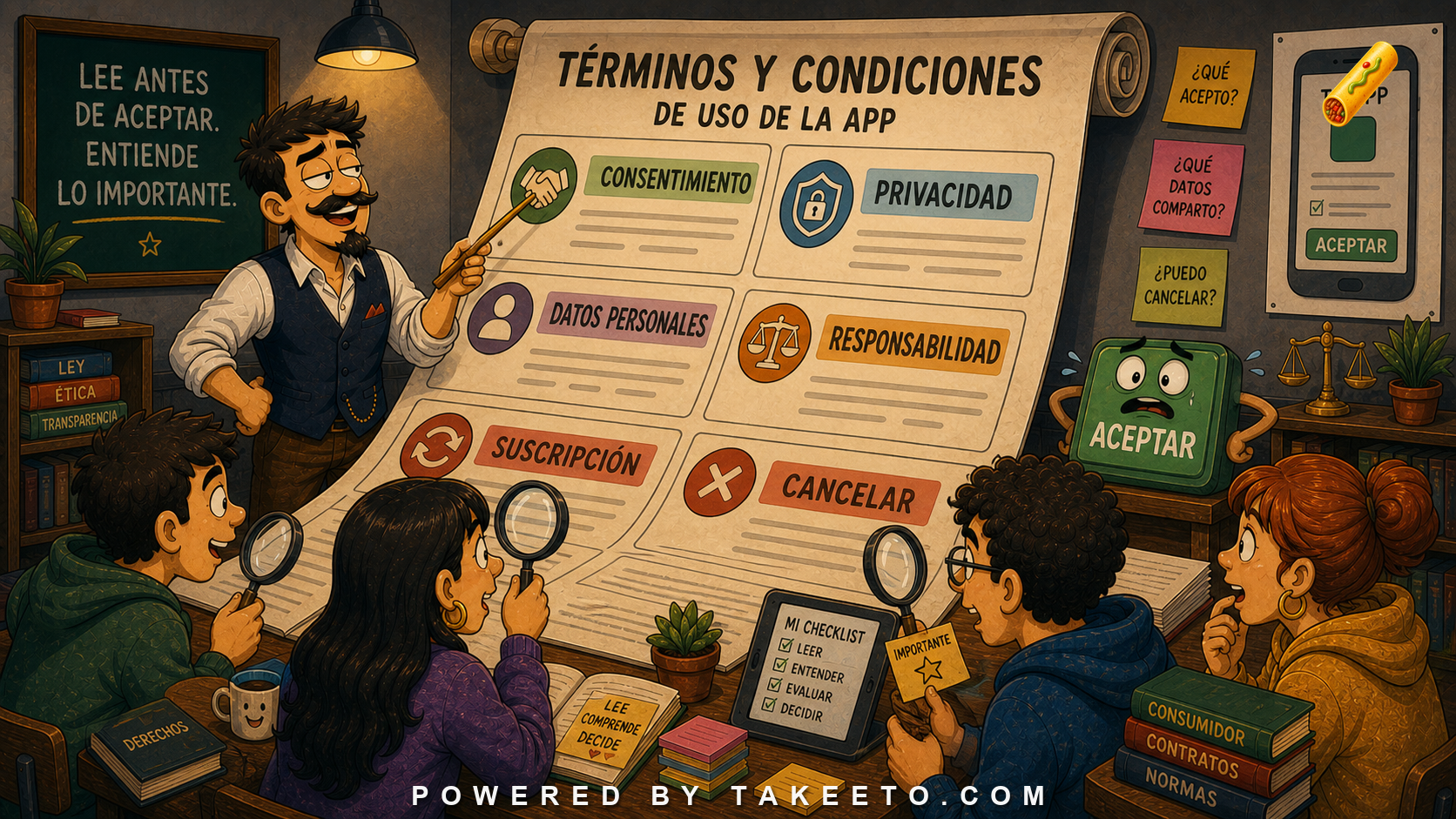
Terms of service are interface language with legal consequences
Most learners meet legal Spanish first through apps and websites, not court filings. They see buttons, pop-ups, subscription notices, privacy banners, refund policies, account warnings, and long terms-and-conditions pages.
The language looks familiar:
Acepto los términos y condiciones.
Puede cancelar su suscripción en cualquier momento.
No nos hacemos responsables de...
But the consequences may be serious. A single screen may combine consent, billing, data processing, limitation of liability, jurisdiction, and cancellation procedure.
The key principle is:
Terms-and-conditions Spanish compresses legal relationships into user actions.
A learner should read these texts not as ordinary app labels, but as structured statements about rights, permissions, obligations, data, payment, and risk.
This article explains the language. It does not replace legal advice or jurisdiction-specific consumer-rights guidance.
Términos, condiciones, aviso, política
Common labels include:
términos y condiciones — terms and conditions
condiciones de uso — terms of use
términos del servicio — terms of service
aviso legal — legal notice
política de privacidad — privacy policy
política de cookies — cookie policy
condiciones de contratación — contracting/purchase terms
These labels overlap but are not identical. Términos y condiciones usually govern the use of the service. Política de privacidad explains personal-data processing. Aviso legal may identify the provider and legal information. Condiciones de contratación may govern purchases, subscriptions, refunds, billing, and cancellation.
A website may link all of them from a footer. An app may hide them under Configuración, Cuenta, Legal, or Privacidad.
Acceptance language: aceptar, consentir, estar de acuerdo
A basic terms screen asks the user to accept something.
Examples:
Al crear una cuenta, aceptas estos términos.
By creating an account, you accept these terms.
Al pulsar “Continuar”, usted declara haber leído y aceptado las condiciones.
By tapping “Continue,” you declare that you have read and accepted the conditions.
El uso del servicio implica la aceptación de los presentes términos.
Use of the service implies acceptance of these terms.
Important verbs:
aceptar — accept
consentir — consent
autorizar — authorize
declarar — declare/state
reconocer — acknowledge
estar de acuerdo — agree
Do not treat aceptar and consentir as always interchangeable. In privacy and legal contexts, consentimiento can have a technical meaning. In a user interface, Aceptar may be a button label, but in the linked document, consentimiento may refer specifically to permission for data processing or communications.
Account and access language
Terms often define what the user may do with an account.
Common vocabulary:
cuenta — account
usuario — user
contraseña — password
credenciales — credentials
acceso — access
uso autorizado — authorized use
suspender — suspend
cancelar — cancel
eliminar — delete
bloquear — block/lock
Example:
Usted es responsable de mantener la confidencialidad de sus credenciales de acceso.
You are responsible for maintaining the confidentiality of your access credentials.
This sentence assigns responsibility to the user. The important noun is responsable, and the object is credenciales de acceso.
Subscription and cancellation language
App terms often include recurring payments.
Key terms:
suscripción — subscription
plan — plan
período de prueba — trial period
prueba gratuita — free trial
renovación automática — automatic renewal
facturación — billing
ciclo de facturación — billing cycle
cancelar — cancel
reembolso — refund
cargo — charge
tarifa — fee/rate
Example:
La suscripción se renovará automáticamente al finalizar cada período, salvo que el usuario la cancele antes de la fecha de renovación.
The subscription will renew automatically at the end of each period unless the user cancels it before the renewal date.
Language anatomy:
se renovará automáticamente = passive-like future process
al finalizar cada período = trigger time
salvo que = unless
la cancele = subjunctive after salvo que
antes de la fecha de renovación = cancellation deadline
Learners often miss salvo que. It is a condition marker, and in subscription Spanish it often tells you what you must do to avoid renewal.
Liability: responsabilidad and limitation formulas
Responsabilidad can mean responsibility or liability. Terms often limit what the provider is responsible for.
Examples:
No nos hacemos responsables de interrupciones causadas por terceros.
We are not responsible for interruptions caused by third parties.
La responsabilidad del proveedor quedará limitada al importe abonado por el usuario.
The provider’s liability shall be limited to the amount paid by the user.
El servicio se ofrece “tal cual”, sin garantías de disponibilidad ininterrumpida.
The service is offered “as is,” without guarantees of uninterrupted availability.
Key phrases:
no nos hacemos responsables — we are not responsible
queda limitada — is limited
en la medida permitida por la ley — to the extent permitted by law
daños directos e indirectos — direct and indirect damages
pérdida de datos — data loss
interrupción del servicio — service interruption
These clauses should not be skimmed if the service handles money, files, business processes, health information, education records, or personal data.
Data language in terms and privacy cross-references
Terms often refer to privacy policies rather than explaining data use in full.
Example:
El tratamiento de datos personales se regirá por nuestra Política de Privacidad.
The processing of personal data will be governed by our Privacy Policy.
Important terms:
datos personales — personal data
tratamiento — processing
finalidad — purpose
consentimiento — consent
privacidad — privacy
terceros — third parties
compartir — share
conservar — retain/store
eliminar — delete
The reader should treat privacy references as cross-links, not decorative legal boilerplate. A terms page may define the service relationship, while the privacy policy defines data handling.
Dense nominalizations
Terms-and-conditions Spanish often uses nouns where ordinary speech would use verbs.
Dense version:
La cancelación de la suscripción deberá realizarse antes de la finalización del período vigente.
Plain version:
El usuario debe cancelar la suscripción antes de que termine el período actual.
Nominalizations:
cancelación — canceling
finalización — ending
aceptación — accepting
contratación — contracting/purchasing
modificación — modifying
suspensión — suspending
A good reading technique is to turn nouns back into verbs:
la modificación de los términos = someone modifies the terms
la suspensión de la cuenta = someone suspends the account
la eliminación de datos = someone deletes data
Then ask: who can do it, when, and with notice or without notice?
Passive se and impersonal se
Terms often avoid naming the actor.
Examples:
Se podrá suspender la cuenta en caso de uso indebido.
The account may be suspended in case of misuse.
Se aplicarán las tarifas vigentes en el momento de la renovación.
The rates in force at the time of renewal will apply.
No se garantiza la disponibilidad permanente del servicio.
Permanent availability of the service is not guaranteed.
These sentences can sound neutral, but they may hide who has power. When you see se podrá, ask:
Who can do this? The provider? The platform? An administrator? The law?
Localization pitfalls
Terms translated from English into Spanish often show problems:
aplicar para un reembolso instead of solicitar un reembolso
hacer clic en cancelar can be acceptable in UI contexts, but pulse “Cancelar” may be clearer in many localized instructions
actualmente wrongly used for “actually” instead of en realidad
inconsistent tú and usted forms
regional confusion between computadora, ordenador, dispositivo, and equipo
Legal localization must be both clear and jurisdiction-aware. A beautiful translation that misstates a right or obligation is dangerous.
Terms-of-service reading workflow
Use this workflow for app or website legal Spanish:
- Identify the document type: terms, privacy policy, cookie policy, legal notice, purchase conditions.
- Find the provider: company name, address, contact, jurisdiction.
- Mark acceptance: what action creates agreement?
- Map user obligations: account, payment, lawful use, content rules.
- Map provider rights: suspension, modification, termination, data use, pricing changes.
- Find subscription terms: renewal, cancellation, trial, refund, billing cycle.
- Find liability limits: service availability, data loss, third-party links, damages.
- Follow privacy cross-references: personal data, consent, rights, sharing.
- Check notice language: how will changes be communicated?
- Escalate when stakes are real: money, business, health, legal compliance, minors, sensitive data.
Remediation: consent language is often spread across the screen
Terms-and-conditions Spanish is not always contained in one paragraph. Consent may be distributed across a button, a checkbox, a link, a banner, a privacy notice, and a subscription disclosure. A reader who looks only at the long legal text may miss the actual user action.
Common interface formulas include:
Al crear una cuenta, aceptas los Términos y Condiciones.
By creating an account, you accept the Terms and Conditions.
Al continuar, confirmas que has leído la Política de Privacidad.
By continuing, you confirm that you have read the Privacy Policy.
Puedes cancelar la suscripción en cualquier momento desde la configuración de tu cuenta.
You may cancel the subscription at any time from your account settings.
The verbs matter. Aceptar usually signals acceptance of terms. Confirmar may signal a factual acknowledgment. Autorizar is stronger and often grants permission. Consentir may have specific privacy or legal meaning. Continuar can function as a consent action when paired with terms language.
A poor localization may say:
Continuar significa que estás de acuerdo con nuestros legales.
A more natural version would be:
Al continuar, aceptas nuestros Términos y Condiciones.
Or, if the function is narrower:
Al continuar, confirmas que has leído esta información.
Do not repair every interface string by making it more formal. Repair it by matching the legal function.
Cancellation and renewal: the learner's danger zone
Subscription Spanish deserves special attention because small words control money.
Look for:
renovación automática
automatic renewal
periodo de prueba
trial period
facturación
billing
ciclo de facturación
billing cycle
cancelar antes de
cancel before
no se realizarán reembolsos
refunds will not be issued
salvo que la ley aplicable disponga lo contrario
unless applicable law provides otherwise
A reader should ask four questions:
- When does payment begin?
- Does the subscription renew automatically?
- Where and how must cancellation happen?
- What happens to access, stored data, and refunds after cancellation?
Example:
La cancelación surtirá efecto al final del periodo de facturación en curso.
This does not usually mean the user loses access immediately. It means the cancellation takes effect at the end of the current billing period. But another clause may say something different for misuse, breach, fraud, chargeback, or deleted accounts.
Plain-Spanish rewrite workshop
Dense legal-app Spanish often hides the user action inside nouns:
La aceptación de las presentes condiciones se entenderá efectuada mediante la utilización continuada del servicio.
Plain Spanish:
Si sigues usando el servicio, entenderemos que aceptas estas condiciones.
Even clearer for interface copy:
Al seguir usando el servicio, aceptas estas condiciones.
The rewrite changes style, not necessarily legal effect. For serious documents, the plain-language version should be reviewed by counsel, but as a reading exercise it reveals the structure:
acceptance = continued use
accepted object = these conditions
mechanism = using the service after notice
That is the heart of ToS literacy: find the action that creates the consequence.
Suggested interactive module: terms-of-service glossary with plain-Spanish explanations
A strong tool for this article would transform dense legal-app language into structured labels.
Suggested functions:
- Term classifier: subscription, account, privacy, liability, cancellation, jurisdiction.
- Nominalization simplifier: convert cancelación, modificación, suspensión into verb-based explanations.
- Risk labels: payment, data, account access, content rights, cancellation deadline.
- Register checker: tú/usted consistency and neutral Spanish choices.
- Plain-Spanish pane: explain clauses without making legal determinations.
- Professional-help warning: flag clauses that may require legal review.
Final rule
Spanish terms and conditions are not just long app text.
They tell you what you accept, what the provider may do, what you must pay, how cancellation works, how your data is handled, and who carries risk. Read them by function: consent, account, subscription, privacy, liability, modification, termination.
In app Spanish, the button may be small, but the language behind it may be large.