
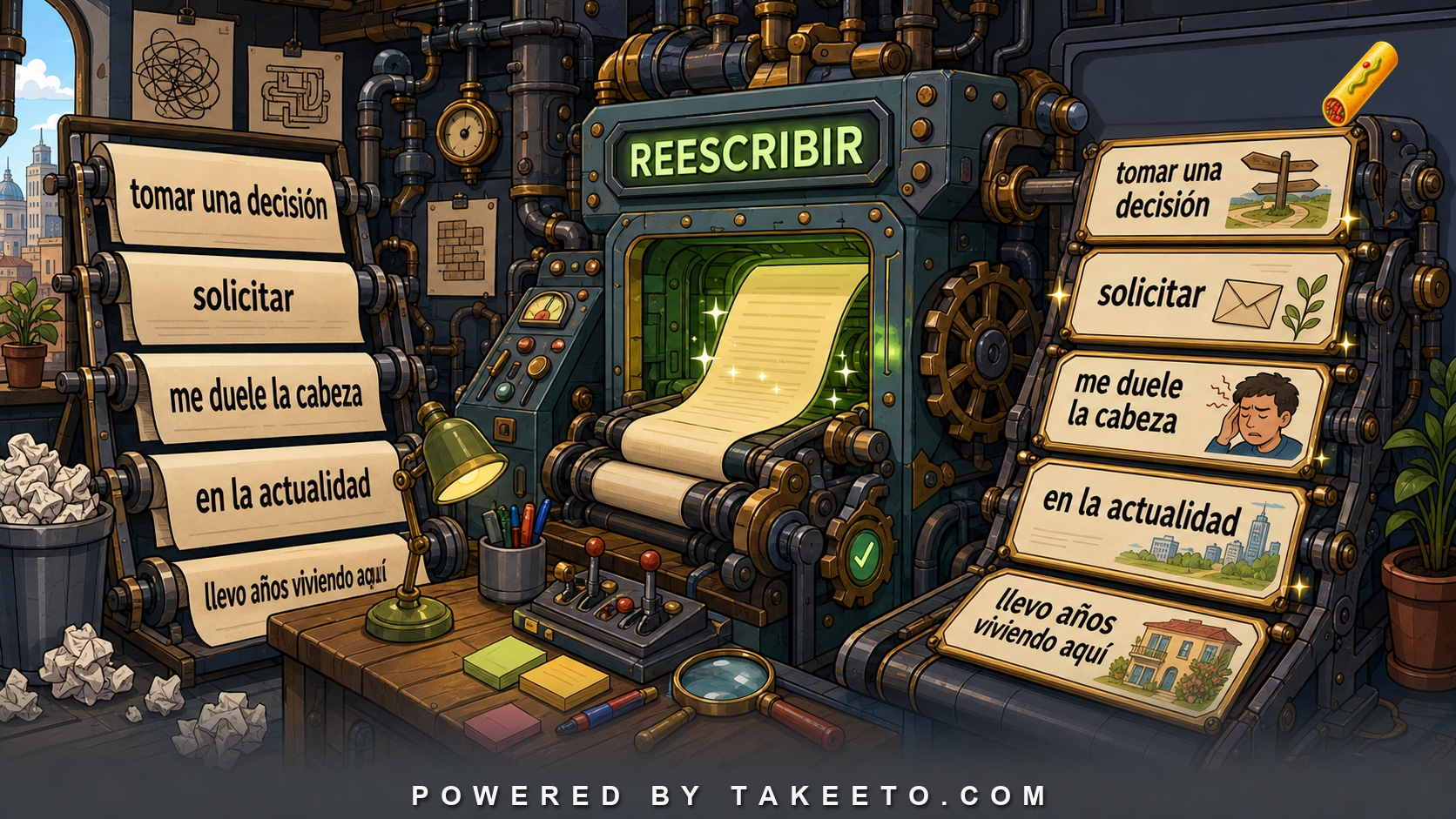
Correct grammar is not the same as Spanish prose
A Spanish sentence can be understandable, grammatical, and still sound as if English is pushing from underneath.
This happens constantly in translated texts, student essays, corporate localization, subtitles, app messages, and bilingual writing. The Spanish is not necessarily “wrong” in the simple classroom sense. The verbs agree. The articles are present. The sentence has a subject and a predicate. But the rhythm, collocations, information order, and grammatical choices feel imported.
Example:
Realicé una decisión importante.
I made an important decision.
A Spanish reader will understand the intended meaning. But the natural Spanish verb is normally:
Tomé una decisión importante.
I made an important decision.
The problem is not the noun decisión. It is the English collocation “make a decision” being mapped mechanically into Spanish.
The key principle is:
Translationese is not just bad vocabulary. It is target-language prose organized by source-language habits.
To revise translationese, you must look beyond individual words. You have to ask whether the sentence is using Spanish grammar as Spanish uses it.
Translationese versus ordinary bilingual influence
Not every unusual sentence is translationese. Spanish is not one uniform object. Region, genre, register, speaker background, and contact with other languages all matter. Some expressions that one reader dislikes may be common in a bilingual community. Some calques enter general use over time. Some technical fields borrow heavily from English.
Translationese is narrower. It means the text has been shaped by the source language in ways that weaken idiom, rhythm, clarity, or register in the target language.
A useful test:
Would a strong Spanish writer, not translating from English, probably choose this structure for this function?
If the answer is no, you may be looking at translationese.
English-shaped word order
English tends to rely on fixed subject-verb-object order and explicit subjects. Spanish allows more flexible information structure and often omits subject pronouns when the verb makes the subject clear.
English-shaped Spanish often overuses explicit pronouns:
Yo creo que yo necesito cambiar mi plan.
I think I need to change my plan.
A more natural version may be:
Creo que necesito cambiar el plan.
I think I need to change the plan.
The issue is not that yo is forbidden. It is emphatic, contrastive, or clarifying. But repeated subject pronouns can give Spanish a heavy, translated rhythm.
English also pushes Spanish toward passive or agentless structures that are not always the best fit.
La decisión fue hecha por el comité.
The decision was made by the committee.
Natural options:
El comité tomó la decisión.
The committee made the decision.
La decisión la tomó el comité.
It was the committee that made the decision.
The second version uses Spanish word order to focus the decision and then identify the agent. That is not a literal passive, but it may be the better translation.
Possessives: English owns more body parts than Spanish does
English says:
My head hurts.
She washed her hands.
He put his jacket on.
Spanish often uses a definite article plus an indirect object when the possessor is obvious:
Me duele la cabeza.
My head hurts.
Se lavó las manos.
She washed her hands.
Se puso la chaqueta.
He put his jacket on.
Learner Spanish often overuses possessives:
Mi cabeza duele.
Ella lavó sus manos.
The first is especially unnatural. The second can be grammatical in a context where the hands must be contrasted with someone else’s, but it is not the default body-part structure.
Learner action:
When English uses “my/your/his/her” with body parts, clothing, or personal effects, check whether Spanish prefers me/te/le/se plus el/la/los/las.
Progressive overuse
English uses the progressive heavily:
I am living here.
I have been studying Spanish for years.
The company is offering new services.
Spanish has the progressive:
Estoy viviendo aquí.
Estoy estudiando.
La empresa está ofreciendo nuevos servicios.
But Spanish does not use it exactly as English does. It often chooses the simple present, llevar + gerund, or a different structure.
Compare:
Estoy viviendo aquí por años.
I have been living here for years.
Better:
Vivo aquí desde hace años.
I have lived here for years.
Llevo años viviendo aquí.
I have been living here for years.
The progressive in Spanish often highlights an ongoing, temporary, or in-progress situation. It is not the default translation for every English -ing form.
Calqued collocations
Translationese often hides inside word partnerships.
English says “make a decision.” Spanish normally says:
tomar una decisión
English says “apply for a job.” Depending on region and context, Spanish may use:
solicitar un empleo
postularse a un puesto
presentar una solicitud
English “actually” is often not actualmente.
Actualmente vivo en Bogotá.
I currently live in Bogotá.
En realidad, no estoy de acuerdo.
Actually, I disagree.
A common mistranslation:
Actualmente, no estoy de acuerdo.
This means something like “Currently, I do not agree,” not “Actually, I disagree.”
Collocation is where good translation becomes good Spanish.
Literal versions and idiomatic rewrites
| English-shaped Spanish | Better Spanish | Why |
|---|---|---|
| Realizar una decisión | tomar una decisión | Spanish uses tomar with decisión. |
| Aplicar para una beca | solicitar una beca / postularse a una beca | Avoid direct English apply for where it sounds calqued. |
| Actualmente, eso no es cierto | En realidad, eso no es cierto | Actually ≠ actualmente. |
| Mi cabeza duele | Me duele la cabeza | Spanish encodes the affected person indirectly. |
| Estoy viviendo aquí por años | Vivo aquí desde hace años / llevo años viviendo aquí | Spanish uses present or llevar for duration. |
| La decisión fue hecha | Se tomó la decisión / tomaron la decisión | Avoid unnecessary passive calque. |
A revision process for translationese
When revising English-shaped Spanish, do not only ask whether the sentence is grammatical.
Ask:
- What is the communicative function? Inform, persuade, warn, explain, apologize, instruct?
- What is the main Spanish verb? Is it a natural collocation?
- Are possessives doing English work? Body parts, clothing, and personal states often need another structure.
- Is the progressive necessary? Could present, preterite, imperfect, or llevar + gerund be better?
- Is the passive natural? Spanish may prefer active, se, or a reordered sentence.
- Is the word order carrying Spanish information structure? Put known information and emphasis where Spanish would put them.
- Does the register match the genre? A legal notice, app button, essay, and conversation do not solve translation the same way.
- Would a Spanish writer choose this collocation without English nearby? If not, rewrite.
Example bank walkthrough
realizar una decisión
This is an English-shaped collocation from “make a decision.”
Learner action: use tomar una decisión in general prose.
aplicar para
This may appear in contact-influenced Spanish, especially in bilingual contexts, but it can sound calqued in edited writing.
Learner action: prefer solicitar, postularse a, presentar una solicitud, or inscribirse depending on context.
actualmente
Means currently/at present, not usually “actually.”
Learner action: translate “actually” as en realidad, de hecho, or actually omit it when it only marks correction.
mi cabeza duele
English-shaped possessive body-part structure.
Learner action: use me duele la cabeza.
estoy viviendo aquí por años
English-shaped duration structure.
Learner action: use vivo aquí desde hace años or llevo años viviendo aquí.
A deeper diagnostic: where English remains after the obvious errors are gone
The first pass in translationese revision usually catches vocabulary: realizar una decisión, aplicar para, actualmente for “actually.” The second pass is harder because the sentence may no longer contain any obvious false friend. It may still have English architecture.
Look at this sentence:
La compañía está comprometida a proveer soluciones que ayudan a sus clientes a alcanzar sus metas.
Nothing here is impossible Spanish. But the sentence carries the texture of corporate English: committed to providing solutions that help clients achieve their goals. A more idiomatic rewrite depends on register, but a cleaner Spanish version might be:
La empresa se compromete a ofrecer herramientas que ayuden a sus clientes a lograr sus objetivos.
Or, if the text is less promotional:
La empresa ofrece herramientas para que sus clientes puedan lograr sus objetivos.
The revision changed more than vocabulary. It changed the verb choice, reduced the noun-heavy phrasing, chose a more Spanish purpose structure, and made the promise less inflated.
A serious translationese check should include these zones:
| Zone | English pressure | Spanish repair question |
|---|---|---|
| Main verb | generic “make/do/provide/perform” | What verb naturally goes with this noun in Spanish? |
| Noun chains | “the implementation of the solution” | Can Spanish use a verb clause instead? |
| Possessives | “their goals,” “your account,” “my head” | Is possession explicit, implicit, or encoded with an indirect object? |
| Duration | “for three years,” “has been doing” | Does Spanish prefer desde hace, llevar + gerundio, or simple present? |
| Passives | “was made,” “was created,” “was decided” | Should Spanish use active voice, se, or a topicalized order? |
| Abstract connectors | “due to the fact that,” “in order to” | Is there a shorter connector: porque, para, como, dado que? |
This is where good revision becomes craft. You are not hunting isolated mistakes. You are changing the center of gravity of the prose.
Mini-workshop: repairing an English-shaped paragraph
Start with this English-shaped Spanish:
Actualmente, estamos trabajando en una actualización que estará permitiendo a los usuarios manejar sus preferencias en una manera más fácil. La decisión fue hecha después de recibir feedback de clientes que aplicaron para acceso temprano.
A strong revision might be:
Estamos preparando una actualización que permitirá a los usuarios gestionar sus preferencias con más facilidad. Tomamos la decisión después de recibir comentarios de clientes que solicitaron acceso anticipado.
What changed?
- Actualmente disappeared because the present progressive already sounded like product-update boilerplate; estamos preparando works if the update is actively in progress.
- Estará permitiendo became permitirá. Spanish does not need a future progressive calque here.
- Manejar sus preferencias became gestionar sus preferencias. In some regions manejar is possible, but gestionar is clearer for settings/preferences in a product context.
- En una manera más fácil became con más facilidad.
- La decisión fue hecha became Tomamos la decisión. Spanish did not need the passive.
- Feedback became comentarios, unless the product team deliberately wants the Anglicism.
- Aplicaron para acceso temprano became solicitaron acceso anticipado.
A worse revision would mechanically replace only the false friends and leave the skeleton intact. A better revision asks what a Spanish product notice would actually sound like.
Do not confuse remediation with purism
There is a lazy version of anti-translationese work: reject anything that resembles English. That is not serious. Spanish in the United States, in technology, in bilingual workplaces, and in international organizations often lives in contact with English. Some borrowings are normal. Some calques are accepted in particular communities. Some regional choices are perfectly legitimate even if they sound unusual elsewhere.
The test is not “Does this remind me of English?” The better test is:
Does this expression serve the reader, register, region, and genre of this Spanish text?
For a local bilingual flyer, aplicar para may match the community’s everyday usage. For an edited international scholarship page, solicitar is usually safer. For a developer changelog, feedback may be normal. For a public education article, comentarios, observaciones, or retroalimentación may fit better depending on region and audience.
Good remediation is not anti-English. It is pro-function. It gives Spanish the structures that make the text clear, credible, and natural for the intended reader.
Suggested interactive module: translationese highlighter
A strong tool for this article would identify English-shaped Spanish and ask for functional rewrites.
Suggested functions:
- Collocation detector: realizar una decisión → tomar una decisión.
- False-friend warning: actualmente vs en realidad.
- Possessive scanner: mi cabeza, sus manos, mi pierna in body-part contexts.
- Progressive checker: estar + gerund where duration or habit is intended.
- Passive audit: fue hecho, fue tomado, fue decidido with rewrite options.
- Register toggle: academic, business, casual, UI, legal.
- Revision card: literal sentence, problem label, natural Spanish rewrite.
Final rule
Translationese is Spanish obeying English too closely.
Do not stop at word replacement. Check collocation, possession, tense/aspect, passive voice, word order, and register. The goal is not to make Spanish less bilingual by ideology. The goal is to make the sentence do its job in Spanish.
Good Spanish translation sounds written from inside Spanish.