
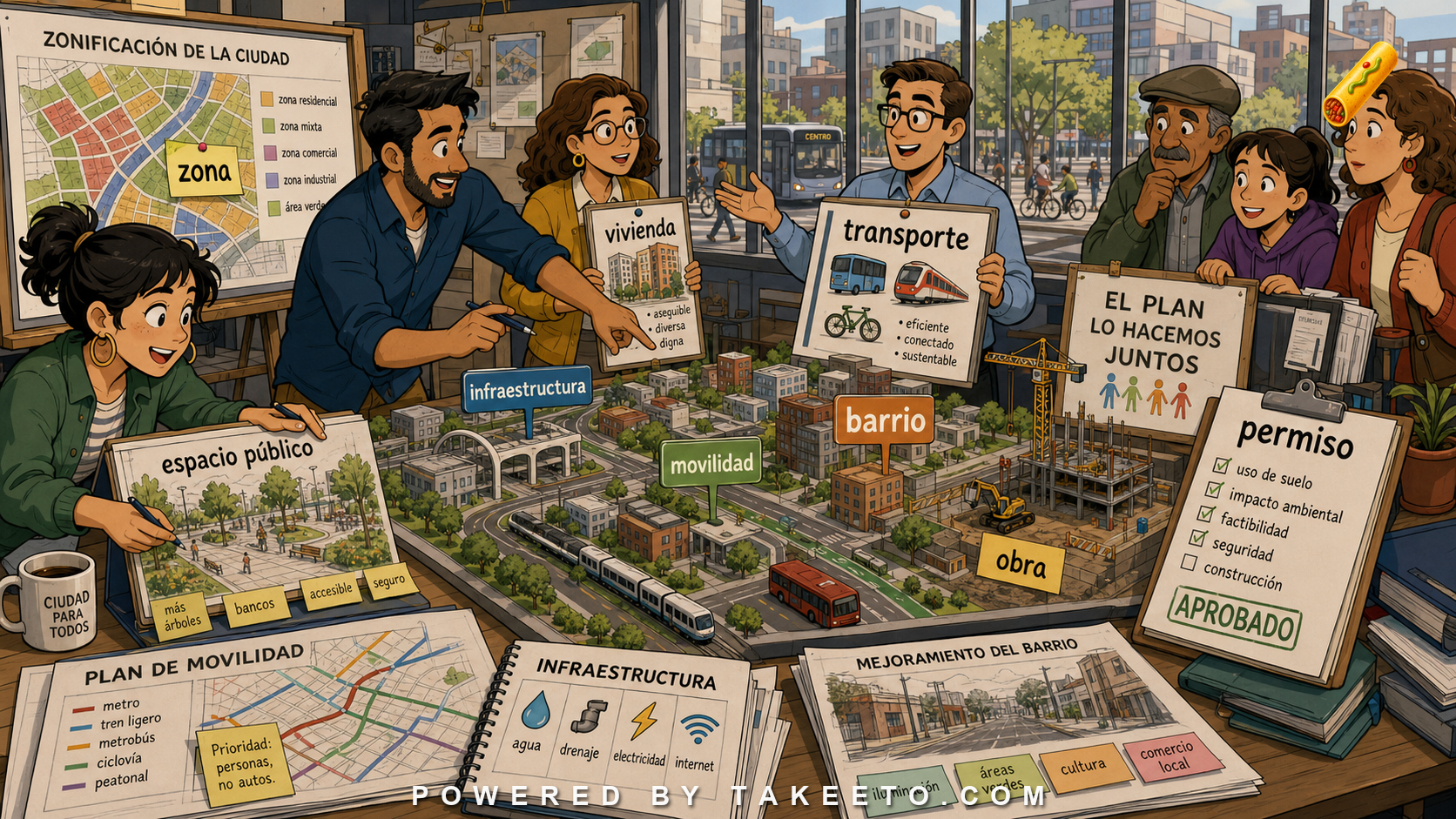
Cities speak in administrative nouns
Urban-planning Spanish is the language of plans, permits, consultations, housing debates, transit projects, infrastructure, and public space. It often appears in municipal notices, public hearings, environmental assessments, neighborhood campaigns, real-estate documents, and news coverage.
It is not conversational Spanish. It is document Spanish. It uses nouns such as ordenamiento, infraestructura, movilidad, zonificación, and rehabilitación to turn decisions into formal categories.
The key principle is:
Urban-planning Spanish describes physical space through administrative categories.
Housing and land use
Important terms:
vivienda
suelo
uso de suelo
zonificación
densidad
lote
parcela
barrio
asentamiento
desarrollo urbano
Vivienda refers to housing or dwelling, not just “life” or “living.” Uso de suelo means land use. Zonificación is zoning. Densidad can refer to population or building density.
El plan propone aumentar la densidad en zonas cercanas al transporte público.
This sentence links housing policy to transit access. A reader must see the planning logic, not only the vocabulary.
Transport and mobility
Urban planning increasingly uses movilidad rather than only transporte.
transporte público
movilidad urbana
movilidad sostenible
peatón
ciclovía / carril bici
estación
corredor
intermodalidad
accesibilidad
Movilidad includes how people move, not only vehicles. Accesibilidad can mean physical accessibility for disabled people, access to services, or transport connectivity depending on context.
La estrategia prioriza la movilidad peatonal y ciclista.
This means the plan prioritizes walking and cycling, not merely traffic flow.
Infrastructure and public works
Important terms:
infraestructura
obra pública
alcantarillado
alumbrado
pavimentación
drenaje
mantenimiento
equipamiento urbano
servicios básicos
Obra can mean work, construction, public project, or artwork in other contexts. In municipal writing, obra often means construction or public works.
Las obras de drenaje comenzarán en junio.
This is a public-infrastructure sentence. It may matter for traffic, flooding, budgets, and neighborhood disruption.
Permits and administrative process
Urban documents often involve permissions:
permiso
licencia
autorización
trámite
expediente
consulta pública
audiencia
impacto ambiental
cumplimiento normativo
A permiso is not always a final right to build. It may be one step in a chain. Licencia de construcción, permiso de obra, and autorización municipal vary by country and city.
El proyecto está sujeto a evaluación de impacto ambiental.
This means approval depends on an environmental review, not merely that the project is environmentally friendly.
Public space and social conflict
Urban planning is often politically charged:
espacio público
parque
plaza
banqueta / acera / vereda
gentrificación
desplazamiento
renovación urbana
seguridad vial
participación ciudadana
Regional sidewalk terms vary: acera, banqueta, vereda. Gentrificación and desplazamiento are not neutral terms; they frame urban change as social pressure and possible harm.
Vecinos denunciaron que el proyecto provocará desplazamiento.
Denunciaron marks public accusation or complaint. The sentence is not neutral city description.
Municipal notices
Municipal Spanish often sounds impersonal:
Se informa a la ciudadanía que...
Queda prohibido estacionar...
Se realizarán cortes de circulación...
La obra tendrá una duración aproximada de...
Se invita a participar en la consulta pública.
The se constructions make notices compact and official. Learners should identify the action required: avoid a street, attend a hearing, submit comments, expect noise, move a vehicle.
Regional terms for neighborhoods and transit
Spanish urban vocabulary is strongly regional. Barrio, colonia, urbanización, comuna, distrito, and municipio do not map perfectly across countries. Public transit terms also vary: metro, subte, bus, colectivo, guagua, micro, camión, autobús.
A good reader notices local institutional vocabulary instead of forcing one country’s terms everywhere.
Example bank walkthrough
Vivienda: housing unit or housing sector.
Transporte: transport system; movilidad is broader.
Infraestructura: physical systems such as roads, drainage, utilities.
Permiso: authorization, often procedural.
Zona: zone or area; check whether it is legal, geographic, or informal.
Barrio: neighborhood; can carry identity and class associations.
Espacio público: public space; often political.
Obra: construction/public works in municipal contexts.
Urban-planning reading workflow
- Identify the document type: notice, plan, hearing, news, permit.
- Locate the place: barrio, zona, district, street, parcel.
- Identify the proposed action.
- Identify actors: municipality, developer, residents, agency.
- Separate land use, transport, housing, and environmental issues.
- Mark public participation language.
- Look for deadlines and required action.
- Watch regional city vocabulary.
- Translate obra by context.
- Ask who benefits and who is affected.
Before/after revision drill
Weak reading:
There will be work in the neighborhood.
Source Spanish:
Se ejecutarán obras de drenaje pluvial en el barrio San Martín, con cortes parciales de circulación durante tres semanas.
Better reading:
Storm-drainage works will be carried out in the San Martín neighborhood, with partial traffic closures for three weeks.
This version specifies the infrastructure type, location, disruption, and duration. Municipal notices are practical; a good reader extracts inconvenience and public impact.
Remediation: city-planning Spanish hides decisions inside nouns
Urban planning Spanish often sounds abstract: movilidad, ordenamiento, infraestructura, vivienda, densificación, espacio público, uso de suelo. These nouns are not harmless abstractions. They often encode decisions about who can live where, how people move, what gets built, who pays, and whose complaints count.
A sentence such as this is dense:
El plan de ordenamiento propone aumentar la densidad habitacional cerca de corredores de transporte masivo.
A learner may translate it mechanically. A domain reader asks:
What kind of housing?
For whom?
Near which transit corridors?
Is this a recommendation, zoning change, incentive, or legal obligation?
Who benefits, who is displaced, and who has to approve it?
Urban planning Spanish is full of nouns that appear neutral but sit inside conflict: obra, permiso, consulta, impacto, renovación, mejoramiento, regularización, desalojo, reubicación. Read them as policy actions, not just vocabulary items.
Mini-workshop: unpack a municipal notice
Take this planning-style sentence:
Se informa a los vecinos que, con motivo de las obras de rehabilitación del espacio público, se modificará temporalmente la circulación vehicular en las calles aledañas.
Unpack it:
Se informa a los vecinos = institutional notice; public audience.
con motivo de = reason/purpose connector.
obras de rehabilitación = construction/improvement project.
espacio público = area affected; possibly plaza, sidewalk, park, street environment.
se modificará temporalmente = future passive/impersonal action.
circulación vehicular = traffic flow, not abstract circulation.
calles aledañas = nearby streets.
Plain-language rewrite:
Por las obras de mejora del espacio público, cambiará temporalmente el tránsito en las calles cercanas.
The official version is not wrong. It is institutional. The remediation skill is being able to move between official and plain versions without losing the action.
Public consultation language
Urban planning documents often include public participation vocabulary:
consulta pública
audiencia
observaciones
alegaciones
participación ciudadana
vecinos afectados
periodo de comentarios
aprobación preliminar
These terms matter because they tell the reader whether the public can still respond. Se somete a consulta means the plan is being opened for input. Se aprobó definitivamente usually means the decision has moved beyond that stage. Observaciones may be comments, objections, or formal submissions depending on jurisdiction.
A learner reading planning Spanish should always ask:
Is this proposal, consultation, approval, implementation, or enforcement?
Before/after: weak translation of movilidad
Weak:
The city will improve mobility.
Better, depending on context:
The city will improve public-transport access.
The city will change traffic circulation.
The city will redesign pedestrian and cycling routes.
The city will reduce car dependence in central areas.
Movilidad is a broad policy noun. It may include buses, subway, walking, biking, traffic, accessibility, emissions, parking, road safety, and land-use coordination. Translate the actual measure, not only the slogan.
Planning-document workflow
When reading an urban-planning text, mark:
- Scale: building, block, neighborhood, corridor, city, metropolitan area.
- Instrument: plan, permit, zoning change, public works project, consultation.
- Affected domain: housing, transport, infrastructure, public space, environment.
- Status: proposed, approved, under construction, suspended, completed.
- Public effect: access, displacement, traffic, noise, cost, services.
- Authority: municipality, ministry, council, developer, agency.
- Action required: comment, comply, detour, apply, attend, object.
Urban planning Spanish is civic literacy. It tells people how space is being governed.
Additional remediation drill: slow the document down
If this article still feels like vocabulary, turn one authentic-looking sentence into a four-line analysis before translating it. Write the original sentence. Then list the actor, the action, the object, and the condition or consequence. Only after that, produce a plain-language paraphrase.
This drill matters because domain Spanish often compresses too much into noun phrases. The learner sees familiar words and moves too quickly. Slowing the sentence down reveals whether the reader understands the document logic or only recognizes terms. For article 265, the safest practice is to treat each key term as a field in a larger system: who is acting, what status is changing, what evidence or condition controls the action, and what the reader should do with the information.
A useful production rule is: do not write a polished sentence until you can write a plain one. Plain Spanish is not inferior; it is the diagnostic layer that proves comprehension.
Suggested interactive module: urban-plan glossary linked to a map
A strong tool would let learners annotate a municipal notice or plan.
Suggested functions:
- Map layer terms: zona, barrio, parcela, corredor.
- Planning category labels: housing, transport, infrastructure, public space.
- Process tracker: permit, consultation, hearing, approval.
- Action extractor: street closure, meeting date, objection deadline.
- Regional transit glossary: bus, colectivo, guagua, metro, subte.
Mini-workshop: expanding a municipal notice
Start with a notice:
Por obras de pavimentación, se realizarán cortes de circulación en la avenida Central del 3 al 10 de junio.
Expand it into plain prose:
Because of paving work, traffic closures will take place on Central Avenue from June 3 to June 10.
Now extract the action: avoid the route, expect delays, or check alternate streets. The notice does not tell a story. It gives a location, cause, date range, and disruption.
The same method works for consultation notices:
Se invita a la ciudadanía a participar en la consulta pública.
Ask: about what plan, where, by what deadline, and how can comments be submitted?
Common learner mistakes
The first mistake is ignoring se constructions. Se realizarán cortes means closures will be carried out. The actor may be the municipality or contractor, but the important immediate fact is the closure. The second mistake is translating obra as “work” too vaguely. In municipal contexts, it often means construction or public works.
The third mistake is missing political vocabulary. Renovación urbana may sound positive, while desplazamiento and gentrificación frame harm. Urban-planning Spanish is not only technical. It often decides who has access to space.
Applied reading drill: turn a municipal notice into a task list
Municipal Spanish often sounds formal, but the practical question is simple: what changes for residents?
Se informa a los vecinos que, con motivo de las obras de mejora de la red de agua, la calle permanecerá cerrada al tránsito desde el lunes 4 hasta el viernes 8.
Extract the action structure:
- Who is addressed? Los vecinos.
- Why? Obras de mejora de la red de agua.
- What changes? La calle permanecerá cerrada al tránsito.
- When? Desde el lunes 4 hasta el viernes 8.
- What should people infer? They may need another route, parking adjustment, delivery plan, or transit alternative.
This turns bureaucratic prose into usable information. Notice also that obras de mejora sounds positive, while calle cerrada is the lived disruption. Urban planning Spanish often balances benefit language and inconvenience language.
For any planning text, ask: what space is affected, what authority is acting, what legal or physical change is proposed, who benefits, who is burdened, and what period for comment or adjustment exists?
Final rule
Urban-planning Spanish turns streets, housing, parks, and transport into administrative language. Read it as a map of decisions: where, what, who authorizes it, who is affected, and what action is required.