
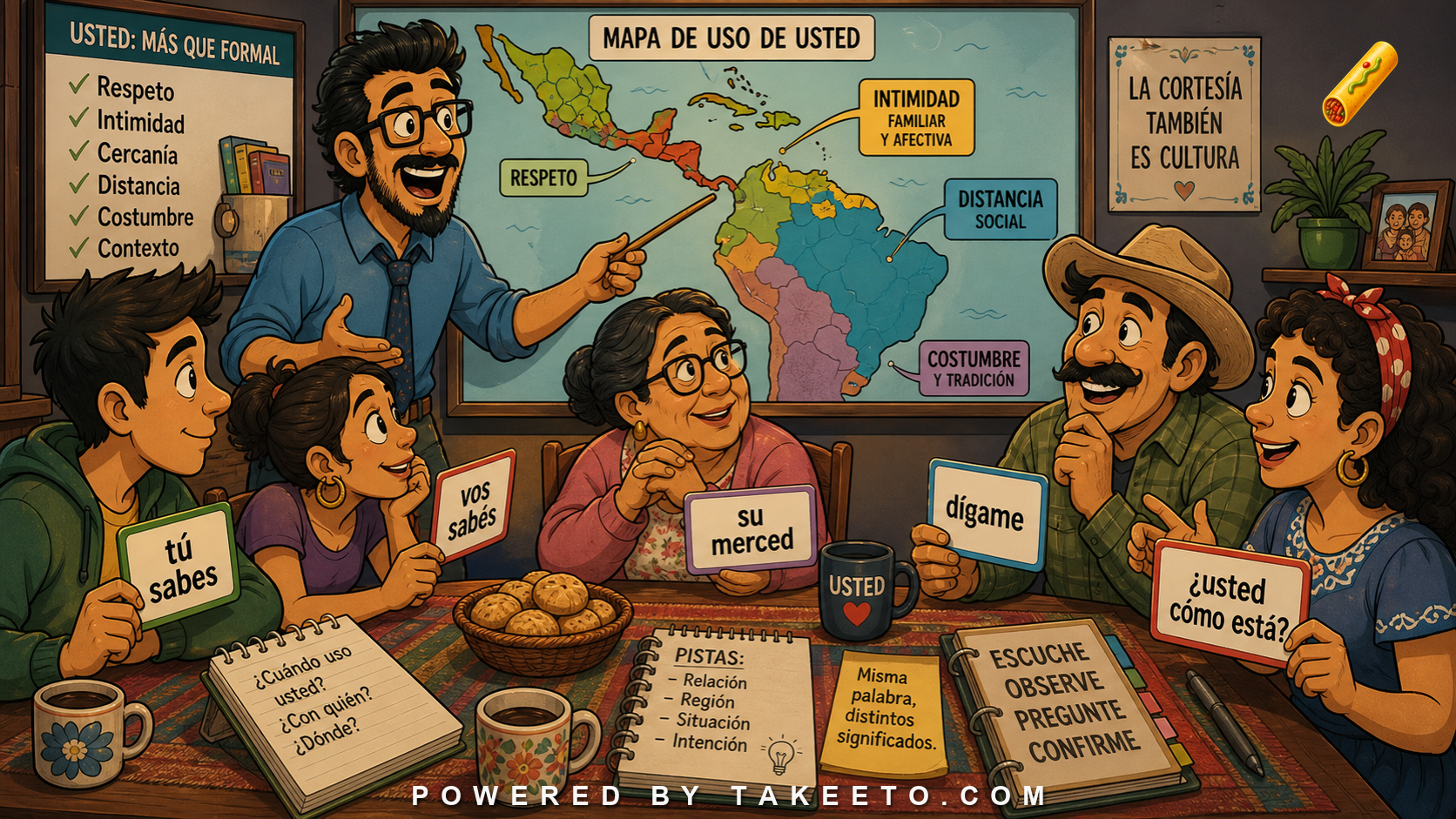
Usted does not always mean distance
Textbooks usually introduce tú as informal and usted as formal. That distinction is useful for beginners, but it becomes misleading quickly. In many Spanish-speaking communities, usted can express respect, distance, authority, affection, family intimacy, regional identity, or ordinary local address.
This broad use is often called ustedeo when usted is used in contexts where another dialect might use tú or vos.
The key principle is:
Usted is not a single emotion. It is a social grammar tool whose meaning depends on region and relationship.
Learners who hear usted from a friend or relative should not automatically think, “They are being cold.” They may be using a local intimacy system.
The basic grammar
Usted is second-person in meaning but third-person in verb agreement.
Usted habla.
You speak.
¿Usted cómo está?
How are you?
Venga, por favor.
Come, please.
Dígame.
Tell me / yes? / how can I help you?
The same verb forms can also refer to él/ella, so context matters.
Viene mañana.
He/she is coming tomorrow OR you formal are coming tomorrow.
This is one reason pronouns may be stated more often when ambiguity matters.
Respectful usted
The familiar textbook use remains important. Usted often marks respect or distance with:
- older people,
- strangers,
- customers,
- officials,
- teachers,
- doctors,
- employers,
- formal service encounters,
- institutional communication.
¿Usted tiene cita?
Do you have an appointment?
Le agradezco su ayuda.
I appreciate your help.
Learners should keep usted as the safe default in many formal or uncertain contexts.
Intimate usted
In parts of Colombia, Costa Rica, Central America, rural areas, and some family or regional communities, usted may be used with close people.
A parent may speak to a child with usted. Friends may use usted playfully or habitually. Romantic partners may shift between tú, vos, and usted. A speaker may use usted to show affection, seriousness, tenderness, or regional belonging.
¿Usted ya comió?
Did you eat yet?
In some contexts, this could be a formal question. In a family kitchen, it could be intimate care.
Pronoun shifts inside relationships
Spanish address is dynamic. A pair of speakers may use different pronouns at different moments:
tú sabes
vos sabés
usted sabe
The shift may signal anger, teasing, tenderness, seriousness, respect, distance, flirtation, or local style. A Colombian speaker might use usted in a way that sounds intimate. A Costa Rican speaker may use usted as a broad default. A speaker may switch to tú to sound softer or to usted to create mock formality.
Learners should observe shifts instead of assigning one fixed meaning.
Su merced
In some Colombian contexts and historical/regional uses, learners may encounter su merced, sometimes reduced or associated with local address traditions.
¿Su merced cómo está?
How are you?
This form has specific regional and social meanings. It should not be imitated casually by learners, but it is worth recognizing as part of the broader address ecology.
Commands with usted
Because usted uses third-person subjunctive forms for commands, many polite commands look like this:
Venga.
Come.
Dígame.
Tell me / yes?
Pase.
Come in / go ahead.
Espere un momento.
Wait a moment.
These can be formal, polite, service-oriented, or ordinary regional address. Tone matters. Venga may sound like a respectful command, an invitation, or a soft interactional cue.
Learner strategy
When entering a new community:
- Start with usted in formal or uncertain contexts.
- Listen for what others use with you.
- Notice what people use with children, elders, friends, and partners.
- Mirror cautiously when invited.
- Do not assume usted means rejection.
- Do not force tú because a textbook told you intimacy requires it.
Address pronouns are social navigation. Being grammatically correct is not enough; you need relational timing.
Example bank walkthrough
¿usted cómo está?
Formal or intimate depending on region and relationship.
Learner action: read tone and setting.
venga
Usted command form of venir.
Learner action: common in service and regional speech.
dígame
Usted command form of decir, often used to answer calls or invite speech.
Learner action: understand it as interactional, not literal only.
tú sabes
Tuteo form.
Learner action: contrast with usted sabe and vos sabés.
vos sabés
Voseo form.
Learner action: learn local address ecosystems.
su merced
Regional/historical respectful address form.
Learner action: recognize, do not casually imitate.
Remediation notes: usted as grammar, stance, and relationship
The article's main point is that usted can be intimate. This remediation adds a second point: usted is socially flexible but grammatically strict in standard Spanish. It refers to the person being addressed, but the verb agreement is third person:
Usted sabe.
Usted tiene.
Usted vino.
Usted puede sentarse.
Learners should not combine usted with second-person verb forms in careful production:
Avoid: usted sabes, usted tienes, dime usted.
Use: usted sabe, usted tiene, dígame usted.
The social interpretation comes after the grammar. A sentence like:
¿Usted ya almorzó?
could be formal in a clinic, caring in a family, normal in Costa Rica, affectionate in parts of Colombia, or distancing in another relationship. The form alone does not settle the meaning.
Address shifts also deserve more depth. A speaker may move from usted to tú or vos not because the relationship permanently changed, but because the moment changed. Pronoun shifts can signal:
joking formality,
anger or seriousness,
tenderness,
respect toward an elder,
flirtation,
local identity,
institutional role.
Learners should keep a notebook of actual situations rather than trying to memorize one universal chart.
The object-pronoun side matters too. With usted, possessives and pronouns follow third-person grammar:
su nombre, not tu nombre, in formal usted use.
le escribo, for an indirect-object/contact formula.
lo/la llamo, or regionally le llamo, depending on dialect and courtesy conventions.
The phrase su merced deserves a stronger caution. It is not a general polite upgrade. It belongs to specific Colombian and historical/regional contexts, and can sound artificial or comic if a learner uses it without local footing.
A practical learner policy:
- Use usted in formal or uncertain interactions.
- Accept usted from others without assuming rejection.
- Mirror local address only after you understand the relationship.
- Keep verb and possessive agreement consistent.
- Treat pronoun shifts as social information, not just grammar.
Production example set:
Formal service: ¿Usted tiene cita? Pase, por favor.
Intimate regional care: ¿Usted ya comió?
Neutral tuteo equivalent: ¿Tú ya comiste?
Voseo equivalent: ¿Vos ya comiste/comiste? depending on region.
The repair is to see usted as a full address system, not a single politeness label.
Suggested interactive module: address-choice scenario map
A useful tool for this article would train social interpretation.
Suggested functions:
- Scenario cards: doctor, grandmother, friend, partner, customer, professor, child.
- Region selector: Colombia, Costa Rica, Mexico, Spain, Central America, neutral international.
- Pronoun choices: tú, vos, usted, su merced.
- Tone labels: respect, distance, affection, seriousness, teasing, formality.
- Command generator: ven/vení/venga, dime/decime/dígame.
- Conversation shifts: show what happens when speakers switch pronouns.
- Learner advice: safest default and when to mirror.
Final rule
Usted does not only mean “formal.”
It can mark respect, distance, affection, intimacy, regional identity, or ordinary local address. Learn the grammar, then watch relationships. In real Spanish, pronouns do social work.